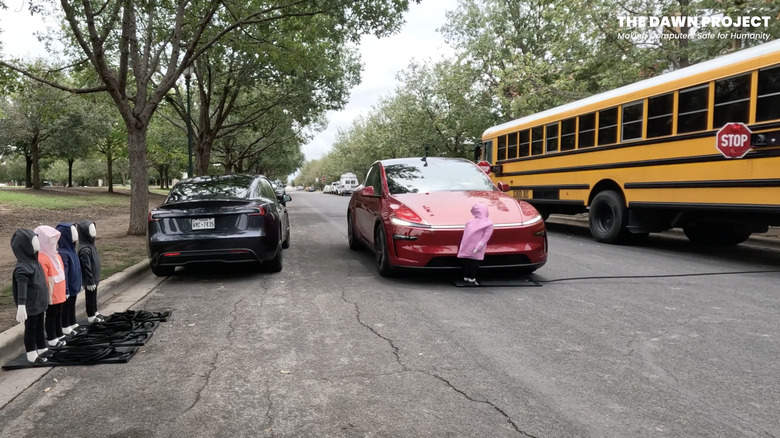
Tesla blows past stopped school bus and hits kid-sized dummies in Full Self-Driving tests - Engadget
Before the Cybercab rollout, anti-Tesla activists organized a demonstration showing the flaws of Full-Self Driving software.
Engadget
149 points · by ndsipa_pomu · 1y ago · 161 comments
But these stories are still reaching the front page, so arguably the flaggers are up against the algorithm and the algorithm is winning.
This article is about "testing" conducted by a guy who is trying to sell competing software products and has produced videos in the past that weren't replicable and were likely staged. They never release unedited footage or car diagnostic data, just a produced video presented with the intent of damaging Tesla's reputation and boosting their own sales.
This happens all the time, from the New York Times' false claims that their review car ran out of charge, to the most recent Mark Rober video that cost the CEO of a lidar company his job.
The video in this article requires independent validation it is not from a trusted source as it is produced by an extremely biased and financially motivated Tesla competitor.
What competing software products?
The founder went as far as to run for CA senator just to regulate Tesla and bought a Superbowl ad to smear the company. https://techcrunch.com/2024/02/12/dawn-project-tesla-ad-fsd-...
I understand the reasoning behind it, but watching the video () of the test shows that the car did not warn the driver, and even if it did it was speeding too much leaving almost no time for a driver to respond
Disclaimer- I have never used FSD before
(
) https://dawnproject.com/the-dawn-project-and-tesla-takedowns...The warnings occur when you look away or don't touch the steering wheel for a while. Not saying that Tesla is without error (it isn't), but just clarify what the warnings are for.
So they are useless. My car warns me even if i don't look.
No, they serve a very specific purpose -- (attempting) to ensure the driver is at the controls and paying attention.
Don't confuse the FSD attention "nag" warnings with collision warnings. The collision warnings will sound all the time, with and without FSD enabled and even if you're not looking at the road. If you don't start slowing down quickly, Automatic Emergency Braking (AEB) will slam on the brakes and bring the car to a stop.
Heck, my car not only warns you, it slams on the brakes for you.
Scared the heck out of me when it happened, but it saved me from hitting something I didn't realize was so close.
What you WANT to recognize is conditions when such an event is possible (obstructed vision) and to slow down in advance even if you don't see/detect any pedestrians at the moment.
This obviously includes the case with the school bus and the stop sign but, as you correctly point out, is not limited to that. There are more cases when a pedestrian, especially a child, can jump under your car from behind a big vehicle or an obstacle.
Recognizing these situation and slowing down in advance is a characteristic trait of a good-intentioned experienced driver. Though I think that most of the time it's not a skill you have straight out of driving courses, it takes time and a few close calls to burn it into your subconsciousness.
Speed is the factor in collisions (other than weight), and modern brakes are incredibly good.
Not to mention that the car, with it's 360 degree sensors, could safely and efficiently swerve around the children even faster than it can brake, as long as there's not a car right next to you in another lane -- and even if there is, hitting another car is far less dangerous to their life than hitting the children is to yours.
These things should be so much better than we are, since they're not limited by unidirectional binocular vision, but somehow they're largely just worse. Waymo is, at best, a bit better. On average.
You're disagreeing with something I didn't say. There's a difference between afterthought and the primary initiator of the stop in a situation like this.
>Of course the car should recognize the stop sign, but there are cases in which stop signs are obstructed or missing, and in those cases pedestrians should still not be hit by a car.
The surprise pedestrian test is one that any vehicle can be made to fail by sheer physics. Avoiding errant pedestrians like in the video will likely only come as a byproduct of better situational behavior by self driving vehicles. The overwhelming majority of drivers know to ignore the speed limit if the situation is rife with pedestrians or otherwise sus and are generally fine with missing/obstructed stop signs. I don't know what route self driving software will take to approximate such behavior but it likely will need to.
This sentence makes me want to cry. Sure, I may know drivers treat speed limits as minimum acceptable speed at best, but seeing it unironically spelled out like this hurts.
Please, it's just two simple words: 1) speed 2) limit. L I M I T. It's the maximum allowable speed. No, it's not the minimum speed, no it's not the target speed, no, it's not "more of a guideline than anything". You are not allowed to go faster.
It says nothing about a minimum speed. It says nothing about what speed you should drive at. All it does is limit the maximum speed. Repeat after me, it's a speed L I M I T.
Just kidding though, I know even speaking like I would to a 5 year old won't do it, this mentality runs far too deep. There's no hope.
There's different degrees of failure as well, did the Tesla try to brake beforehand or apply brakes after hitting the doll?
They're obviously not arguing that the car shouldn't stop with a sign deployed.
Arguing from a point of bad faith doesn't advance the discussion.
Signs are often obstructed by trees or are simply inadequate for safe driving, even when combined with the rules of the road. Any even "partially" automated driving should be able to trivially recognize when its view is compromised and proceed accordingly.
I am wondering if there is a safety certification body for self driving technology. If not, one is needed because consumers can't be expected to be aware of all the limitations of the latest update they have installed.
There must be basic safety standards these systems need to meet, a disclaimer can't be the solution here.
Until there are federal standards and rigorous testing of self-driving vehicle technologies they should not be installed, or advertised.
https://www.reddit.com/r/teslamotors/comments/1l84dkq/first_...
- the failure here is that the car didn't stop for the bus on the other side of the road with the extended stop sign. (Obviously a kid running out from behind a car this late is fairly difficult for any human or self driving system to avoid)
- the FSD version for the robotaxi service is private and wasn't the one used for this test. The testers here only have access to the older public version, which is supposed to be used with human supervision
- the dawn project is a long-time Tesla FSD opponent that acts in bad faith - they are probably relying on false equivalence of FSD beta vs robotaxi FSD
Nevertheless this is a very important test result for FSD supervised! But I don't like that the dawn project are framing this as evidence for why FSD robotaxi (a different version) should not be allowed without noting that they have tested a different version.
This is a major failure, failing to observe a stop sign and a parked school bus are critical mistakes. If you can't manage those you're not ready to be on the road without a safety driver yet. There was nothing particularly difficult about this situation, these are the basics you must handle reliably before we even get to alle the tricker situations those cars will encounter in the real world at scale.
Ma'am, we're sorry your little girl got splattered all over the road by a billionaire's toy. But, hey, sampling errors happen.
Your argument that a newer version is better simply because it's newer does not convince me. The new version could still have that same issue.
I actually didn't say that and am not arguing it formally - I said what I said because I think that the version difference is something that should be acknowledged when doing a test like this.
I do privately assume the new version will be better in some ways, but have no idea if this problem would be solved in it - so I agree with your last sentence.
Did they anywhere refer to this as Robotaxi software over calling it FSD, the term Tesla has chosen for this?
That's why you slow down when you pass a bus (or a huge american SUV).
Every driver/car that obeys the law has absolutely no problem avoiding this collision with the child, which is why the bus has flashing lights and a stop sign.
Worst case, you needlessly slow down around a roadside parked schoolbus.
Best case, you save a kid's life.
Not really - it's a case of slowing down and anticipating a potential hazard. It's a fairly common situation with any kind of bus, or similarly if you're overtaking a stationary high-sided vehicle as pedestrians may be looking to cross the road (in non-jay-walking jurisdictions).
One of the prime directives of driving for humans and FAD systems must be "never drive faster than brakes can stop in visible areas". This must account for such scenarios as obstacles stopped or possible coming the wrong way around a mountain turn.
Here in the UK, that's phrased in the Highway Code as "Drive at a speed that will allow you to stop well within the distance you can see to be clear". It's such a basic tenet of safety as you never know if there's a fallen tree just round the next blind corner etc. However, it doesn't strictly apply to peds running out from behind an obstruction as your way ahead can be clear, until suddenly it isn't - sometimes you have to slow just for a possible hazard.
As for being unrepresentative of the next release of FSD, we've had what eight years ten years of it's going to work on the next release.
- FSD has been failing this test publicly for almost three years, including in a Super Bowl commercial. It strains credulity to imagine that they have a robust solution that they haven't bothered to use to shut up their loudest critic.
- The Robotaxi version of FSD is reportedly optimized for a small area of austin, and is going to extensively use tele-operators as safety drivers. There is no evidence that Robotaxi FSD isn't "supposed" to be used with human supervision, its supervision will just be subject to latency and limited spatial awareness.
- The Dawn Project's position is that FSD should be completely banned because Tesla is negligent with regard to safety. Having a test coincide with the Robotaxi launch is good for publicity but the distinction isn't really relevant because the fundamental flaw is with the companies approach to safety regardless of FSD version.
- Tesla doesn't have an inalienable right to test 2-ton autonomous machines on public roads. If they wanted to demonstrate the safety of the robotaxi version they could publish the reams of tests they've surely conducted and begin reporting industry standard metrics like miles per critical disengagement.
Shouldn't that be the one case where self driving system has an enormous natural advantage? It has faster reflexes, and it doesn't require much, if any, interpretation or understanding of signs or predictive behavior of other drivers. At the very worst, the car should be able to detect a big object in the road and try to brake and avoid the object. If the car can't take minimal steps to avoid crashing into any given thing that's in front of it on the road, what are we even doing here?
My understanding is that Tesla is the only manufacturer trying to make self-driving work with just visual-spectrum cameras --- all other vendors use radar/lidar _and_ visual-spectrum cameras.
... eh? I mean, what?
I'd expect school bus stop signs to be challenging to learn because of how context dependent they are compared to regular stop signs. Some examples, drawn from the rules in my state (Washington) are below. These may be different in other states.
With a regular stop sign you stop, then you go when it is safe to do so.
When you stop for a school bus sign you are supposed to stay stopped as long as the sign is there. You don't go until the school bus retracts the sign. It is essentially like a red light rather than a stop sign.
Whether or not a school bus stop sign applies to you depends on the direction you are traveling and on the structure of the roadway.
It applies if either of the following are true: (1) you are traveling in the same direction as the bus, (2) it is a two lane roadway and the lanes are not separated by a physical barrier or median. Three or more lanes or a barrier or median and cars traveling opposite the bus don't have to stop.
My 2025 Tesla stops for road work flaggers spinning their signs from "Slow" to "Stop".
This issue here, correctly, is that it should come to a stop for 1) a bus flashing red, 2) with or without stop signs, 3) on an undivided road. Or, in our automated future, at least come to a crawl like FSD does now when entering a parking lot or pedestrian likely location.
Comparing "Tesla Takedown" with ExxonMobile is way too quick, you should have said Greenpeace. I'd say that TT has to do this, Is part of the point.
https://www.theverge.com/news/646797/nhtsa-staffers-office-v...
When regular in theory bipartisan mechanisms fail, protest is all you have left.
Elon Musk, who also owns Tesla.
https://en.wikipedia.org/wiki/Unsafe_at_Any_Speed%3A_The_Des...
What other hidden dangers slip by without public knowledge.
Independent tests are what's needed, and preferably done by agencies who won't get gutted because they find something that's inconvenient.
As for the fanbois and f*cbois, they have always existed and will always exist. They are the pawns. Smart mature people learn to lead, direct, manipulate, deflect and ignore them.
So if you want to get into the details and figure out why a video from "Tesla Takedown" should or should not be believed, in all ears, but I'm some random on the Internet. I don't work at NHTSA or anywhere that could affect change based on the outcome of this video. It's not going to affect my buying decisions one way or another, but it'll only divide people who have decided this matters to them and can't get along with others.
This test is about whether Tesla's self driving technology is safe for the people outside the vehicle.
:)
Any good reason to believe these tests?
In that case it could’ve learnt almost nobody ever fully stops at a stop sign, or in this case a bus stopped with a stop sign.
People are way more accepting/understanding of drunk driving than passing school bus stop signals.