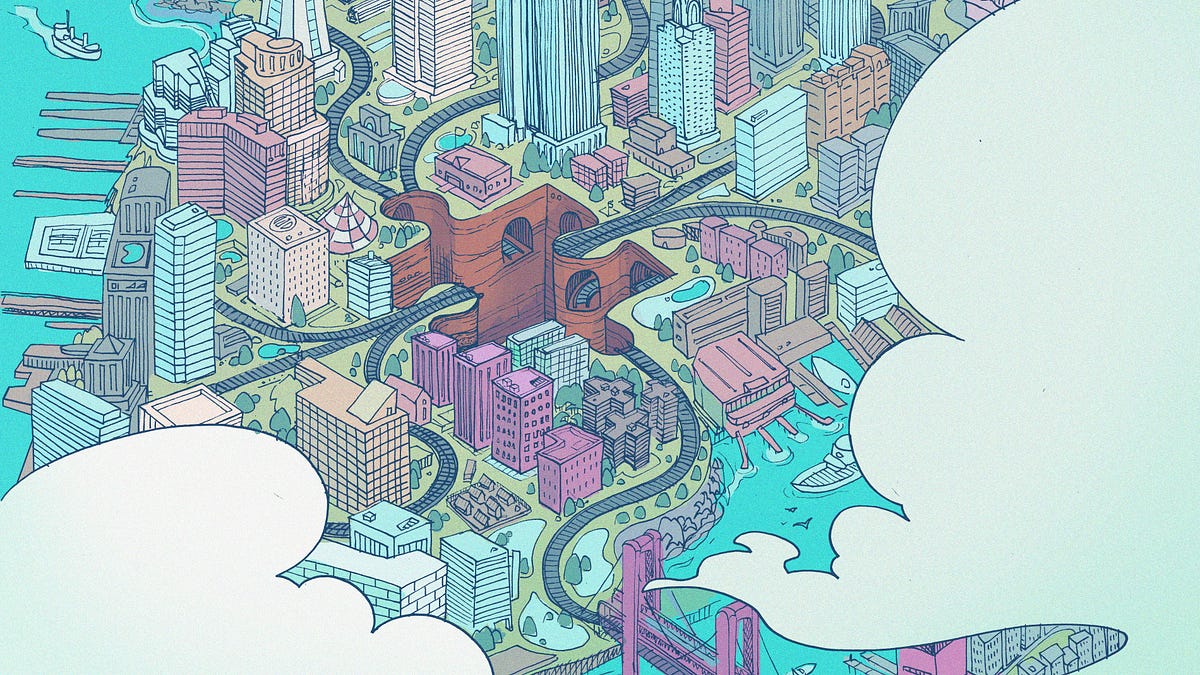
The magic of through running
By weaving together existing railway lines, some cities can build the best transit in the world
worksinprogress.news
187 points · by ortegaygasset · 1y ago · 134 comments
There's a curious European vs American distinction that the article doesn't address -- many modern, large American cities are younger than that.
Especially southern and western ones that grew up on rail lines.
There, the only thing that would be needed is the political will to fund and build new bypass, outside-the-city freight track to free up the contiguous in-city rights of way.
I mean even in NYC in 1850s, 42nd street was practically "uptown" and what we now call "uptown" was farmland. Brooklyn & Queens which are now the population centers of NYC with ~2.5M residents each had a grand total of under 200K back then. At the time Manhattan had 500K residents (2.5x BK&QNS 200K) while it has 1.7M now (1/3 the ~5M across BK&QNS now).
So the population center even within our biggest city has completely shifted from the time our railroads were built out.
Another major issue is the way transit authorities tend to be governed and funded in the US. They're often prone to political disagreements between cities and suburbs, or between city and state governments, or between multiple states. The two-party system doesn't exactly lead to coalition-building.
Take Philly for example: SEPTA regional rail has been through-running since the mid 80s, which is great, and the network is fairly well-aligned with population centers and employment centers. But year after year, SEPTA is consistently in a state of utter crisis, typically due to lack of funding.
In the US, at least in coastal cities, we sometimes seem more concerned that transit be cheap than that it be good. Transit in NYC is so cheap as to be almost free, especially considering something like 50% of bus riders beat the fare.
NYC subway fare is unlimited distance and about half the price of a London zone 1 fare. This is despite white collar jobs in NYC often paying 2x the equivalent London wage.
So instead of funding with usage fees at all (and say subsidizing/discounting for those in need), we just set ridiculously low fares and then try to go after higher incomes in the region with income tax levies, which is obviously unpopular.
Per BBC graphic / data provided by TfL for example, London Underground is 72% funded by fares vs 38% in NYC.
1842 is at 2:55 in the video.
We always had a good train network around here. When the shift happened though, the "hub" stations have not really moved. Today the main stations are still where the old center of town was. As a result, taking the train for me is a bit like going to the airport you're gonna have to take a 30min trip(without traffic) and 60min trip(with traffic) or a 30min metro (crowded) or a 45min (but less punctual and gets full too often) bus/suburban train to reach the station.
As I type this, the city keeps expanding on one side, so in a decade's time, there will be a new city center, closer to the airport, but further and further away from the hub station. I'll have to wait and see if they change the hub station to a more central one at that point.
   1. Identify direction of expansion
   2. Buy / eminent domain land
   3. Build transit
   4. Develop area
Crossrail (aka Elizabeth line) was being talked about or built the whole two decades I lived there but opened after I left.
There was discussion during the planning of the "Big Dig" infrastructure project of the 1990s to join these systems via a tunnel, but this was rejected due to the technical complexity, and more importantly, the cost, with the politicial battle around the project as a whole.
We could have had, for example, through service between Lowell and Providence, or between Newburyport and Worcester. Amtrak could have continued the Northeast Corridor into Maine.
sort of reminds me of shipping before container ships, where you had to have freight forwarders to get stuff through the morass of trucks, trains, and ships, each with their own politics/unions/finances stepping in the way.
The politics of different means of transportation, with different systems just runs into enough of these barriers to self-limit their own use. and we end up being a nation of cars.
How recently is recently?
BART’s SFO station opened June 2003, and the OAK station opened November 2014.
https://www.2.stammstrecke-muenchen.de/home.html
> To upgrade the S-Bahn system and to reduce the traffic burden on the existing core line, two new tracks will be built parallel to it between the stations of Laim in the west of the city and Leuchtenbergring in the east, covering a total of about 10 kilometres. The core of the new east-west connection is a 7-kilometre tunnel linking Munich's main station Hauptbahnhof with the eastern hub Ostbahnhof.
(Source: Projektplan / SZ.de)
https://en.wikipedia.org/wiki/Trunk_line_2_(Munich_S-Bahn)#/...
> zwei Stammstrecke will make it horrible long to switch from platform 1 to platform 2, through elevators 40m up + down on each side, forcing you to go completely upwards, and then going down again
Are the connections between the faster and the slower lines going to be equally bad at all five connection points (Laim, Hbf, Marienhof or -platz, Ostbahnhof and Leuchtenbergring)?
In the case of Melbourne, the design was chosen because of the extremely lop-sided development of the city, whose centre (“the city”) lies at the head of a bay, with most of the population and population growth to the south and east of the city in the 1970s. This is true to a lesser extent in Sydney, bearing in mind that its city loop was designed before the Harbour Bridge was built.
Melbourne’s current through-running project, the Metro Tunnel, appears in the first table, but it doesn’t belong in the second table of cities which could greatly benefit from future through-running projects. All 16 lines can access the city loop (which has 4 parallel tunnels). Due to capacity constraints, most of the time one of those 16 lines terminates at a main city station, and two others through run with each other. The Metro Tunnel will relieve the city loop, similar to the Munich trunk amplification project described in TFA; once it opens all lines will either through-run or go around a loop.
Locals are used to the City Loop but some visitors find it hard to navigate. Each line runs either clockwise or anticlockwise. For historical reasons two of the four loops still reverse direction in the middle of the day.
It’s true that a further through-running tunnel (Metro Tunnel 2) and conversion of two of the four City Loop tunnels to through-running (City Loop Reconfiguration) appeared on the long-range plans from 2012. But these are not required yet; the city is building three other major rail projects first.
This is confusing.
Subway is already a kind of train.
You mean to say that the train partly runs underground? That is pretty common. I actually can't remember any city where airport connecting train does not do the same at some point or another.
What's kinda interesting is does that train classify as metro transit that goes slightly beyond city to airport and such (making many stops all the way) or distance intercity train that happens to stop both at airport and city? Or does it change this classification? That would be actually unusual.
For example, let’s say you are going from Motomachi Chukagai to Kawagoe, try plugging this into Google Maps - you board the Minatomirai line, then once you reach Yokohama, without getting off your seat you are now on the Tokyu Toyoko line, then again at Shibuya it becomes the Tokyo Metro Fukutoshin line, then again at Wakoshi it becomes the Tobu Tojo line.
4 different train operators maintained and run by 4 different companies with their own rolling stock and drivers, but they share access to the track and trains, they interoperate, and it just feels like one train with no dip in service quality. Many lines here do this.
> > What's kinda interesting is does that train classify as metro transit that goes slightly beyond city to airport and such (making many stops all the way) or distance intercity train that happens to stop both at airport and city? Or does it change this classification? That would be actually unusual
Also, about this part:
> You typically schedule your trip based on the train’s schedule.
Many counterexamples to that around East Asia (and probably Europe?). Trains are frequent enough that you just come most of the day. Apart from late hours when it is the same for both metro and distance trains, you have to know when they depart because both become rare and you can be late for the last one.
I suppose a subway train with rail only supply that goes overground sometimes is more dangerous because it is easier to accidentally step on a rail and rail is powered?
https://en.wikipedia.org/wiki/Electroliner
It sounds crazy to say now but America used to have the best passenger rail infrastructure in the world.
The best part is when you get on a through-running trains in Tokyo and the route map in the train has no Tokyo stops listed on it. Signage has gotten better in recent years, at the cost of complexity:
https://www.kotsu.metro.tokyo.jp/subway/stops/asakusa_sogo.h...
Anyone who lives on the outskirts of London near a big commuter station knows that pain: 15 minutes to get into the centre, and another 25 to get anywhere else.
The city is very much not-flat, with significant altitude differences, a lot of already existing infrastructure under the surface (three extant lines of metro with fourth one being built, some road tunnels, parking spaces etc.), and a major river must be crossed. Plus, the rocks underneath are fractured and finicky. It isn't a nice big slab of granite, but a mixture of sediments, water and various primordial rocks. Quite hellish to put tunnels into.
In the UK outside London, a journey via a 'metro' (suburban railway), a tram and a bus could well require the purchase of three separate tickets at a significant premium over sticking to one mode of transport even if less efficient. I would suggest a move to single tickets within urban areas. That would allow multimodal travel - if the tram is in and the train is delayed just hop on the tram.
I suppose this is more a problem of sharing track than through running, but I just found it funny to see Munich public transport described so positively.
Been living in Munich for the past 9 years, with the exception of the S-Bahn, it's still very good. I've never felt the need to own a car (only the occasional rental for moving or trips to more remote areas). Anecdotally, I know colleagues and friends who also make do without one, even those with kids.
Only city I've experienced better is Singapore (where I lived for ~7 years), though people complain all the same :D
In an airport, people complained that luggage delivery was so slow after landings. Airport measured the time, agreed with passengers and increased workforce to reduce waiting times substantially, but the complaints didn't reduce.
Instead, they routed passengers through a longer path, so their luggage was waiting for them when they arrived, and nobody complained about the longer walk.
We, the humans, are interesting.
I've never formally complained about luggage arrival delays, but I have definitely noticed long walks. Some ridiculously so. I suppose I should complain, but to whom?
The London underground is indeed a redundant spiderweb. But the article focuses more on mainline trains, which are much more constrained.
The only way right through central London for these trains was north-to-south, the Snow Hill tunnel: Kings Cross -> Farringdon -> City Thameslink -> Blackfriars -> South of the river. This can only be a bottleneck.
But now there is the Elizabeth line east-to-west as well.
Heavy rail; 50 million
Light rail: 25 million
Freeway:5-10 million
So why aren't they simply doing dedicated roads for transport?
With AI platooning and supervised self driving, "trains" of busses can run along those lines, but split off and merge in from local service seamlessly.
Commercial traffic (even through traffic) can piggyback on low traffic periods.
In emergencies, they are additional roads for evac or supply.
Roads are much more easily repaired and fail less catastrophically.
Electrification of busses is well underway and should be simpler / cheaper for recharging infrastructure.
Platooned "trains" of busses will conserve energy and likely could go 100 mph or more with proper convergent sensors monitoring and maintenance.
Safety should be equivalent.
I suspect there are political nuances where rail gets its own budget apart from roads, whereas dedicated roads get thrown it with general road funding, and then wouldn't get proper funding.
Also in London we dont have space to build massive carparks everywhere so lots of people in London dont have cars.
I'm not sure that's true for HS2. In practice the UK builds occasional new roads and very rarely new rail. Crossrail and Thameslink are exceptions that took decades to get approved.
I'm guessing even a busy/congested freeway has a greater throughput per lane than transit; even with automobiles with only 1-2 people in it, vs a train that may have hundreds but pass only every few minutes at most.
One problem with roads is that once you get off the freeway, you need more roads to serve housing and businesses; and the size of those leaf nodes pushes businesses and houses all further apart from each other, necessitating MORE road trips and decreasing walkability.
Not even remotely close: https://en.m.wikipedia.org/wiki/Route_capacity
Guided busways exist, but as far as I know nobody's doing platooning yet? Edinburgh had a guided busway for a few years but eventually built a tram over it because buses couldn't manage the throughput.
https://www.fhwa.dot.gov/policy/23cpr/appendixa.cfm (scroll down a little ways)
so your reference for freeway is likely using a single lane number not the actual cost of a 4 lane high way which would be 12 - 80 million per mile.
I wish I knew how much that cost, but I'm starting to see its point now.
Brussels got its through running project in 1952, a 6 track tunnel under its city centre between North and South (aka Midi) stations. That was back when disruption and demolishing things were just things that happened, and it is one of the reasons why ‘brusselization’ is a word. By now operates near its max capacity of 96 trains per hour.
Instead of having an hour commute to move a few miles, you could have a half hour commute to move 30 miles.
This made land ownership possible for this group of people. Low value land that was too far from work was now usable for those same jobs.
Whenever I see propositions of removing lanes from freeways, I think how that benefits only rich people and landlords. I can afford to live near my company because I'm well-off, but I know plenty of people making 40-60k/yr that have plots of land 30-60 minutes from their jobs. They would otherwise be renting apartments 1/3 of the size of their home.
I live in a suburb of Stockholm, 15km away from the city centre but it takes me only some 35 min to get to the central station on the metro, I have the option to take a 10 min bus to the nearest rail station that connects me to a different part of the city so if I need to go there I can choose the commuter train. Not only that but I do get local trains taking me to different towns southwards, also a direct connection to the airport and other towns northwards, and a connection to the long distance rail that can take me to the other coast, or south to Malmö/Copenhagen.
My suburb only exists because the metro station was built here, around the station there's a small centre with shops for daily needs, all of that was designed prior the existence of residential buildings to support the city's expansion, around the station are the higher-density buildings with apartments while I live some 5-10 min away in a townhouse; and this suburb is considered a poorer area of the Stockholm metropolitan region, not requiring a car was a must.
Yes, and with reference to London, one of the cities discussed, cars are now literally poisoning us.
> The most economically disadvantaged are often those worst affected by air pollution, particularly because they often live in less desirable locations, such as near busy roads. But they are conversely least likely to own a car or use them as much and therefore emit the least pollution.
https://trustforlondon.org.uk/news/london-inequalities-infec...
https://www.london.gov.uk/press-releases/mayoral/bame-and-po...
If cars are so great all around, ever think why "near busy roads" are "less desirable locations" ?
Well unless half a million people try to commute along you during the same rush hour, with their commute ending in the wider centre of an old city which cannot absorb all the cars.
In Prague it is quite common to spend half an hour to cross the outer 25 miles of your journey and spend another half an hour in the traffic jam of the last 5 miles.
If it wasn't for the suburban trains and buses which alleviate the pressure, that last 5 miles would be one huge gridlock moving at the speed of a slow walk.
The same is the case with public transport where available and where the city is built to support it. Which is what the poor people and rising middle class used -- especially as they didn't afford a car until the 1930s (and in places like New York not even then, though they still managed to turn from piss poor Italian, Jewish, Greek, Bulgarian, Irish, etc immigrants to middle class).
I've lived 40km from my office, commuting by bicycle (there was an highway and a railway available as well). I was super fit at the time. I've lived 100km from my office, taking a mix of train + bicycle. Despite being a wee bit slower than using a car, I could do something ( or sleep/nap) in the train, so that was better time spent.
Anyway you look at it, even when it is faster, using a car in an area that has decent public transport is a time that is not well spent over different modes of transportation and you don't really gain time if you think of it thorously.
Traveling faster than what the human body is capable of on its own feels like time travel to me. Horse, buggy, car, whatever... like stepping into or activating a warp bubble where your consciousness arrives at a place faster than humanly possible. Similarly, having access to information or experience (different manners of vehicles) is potentially a huge advantage or major pitfall. (Perhaps why some ancient maps indicate, "here be dragons!")
Inversely, moving slow when others are traveling fast allows you to witness where those paths lead without having to go down proverbial rabbit holes.
This is one of those things that works up to a point, and then scaling goes in reverse once everybody starts doing it. You can't maintain 60mph commute. In London the average speed is more like 10mph. There's no way to move enough people in and out on a daily basis without everyone packing into trains.
Occasionally it gets completely out of hand: https://en.wikipedia.org/wiki/China_National_Highway_110_tra...
only by ignoring the externalities of traffic and highways. If everyone tries to do this, it doesn't work. Hence the need for public transit
A good public transport is a boon to the poor and even middle class. In Europe, in cities where it's available, even the rich (the top 10%-5%, not the top 0.01%) routinely take it.
In the long term, it's anyone's guess. My fear is it would be another Airtrain.
With specific reference to Mr Musk and commuter rail, this is the opposite of reality. https://news.ycombinator.com/item?id=44297667
Good one.
This message was not written from my hyperloop commute to Mars.
It’s an okay article but there’s no real magic to it. It amounts to wordy trivia and you spend your time reading it as I have at your peril. Zero-calorie content is easily forgotten.