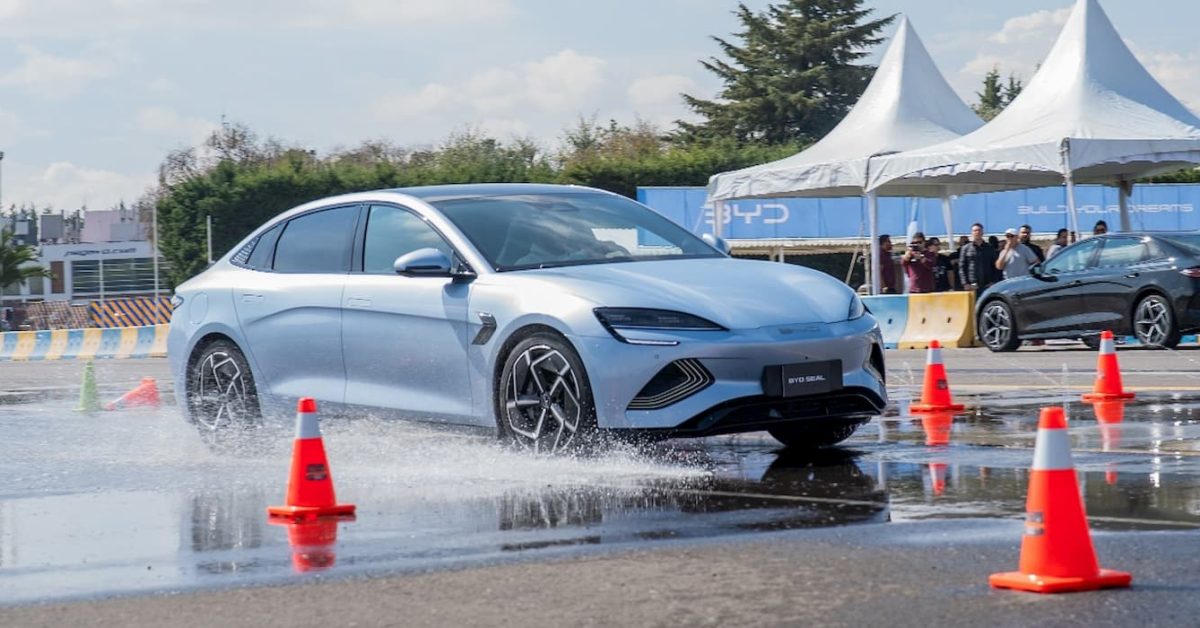
BYD shuts down rumors of testing a Seal EV with solid-state batteries for +1,100 miles
BYD is responding to a report that it’s testing solid-state EV batteries in its Tesla Model 3-rivalling Seal. The rumors...
Electrek
178 points · by toomuchtodo · 1y ago · 243 comments
If we're really so concerned about 'supply chain' issues we could build up a strategic reserve of batteries and solar panels. If china wants to continue subsidizing their industry below costs of manufacture I see no reason why we shouldn't exploit their generosity to meet our climate goals as quickly as possible.
One of the 'good news' stories re: the recent datacenter buildout is that grid storage is now being more widely deployed, and that compliments the roll out of renewable energy.
Anyone who mentions China's subsides without mentioning the US's $2.5B+ in EV subsidies is mostly likely ignorant and bluffing, or intentionally misleading you.
And don't even get me started on how it took $80B in AIFP subsidies to keep our auto industry from just dying completely ~16 years ago.
This "China subsidizes EVs" BS needs to end. Everyone subsidizes. The only meaningful questions are how much and to what end.
If anything you are proving the US doesn't understand research or science behind producing electric vehicles and simply funding EVs directly instead of associated organizations.
Given the current climate theres no way to explain it without sounding like a crazy person.
This fits well with the corporate donor driven political system where the government puts no pressure on the corporations on their production side allowing them to outsource their production to the rest of the world and instead focuses on growing the American market and consumer demand for them.
One of the largest recipients of Chinese EV subsidies is ... (drumroll) ... Tesla, an American company.
I consistently hear 2 main arguments against electric vehicles in the US. Range, and cost.
BYD & China is solving both. Range is important because we lack charging infrastructure still, and anyone who rents at an apartment complex, you are screwed and have to rely on public charging stations. Big batteries are important for these folks. People also still have range anxiety, so when a fuel efficient gas car will get ~400+ miles per full tank, only having more expensive cars with a ~250 mile range is a non starter for a lot of people in the US.
Cost is self explanatory. One of the better electric cars sold in the US, the Ioniq 6 STARTS at $38k, which is already more than a significant chunk of the population can afford - you're looking at close to an $800/month payment at current rates for entry level. BYD could sell in the US at around $20,000.
https://www.pewresearch.org/data-labs/2024/05/23/electric-ve...
Key takeaways from the above:
> The number of EV charging stations has more than doubled since 2020. In December 2020, the Department of Energy reported that there were nearly 29,000 public charging stations nationwide. By February 2024, that number had increased to more than 61,000 stations. Over 95% of the American public now lives in a county that has at least one public EV charging station.
> EV charging stations are most accessible to residents of urban areas: 60% of urban residents live less than a mile from the nearest public EV charger, compared with 41% of those in the suburbs and just 17% of rural Americans.
Maps: https://supercharge.info/map | https://www.plugshare.com/ | https://afdc.energy.gov/stations#/find/nearest?country=US&fu...
If this includes AC chargers, leaving your car for 8 hours 2 miles away is an absolute pain.
If it doesn't, the question becomes are the chargers occupied? Are they operational?
Waiting at a gas station takes a minute, waiting at a charger takes 30.
I've been driving an EV for more than 5 years and pretending that charging isn't a significant hindrance to EV ownership is disingenuous. It's actually gotten worse because more EVs are on the road and the chargers haven't kept pace with the rising demand.
Even among Americans, American cars aren't considered that good. There's a massive reliability premium you pay for Honda and Toyota. Even cars with 100k miles on them (frustratingly as a buyer) keep their value. And they're manufactured in the US, inasmuch as any car can be said to be manufactured in a single location.
I've been searching around and I can't even find data about other countries importing our cars which to me would be the biggest signal of strength.
However, the much higher prices these companies are selling their cars outside of China are still much lower than the prices American cars are available at.
My car gets ~500 miles/800 km per tank. My wife's car, which has a more efficient engine and transmission and is also smaller, but with the same huge tank, gets ~600 miles/960 km per tank. I will have to stop for a bathroom somewhere along a route that long, but only once or twice. I used to have to stop three times for a ~900 mile/1500 km trip that I did a few times.
This is a problem with EV proponents who try to argue that "you'll stop every couple of hours for half an hour or so anyway, so charging isn't an issue". No, I won't. I'll drive 1000 miles with less than 45 minutes of downtime on the whole trip. I don't stop every two hours. Maybe 15 minutes every 4 hours, of which 10 is fueling and going to the bathroom and 5 is getting off and back on the highway.
That's not a slam against EV's, but let's acknowledge their weak points honestly.
I guess if you’re trying to follow an ICE car on a road trip then yeah it might be a weak point. If you’re already stopping every 200 miles then it’s no matter. For us, we enjoy travel days more with the built in stretch/bathroom breaks.
My car (Mazda3 hatch) gets 24 mpg, which is actually typical for US mid-sized cars.
I have a 3-5 minute gas station fill up every 260 miles or so, basically once a week. The Chinese MG4 does 435 miles on a charge, 95% of which I could charge at home, the remaining 5% of my miles are my twice a year road trips @ ~400 mi (to LA) and ~800 mi (to Seattle).
The MG4 makes LA without a stop and Seattle with 1 stop.
That's a once a year stop for ~30 minute in the EV compared to 3-4 hours a year sitting at smelly gas stations for my Mazda ICE.
I would certainly trade never having to ever take my car into a gas station, ever again, for one brief stop once a year on my leisurely road trip if I had the cash to buy a great EV.
But to be fair, not every product has to perfectly fit every context. To be successful a product can fill a small niche, or it can appeal to a large market- it doesn't have to satisfy every use case.
So you're right - driving 1000 miles with no downtime is not an EV strength. But the percentage of the market doing that is tiny. Conversely the proportion of people who live in a house (home charging) and drive < 100 miles a day, is huge.
Even for those doing a "once a year road trip" - well, hire cars exist.
So I completely agree that an EV is not useful to you. I would suggest though that a product can be massively successful, while at the same time appealing to a subset of the market. And appealing to a subset does not limit validity or indeed profitability.
Lipstick seems to be a successful product, despite only appealing to something less than 50% of the market.
I'm American, so grew up in car culture, but I've never driven more than 200 - 300 miles in a day.
Yes, EVs do slow down long road trips a bit. But it’s really not much of a difference. I just did 3000 miles in 10 days in one.
I recently moved to an EV for my road-tripper vehicle. Yes, I need to stop and recharge every 4-5 hours for 20-40mn.
I find that I like it. A stretch, a coffee, snacks and replenishment. My favorite chargers are at a supermarket and a cafe' nearby.
I agree the pro-EV types try to whitewash this a lot, and I agree it is dishonest.
...but I find that I am okay with the cross-country EV reality anyway.
$0.02
Are they even doing that? A few billion dollars a year is meaningful but it's not dumping for an industry this big.
It's not just that China has reached some kind of quality parity with North America. There are now significant market segments that the US functionally cannot manufacture because we completely ceded the institutional knowledge and infrastructure in favor of financialization and outsourcing of the US economy.
My specific area of expertise is robotic / computer controlled manufacturing equipment and a lot of the components (high precision servos, sensors and other motion components) are functionally impossible to source domestically. There are still some boutique manufacturers making things in low efficiency / low volume in the USA but touring the manufacturing campuses of Chinese suppliers has been shocking in the last five years. The sheer scale of efficient, automated assembly they are capable of operating at makes a big-three automotive assembly line look like a dirt-floored shack with men knocking things together with rocks.
They are laser focused on lights-out manufacturing at extreme volume in ways I have never seen in the US. Entire production lines of high complexity electronics that are completely vertically integrated (everything from the injection molding for the plastic enclosure to the PCB manufactured on one campus) with human hands touching them for the first time as they leave the automated quality control line to be boxed up.
I don't think American people fully comprehend the brain and skill drain that has already taken place.
He also was a guest on the Search Engine podcast to discuss the same topic earlier this year [1]. I enjoyed this more than the video.
I think there’s some nuance and slight nationalism to take with a grain of salt, but the point is extremely well demonstrated.
[0] https://youtu.be/3ZTGwcHQfLY?si=2jaYQZEinXsJBk2L
[1] https://podcasts.apple.com/us/podcast/search-engine/id161425...
Assume a generation to be about 21 years (birth to high school + trade training).
Our business leaders since the 1980s failed to quantify the cost of a possible revamp, and I wonder what the true cost will end up being.
I’ve seen some of the Great Lake cities and towns that are in sad shape; but I was too young (and being immigrants, also too poor) to tour those areas in any depth in the Reagan/Carter days so I can only imagine what they were like back then.
At least 40% of Americans do not give a crap about addressing climate change. Many Americans see EVs as a waste of time and a direct attack on the US.
Given our recent election results, it seems to me that we don't want to.
Because your own industrial base atrophies is one reason:
> Democratic countries’ economies are mainly set up as free market economies with redistribution, because this is what maximizes living standards in peacetime. In a free market economy, if a foreign country wants to sell you cheap cars, you let them do it, and you allocate your own productive resources to something more profitable instead. If China is willing to sell you brand-new electric vehicles for $10,000, why should you turn them down? Just make B2B SaaS and advertising platforms and chat apps, sell them for a high profit margin, and drive a Chinese car.
> Except then a war comes, and suddenly you find that B2B SaaS and advertising platforms and chat apps aren’t very useful for defending your freedoms. Oops! The right time to worry about manufacturing would have been years before the war, except you weren’t able to anticipate and prepare for the future. Manufacturing doesn’t just support war — in a very real way, it’s a war in and of itself.
* https://www.noahpinion.blog/p/manufacturing-is-a-war-now
That's (partly) what did-in Japan and Germany in during WW2: they couldn't produce enough to actually run a war. Even the just the UK was out-producing Germany in many measures (e.g., aircraft).
The Big 3 completely retooled for war in very short order. If things go hot again you want factory capacity available for retooling to be possible.
A society just has to be willing to pay for that capacity instead of deciding that they want the cheapest widget made somewhere else.
Given the use of drones in Russia-Ukraine, what is the drone-making capacity of the US versus some other countries?
Stellantis sells a good number of EVs in Europe, but almost entirely in form factors that won't sell in North America. Perhaps this expertise and experience will be useful.
I hope domestic manufacturers survive the "protection" Trump is giving them, but the protection may prove fatal.
Point your gun where it belongs which is the oil industry and its lobbyists.
They are indeed the enemy. They've managed to convince a large swath of the population to hate everything that is not fossil-fueled.
Example: God made the sun and the sky. That's where heaven is. Fossil fuels come from under the earth. Something else really bad is down there too. I don't want to spell it out, but it's the opposite of heaven.
Or for the "independent, lion-not-sheep" types: I don't depend on big companies. My energy comes from up above. You can't take the sky from me. etc.
heheh
The climate thing itself is a giant oligarchy influenced manipulative game play. This nation is built on capital. Capital by its nature looks to dominate humanity and freewill.
The treacherous twists to turn a noble pursuit into a way for developed nations to continue dominate developing nations is beyond the space of this comment, but you can see that clearly over the history: Caesar Hitler Mao Trump Xi etc.
We people have truly never been able to wield the power ourselves.
How we made it: will China be the first electrostate? - https://www.ft.com/content/e1a232c7-52a0-44dd-a13b-c4af54e74... | https://archive.today/OSFYo
Because the unfair advantage distorts the market leading to a potentially otherwise noncompetitive product destroying the competition at which point they can (and will) jack up prices, so not only do you get more expensive vehicles, but you've also destroyed an entire industry and several adjacent industries at the same time.
It's not like you can't just snap your fingers and re-establish a vehicle manufacturing supply chain once it disappears.
I get people just want cheap vehicles, but the short-term benefit simply isn't worth it.
Purchase discounts for EVs in the US, for instance, didn't discriminate based on manufacturer. You could buy a foreign made EV and you still get the discount.
Discriminatory subsidies, like for instance, funneling billions of dollars per year into Chinese-owned manufacturers of EVs, parts and even even shippers, is not ok.
The US has, of course, been accused of discriminatory subsidies as well and countries have retaliated, correctly, with increased tariffs to offset the unfair advantage.
In the long run, I really don't think we can tariff our way around technical innovation.
900 miles of range in 12 mins of charging... Charge for 20 mins and have enough range for 2 full days of travel driving!
And this is only when driving long distances. Anyone with a driveway can eassily charge overnight for typical daily driving.
The whole package: many types of energy source providing electricity, never having to go to a gas station for typical daily driving, path to complete elimination of petro combustion byproducts, massive simplification of the overall vehicle mechanism, significant performance enhancements, etc.
All technical evaluation come out in favor of EVs...
The thing is, the average American is also very sensitive to any kind of change to their daily life. And taking advice from anyone how “it is better for you” is against the whole individual thought idea. So, good luck.
> BYD’s solid-state EV batteries set a record by gaining 1,500 km (932 miles) range in just 12 minutes of charging.
> The test charged the battery to just 80%, meaning total EV range could reach upwards of 1,875 km (1,165 miles). Keep in mind, that is CLTC range. On the EPA scale, it would be closer to 1,300 km (808 miles)
Is this true? How quickly will other companies be making these types of batteries?
Is there some reason why solid state batteries seem to be being deployed in cars sooner than in phones?
When price comes down and production comes up (assuming those things happen), then I would expect them to start appearing in phones as well.
I personally thought that the more interesting part of the article was where they claimed to be able to add 800 miles of range in 12 minutes. At those kinds of charge rates, my ideal EV would probably have a 300ish mile range that I could charge from 10-80 in <10 minutes (although I believe that part of the way they get those charge rates is with large battery packs, so a smaller pack would probably not charge as fast).
Additionally, while the specs for EV sedans are currently fine, batteries are only barely good enough for larger, less efficient vehicles. Maybe the killer app here isn't a sedan that goes 1000 miles, but a truck or SUV that can go 500.
The point is, whatever your and my opinions on the adequacy of current EV charging, the market seems to value improved battery specs more highly in the EV space than it does in the phone space (or maybe it doesn't and BYD is making a mistake by keeping their batteries for their cars instead of selling them to phone manufacturers).
Doesn’t work with a car.
Really easy to work around Apple’s utterly crap battery life. If it were better that would be nice to have.
Going a certain distance so can’t take an ev at all. It’d be nice if you could, if your usage is mostly very urban, sure that’s just nice. Gotta visit Dad on the farm a dozen times a year or whatever? That’s not your life so you don’t see it as essential even if the rest of the driving is much shorter range.
Just look at rumored iphone air
Not quite energy density, but the energy density, cost, complexity when combined with the discharge profile generates a very "interesting" phase space.
There's a few promising technologies which have very, very good efficiencies but only like very slow predictable discharge cycles. These are excellent for say building giant GW batteries in the desert, but not so great for even car batteries.
Phones and tech have bursty power needs based on use, the cost of taking other tech down to the size of a phone is extremely high (especially if you're first to market unless you know you will sell millions of units). Not to mention the reliability of batteries typically decreasing as the size drops.
Cars tend to be in the middle with their discharge profiles being relatively smooth compared to say a laptop, but yes you still have economies of scale, complexity, reliability and supply chain and patents to contend with ;)
Anyways- isn't a normal cell in an EV battery is like a AA size? Is this still true for solid state?
No. Some companies use tons of cylindrical cells that are larger AAs (like 18mmx65mm, 21mmx80mm, or 46mmx80mm). But even then at 46mm in diameter it's a good bit bigger than a AA.
But lots of manufacturers use prismatic or pouch like batteries. They're large and rectangular. Like these batteries on this BYD, they're called "blades". Most other major manufacturers use prismatic cells.
Oh, that's easy. I already knew the answer, which probably means just about every AI could tell you. Phone batteries use Li Polymer (which is solid state BTW), because they can be any shape, including flat, wide and very thin. Other chemistry's can't be thin.
Other phones targeting the Chinese market have reached 8000.
But companies like Apple and Samsung like to just sit on their laurels and sell the same thing again.
But yes Apple and Samsung has been very slow in adoption to new Battery Tech, even when it is somewhat market tested by Chinese phone markers.
If so, can this be beneficial to use cases outside auto industry? Eg. Power walls. If so, I am more excited for that. I am tired of electricity bills.
Also, what happens when an EV taxi runs out of battery power in China? They actually have stations setup all over that you simply drive into and it replaces the entire battery pack... in minutes.
Imo that's stepping beyond the risk profile of filling a tank with a known high explosive that can evaporate and suffocate and catch fire in the sun ... But risk profiles are inherently personal
I thought the big issue with solid-state (besides dendrites) was a lower energy density than Li-ion? What happened?
Maybe you are comparing the density of research batteries that weren't worth commercializing to highly developed lithium ion batteries?
Given it's still lithium based I'd still think twice before chucking a bucket of water on one that's fizzing :p
As for how this battery is better I'm not an expert, but good to read if true.
Newer models have heat pumps that greatly improve efficiency in cold weather. They also have better battery chemistries that store more energy in the same form factor. Unless you live in a very remote, very cold location (eg: rural Alaska), an EV is a fine choice.
It’s simply not a concern. Only a range reduction. A non-issue.
If you developed a hyper-efficient ICE engine that didn’t generate a pile of waste heat, you’d have to actively make it less efficient in the cold, or install heating hardware and burn extra gas to power that hardware - but nobody would criticize that hyper-efficient engine for being “worse in the cold”.
If you lowered the efficiency of an EV by turning half of its energy output into heat all the time, you’d greatly narrow the gap between warm-weather and cold-weather performance.
If it’s less than like 100 miles (161km) I think that the vast majority of EV batteries are going to get you where you want to go, even with 25% reductions due to cold weather. FWIW, the American average is around 36 miles/day.
There is a semi famous YouTuber named Hank Green that lives in Montana and daily drives an EV. He occasionally makes videos about his experience.
we typically have at least five 1000+ mile trips in a summer
the gas/diesel infrastructure and refill times make it the most viable option for now, but i'm hoping that changes w/solid state technology
How so? A full battery can run your seat heaters for about a month. That's a lot better than the hours of heat you'd get out of a full tank of gasoline.
Not to mention that you'll never get carbon monoxide poisoning from a gasoline engine with a tailpipe blocked with snow.
https://www.cdc.gov/mmwr/preview/mmwrhtml/00039929.htm https://www.rearviewsafety.com/safety/news/news-release-dead...
But it sounds like it's hard to get a handle on how common it is. It feels like it's more on the level of "a handful a year in North America/freak occurrance", rather than "common way to die".
What kills in the winter is unpredictability. Range is predictable and easy to mitigate.
It's the winter. You've slid off the road. You're probably in the ditch. You've probably taken some damage to the vehicle. Whether or not you've taken damage, you're now stuck. Something is preventing you from safely walking for help. At -30 or worse after an accident that's more likely than not.
The above is not an uncommon scenario in the winter. So you wait in the vehicle for help to arrive, hoping you don't freeze to death before it does.
You're safer in an electric vehicle.
- If you've plowed into a snow covered ditch, your car may be partially or fully entombed, and you're at risk of a carbon monoxide poisoning.
- there are stories of such vehicles not being found for days. Having heat for days might save your life
Is it road-accessible? What kinds of vehicles can get there?
The cars in the article have twice as much range as a gas car or more, even in the cold. And it's easier to charge them at remote locations than to get fuel deliveries to those same remote locations.
I'm sure a scenario could be contrived where any type of car wins, but on average I expect a long range battery car to do quite well.
https://eu-evs.com/marketShare/ALL/Groups/Line/All-time-by-Q...
Swasticars don't sell well. Musk needs to leave the company to give Tesla a chance to recover.
I drive a gas-powered Subaru because the Volvo dealership in Montana was being insufferable when I wanted a C40. My neighbour can easily go 200+ miles in the winter. (Apparently pre-conditioning is a thing.) Works fine for road trips to Missoula and Salt Lake City, for them, from Jackson.
https://electrek.co/2024/05/22/byds-10000-seagull-ev-worryin...
https://electrek.co/2025/04/08/byds-low-cost-seagull-ev-now-...
Why are we at that with gas cars?
Electric cars will carry a thousand pounds of battery to get that much range, while a typical gas car will only be equipped to carry a hundred pounds of fuel, using less than a third as much space. It's not even 5% of the car's weight.
On the other hand, we have to assume the average fuel tank load is <50%, so a larger tank truly DOES end up resulting in a heavier vehicle and lower fuel economy on average. We'd all get better mileage if we ran tiny fuel tanks and fueled our cars every day.