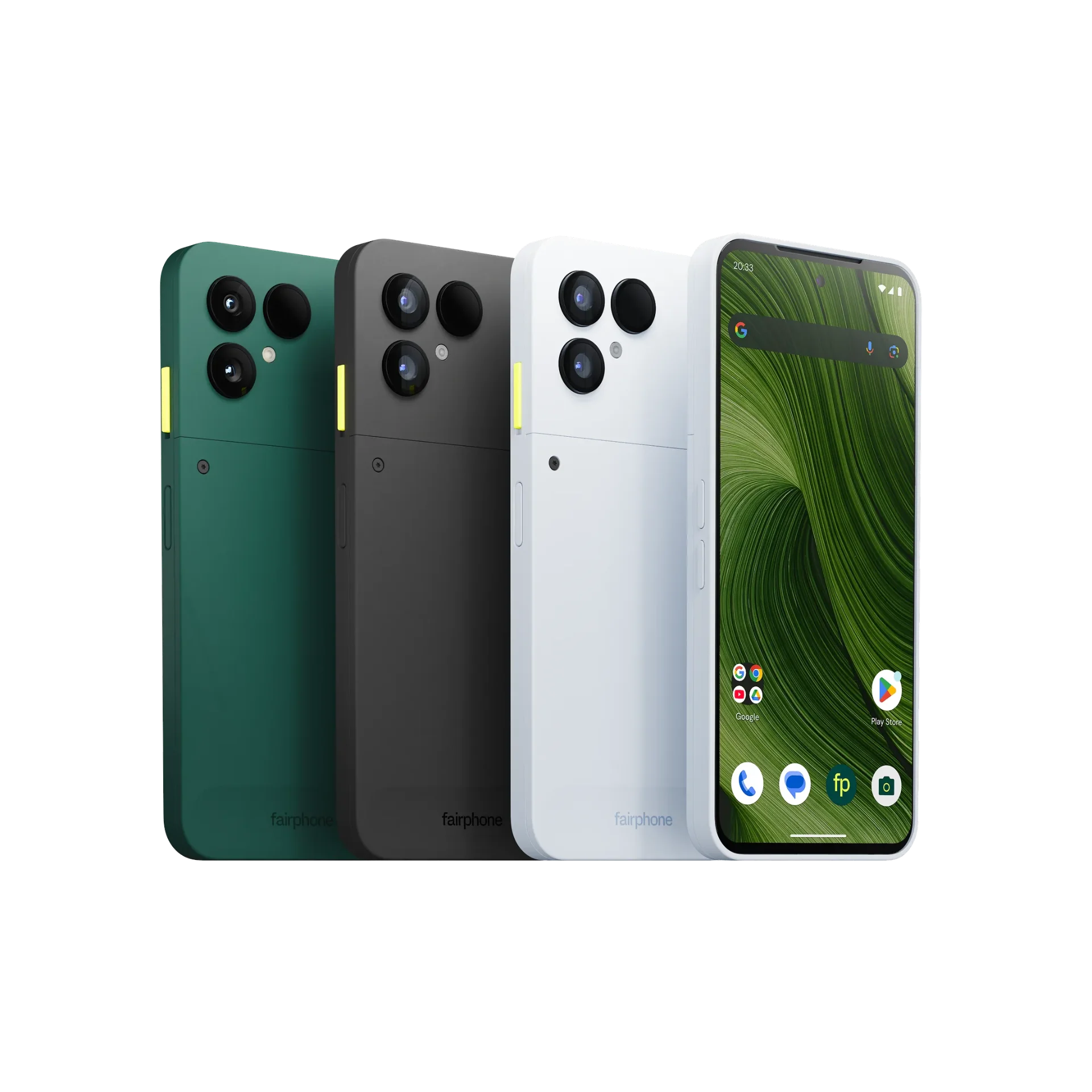
Switch to fair. Switch to The Fairphone (Gen. 6).
Future-proof. Long-lasting. Modular design inside and out. Switch to The Fairphone (Gen. 6). It's two phones in one. For a more mindful you.
Fairphone
158 points · by DavideNL · 1y ago · 146 comments
USB-C 2.0 (OTG capable) can be used to connect USB Sticks/SD-Cards/Audio Amplifier/Network-adapters directly
I was really looking forward to use this with a pair of display glasses, like the XREAL One Pro, but this seems like the Fairphone 6 might not support display output? That's sad. Especially since the Fairphone 5 had this in their tech specs:
USB-C 3.0 (OTG capable) can be used to connect USB Sticks/SD-Cards/display (also Android™ desktop mode)/Camera/Audio Amplifier/Network-adapters directly
But maybe it was not used enough?
Based on what I had read yesterday, when I still hoped that it will have the same USB 3.0/DisplayPort like Fairphone 5, I was considering very seriously to upgrade my rather old ASUS smartphone to a Fairphone 6.
However, if it lacks USB 3.0/DisplayPort, which can be acceptable for a $200 smartphone, but never for a $600 smartphone, then Fairphone 6 is completely disqualified from my point of view.
Unfortunately, only some Chinese smartphones, e.g. from Motorola, offer USB 3.0/DisplayPort in smartphones with decent price/performance ratios and up-to-date Qualcomm SoCs, starting as low as $400.
Which is to say, buying the previous Fairphone is a perfectly sensible thing to do.
Likely not used enough, yet. It would be premature to drop support this quick, as Google seems to just now move Android in the direction (DEX by Samsung is the same thing, but it's Samsung specific).
At the same time, only last year I saw a device in which I'd "dock" my phone (the Nexdock looked reasonably priced) and having both a phone and the steam deck with desktop mode would make such a device more useful.
I know you're talking strictly from the perspective of display glasses, but convergence is the main category under which I'd classify this feature.
Except I don't want to put up with the bs that Apple does to its customers, otherwise I'd buy an iPhone. It's not outrageous to expect USB 3.0, a 15 year old standard, on a 600 Euro phone with modern internals in 2025 that users are expected to keep for a long time without upgrading.
>It's just fine.
Just because it's fine for you doesn't mean it's fine for others. For other's that's the dealbreaker. Fairphone isn't a mainstream brand, it's a niche brand which tends to draw enthusiasts (often tech workers, hackers, tinkerers, etc), and enthusiasts are more picky and expect more features than your regular Apple and Samsung "muggles".
People buy niche phone brands not because they're the most performant or sexy, but because they still provide the niche features that Apple and Samsung gave up on, like SD cards, headphone jacks, removable batteries, etc.
OnePlus had USB 3.0 and DisplayPort outputs on 500 Euro phones all the way in 2019, and that feature was a lifesaver when my laptop suddenly died. There's no excuse now for this phone.
As a product manager, if I had a dime for every time someone insisted with stridency bordering on rudeness that some fringe feature was absolutely critical to my product’s success, despite data showing no market demand even from these overconfident “experts”… I would have a lot of dimes.
Shouldn't the user decide what to use it for, instead of others?
If people aren't gonna use USB 3.0, that's fine, but at least have it for those who do, it's not gonna bother the rest.
It's not like USB 3.0 is some expensive rocket science that takes a lot of effort to implement or takes up space in the phone like the headphone jack.
Or would there be other limitations, like compatibility with a processor/chip…?
My only issue with my FP3 is that I have to tighten all the screws from time to time otherwise whenever the screen displays too many green pixels the touchscreen will start to trigger at random.
It still works very well with CalyxOS so the rational thing to do is to keep using it.
As I near the eol of my daily driver, I'm considering a Fairphone, but what it's missing is a folding card holder, like the Satechi wallet stand for iPhone. Putting the phone in horizontal mode on a table and using a bt keyboard is how I do a lot of my writing
The Reason GrapheneOS isn't made for Fairphones Officially is that Fairphones lack a lot of base requirements for official support:
https://grapheneos.org/faq#future-devices
There's nothing preventing anyone from making a 3rd Party port of GrapheneOS to Fairphones, it just seems no one does.
The "Complete monthly Android Security Bulletin patches without any regular delays longer than a week for device support code (firmware, drivers and HALs)" part isn't even true for Pixels.
> The "Complete monthly Android Security Bulletin patches without any regular delays longer than a week for device support code (firmware, drivers and HALs)" part isn't even true for Pixels.
That's not correct. Pixels also ship the monthly, quarterly and yearly OS updates rather than the Android Security Bulletin backports to older releases. Android Security Bulletins are backports of High and Critical severity patches to the initial yearly releases from the past several years. Stock Pixel OS and AOSP have a new release each month and often ship those patches before they're backporting.
Android Security Bulletins also include a small subset of SoC vendor patches, but the remaining SoC vendor patches and other hardware component patches also need to be provided as part of meeting our requirements.
Doesn't the ASB get published at the same time as pixel updates? So by definition it's up to date.
I suspect it's the features of the titan m2 security chip. It's a pretty cool piece engineering [0].
[0] https://www.androidauthority.com/titan-m2-google-3261547/
The makers of GrapheneOS have indicated that Fairphone doesn't meet their security requirements:
https://grapheneos.social/@GrapheneOS/114737139118874189
I think there are some fundamental flaws with how Fairphone operates, plus they don't seem to release security updates promptly.
They did announce they're going to do daily linux patches though, so that's atleast something https://www.phoronix.com/news/Fairphone-6-Linux
It would be good if Fairphone could make a product that meets GrapheneOS requirements, but they measure the tradeoffs between security, usability, and cost (to do hardware and software things) differently. Each team is free to make the choices they deem fit. If only the intersection of GrapheneOS and Fairphone users were bigger, market forces would push them towards a common vision.
There's is no bad blood here, it's merely that fairphone doesn't meet the required standards for them to be a target the graphene team is interested in supporting offically. There's nothing preventing anyone from porting it themselves and nothing preventing fairphone from porting an inferior version of grapheneos to their phoens.
However you could also install eOS yourself instead of course, if you prefer.
Yes, the closed-source camera app that does not work on Lineage OS and other alternative firmwares has a 50MP switch, however the quality of the 50MP photo is as poor if not worse than the processed 13MP photo...
I believe the app I was referring to is not installed by default; you have to explicitly choose it from settings.
However I also find some of the supporters of consumer friendliness unbearable (e.g. Framework or Thinkpad fans).
I get that tribalism is present in many layers of our society and culture (politics, sports, music), but I always found it weirder when people do it for products. The only goal of a company is to maximize their profits, why someone becomes a die hard supporter of them is beyond me.
To summarize, I just wish people would put less emphasis on consumer practices. Buy a product you like and is beneficial for you, but don’t judge others for their choices.
Overall this is effectively true, but it is not a law of the universe or anything.
Why can't a collection of people have ideals, want to support and realize those ideals through action, and also find a way to financially support themselves and even profit by pursuing those ideals?
The hypothesis you've put forth is that the group that founded Framework were sitting around thinking about the best way they could invest money to make money, and the best option they could come up with was to make modular laptops. What has their return on investment been thus far, and does it clearly and readily beat all other options they had for investing?
I agree with a live and let live view of purchasing decisions, and I agree that tribalism about companies is weird, but at the end of the day it’s far too reductive to say all companies prioritize profits equally.
A large amount of energy is wasted on "infighting" where people spend significant effort on attacking projects that, seen from a distance, are actually allies¹.
Or where people dismiss the entire project because it's not 100 aligned with their view of perfection².
Or, indeed, where people who don't even use or want to use a project, spend significant effort to discredit this project.
¹ an example is the enormous amount of effort and campaigning within the "mastodon" community against projects like bluesky or nostr. But also gnome vs kde, Ubuntu vs Redhat, Etc
² an example is Opensource software being discredited because they use GitHub, or host on AWS. It's Patagonia being discredited because they use plastic. Or Fairtrade coffee being dismissed because it transports coffee with trucks and ships burning oil.
Framework/Oura/Whoop/Garmin/Fairphone etc etc it's all the same.
People seem to flock to smaller phone companies and demand they fill in their one feature. Whether it's USB-OTG display functionality, headphone jack, slider to kill all connections, etc, everybody is convinced their one feature is holding this phone company back, just because they want this one feature.
It's just disappointing. I'm just happy with my long-lasting repairable phone.
I just bought their 2025 model for that reason.
I've got a Fairphone 4 and the most useful thing about it is the replaceable battery. I can't count the number of times an extra battery in my backpack has saved me.
Sure, maybe it's not that big of a deal to bring a screwdriver with me as well. But I just know I'm going to lose those tiny screws and changing the battery at the back of a taxi goes out the window.
I wish there is compact android phone with open bootloadet option.
If the latter, do you have a source or some research to point to?
If the former, why did you choose to present a personal preference as a common truth?
[0] https://www.fairphone.com/en/2024/01/24/have-you-seen-the-sc...
[1] https://www.fairphone.com/wp-content/uploads/2024/02/Fairpho...
I doubt they'd even get the RND cost for that change back, this is a feature no one cares about except a very very small minority within a small minority. I'm a hardcare FOSS only user and only use grapheneos/fedora linux on my devices for privacy and security reasons and even I am not remotely concerned about hardware switches when i can just powerdown the wifi/Gps/wwan connection.
At the moment iPhones seem to drain power even when they are "off" which makes me suspect that they aren't, in fact, actually fully powered off. There have been a few occasions when I have been without a charger for one reason or another, and would like to be able to fully power off my phone in order to save battery.
Turning off connectivity doesn't help as much to guarantee your privacy as the phone could theoretically be recording and then upload the recording later, when you turn it back on (if it was thoroughly compromised, which admittedly seems unlikely, but nevertheless it would be nice to have some guarantee that it's impossible).
Wireless-only, data-harvesting slabs are good enough for ME, so they oughta be good enough FOR EVERYONE!
Then once I'm there, what do I do with the phone? Ask to put it in a separate room and hope that the microphone isn't powerful enough to pick up our conversation?
I could turn it off entirely, but what if someone needs to call me for an emergency?
For me, as a user, the easiest solution would be to have a killswitch. I understand that building it would be more work, of course :)
What a lot of people talk about is a headphone jack. But even that niche has been filled by USB-C adapters for people that really want them and not only talk nostalgic about it.
The demand for a headphone jack is fueled by functionality and sustainability concerns, not nostalgia - can't, too recent a change and current devices do have the port.
The one upside is convenience of not having a separate dongle, which is pretty well offset by the significant increase in phone size needed to accommodate the jack.
I think you overestimate the appeal of such a feature
They probably don't want to position themselves against security-focused phones as they would likely be compared unfavorably with them. That is unless they also do whatever it takes to enter that market, for example by supporting a security-focused OS like GrapheneOS.
They could have kept the headphone jack though, but I guess they wanted to sell their earbuds (with replaceable batteries! which is at least a good point).
Now Apple has removed that ... and I am not happy. Yes, the functionality is theoretically available by configuring the 'smart button'. But I don't physically see the state of the device without picking it up.
Kind of defeats the purpose, no?
put at least 12 GBs or just don't even bother, EU already has rules for software updates and repairability, so there're not that many selling points left