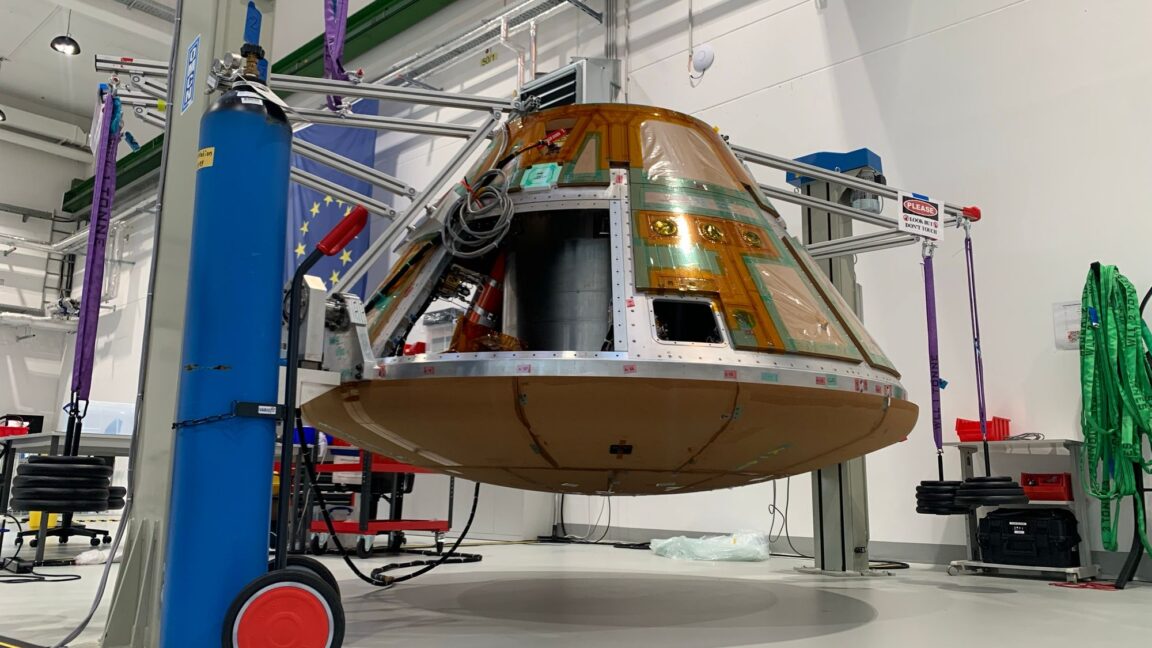
After successfully entering Earth’s atmosphere, a European spacecraft is lost
This partial success reflects both ambition and the inherent risks of innovation."
Ars Technica
73 points · by rbanffy · 1y ago · 41 comments
"SpaceX required [..] nearly $3 billion [..] The Exploration Company would require a similar amount [..] It is not possible to raise that money from private capital markets right now by promising a great return a decade from now."
In other words: All the investors are looking for a quick buck. Nobody is willing to invest into the longer-term future anymore.
SpaceX raised private capital. It continues to raise private capital. (It still tapped into public coffers for Crew Dragon, though, because the demand side of that market remains entirely public.)
It could do this because NASA had committed to the Artemis programme. That’s the demand. ESA has no similar promise of returns for a private backer; giving money to these guys strikes closer to a grant or donation than investment.
Of course one can. Those plans could change. But they were set and funded and that inertia appears to be saving them [1].
ESA has nothing similar planned. (Beyond collaboration [2].)
[1] https://yellowhammernews.com/u-s-senate-directive-would-revi...
[2] https://www.nasa.gov/news-release/nasa-european-space-agency...
that's a myth
you are confusing liquidity with other aspects of investing. name the biggest companies on the stock exchanges, they've been around for many years, and are expected to be around many more years. That's long term investing.
liquidity means that any particular investor can change their own personal priorities and get out of the long term play in the short term. You want to buy a house with your money, that's ok, the projects you've been invested in can soldier on without you.
if a new company with no track record of making money wants to tie up your investment while showing no results for a decade or more, you yourself would probably be unwilling to invest, because there are many alternative investments that give you liquidity and show results regularly.
But then, how can anyone finance a start-up that takes a bit longer to build than the usual web mitm or web advertising play?
Companies offering long-term prospects definitely fill a need.
or are they trying to prove that the EU isn't willing "to adequately do space stuff"?
the US grabbed a top robotics company from the EU because the EU apparently refuses to evolve the game based on the rule set they created and CEOs are complaining about too much regulation instead of working with the constraints.
the US reduced constraints to an absolute minimum and, without question, got much farther than European companies but there is zero chance they can handle all the future load without becoming dependent on Chinese supply chains, or is there? and so they need to drive EU spending and European competition in order to drive the creation of European supply chains, in order to keep the markets diverse and incentivise the EU to strengthen their game on the African continent.
I'm out of the loop and mostly guessing ... a lot of middle class Germans are about to be 3rd, 4th, 5th generations heirs, ascending into the 1% and they will have the liquidity to build and expand 3D printing companies in all industries, including metal and construction and German universities are up to speed and I assume other European countries aren't too far behind.
then there is the whole 'Wiederaufbau' of Ukraine in the planning, a country with tech talent and space and now more than present in people's minds, which should additionally drive investments and partnerships aiming at next gen city, civil, construction and space tech.
would love to hear some opionions.
It’s great to see a company blow past the usual reasons mentioned by European naysayers.
SpaceX relies on Europe and Taiwan for its semiconductors. Does the fact SpaceX can't be adequately served by domestic capacity and their in-house semiconductor programme is just getting started mean they don't execute?! Or is it just a little thing called trade that Americans used to believe in?
Hilarious.
1. The Exploration Company builds shuttles, not launchers
2. The US had to rely on Russian shuttles for decades after the Challenger drama
Space is hard and sarcasm not useful.
the US picked an entirely different set of constraints and thus dominated the past decades with ease.
the EU on the other hand, handles and will handle millions of refugees to come, pay for their education and it will be imperative to expand the job markets. and industries.
this should, theoretically, within 10 years, "change the game" again.
"European", "US", "Asian" is just a sponsorship tag with the teams, hardware and knowledge supply chains being globalised anyway, if I am not wrong.
That sounds simplistic. They each have vastly different governance principles and philosophical views about the economy.