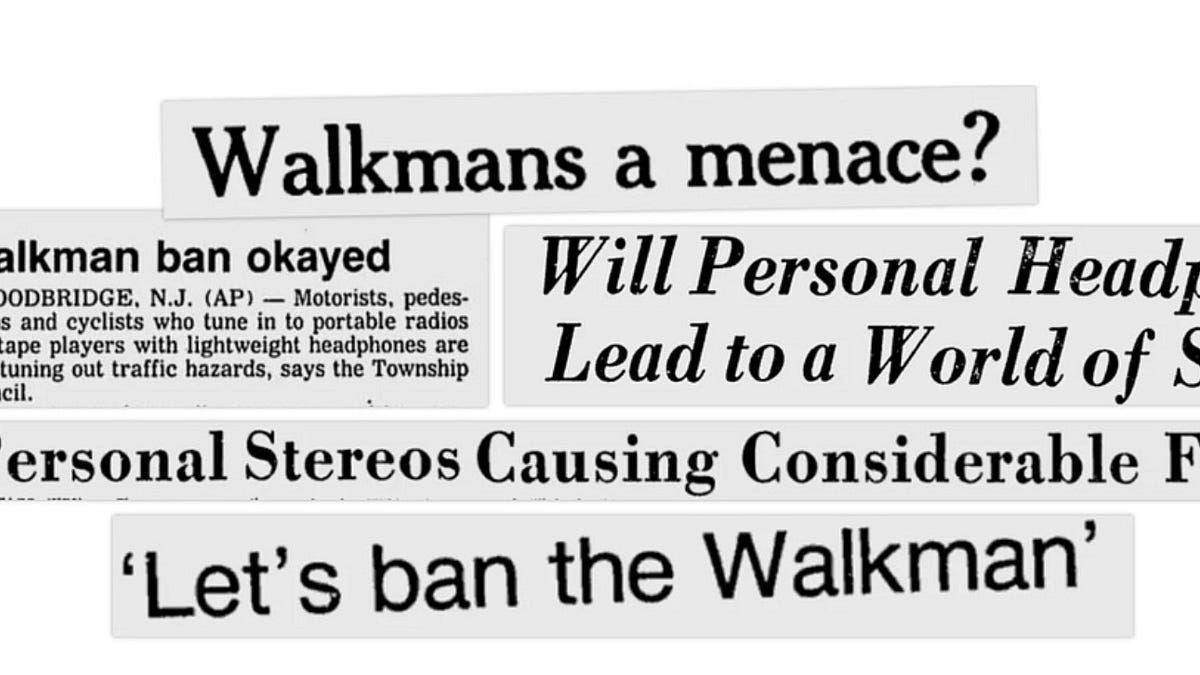
The Forgotten War on the Walkman
The Sony Walkman is now iconic of the 1980s, eliciting nostalgia for the ‘good old days’ of owning music, rather than renting it.
newsletter.pessimistsarchive.org
109 points · by mfiguiere · 1y ago · 110 comments
I remember being annoyed when a coworker had AirPods on constantly, even when conversing with other people. Obviously we could have a conversation, but it felt like they didn't value it enough to give it their full attention (I don't doubt the music was turned off, though).
In the early days when everyone was starting to get smartphones, there were lots of memes about people staring at their phones constantly and maybe walking into traffic or bumping into people. Constant smartphone use has been normalized now (for better or worse). In the early days, people felt bad when they pulled out their phone to look something up during a conversation, but that behavior is no longer looked down on. It doesn't feel rude if somebody breaks out their phone mid-conversation and starts scrolling for a little bit.
This feels incredibly rude, and I honestly don’t know anyone who would not consider this rude.
Arbitrarily scrolling in mid-conversation is rude, but somebody picking up their phone to look something up or read a text message now happens without a big fuss, whereas before, I think people were more likely to apologize for the action. It's acceptable to just pick up your phone now to look up something or check your messages during a conversation in a lull.
On the other hand, I see couples seated together in restaurants just scrolling their phones privately at the same table, so generally it seems like it's more "okay" to disengage to your technology.
I still feel like this.
>It doesn't feel rude if somebody breaks out their phone mid-conversation and starts scrolling for a little bit.
And I do not agree about this either. Also, I think most of the people I spend my time with would also agree. But perhaps I'm (unfortunately) an outlier.
This says more about you than them. What was the point? To have a conversation or to get your coworker to behave a certain way? You're annoyed at arbitrary aesthetics, as if this person didn't show enough deference to your preferences, even though you were sure they turned off their music and you were able to have a conversation.
And the beggars, I really don't carry money anymore.
But having headphones in really helps avoid these people. I can see them looking at me, seeing my headphones and subconsciously eliminating me from their list of targets.
I'm not even really into music but I usually listen to nature sounds and have the noise cancelling on full blast. It also helps reduce stress and fatigue from overly loud city noises like big diesel buses, assholes that have to honk constantly when traffic is stuck, etc. I still hear them of course but it doesn't feel that heavy.
from my experience, strangers who start a conversation with you in public always want something, usually money
Before the walkman there was the newspaper as a tool for isolation. Besides, who says it is desirable that a stranger can strike up a conversation with me at any time?
The people that want this are overhelmingly living in villages anyway where they can do their thing.
Good. I'm not your personal entertainment machine. Bring a book if you get bored.
But sure, I'll admit to writing in an abrasive style. So I'll rephrase.
"This is a good thing. It clearly signals to others that I have no value to bring to a conversation with a random person. Might I suggest you read a book on a topic you find exhilarating? It will be infinitely more rewarding than any conversation with me will be for you."
Happy now?
You don't have some God-given right to demand the undivided attention of a stranger. That is literally the behavior of a 5-year old. Grow up.
We can probably measure the impact this is having culturally specifically in non-western cultures, because their baseline is not as anti-social compared to the west.
I think it's also worth noting that many are not going to read this article and go "hah, they got it totally wrong". They didn't. Mass scale human behavioral change has the been the story for a while now.
I'm just being descriptive here, not normative.
The reason I live in a big city is that it has enough of a base to make even small fringey communities viable. Such as the makerspace I'm part of, and some more NSFW activities too. I'm sure 95% of people don't care about those things but for me they are very defining.
Traveling abroad and being a tourist, usually invites tons of conversation and sharing of culture from both sides, especially if the person visiting has put in effort to learn the language.
I'm more of the shy type, but I always enjoyed traveling by train with a friend who can strike a conversation with everyone.
And yet still, plenty of women report persistent men telling them to remove their headphones so they can engage in unwanted conversation.
The alienation was already there; the headphone just made it more acceptable to signal.
As for women who don't want to be approached, harassment is an entirely different issue. Just because talking to strangers and harassing women were more acceptable in the past doesn't mean that one follows from the other.
Unwanted advances, whether sexual, social, or commercial in nature, are all harassment. They all make the recipient uncomfortable, and others should be able to identify and respect anti-openness signaling like wearing earbuds or not sustaining eye contact.
This isn't part of the social conditioning, it is because most people are not very interesting.
since when?
I don't think my headphones are depriving me of some grand experience of human life.
I have no desire to go back to that. New music is being created WORLDWIDE constantly and we also have a few hundred years of already-made music. There's no way I could even come close to 'owning' all of the music I'd want to own.
Discovering good new music is a problem becasuse there's so much of it. Since '99 I've been listening to one of the first streaming internet station. DJs give them one to two hour sets that go into rotation. There's no limit to the variety - you'll get an hour of Portuguese Fado music (was a fad in L.A. for awhile) followed by 8-bit video game music then Iranian music... I like it because it's curated by humans and not computer.
For less than the price of 1 CD per month (and I used to buy WAY more than 1 CD per month) I have access to a near-infinite amount of music.
I've added 49 full or partial albums to my library since 1/1/2025 for $78. And some of that stuff has an EXACT AND PRECISE 0.00% of having ever been carried in a physical shop on physical media such as: a DJ set consisting mainly of remixes of The Hacker tracks from the late 90s, recorded by a Canadian DJ in a Frankfurt Studio in 2025.
We're eating perfectly-prepared filet every day and people are reminiscing about school cafeteria salisbury steak.
They didn’t suck. Like many situations that were resource constrained they had unique positive attributes even though you have a strong preference for the alternative strictly speaking.
Sometimes being constrained forces you to have a different and better experience, like when you’re young and broke and have adventures, or there’s a power outage and the city turns into a party, or when you miss the bus and have an interesting walk.
I was and am a musician and massive music fan. I miss the experience of being on a long train trip with only 10 CDs and really deeply connecting to each of them with no distractions. I miss discovering something on a record store clerk’s recommendation. And it’s not fair to say I just miss being younger those were specific experiences and they were pleasant.
I’m not saying I’m going back, or that we all should. I am happy with unlimited access to everything that’s also great. But back then it didn’t suck, it was great in a different way.
> I've added 49 full or partial albums to my library since 1/1/2025 for $78.
Counterpoint: I haven't bought a record in over 10 years. That is, I have added exactly zero full or partial albums to my library since 1/1/2014. Even though I stopped spending money, I didn't have to stop (legally) listening.
If your numbers are correct, this (being able to play the music that I've listened to over the last 10 years) is something would have cost me over $1500.
I stopped digging, but from what I hear in the mainstream it tastes more like plastic burger than triple-a filet.
When has it not?
Not really, discovering it is a problem because it is hidden. Current algorithms are designed to revert you to the same old and to show you stuff similar to what you have seen. You need to know specific terms to find something new - but of course if it is truly new for you, you do not know those terms.
the musicians making it know this deep down. it's like the music is there, and the musician who "made" it indeed only brought it from "there" to here. that is it.
at most you own the medium in which the music's representation is stored, which is streaming's problem. the medium is your internet connection if anything
Care to share which one? I personally like FIP.
Have they though? Because scanning those headlines I get a vivid image in my head of newspapermen salivating at the chance to fabricate a moral panic out of thin air.
I had a walkman in the early 1980s, and really didn't end up using it that much, for similar reasons. They ate batteries, a cassette tape would run for about 20-30 minutes before you had to turn it over, so one tape got repetitive pretty quickly, and carrying more than a few tapes became inconvenient if you were out and about.
I later got a walkman-like device that was just a radio, which was much lighter and more practical if I was out on a long walk or run.
Thing 1: Everyone staring into their smartphones, nobody conversing at all. In many context where in the past, people would have started conversations out of sheer boredom, but made social connections that way.
Thing 2: A good 50% (and growing) people on sidewalks, bike paths etc. are completely oblivious to auditory stimuli such as callouts like "may I pass please" or bike bells or, for that matter, cars! Inevitably they have Airpods-style earphones in. With advanced environmental noise cancellation. At least the foam pad on-ear headphones of the Walkman era let other sounds through.
I'm a techno optimist through and through. I've spent my life and career close to technology, but in the same breath I think we'd be foolish to pretend humanity's relationship is without drawbacks.
https://www.sciencedirect.com/science/article/abs/pii/S00221...
And deaf people shouldn't be allowed to do either?
That's a poor comparison, for a few reasons.
1. Headphones can prevent you from responding to outside sounds in at least two ways: (1) the sound from the headphones might mask the outside sound so it is not audible to you, and (2) you might be distracted enough by the sound from the headphones that even if the outside sound is audible through the headphones you fail to notice it. Also that distraction can also take your attention away from other important things needed for safe driving.
Deafness only prevents you from responding to outside sounds by making it so you don't hear them. It does not add distractions on top of that.
2. Deafness is a disability. We often relax rules for people with disabilities to help them have a more ordinary life.
In the US less than 2 percent of the population is deaf. Letting that small number of people drive despite not being able to hear provides them with great benefit. It probably does slightly increase the overall accident rate but with it only being 2 percent or less of drivers the effect is limited.
People with headphones appears to be way higher than 2 percent. They will have a much bigger impact the 2 percent who are deaf.
3. Deaf people have likely been deaf for most or all of their lives. I'd expect they have learned to compensate by paying more attention visually to their surroundings. When they learned to drive they were likely taught the importance of such compensation and have been practicing and perfecting it ever since.
Headphones are temporary. Very few people wearing headphones while driving are going to have the compensation skills that deaf people have for dealing with not hearing outside sounds.
Wind in the ears can be a problem. Blocking the wind helps people hear cars/ dangers better, provided the music is off/ very low volume. I, and several other cyclists i know wear buds (no music) for this reason. You can't always tell if people are listening to music, or not. With walkman headphones, i always remember being able to hear the high frequencies of other people's music.
debatable.
> The sudden rise of headphone wearing pedestrians - spurred by Sony’s lightweight headsets (17% the weight of others)
Funny to see this trend has completely reversed. People wear more and more huge behemoths of headphones again. Not that I mind that but I find it an interesting development.
The article also goes on about beepers/pagers. I didn't know these were also demonised. I really miss mine in fact, it was great to be reachable while not constantly sending my location to 2000 "trusted partners". Unfortunately here in Spain there is no longer even a single pager network in operation.
A dumbphone only gets part of the way, as the operator still knows pretty well where I'm hanging out. As does the government.
> The market for earphones accounted for around 90% of the overall share in 2022 and is anticipated to witness a CAGR of 13.2 % from 2023 to 2030
not sure about the masturbational fantasy but the rest seems fairly spot on as a critique?
1. Apologies if autotune pop music is your thing but it makes my skin crawl so please, keep it to yourself.
https://en.m.wikinews.org/wiki/Pedestrian,_three_others_kill...
People's rush to blame the victim never ceases to amaze me. I think that people see that the victim did X, and they don't do X, therefore they'll never suffer a similar fate, and they need to proudly proclaim it to the world. Maybe it's related to magical thinking and the just world fallacy.