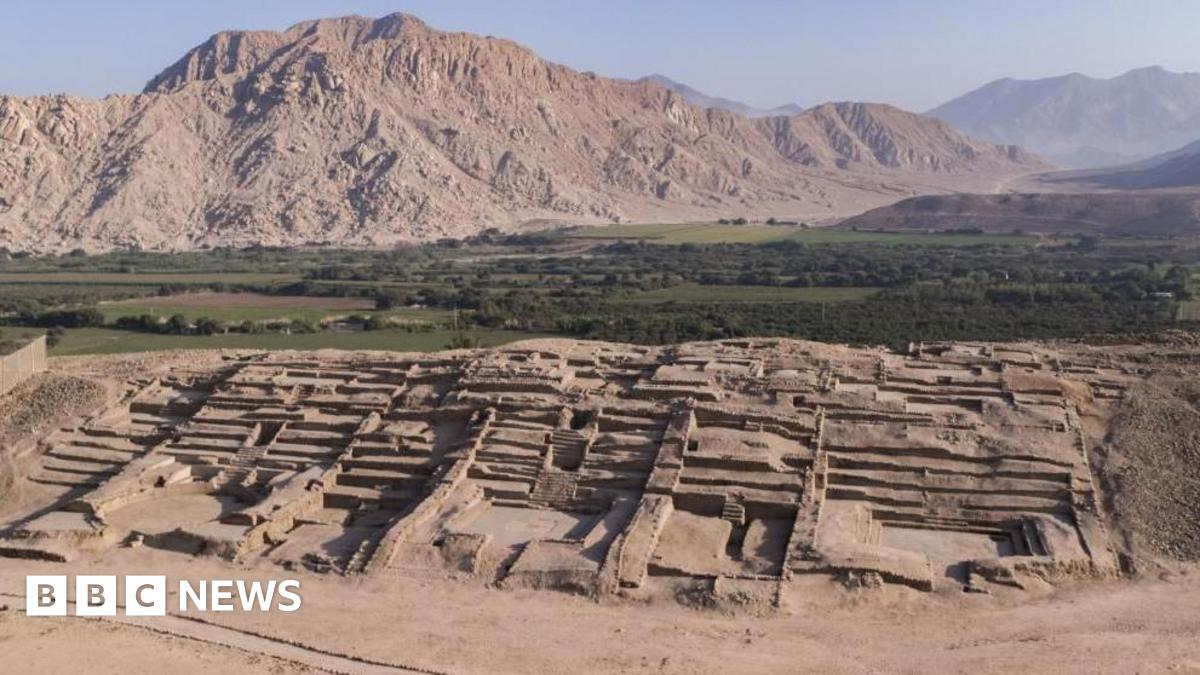
Archaeologists discover 3,500-year-old city in Peru
Researchers believe Peñico served as a trading hub linking ancient Pacific coast communities with those living in the Andes and Amazon.
BBC News
182 points · by neversaydie · 1y ago · 60 comments
Perhaps something got lost in translation?
Archaeologists are excited for this find because it comes with a visitor's center and a parking lot.
Looking at a couple other articles I gather that it was announced as open to the public? Another article mentioned that they have been working on the site for over 8 years: https://www.reuters.com/science/archaeologists-peru-unveil-3...
Probably timed to coincide with the peak of the tourist season in Peru. Dry season is May-Oct (not at all advisable to visit Machu Picchu in the wet season). Jul-Aug is summer holidays for Europeans, who are the biggest cohort of international tourists in Peru (and summer holidays for North Americans). And Peru's independence day is 28 Jul, so locals take an (often extended) long weekend, so a bit of a spike in domestic tourism coming up too.
Eight years of research at the site unearthed 18 structures, including ceremonial temples and residential complexes....
>Researchers say the discovery sheds light on what became of the Americas' oldest civilisation, the Caral.
Oldest civilization is a bit of a stretch. Earliest surviving structures is a stretch, but it's one we know about, so I guess they have to base it off that. More and more evidence is showing that humans were in the Americas farther back in time. While they weren't the builders of of fine stonework and megalithic structures like the Olmec (that we know of), there were certainly civilizations and cities before humans suddenly started building the massive pyramids and cities we have uncovered so far. There's a lot of secrets still hidden in the South American jungles.
Caral at 5000 years old is quite old! For additional context the Pyramids of Giza are ~4600 years old and Stonehenge is ~5100 years old. Given that it's in Peru this does not counter your narrative. But Archaeology is a Science and they cannot definitively say there is an older city without discovering it. It also might be unlikely to find what would be qualified as a "City" that is older. We've certainly found much older human settlements in the Americas, but megalithic building and cities is harder to say. Perhaps we'll find packed earth ones somewhere, but Peru really did have the jump on what would term "complex societies" in the Americas
Archaeology is a collection of arbitrary-but-largely-agreed-upon definitions. That doesn't make it a science. The entire focus on whether or not this is a civilization (or indeed why such a determination matters) is a great example of why you should abandon consensus at the door.
Usually we say archaeology is a "big tent" field, where anything that's useful can find a place rather than relying on prescriptive definitions of what should and shouldn't be used. If this gives you flashbacks to Feyerabend's epistemological anarchism, you've got the idea.
There are definitely scientific things within archaeology and many archaeologists who spend their days doing activities indistinguishable from what goes on in adjacent geology and biology labs. It's not uncommon for archaeologists to hop back and forth from the biology and anthropology departments either. There was even a movement called processualism in the 50s-70s to fit archaeology within the scope of a traditional science that's widely regarded as a failure.
Of course we would also have to ask what a science is. The traditional hypothesis->experiment "scientific method" is used in archaeology, but doesn't really apply to historical events. We can generalize that a bit to the Cleland's "smoking gun" idea for historical sciences (so we don't need to fully throw out popper) and indeed it's quite a popular perspective today for the "best" way to do archaeology. It's just not the the totality of methods used by the people we call archaeologists.
As I see here[0], cement stucko on top of natural stone was pretty popular technique back then.
[0]: https://odysee.com/@hiddenincatours:3/megalithic-saqsaywaman...
It's not like we don't know about a bunch of different peoples that existed even earlier (i.e. Toca da Tira Peia is ~22 kYa), but the evidence we have of them is basically a few burial mounds and maybe some domestic structures, and that does not rise to the threshold of a civilization for the intents and purposes of archaeology.
Does anyone know of a catalog of ancient irrigation systems. I’m curious about the variety of geographically dispersed irrigation techniques of the ancient world.
(maintained by one Gonzalo Chavez https://x.com/gchavez101 )
> "They're not extraterrestrials. They're dolls made from animal bones from this planet joined together with modern synthetic glue," said Flavio Estrada, an archeologist with Peru's Institute for Legal Medicine and Forensic Sciences. "It's totally a made-up story," Estrada added.
https://www.reuters.com/world/americas/scientists-assert-ali...
Here’s an X-ray comparison between the two where it’s very obvious that there’s a difference between the modern dolls and the archaeological discoveries:
https://x.com/_stranger357/status/1805272924640682036
Even if you’re incredulous that these bodies were living creatures, no one disputes their carbon dating of 500-1500 years old and this has been confirmed by multiple labs. It’s not possible to construct bodies from biological material that is that old, so if they were constructed it would have to have been done by ancient Peruvians. This begs the question of why ancient Peruvians were making constructions of beings that look remarkably similar to modern aliens as described by UFO experiencers:
https://x.com/_stranger357/status/1804973689567326435
The archaeological discoveries are being studied by the University of Ica and other South American scientists across many disciplines. The South American cultures also have a long history of depicting tridactyl beings in their artworks, there are hundreds of examples but here’s one:
https://x.com/_stranger357/status/1789875845542076808
So it’s really quite ridiculous to suggest this is disrespectful to Peruvians. Their own culture describes these creatures, and their scientists are the ones promoting the authenticity of the bodies. You’re just propagating ignorance.
Skepticism has turned into a religion, the rational perspective here is that we have a genuine mystery that needs further investigation.
- demand your salary be paid in salt
- have all arenas be covered in sand
- calculate only with pebbles
- only allow xylophones made of wood
And so on. It's a tiring journey to embark on -- oops, one can only embark on ships...
https://www.savagechickens.com/2007/08/public-service-announ...
Meanings change over time, and whenever this comes up it always just feels like some folks are adamant about the archaic usage just to (try to) show how smart they are.
OED dates the first known use of "to reduce drastically or severely; to destroy, ruin, devastate" to 1660.
But "decimate"? How often do you feel the need to refer to reducing the size of something by one tenth? This is bizarrely specific and I highly doubt it ever has any real applications unless you invent one.
I instantly howled with anguish. Surely decimating them should mean removing NINE tenths. The Master was a small-minded coward.
Seriously though, languages change.