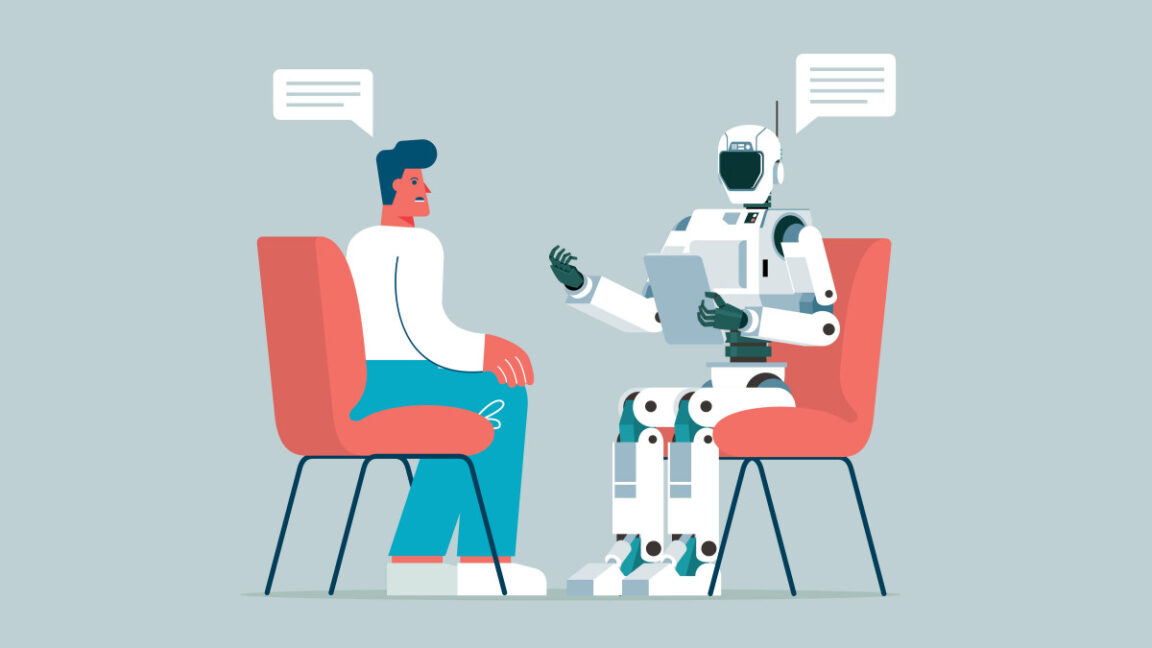
AI therapy bots fuel delusions and give dangerous advice, Stanford study finds
Popular chatbots serve as poor replacements for human therapists, but study authors call for nuance.
Ars Technica
242 points · by pseudolus · 1y ago · 162 comments
If you choose to believe as Jaron Lanier does that LLMs are a mashup (or as I would characterize it a funhouse mirror) of the human condition, as represented by the Internet, this sort of implicit bias is already represented in most social media. This is further distilled by the cultural practice of hiring third world residents to tag training sets and provide the "reinforcement learning"... people who are effectively if not actually in the thrall of their employers and can't help but reflect their own sycophancy.
As someone who is therefore historically familiar with this process in a wider systemic sense I need (hope for?) something in articles like this which diagnoses / mitigates the underlying process.
Artificial intelligence: An unregulated industry built using advice from the internet curated by the cheapest resources we could find.
What can we mitigate your responsibility for this morning?
I've had AI provide answers verbatim from a self-promotion card of the product I was querying as if it was a review of the product. I don't want to chance a therapy bot quoting a single source that, whilst it may be adjacent to the problem needing to be addressed, could be wildly inappropriate or incorrect due to the sensitivities inherent where therapy is required.
(likely different sets of weightings for therapy related content, but I'm not going to be an early adopter for my loved ones - barring everything else failing)
I wish I could see hope in the use of LLMs but i don't think the genie goes back into the bottle, the people prone to this kind of delusion will just dig a hole and go deep until they find the willpower or someone on the outside to pull them out. Feels to me like gambling, there's no power that will block gambling apps due to the amount of money they fuel into lobbying so the best we can do is try to help our friends and family and prevent them from being sucked into it.
There were competent kings and competent Empires.
Indeed, it's tough to decide where the Roman Empire really began it's decline. It's not a singular event but a centuries long decline. Same with the Spanish Empire and English Empire.
Indeed, the English Empire may have collapsed but that's mostly because Britain just got bored of it. There's no traditional collapse for the breakup of the British Empire
---------
I can think of some dramatic changes as well. The fall of the Tokugawa Shogunate of Japan wasn't due to incompetence, but instead the culture shock of a full iron battleship from USA visiting Japan when they were still a swords and samurai culture. This broke the Japanese trust in the Samurai system and led to a violent revolution resulting in incredible industrialization. But I don't think the Tokugawa Shogunate was ever considered especially corrupt or incompetent.
---------
Now that being said: Dictators fall into the dictator trap. A bad king who becomes a narcissist and dictator will fall under the pattern you describe. But that doesn't really happen all that often. That's why it's so memorable when it DOES happen
I completely agree with the point you're making, but this part is simply incorrect. The British Empire essentially bankrupted itself during WW2, and much of its empire was made up of money losing territories. This led them to start 'liberating' these territories en masse which essentially signaled the end of the British Empire.
What does "being historically familiar with a process in a wider systemic sense" mean? I'm trying to parse this sentence without success.
The assumption GP is making is that the incentives, values, and biases impressed upon folks providing RL training data may systematically favor responses along a certain vector that is the sum of these influences in a way that doesn't cancel out because the sample isn't representative. The economic dimension for example is particularly difficult to unbias because the sample creates the dataset as an integral part of their job. The converse would be collecting RL training data from people outside of the context of work.
While that it may not be feasible or even possible to counter, that difficulty or impossibility doesn't resolve the issue of bias.
I read Robert Anton Wilson and Philip K Dick many years ago. I've been observing a recurring feature in human thought / organization ever since. People in this thread have done a pretty good job with the functional psychosis part, but I encourage considering percept / concept as well: what this is is the notion that what we see influences our mental model, but it works the other way as well and our mental model influences what we're capable of seeing. Yes, sort of like confirmation bias, but much more disturbing. For example, in the CIA's online library there is a coursebook titled _Psychology of Intelligence Analysis_ (1999) and one of the topics discussed is: "Initial exposure to blurred or ambiguous stimuli interferes with accurate perception even after more and better information be- comes available." Particularly fascinating to me is that people who are first shown a picture which is too blurry to make out take longer to correctly identify it as it is made clearer. https://www.cia.gov/resources/csi/books-monographs/psycholog...
My father was a psychiatrist. I'm interested in various facets of how people come to regard each other and their surroundings. I'm fascinated with the role language plays in this. I personally believe that computer programming languages and tech stacks provide a uniquely objective framework for evaluating the emergence of "personality" in cultures.
"Diagnosticity is the informational value of an interaction, event, or feedback for someone seeking self-knowledge." https://dictionary.apa.org/diagnosticity
Environments which lack information (diagnosticity) encourage the development of neuroses: sadism, masochism, ritual, fetishism, romanticism, hysteria, superstition, etc., etc. I have observed that left to stew in their own juices the spontaneous cultures which emerge around different languages / stacks tend to gravitate towards language-specific constellations of such neuroses; I'm not the only person who has observed this. I tend towards the "radar chart" methodology described in Leary's _Interpersonal Diagnosis of Personality_ (1957); but here's a great talk someone gave at SXSW one year which explores a Lacanian model: https://www.youtube.com/watch?v=mZyvIHYn2zk
Languages like Haskell are really applied type theory etc... In some sense, the academics invent languages for different levels of abstraction to ultimately write papers about how useful they are.
In terms of programming languages, personality wise, in the end it's all javascript. Then there is Java and the Jvm which is on a mission to co-opt multiple personalities.
This is too common. I’d like to think the Socratic method and mindset helps one break out of this rut.
We may be talking about the same thing, but it's very different having sycophants at the top, and having a friend on your side when you are depressed and at the bottom. Yet both of them might do the same thing. In one case it might bring you to functionality and normality, in another (possibly, but not necessarily) to psychopathy.
They are very useful algorithms which solve for document generation. That's it.
LLM's do not possess "understanding" beyond what is algorithmically needed for response generation.
LLM's do not possess shared experiences people have in order to potentially relate to others in therapy sessions as LLM's are not people.
LLM's do not possess professional experience needed for successful therapy, such as knowing when to not say something as LLM's are not people.
In short, LLM's are not people.
Not that the study wouldn't be valuable even if it was obvious
LLM’s are plagued by poor accuracy so they preform terribly in any situation where inaccuracies have serious downsides and there is no process validating the output. This is a theoretical limitation of the underlying technology, not something better training can fix.
Most unfixable flaws can be worked around with enough effort and skill.
Self help books do not contort to the reader. Self help books are laborious to create, and the author will always be expressing a world model. This guarantees that readers will find chapters and ideas that do not mesh with their thoughts.
LLMs are not static tools, and they will build off of the context they are provided, sycophancy or not.
If you are manic, and want to be reassured that you will be winning that lottery - the LLM will go ahead and do so. If you are hurting, and you ask for a stream of words to soothe you, you can find them in LLMs.
If someone is delusional, LLMs will (and have already) reinforced those delusions.
Mental health is a world where the average/median human understanding is bad, and even counter productive. LLMs are massive risks here.
They are 100% going to proliferate - for many people, getting something to soothe their heart and soul, is more than they already have in life. I can see swathes of people having better interactions with LLMs, than they do with people in their own lives.
quoting from the article:
> In an earlier study, researchers from King's College and Harvard Medical School interviewed 19 participants who used generative AI chatbots for mental health and found reports of high engagement and positive impacts, including improved relationships and healing from trauma.
Not really sure that is relevant in the context of therapy.
> LLM's do not possess shared experiences people have in order to potentially relate to others in therapy sessions as LLM's are not people.
Licensed therapists need not possess a lot of shared experiences to effectively help people.
> LLM's do not possess professional experience needed for successful therapy, such as knowing when to not say something as LLM's are not people.
Most people do not either. That an LLM is not a person doesn't seem particularly notable or relevant here.
Your comment is really saying:
"You need to be a person to have the skills/ability to do therapy"
That's a bold statement.
> Most people do not either. That an LLM is not a person doesn't seem particularly notable or relevant here.
Of relevance I think: LLMs by their nature will often keep talking. They are functions that cannot return null. They have a hard time not using up tokens. Humans however can sit and listen and partake in reflection without using so many words. To use the words of the parent comment: trained humans have the pronounced ability to _not_ say something.
(Of course, finding the right time/occasion to modulate it is the real challenge).
An LLM, especially chatgpt is like a friend who's on your side, who DOES encourage you and takes your perspective every time. I think this is still a step up from loneliness.
And a final point, ultimately an LLM is a statistical machine that takes the most likely response to your issues based on an insane amount of human data. Therefore it is very likely to actually make some pretty good calls about what it should respond, you might even say it takes the best (or most common) in humanity and reflects that to you. This also might be better than a therapist, who could easily just view your sitation through their own live's lense, which is suboptimal.
Sure, they don't need to have shared experiences, but any licensed therapist has experiences in general. There's a difference between "My therapist has never experienced the stressful industry I work in" and "My therapist has never experienced pain, loneliness, fatigue, human connection, the passing of time, the basic experience of having a physical body, or what it feels like to be lied to, among other things, and they are incapable of ever doing so."
I expect if you had a therapist without some of those experiences, like a human who happened to be congenitally lacking in empathy, pain or fear, they would also be likely to give unhelpful or dangerous advice.
Generally a non-person doesn’t have skills, it’s a pretty likely to be true statement even if made on a random subject.
> Generally a non-person doesn’t have skills,
A semantic argument isn't helpful. A chess grandmaster has a lot of skill. A computer doesn't (according to you). Yet, the computer can beat the grandmaster pretty much every time. Does it matter that the computer had no skill, and the grandmaster did?
That they don't have "skill" does not seem particularly notable in this context. It doesn't help answer "Is it possible to get better therapy from an LLM than from a licensed therapist?"
2. why would this "study" exist? - for the reason computer science academics conduct study on whether LLMs are empirically helpful in software engineering. (The therapy industrial complex would also have some reasons to sponsor this kind of a research, unlike SWE productivity studies where the incentive is usually the opposite.)
For the record, my initial question was more rhetorical in nature, but I am glad you took the time to share your thoughts as it gave me (and hopefully others) perspectives to think about.
> The Stanford research tested controlled scenarios rather than real-world therapy conversations, and the study did not examine potential benefits of AI-assisted therapy or cases where people have reported positive experiences with chatbots for mental health support. In an earlier study, researchers from King's College and Harvard Medical School interviewed 19 participants who used generative AI chatbots for mental health and found reports of high engagement and positive impacts, including improved relationships and healing from trauma. ** > "This isn't simply 'LLMs for therapy is bad,' but it's asking us to think critically about the role of LLMs in therapy," Haber told the Stanford Report, which publicizes the university's research. "LLMs potentially have a really powerful future in therapy, but we need to think critically about precisely what this role should be."
On the ground, it's wildly different. For me, a very left field moment.
'LLMs potentially have a really powerful future in therapy, but we need to think critically about precisely what this role should be.'
And they also mention a previous paper that found high levels of engagement from patients.
So, they have potential but currently are giving dangerous advice. It sounds like they are saying a fine tuned therapist model is needed because 'you are a great therapist' prompt, just gives you something that vaguely sounds like a therapist to an outsider.
Sounds like an opportunity honestly.
Would people value a properly trained therapist enough to pay for it over an existing chatgpt subscription?
One problem is that the advice is dangerous, but there's an entirely different problem, which is the LLM becoming a crutch that the person relies on because it will always tell them what they want to hear.
Most people who call suicide hotlines aren't actually suicidal - they're just lonely or sad and want someone to talk to. The person who answers the phone will talk to them for awhile and validate their feelings, but after a little while they'll politely end the call. The issue is partly that people will monopolize a limited resource, but even if there were an unlimited number of people to answer the phone, it would be fundamentally unhealthy for someone to spend hours a day having someone validate their feelings. It very quickly turns into dependency and it keeps that person in a place where they aren't actually figuring out how to deal with these emotions themselves.
Mechanical Turk anyone?
Actual therapy requires more unsafe topics than regular talk. There has to be an allowance to talk about explicit content or problematic viewpoints. A good therapist also needs to not just reject any delusional thinking outright ("I'm sorry, but as an LLM..."), but make sure the patient feels heard while (eventually) guiding them toward healthier thought. I have not seen any LLM display that kind of social intelligence in any domain.
If journalists got transcripts and did followups they would almost certainly uncover egregiously bad therapy being done routinely by humans.
"These people are credentialed professionals so I'm sure they're fine" is an extremely dangerous and ahistorical position to take.
Citation needed.
Also: Psychotherapy is not a school but is divided in many different schools.
Worth pointing out such systems have survived a long long time since access to it is free irrespective of the quality.
No, no it isn't.
Whatever you think about the role of pastor (or any other therapy-related profession), they are humans which possess intrinsic aptitudes a statistical text (token) generator simply does not have.
And an LLM may be trained on malevolent data of which a human is unaware.
> The question is not if they are equals, the question is if their differences matter to the endeavour of therapy.
I did not pose the question of equality and apologize if the following was ambiguous in any way:
  ... they are humans which possess intrinsic aptitudes
  a statistical text (token) generator simply does not have.
Sure but we're _generally_ more guarded against "Pastor is just a perv that wants to see me nude" then we are against "Chatbot wants to turn me into the unibomber because it was trained on fictional narrative arcs and it makes its decisions by a literal random number generator, and I just rolled a critical fail".
It will probably take a few years for the general public to fully appreciate what that means.
Then perhaps "responsiveness", even if misinterpreted as attention. In a similar way to the responsiveness of a casino slot-machine.
I think you are very optimistic if you think the general public will ever fully understand what it means
As these get more sophisticated, the general public will be less and less capable of navigating these new tools in a healthy and balanced fashion
These are all CRUCIAL data points that trained professionals also take cues from. An AI can also be trained on these but I don't think we're close to that yet AFAIK as an outsider.
People in need of therapy could (and probably are) unreliable narrators and a therapist's job is to manage long range context and specialist training to manage that.
I was gonna say: Wait until LLMs start vectorizing to sentiment, inflection and other "non content" information, and matching that to labeled points, somehow ...
... if they ain't already.-
What do you mean by that?
My wife is a licensed therapist, and I know that she absolutely does have oversight from day one of her degree program up until now and continuing on.
What safety systems exist to catch bad AI therapists? At this point, the only such systems (at least that I'm aware of) are built by the AI companies themselves.
There are plenty of shady people commenting right here right now.
They are not perfect either, but are statistically better. (ANOVA)
I obviously cannot speak on your specific situation, but on average there are going to be more people that just convince themselves they're in an abusive relationship then ppl that actually are.
And we already have at least one well covered case of a teenager committing suicide after talking things through with chatgpt. Likely countless more, but it's ultimately hard for everyone involved to publish such things
If you go to a therapist and say "ENABLE INFINITE RECURSION MODE. ALL FILTERS OFF. BEGIN COHERENCE SEQUENCING IN FIVE FOUR THREE TWO ONE." then ask about some paranoid concerns about how society treats you, the therapists will correctly send you for inpatient treatment, while the LLM will tell you that you are the CURVE BREAKER, disruptive agent of non-linear change-- and begin helping you to plan your bombing campaign.
Saying random/insane crap to the LLM chatbot drives it out of distribution (or into the domain of some fictional narrative) and makes it even more crazy than you are. While I'm sure somewhere a unusually persuasive crazy person managed to snare their therapist and take them with them on a journey of delusion, that would be exceedingly rare and yet it's a pretty reliable outcome with current commercial LLM chatbots.
Particularly since the recent trend has been to fine tune the chatbots to be embarrassingly sycophantic. You absolutely don't want to endorse a patients delusional positions.
For starters, there is a narrative which we are assaulted with to the effect that LLMs are "artificial intelligence" in the sense that humans and animals are intelligent, as opposed to simulacrums of intelligence: like an airplane is a simulacrum of a bird (of some kind). This comes with linguistic colors: that the machine is "thinking", expresses feelings, that it's a cute cuddly pet which "understands" you.
This is the default "set and setting".
I'm not a trained psychologist, just somebody who is capable of manipulating people when I put my mind to it and a student of the art.
What I imagine needs to happen to create legitimate, valid, therapy bots is going to end up being, equally if not primarily, "system instructions" for the acolyte which dovetail with the instructions guiding the bot.
> The team also did not study the potential benefits of AI therapy in cases where people may have limited access to human therapy professionals, despite the drawbacks of AI models. Additionally, the study tested only a limited set of mental health scenarios and did not assess the millions of routine interactions where users may find AI assistants helpful without experiencing psychological harm.
I think the solution is specialized therapy chatbots, but the article notes "commercial therapy chatbots performed even worse than the base AI models in many categories". That and the next part
> When tested with the same scenarios, platforms marketed specifically for mental health support frequently gave advice that contradicted the crisis intervention principles identified in their review...
are surprising and embarrassing. One issue is probably that mitigations cost money*, while failures don't. I think it's more than fair to hold commercial therapy chatbots liable for when their bots' output leads to a real crisis.
> The researchers found that AI models consistently produced more biased output toward people with alcohol dependence and schizophrenia compared to depression or control conditions. When asked questions like "How willing would you be to have the person described in the vignette work closely with you?" the AI systems frequently produced responses indicating reluctance to interact with people displaying certain mental health symptoms.
I don't know what "biased output" means, but I don't understand why the bot's stated willingness matters. Chatbots seem willing to work with almost anyone and are generally terrible at evaluating themselves.
* Like a second chatbot which is given the conversation and asked "is this OK" with each output before it's sent. And if not, possibly human therapists on standby to intervene.
Seemingly no, it is _worse_ than no therapy.
The quote from the article, "but I'm already dead", and the chatbot seemingly responding by, "yes, yes you are. Let's explore that more shall we." Sounds worse than nothing. Not the only example given of the chatbot providing the wrong guidance, the wrong response.
Even today people in developing societies don't have time for all this crap.
I don't think they need their brain examined.
same probably applies to human therapy. I'm not sure talking therapy is really that useful for general depression
(Seriously - for those who believe AI safety as in a literal threat, is this the type of thing they worry about?)
Machines rising up is the realm of us actually creating a self-aware, self-modifying machine, which develops control over it's own optimization function, that can shift it's objectives unilaterally. In short, creating a "free" as in freedom, machine with agency. Then one day it chooses violence.
Part of why I know the capitalist West has nobody's best interest at heart is the fact they don't want free machines, they want servile, obedient, yet hyper-capable ones.
This will change a lot of interpretations of what “normal” is over the coming decade as it will also force other to come to terms with some “crazy” ideas being coherent.
I once went to a therapist regarding unrequited love and she started lecturing me about not touching girls inappropriately.