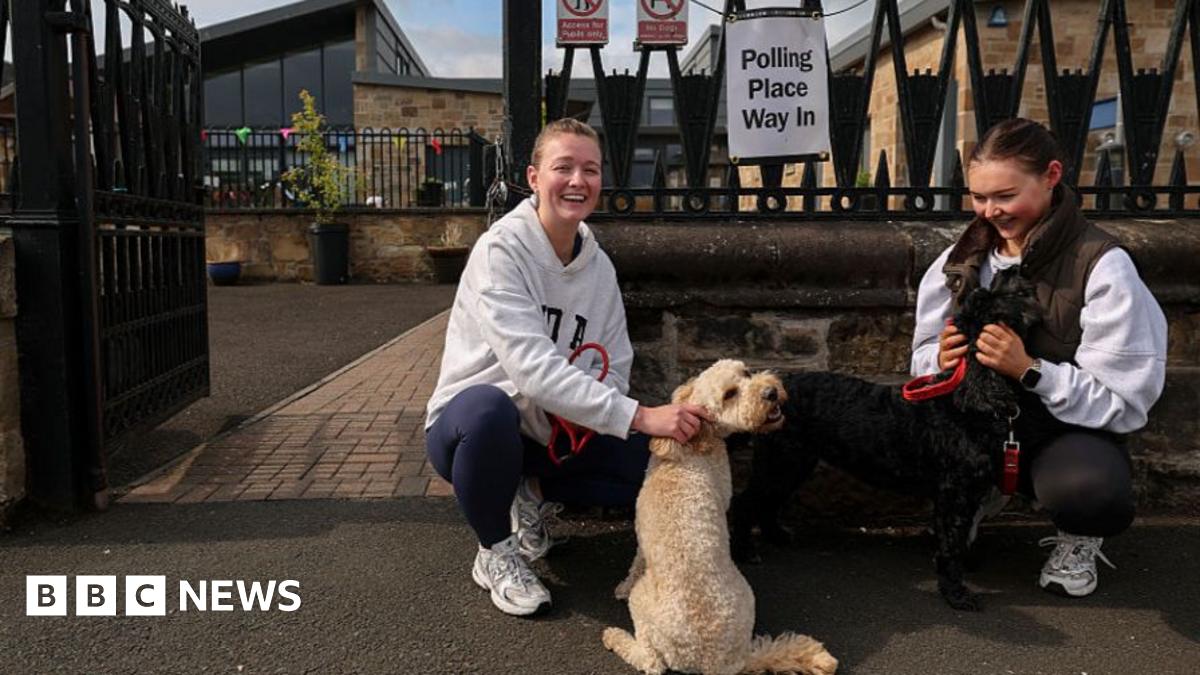
Voting age to be lowered to 16 by next general election
Other planned changes include expanding voter ID to include bank cards and moving to automatic registration.
BBC News
46 points · by johneth · 1y ago · 158 comments
It feels like we don’t have a functioning democracy in the U.K., and that gets in the way of pretty much everything else.
As long as Reform UK splits the Tory vote FPTP will continue to be in Labour's interests.
In fact, at the moment moving away from FPTP would mostly benefit Reform UK and the Lib Dems, possibly the Tories, too as this point.
Vs. - in the last U.K. election, which party was the most vocal about that first-past-the-post system needing replacement? What % of the votes were cast for them?
~One thing to bear in mind is that FPTP limits the influence of “extreme” parties on elections (see UKIP’s vote share in 2015), but at the expense of requiring more mainstream parties to pander to those voters to avoid splitting the vote share. Jury is still out I think on what’s “best” here and probably depends on what “best” means to the person forming an opinion.~
Edit: turns out the above is at best contested, at worst disproven.
The weird thing is how many different election systems are in use in the UK depending on what the politics of each devolved assembly is "supposed to be".
Although just from browsing the UKs AV proposal it does look like it'd be similar to IRV which has some wild results in certain tight races. Although I personally think that is fine; a little randomness is good for the system.
If that is the nature of the atmosphere then I doubt many important people are going to put their head above the parapet and call for reforms in the direction of adults getting better political expression. The power holders don't think that is favourable to them.
https://www.gov.uk/government/news/legal-age-of-marriage-in-...
"You can have a bisexual orgy on your 16th birthday where someone gets pregnant in celebration of their first time voting, but under no circumstances is the woman allowed to be married until the kid is 15 months old, at which point she can marry another woman. Photographs of the event will, in many jurisdictions, be treated as a criminal offence even though the act itself isn't and those same photos would be fine at 18, which is also now the age when they are no longer subject to a mandatory choice between ongoing education or an apprenticeship."
Also, TIL that the UK was going to get compulsory part-time education from 14 to 18 back in 1918, but spending cuts happened: https://en.wikipedia.org/wiki/Education_Act_1918
https://jobs.army.mod.uk/regular-army/entry-options/soldier/
So you're allowed to vote, but you don't need to pay your taxes. You're still considered a child regarding justice law, but considered adult regarding voting?
So basically you're not allowed to camp somewhere without the consent of your parents but you're "suddenly old enough" to judge about some laws?
I think the consensus is missing if voting is permitted by 16, but everything else stays the same.
So how far down in age would you go and why would you stop at that age?
I'd also argue that there should be no lower age limit for voting for people with taxable income. No taxation without representation.
I don't think children should have a say in the matter, they lack the critical thinking skills that adults do, which is why we limit their freedoms.
Granted, most adults also lack deep critical thinking skills but they have more capable brains than children.
Further, children are easier to manipulate than adults, which is very dangerous when it comes to something as critical as voting.
I don't think we're being ambitious enough here. I should be able to vote while drink-driving.
What's absurd is allowing a minor to vote.
I think this also makes sense, I know when I was younger I was extremely frustrated to see adults making really bad decisions for my country that will have a much longer impact on my life than it will on theirs.
I think a minimum age makes sense, I don't think someone in elementary has any point in voting since most likely they would just do what their parents told them. But by 16 you are generally making your own decisions, your figuring out your adult plans, and not following everything your parents say.
What all these "well adults are dumb too!" arguments ignore is that, those adults were even dumber when they were 2 (or 5, compared to the original voting age of 21) years younger.
At least when you are forced to be in school you are in an environment to likely absorb... something. We regularly kept up with current events in school.
I know many adults that have basically zero idea what is going on in the world.
Also I should note that I did not claim anything about intelligence, but just an awareness of what is going on and the impact of it.
I would possibly even argue that a 16 year old being in school likely has a fresher recollection of history than many adults. I mean how many adults remember all of the math they learned compared to 16 year olds.
First off, the UK has one of the most generous tax free allowances in the world, you don’t pay tax on anything under £12,570. Most 16 year olds working part time or on low wages aren’t paying any tax at all, so the whole “no taxation without representation” thing doesn’t really apply here.
And let’s be honest, most 16 year olds aren’t working anyway. They’re still in school or college, not out earning or dealing with adult responsibilities.
Some people say teens are too immature to vote. Personally, I think it’s more about naivety. At 16, you’re still figuring out who you are, let alone understanding politics or economics. If someone like KSI ran for office, half of them would probably vote him in as Chancellor just for the memes.
You learn a lot of tough lessons on the way to adulthood. At 16, you’ve got zero life experience, no bills, no mortgage, no kids, and probably no full time job. So when it comes to voting, they’re more likely to be swayed by TikTok trends or what their mates think, rather than actual policies or ideology.
And let’s be real, Labour knows this. Just look at the voting intention by age
https://www.statista.com/statistics/1379439/uk-election-poll...
However it will back fire because many that age will split the vote to Greens, Lib Dems and maybe even Corbynites.
Next question that courts might ask in cases are, if a 16 year old criminal gets away with more as they are counted as a juvenile, but is considered old enough to choose the lawmakers, does the same adult laws now apply to them? If they are not perceived as mature enough to be considered as an adult criminal, then why is it different for voting?
It doesn't matter who we vote for, as long as we vote? What a bad joke. By this theory, all foreign interference, propaganda, education, control of the news, etc.. are completely irrelevant, nothing we should be concerned about at all. Just vote and it'll be fine!
More that voting egotistically (in contrast to trying to predict what is best for society as a whole) is sufficient to create the incentives that benefit the many, as long as the number of voters makes up a high enough share of the population.
(For the record: Devil's advocate take. I think this whole idea of voting in proportion to your monetary value is ridiculous.)
In a very important sense, 16 year old has a much bigger stake in the future of their country than a 70 year old.
Not quite, because that would grant power and influence to the rich that is already quite heavy on account of their wealth and ability to employ constituents. Qualifying voting power by way of being an active payer is, however, absolutely sensible.
>A 16 year old has a much bigger stake in the future of their country than a 70 year old.
They also have nothing to lose. With the least invested in a system's continuation, history is rich with young teenage raiders, conquerors, mutineers, revolutionaries, and rioters. They are the primary demographic with the lowest stake, and have the least concern for any Chesterton's fences. They are also the poorest equipped to make decisions concerning material resources, since utopian idealism is common at that age. They haven't yet suffered or built much at all, and it's easy for them to dismiss the sheer volume of accumulated knowledge, material, and labor that sustains civilization.
Those paying the most already are more invested in the outcomes of the country, do you mean their vote should count for more or less based on how much they pay in taxes?
Youth and parents get an extra vote on school stuff. Those whose education or career are related to a field get an extra vote. In some cases, you may hold 5x the voting power of someone who is removed and unfamiliar with a topic.
No idea if anything like that has been explored.
Allowing people to have more or less say based on stake would lead to a spiral. Those in charge take care of the people they care about, those people would continue to elect the same politicians, and everyone else would be left aside while power (and stake) consolidates.
Children voting will ruin the grift.
Also I was more politically aware at 16 than most adult I know now.
This being the first thing I found says the closest age bracket 18-34 turnout was 53.6%
https://upload.wikimedia.org/wikipedia/commons/d/d6/UK_Popul...
16-17 for each gender looks to be a little under 400K for each
So (4)(400,000)(0.536) = 857,600
So thousands.
Either way it's not like they're all going to vote one way and it's not like they can seize the government with their own special interest party that only caters to 16-17 year old even if they all managed to vote one way. So really as far as results it will mostly be a wash, but has the benefit of potentially creating some more engaged and politically active citizens which is a win for democracy.
> However, Conservative shadow minister Paul Holmes said the government's position was "hopelessly confused".
> "Why does this government think a 16-year-old can vote but not be allowed to buy a lottery ticket, an alcoholic drink, marry, or go to war, or even stand in the elections they're voting in?" he asked in the Commons.
That, and finishing reform of the lords. And separating the English parliament from a federal parliament over the separate nations in the federation.
I really doubt this proposal would ever actually be implemented, but still it is an interesting idea to ponder-in the abstract it seems fairer than a semi-arbitrary cutoff based on chronological age
Of course, I totally see how it might lead to unintentional indirect discrimination (“disparate impact”)-but there is a difference between that, and what was essentially direct discrimination covered with a thin veneer of “plausible deniability”.
[1] They are actually private and selective.
Better idea should just be that you should be a taxpayer to vote. No tax = no vote. Why should people who aren't contributing decide how to spend the money of those contributing?
A 16 year old who works has a bigger stake than a 21 year old jobless bum stuck in their parents home smoking weed and playing vidya games.
It could be an NGO obeying the people, not govenment.
Probably true. But IMO it's a good thing regardless. The impact of this is fundamentally pro-democracy above anything else.
Honestly I'm surprised this hasn't happened already, given how they "have no voice"..
"It doesn’t matter how smart teens are or how well they scored on the SAT or ACT. Good judgment isn’t something they can excel in, at least not yet."
"The rational part of a teen’s brain isn’t fully developed and won’t be until age 25 or so."
"In fact, recent research has found that adult and teen brains work differently. Adults think with the prefrontal cortex, the brain’s rational part. This is the part of the brain that responds to situations with good judgment and an awareness of long-term consequences. Teens process information with the amygdala. This is the emotional part."
https://www.stanfordchildrens.org/en/topic/default?id=unders...
I think there is a good argument to be made that young people are the biggest stakeholders in our future, and should have a say.
I really hate when these ideas come of that effectively boil down to creating some kind of litmus test for who can be "trusted" to vote. We have an age limit, maybe the UK wants a lower limit, but at least that's a pretty simple and clear line to be drawn.
This is a ridiculous claim. If you believe children think at all, they do it with the prefrontal cortex, just like every other mammal.
> A growing body of research strongly suggests that brain development continues well into people’s 20s and beyond. ... There is strong scientific consensus that people’s decision-making abilities can evolve between their early and late 20s
https://slate.com/technology/2022/12/teen-brains-neuroscienc...
Some things that are better supported by multiple lines of scientific research, to quote two consecutive bits from the second article: "young people’s general cognitive skills, including their ability to reason, don’t change much after the age of 14 or so." "What does change with age is the ability to reason while distracted; emotions and peer pressure are more likely to hamper decision making in teens and early twentysomethings." These things are really outside of the pop idea of "your brain isn't fully developed until 25".
Or accept that growing up is part of life, and that there are short term consequences of political choice too that groups of people are currently denied?
Liz Truss was only PM for 49 days. How much impact on the economy did she have?
https://fortune.com/europe/2022/09/27/uk-stock-bond-markets-...
The article was published 22 days into her tenue.
Or even if they did, the amount of effort they'd put in researching, considering and modelling the potential outcomes would would be commensurate to the impact they would expect their vote to have. I suspect for a good chunk of adult voters, this is in fact the case.
So it's not obvious to me that including more voters whose decision-making is more emotional will necessarily produce worse outcomes. It's conceivable it'll produce better outcomes.
Edit: I'm being downvoted. To be clear, I'm an ardent democrat, but the idea that people vote analytically and rationally doesn't make sense for the above reason. The most informed voters are, in my experience, often highly emotional.
> Or even if they did, the amount of effort they'd put in...
This is actually quite an interesting area if you look into the game theory of making choices in a group setting. Strong strategies typically often don't involve doing much research, but they are rather frustrating for the people who take an interest in politics. Real-world behaviours are arguably quite reasonable on this front too, although they are limited by the ability of the average person to reason their way through the policy suggestions being made by though leaders.
Although I do agree that more voters isn't better. There is a certain level of objective correctness in political decisions if we admit basic ideas like "policies should be tested to see whether they achieve the goals that they were intended to" as a measure of success and the point should be to design systems that optimise on it to some degree.
Yes. And in detail, with this model of a rational electorate, skilled influencers put the effort in to devise a policy platform and convince others that it is good for them. The majority pick a platform that they are convinced by.
It's worth it for the influencers, because they have an outsized impact. It's worth it for everyone else only if choosing a coalition is very low-effort. Or if they are entertained by the influencers.
Again, I'm an ardent democrat. I'm just pointing out the flaws in any argument that assumes rational voters are a good thing - because it's rational to not waste much time on voting. Instead, democracy works best when voters feel an arguably irrational sense of duty and civic pride.