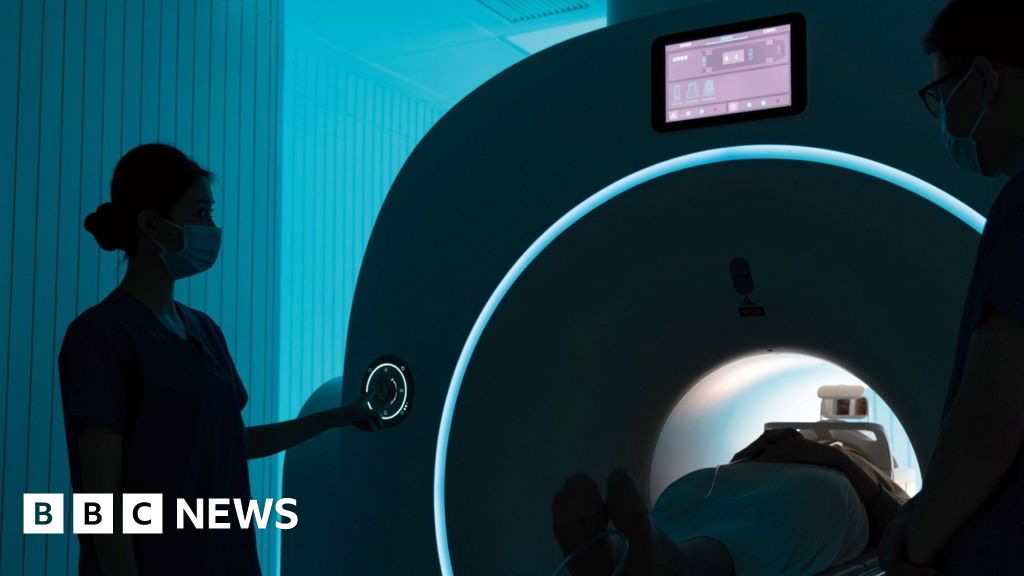
Man wearing heavy metallic necklace dies after being sucked into MRI machine
The man entered a room as his wife was having a scan on her knee, according to local media.
bbc.com
175 points · by brudgers · 1y ago · 542 comments
I never had anxiety in my daily practice in the OR but anesthesia in the MRI suite ALWAYS provoked anxiety because:
1. I had to anesthetize the patient in the sub-basement, two floors below the main OR — where there were always other anesthesiologists able to help in an emergency. In the MRI suite, no one could hear my silent screams if I got in trouble nor were there knowledgeable extra hands to, for example, squeeze the breathing bag if I needed to prepare for an emergency intubation.
2. Once the patient was anesthetized and the heavy door to the MRI machine room was closed and locked, I could only monitor my unconscious patient through a darkened heavy glass window. Sure, I had monitors for EKG and oxygen saturation outside the MRI room, near the control board where technicians operated the machine, but the automatic blood pressure cuff inflator dial on the anesthesia machine was inside the room and hard to see through the dark glass.
3. It was my good fortune to never have had an emergency in the MRI suite, but events such as that reported above in the OP happened from time to time in hospitals throughout the U.S. and were occasionally reported in the anesthesia literature with the expected cautionary advice. Many more events occurred than were reported.
You are allowed to put patients under general with no one else present? That doesn't seem like it should be possible
Every day in ORs around the world manuy thousands of anesthesiologists — and CRNAs where approved — put patients under general with no one else present. Are you proposing that two anesthesiologists be assigned per patient, like scheduled airlines?
Should piloting a plane solo be outlawed?
If, after three years of residency and roughly 1,500 cases done under supervision, many more done without supervision, a written examination, and an oral examination, you aren't qualified to administer a general anesthetic solo, then you have NO business giving general anesthesia no matter how many other qualified or unqualified others are present.
Pretty much every civil aviation authority in the world requires two pilots on commercial flights.
> In the MRI suite, no one could hear my silent screams if I got in trouble nor were there knowledgeable extra hands to, for example, squeeze the breathing bag if I needed to prepare for an emergency intubation.
Presumably the patient just dies in that scenario that you are supposedly qualified and prepared for?
I can certainly imagine there are many similar scenarios where it's just not possible for a patient to be completely still, or it's better for them to avoid excessive rescans.
I have a lot of sympathy. I'm pretty good in confined spaces usually, but even after multiple MRIs it's still a surprisingly stressful experience. The buildup and safety questions make the pre-experience worrying. The aperture is surprisingly small. Depending on the scan, part of you might be caged in place, and it's extremely noisy and you're aware of a lot of mass and power spinning very close to your face.
Also, some of the radiologists don't help. It's not deliberate, but they're entirely desensitised to the experience (and often haven't actually gone through it themselves; which again seems crazy considering the lack of radiation). My last scan was of my lower back, but they were already set up (from the previous scan) to feed me in head first rather than feet first. From their point of view it saves a bit of faffing with the software and moving the pillow to the other end. From a patients point of view it makes all the difference in the world; it's a very different psychological experience having your legs inside with your head free, vs being stuck head first in something and having it whizz past next to your head.
I've had a goodly (read unhealthy) number of CT and MRI scans and I'm bright enough to understand which one is significantly more detrimental to my long term health. I'm also aware that on a subconscious almost cellular level, it's the benign one that absolutely terrifies me every time...
I understand it is caused the 'donut of death' for that reason.
Why was the door locked?
The doors can also lock (I'm pretty sure they are required to be locked when qualified personnel are not present) but usually they are not locked when the scanner is staffed and in use.
I do wonder if someone being in the room is enough to distort a scan? As there's no ionising radiation danger, it always seemed odd that you were left alone in there.
It should be lockable when no staff are present and no one is in there.
It just needs to close when in use.
It certainly shouldn’t with people inside.
I work in MRI.
Fatal mistakes usually stay within hospital departments and are discussed at length in regular confidential Morbidity and Mortality conferences.
Last time I had a major surgery the anesthesiologist at Stanford was also simultaneously a full time employee of Apple. (At the time we were competitors; we figured out during surgical prep that we had friends/colleagues in common.)
Similarly, while working at another FAANG company, one of my colleagues was simultaneously a practicing MD (PCP) at Stanford. He later left both jobs, to start own biz.
At one point he referred me to another Stanford doc who was simultaneously the founder of a diagnostic-tech startup, which sadly has since fizzled.
Lastly, I know a practicing anesthesiologist married to a serial entrepreneur who's built and sold stuff you've heard of. They or some of their hundreds of employees may be here, dunno. Won't out them.
I work as a programmer, but it was and still is my hobby. And I could have ended up in a different line of work. In which case I'd most likely still be here but with a different day job experience.
The superconducting magnet in an MRI scanner is always on even when not performing a scan.
This was pure and simple negligence by the MRI operators. Access control is the most basic part of MRI safety!
Even if he was not wearing this “chain”, he never should have been allowed to enter the room. He could’ve been wearing a steel wristwatch, had a keyring in his pocket, etc.
The journalist missed a golden opportunity for education here: most MRI scanner magnets cannot be turned off like that. For the few that can, it's going to cost >$50,000 just to refill the liquid helium, not to mention the real and opportunity costs associated with rendering the machine offline for days or weeks.
If people don't know about the magnet, or don't know that it can't be turned off (or perhaps assume it's "off" because the scan was over, as I would guess happened here), accidents happen.
https://www.youtube.com/watch?v=9SOUJP5dFEg
You push the button, then 15 seconds later the liquid helium is vented through a pipe on the roof of the hospital (it's quite a spectacular display), and then the superconductor starts to heat up and no longer be a superconductor so the current that's been flowing through the coils (they are energized once, when the machine is first installed, and then continue flowing forever so long as the superconductor is superconducting since there's no resistance) and the magnetic field decays to nothing.
It's not an instantaneous process.
Quenching the magnet takes up to several minutes. There are also alarms to warn people to get away because the rapidly expanding helium could displace oxygen in the room.
It’s not about the cost. If there’s an emergency that necessitates pressing the button they’ll be pressing it as soon as someone can reach it. It still takes time for the magnetic field to dissipate.
I thought these days, most MRIs did have an emergency quench button.
So the emergency quench is less useful than it sounds in these situations... it's very likely if an MRI is going to kill you it's going to do it fast enough for it not to be relevant.
Thanks for that - and it reminded me of the sad state media is today. I read the same story in about 4 papers and nowhere was written _why_ they couldn't turn off the machine.
Miss the days where journalists actually read what they have written.
In this case, they were going to have to do that anyway. Might as well shut it down right away.
There isn’t a way to instantly turn it off.
Surprise! It turns out there is a reason it should be connected.
https://www.diagnosticimaging.com/view/everything-you-need-k...
I think the big question here is why they didn’t..
I now nothing about MDI so please tell me: why does it need to refuel the helium? Aren't the magnets “just” superconductive electromagnets? Why can't the current powering the magnet be stopped?
Edit: thanks everyone for your explanations, I appreciate it.
And with superconductivity, by definition, current flows without resistance; it continues even without energy, so turning off the power won't stop it. Nor will it heat up and decay from resistance. Modern MRIs are well-insulated enough to maintain their field without power from days to weeks.
The only thing that collapses the field is to warm it up to where superconductivity stops, which can be done slow and expensively, or in an emergency, fast and even more expensively.
By venting the supercooled gases in what's called a quench, you can turn it off faster, but the time it needs can depend on the model. It could be 20 seconds, or it could be 2 minutes, which, depending on the emergency, may be insufficient.
A quench itself can be dangerous, though usually less so than a patient pinned to the magnet. There's a chance that poor ventilation can flood the room with helium, causing loss of consciousness in seconds. The increase in pressure can also make it impossible to escape if the door's not built for that. You'd have to break a window. On top of which, it's dangerously cold, and the explosive bang can rupture your eardrums.
You also can't open a switch to stop the current because it's basically a giant inductor, it really wants to keep the magnetic field (and current) constant. Meaning if you suddenly disconnected the winding, it would arc across the gap (continuously, for quite a while until the stored energy was spent).
So what they do is vent/boil off the liquid helium which is keeping the magnet cold, such that it's no longer superconducting and the current will die off. You can't reclaim the helium, hence you need a fresh refill to chill down the magnet again.
"Any change to the current through the magnet must be done very slowly, first because electrically the magnet is a large inductor and an abrupt current change will result in a large voltage spike across the windings, and more importantly because fast changes in current can cause eddy currents and mechanical stresses in the windings that can precipitate a quench [...]. So the power supply is usually microprocessor-controlled, programmed to accomplish current changes gradually, in gentle ramps. It usually takes several minutes to energize or de-energize a laboratory-sized magnet."
So there is no current to turn off. The current in the magnet is running on its own from when it was first supplied. The only way to stop it is to heat up the superconductor.
I thought maybe you could draw it off and use it up somewhere else, but then if I’m remembering right electricity will always take the last of least resistance, so none of it would leave a superconductor. Right?
It also makes me wonder, if someone is ever able to build a warm superconductor, how would we ever stop electricity we’ve put into a system like that?
So at least in some places, this is the SOP.
I’m not sure what kind of emergency would warrant allowing metal to pass through when metal is detected, if there is a risk of death for using it.
The risk would be in the false positive during an emergency situation.
Wide: "honey can you come in here and help me since I don't have my walker"
<dude walks right in and gets dead>
Not hard to imagine something like that happening too fast to be stopped, especially if staff is distracted by the transition from running an MRI to getting the patient in/out.
https://www.reddit.com/r/explainlikeimfive/comments/m9algh/e...
According to the above post, it's a venting of the liquid helium, which requires ~$25,000 to replace).
This should be placed on the entrance with big bold letters, I think that a lot of accidents could be avoided by simply providing "WHY" information. I had MRI scan and I wasn't aware that machine was active even when not performing scan and now after knowing that I think that personnel there was very lax with allowing me to enter the room after instructing me to put metal objects away AND without enough emphasis how dangerous it could be if I forgot to do so.
0 - https://www.zzmedical.com/exclusives/mri-warning-wall-sign-m...
They'll try to talk sense into you, but they're not security guards nor trained in close combat.
Nor are the doors locked or secured, they kinda assume that people don't just rush in and do as they're told.
He is able to talk, you can make out his words, but he is clearly choking or being strangled. He was fully sucked into the machine. There was a very strong guy trying with everything to pull him out. He made some pretty sad and harrowing words when he realized he wasn't going to make it. Again, the video is out there if you really want to see it. I do NOT recommend it though.
I believe many articles are leaving these parts unsaid due to sensational assumptions they benefit from in virality.
EDIT: source https://healthimaging.com/topics/medical-imaging/magnetic-re...
Which makes sense since it's about the same timeline of death and outcome you'd expect from an industrial accident involving big industrial chain at a hundred pounds per link or whatever.
Turns out, it's pretty relevant to the situation - especially how the unauthorized access was possible.
This wasn't your typical hospital MRI. This is basically your local tanning salon that somehow acquired an MRI machine.
I don't understand how such a dangerous machine can end up in a place that looks like that.
Once, I heard a story where some company was trying to get MRI test participants, and if you agreed they offered to print your brain for you as one of the perks.
Turns out, they gave everyone the same brain, like they would just always use the same file when 3D printing it. Probably had a box of pre-printed ones in the back. Dishonest, but I guess how would you ever find out?
I can tell you that I don't trust you as a doctor unless you are physically located in a hospital, preferably the larger the better.
If I have an appendicitis on the way to my normal procedure, I want to be within less than 100M of an emergency room already.
Small scale/small time medical offices were a mistake and I'll never change my mind.
Tell a person there's a tarantula or a cobra in the next room and not a second will go by without them being deeply aware of this information.
Tell them it's a 3 tesla magnetic field and they'll run in carrying a piece of sheet metal and a pocket full of ball bearings.
Entering the MRI room myself I was very familiar with the dangers of bringing metal inside, to the point where I would second guess myself and my own body. "What if my leg bone actually has metal in it for some reason?!"
I know people who if you tried to explain an MRI to them, would become visibly uncomfortable and search for any way to change the topic.
Expected behavior. Explanations of complex topics are to be rejected if explainer does not have sufficient authority to make behaver hold-still-and-listen.
I know such folk, too, and this is among the thing about people which annoys me to no end. If a MRI tech tried to explain the shit to one such acquaintance, they would try to change the subject like you say. OTOH, if the doctor in charge tries the same, the listener will instead have to zone out. But zoning out is a more expensive operation, as any zooner knows. (Which is why they hold doctors, lawyers, and other semi-priests in high reverence, up to pushing kids to take up these rather joyless professions to the exclusion of all sense.)
Peeps here equally well-behaved other way round tho. C-f "mal" = 0. Geez I really needed to witness the absolute by-the-book Freudian slip that can be found at 1:55 of one of the probably infinite interview cuts, then have MRI safety explained to me by hacker noosers on their Monday morning.
I have a titanium plate in my head, so it's not magnetic.
When the MRI tech asked if I had any metal in me, I said I had titanium on my skull.
She asked if I was sure it was titanium.
I knew it was, but I was nervous, so I said, "I think so."
She half-joked, "Well, if it's not, we'll find out real quick."
It was titanium.
But they never really double-checked or anything.
Part of me thinks that because of my age, she could tell it wasn't iron or anything dangerous.
But another part of me feels like she honestly didn't care that much and meant it when she said we'd find out fast.
Consider the “Things I Won’t Work With” column. There is a healthy degree of respect for various compounds that’s learned with experience. This is similar to the way that (properly trained) electricians work with electricity, and nuclear plant techs work around radioactive material.
I had that constant thought for the 15 minutes of my knee MRI (except s/leg bone/body/). Most discombobulating.
If MRI scanners are this deadly, everybody should be really thoroughly screened and scanned to be allowed into the room. And even into the room next to it. How can the door of that room open while the machine is still turned on? (Edit: apparently the magnets in these machines usually can't be turned off, which changes the question to: how was he allowed to enter the room at all?)
But wearing such a heavy chain while accompanying your spouse to an MRI scan, is also not the best move.
https://www.robarts.ca/scholl_group/research/peripheral_nerv...
Apparently it's not an issue, even if you do have them.
But you need to seriously piss off the tarantula for it to engage in a fight with an opponent our size. Most of them are sweet and just want to get on with their tiny lives. They are well aware we are not food. Poisonous snakes, on the other hand, tend to be much less chill. Much like wasps, they seem to enjoy causing pain and suffering.
> Poisonous snakes, on the other hand, tend to be much less chill. Much like wasps, they seem to enjoy causing pain and suffering.
Eh, I don't know about that. For example, sea snakes, despite being incredibly venomous, are actually pretty timid creatures.
Also:
https://www.britannica.com/story/whats-the-difference-betwee...
Oh, wait, you still want them willing to go near the machine? That complicates things a bit ;)
How difficult would it be to install metal detectors to give an alarm to people who enter. I have had a few MRIs and they did seem too trusting that I properly remembered to remove anything magnetic.
I'm going by; https://www.youtube.com/watch?v=3L4lxusff1c "The Surprising Reason Babies Are NOT Afraid of Snakes | Secret Science"
Intellectually, you can think that "If a jet can move a plane, it can move me through space", but you never experience a fan even close to that in real life.
30,000 gauss sounds a lot scarier.
A little rare earth magnet can easily have a 1T field at its surface, but some inches away the field is negligible.
Sounds like Darwin Awards material
sounds like people wear them all day, so it would more be a case of "why would i take this off?"
I would have thought the dozens of huge warning signs around the MRI room would have tipped him off but i guess warning fatigue is a thing
Also, the person wearing the 20lb chain was not the patient. There was an access control failure (someone peeking their head into the room?) combined with the extraordinary amount of metal resulting in a lot of pull.
>he was wearing a 20lb (9kg) chain with a lock that he used for weight training.
That is not what any reasonable person would call a "necklace." Yes, metal and MRIs don't mix well, but normal jewellery won't be able to generate enough force to kill you. It might actually be more dangerous due to inducted currents heating the thing up and giving you burns.
This is international news, which means that this kind of event is extremely rare. People are often pretty dumb, and magnetic metal is common, so that means that the existing precautions are very effective. There's probably room for improvement, but there isn't some blisteringly obvious thing that's been overlooked that would save many lives.
Even after adding MRI levels of force a 1oz pen is still gonna be something that you can pick up.
For quoting the article : « According to the US Food and Drug Administration, MRI machines have magnetic fields that will attract magnetic objects of all sizes - keys, mobile phones and even oxygen tanks - which "may cause damage to the scanner or injury to the patient or medical professionals if those objects become projectiles". » the choice of words from both the bbc and the FDA don't really convey the risks.
Anyway there are very surprising issues in what is described : why did the wife needed her husband's help to get help although it is the role of the technicians ? Why was the husband in a place where he was able to hear his wife and not being prepped for MRI ? Why was it possible for him to enter ? And why wasn't the technician able to stop him entering ?
They replaced the lens with a very long throw one so the projector could be located far away and bolted to the wall. It still had some steel components inside, but the manual made it very clear you were not supposed to open the case while in the same room with the magnet. No other manual I've read has warnings that trying to change a light bulb could kill you.
¹it was designed to be used within the same room as the MRI, but not to go into the magnet bore itself. You were supposed to securely mount it at a distance where the field strength was less than 100 gauss. Since it still contained steel, there were still warnings all over that "this device may become a projectile" if you got too close to the magnet. Installation must have been a bit nerve wracking!
They almost certainly just selected a drywall anchor based on the rating advertised on the package and sent it without any more thought, their ass was covered.
Big picture people who take a step back think about what they're doing don't tend to find themselves installing projectors in hospitals, or if they do they aren't there very long.
They're installed for fMRI research, to show stimuli to study participants.
I love this old GE training video around the time of MRI's introduction to the medical market. Even the oldest machines could show some significant power back then.
Watching the scale attached to a pipe wrench pulling some significant weight on a wrench will help show the forces that a 20 pound chain would have made...
(Oh, and stay for the 'old custodian' tale in the intro of this one...)
This is probably the main one. I could completely understand wanting the assistance of a loved one for mundane things like standing up.
Although to your “not prepped for MRI” point, it is kind of wild that someone with a 20 lbs chain around their neck would be allowed even on the same floor as a MRI machine. Although last time I saw one in person, the door to the room did have some pretty blunt warning text in large print.
A lot of fatal accidents are like that - a series of small mistakes nobody notices, each individually harmless, followed by THAT ONE BIG MISTAKE that ends up killing someone (or a lot of people).
"nah man, gotta hit my 5k steps wearing 20lb for my fitness goal"
"ok, well just don't go in the room"
"sure"
The kind of interaction that many people will pretty much forget having within the hour.
I guess maybe the MRI machine might interfere with metal detecting?
A fist-sized powerful magnet that's next to impossible to straight-up pull out of ANYTHING. You need to slide it carefully and NOT let your fingers get in between it and anything else.
Now imagine a magnet that's infinitely more powerful than that.
The difference is the size. Even a large magnet only hits that 20g force over an inch or two. An MRI pulls at that force over a full foot or more; equivalent to dropping the object from 20'+. Worse, the MRI starts pulling at 5 or 10 feet away. Objects can experience a tremendous amount of uncontrolled acceleration in fractions of a second.
It's not like a black hole- unless you are trapped under something very large, the crushing force is substantial but not incredible. In fact inside the tube the gradient is actually smaller than the entrance of the tube- you are pulled in strongly, but once inside the tube you are pressed against the wall somewhat less forcefully. Instead it's like an invisible waterfall, and any metal will be swept away in it, fast enough to put holes in you.
Also, twenty pound necklace?
"She said he was wearing a 20lb (9kg) chain with a lock that he used for weight training."
> She said she had called him into the room after she had a scan on Wednesday.
Part of me wonders why the wife felt empowered to invite her husband, who she knew was wearing a giant metal necklace, into the MRI room after her scan. The hospital would have been very clear with her about the dangers of wearing any metal in the room even when the scanner was not running especially because it's common for women to wear jewelry containing various metals and alloys.
Presumably, the husband would have been part of those conversations as well, and thus, should have refrained from joining her in the room anyway, so he isn't completely absolved of responsibility.
It seems there's plenty of blame to go around.
I once bought a can of coke and put it in my backpack, then I forgot about it. At the airport a few hours later I went through security and didn't think about it at all. No idea why my bag was selected for a manual check. Until he pulled out the soda can. Big (but harmless) do'h moment. People's brains and memories are just wonky like that sometimes; most people have a few "I'm an idiot" anecdotes like that. Even with training by the way: which is why checklists exists for safety critical stuff. "They have been warned about MRI dangers" is pretty meaningless.
The failure is 100% on the facility for not properly controlling access to the MRI room, and people can just walk in apparently(?) And no, a sign or some briefing doesn't cut it.
This is also a risk for absent-minded staff by the way: I don't think I'm the only person who has walked in the wrong room by accident. Or just a small confusion about whether the MRI is operational. Things like that.
It was not in a hospital: https://news.ycombinator.com/item?id=44630969
Per the article, the chain was stupid heavy because it was gym/weight training stuff, he was tossed and pinned to the machine where he suffocated, he died at the hospital.
> In 2001, a six-year-old boy died of a fractured skull at a New York City medical centre while undergoing an MRI exam after its powerful magnetic force propelled an oxygen tank across the room.
There shouldn't exist any metals in the room (that are not the machine itself), period. The smallest metallic object can fly off like a bullet. Everything and everyone that enters the room should be required to be scanned with a handheld metal detector.
People think they can do anything they want nowadays.
The same questions are being asked: how come anyone can enter a NICU? How could the parents let an unsupervised child roam the hospital? How come no one intervened? The worst part is that other parents had complained about the unsupervised child the day before.
Failures all along... that's often how accidents happen.
Freak accidents will always happen, and if mitigation is simple and cheap, we should do it. But as soon as we get into the territory of "NICU doors need to be locked with keycard access" (causing every doctor and nurse to do a badge scan 40-50 times a day) then I think it's ok to have 1 infant death every 50 years globally because of it.
Yeah, sometimes enough fractional close calls add up (usually to a big lawsuit) and policy changes without and death, but don't bet on it.
But, on the other end of the spectrum, having all sorts of absurd policy and procedure because someone might die so incredibly rarely we can't quantify it is terrible too.
The magnet is always on. His wife was in the room. Unless you're previously aware of the dangers of an MRI machine it looks like any other exam room with some equipment in it. It's up to the staff to inform and keep people out and enforce that. IMHO he should not have even been in the outer room wearing a chain like that.
> Melonie Longacre, VP of Operations at Northwell Health, explained MRI safety protocols, emphasizing the importance of multizone procedures to ensure safety around the powerful magnet.
> "Zone I is just for awareness that there’s an MRI in the vicinity, Zone II is the patient screening zone where they get screened. Zone III is the post-screening zone, and Zone IV is the actual magnet room," she said. "It’s important to be educated and safe."
It's unclear if Nassau Open MRI (where this incident took place) had similar safety protocols. I'm guessing not.
[1]: https://www.fox5ny.com/news/long-island-mri-freak-accident
big fat metal chain + big fat powerful magnet = disaster.
In fact, whenever I hear MRI I instantly think dental fillings. You’d think the patients and their handlers would instinctively think about all the metal they carry. How could big fat metal chain on neck not come to mind?
Step 2: Lock metallic decapitation device in place.
By the way, a much larger responsibility for CT/MRI centers remains a patient's allergic reaction to the contrast medium infused intravenously.
I guess cubic growth (?) changes from mild to dangerous so quickly when walking towards a MRI machine that once you realize what happening it's already too late.
There isn't a gradual increase in pull when magnets are involved. My wife used to work for a company whose product involved powerful magnets. For a while they produced a demo kit in which a magnet would hold a large ball-bearing levitated against gravity. That thing was lethal. If the ball-bearing approached the magnet too closely it instantly became a dangerously fast finger-crushing hammer.
No, for "a magnet" it's an inverse cube law. I've often wondered if the force holding a nucleus together is really magnetism. No, physicists you don't need to correct me, I know how off the wall that sounds ;-)
Good thing they sourced that fact, I never would have guessed.
* https://fox5ny.com/news/long-island-mri-freak-accident
(Many U.S.A. news services do a better job than BBC News does on U.S.A. stories. But this is the BBC being beaten by Fox, specificially.)
Many of the Fox Affiliates are still best-in-class local news. (Though it varies from city to city.) The Fox News cable channel lowered the bar on what Americans think news is supposed to be to historic low levels.
But the level of Foxness that I was alluding to was not that of GB News, but rather more that of Reach PLC; which isn't Murdoch-owned, but which runs a whole network of purportedly regional news outlets which turn out to be just localized skins applied to a big syndicated empire, and which BBC News often does better than locally.
One other notorious example is Sinclair Broadcasting [1]. Sinclair-owned stations include all of the major Affiliate Networks in the US and some of the minor ones, but are known for how much they farm politically-biased news content across their platforms, including trying to pass off editorial content as news content.
(ETA: Which is to say that yeah a FOX affiliate gets entertainment programming from what is left of Rupert Murdoch's empire, but could be getting news content from all sorts of places from home-grown proper local journalism to content farms from their real owners.)
[1] A humorous rant on it: https://www.youtube.com/watch?v=GvtNyOzGogc
https://en.wikipedia.org/wiki/WNYW#News_operation Fox 5 NY seems that it used to notably be a trailblazer
Is there information on why they didn’t quench?
They teach anyone operating MRI or even sitting by - in the first instruction lesson - that if life is at danger in relation to the magnet, you quench (=release the helium to stop the magnet).
Google AI said steel isn’t affected by magnetic fields and the effects of gravity would dominate.
Realistically, an 18 pound chain will be pulled towards such a magnetic field with a considerable force, topping off somewhere around a couple hundred pounds.
Door should only open if no metals detected.
Isn’t there something like an airport scanner before you get to an MRI. Is it thought that people just wouldn’t do this sort of thing?
How is that possible ? I would think at the very least the door would be locked.
From quick searches I believe it is a for profit company.
https://opennpi.com/provider/1851878409
Granted that probably does not matter, but to me, for profit generally means cut costs, even safety costs to maximize profits.
While the MRI angle makes it "newsworthy," there are many ways in which a chain might be caught and cause injury if it does not disconnect at a lower energy level than the minimum amount of injury the wearer is willing to accept.
"It was also not the first time that the employee had seen her husband's weight that he used for training, she said."
"She claimed an employee and her husband previously "had a conversation about it before: 'Oh that's a big chain'"."
"I'm saying, 'Could you turn off the machine?" she said. "Call 911. Do something. Turn this damn thing off!'"
This is really so sad, reminds me some facts about ancient Roman history and how everyone kept trying to sue somebody else for some easy money.
The "OFF" switch vents the coolant (helium) outside the hospital so the electromagnet stops superconducting and can turn off.
Outside the hospital it would look something like: https://www.youtube.com/shorts/krMbFT0Ums0
Tragedy all around. Feel bad for that lady.
Um, ok.
It's a slow process. There is an enormous amount of energy in that magnet which has to go somewhere.
Perhaps the companies that sell or install them need to start stating it will need double the amount of room:
The room where it is installed and a room where you pass through to get to it. The pass through room can check your magneticness before it unlocks the door.
There is always a solution.
The exact setup varies, but it's most often a metal detector you have to go through at the door with an alarm.
I expect this story to be promoted by people who benefit from sales of x-ray / CT machines though. MRIs and all of their promise for public health could continue to be set back.
That sounds like it a bit of an overstatement. 200 tonnes of 747 at 250kph is nearly 500 MJ. Even the biggest, baddest high-tesla MRIs are maybe 10MJ. Which is still a 67-tonne M1 Abrams at 40 mph, so it's not like it's an unimpressive amount of energy!
Sure, a tank can stop from 40mph in not much time due to a very big braking system (https://youtu.be/f5XUQ2beGfM?t=85), but also a tank at 40mph will utterly demolish an MRI suite, patient and all if it drives into it.
Anyway, I’m complaining as someone who personally has turned down recommended medical procedures after checking radiation cancer risk numbers and realizing the radiation risk was being downplayed. When I saw the numbers, to me the cancer risk wasn’t worth it, so I went without a solution to my health problem. Had an MRI been an option, I would have more likely said yes.
Take a look at the Google Street View link someone posted. It's pretty clear this facility -shouldn't- have been able to acquire an MRI machine in the first place.
It also elucidates how such an accident could happen, i.e they clearly don't have the trained staff and protocols necessary given the danger of an MRI machine. It's very likely the poor gentleman didn't understand the immense danger the machine poses.
They are expensive and rare for a reason IMO. Yes it would be great to have more of them but the best place for more of them is within proper hospitals and leveraging economies of scale to share technicians across a fleet of them in a well run facility.
They shouldn't have been, it's a major failure of access control.
Astonishing.
So once you divide by the "lying to people allegedly for their own good and trading away credibility in the process" factor what does that come out to? A semi truck at highway speeds? Those can stop in under 10sec.