If the world’s population lived like… — Per Square Mile
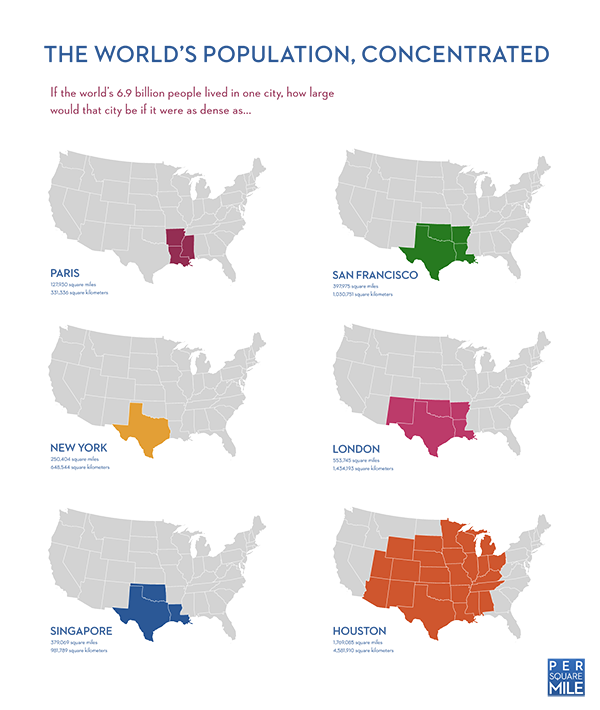
Shortly after I started Per Square Mile, I produced an infographic that showed how big a city would have to be to house the world’s 7 billion people.
Per Square Mile
129 points · by thibaut_barrere · 14y ago · 55 comments
I wish people could input their own cites and of course other type of dynamic data. e.g water consumption. I guess that kind of dynamic infographic is what Erick Schonfeld was talking about. [1]
[1] http://erickschonfeld.com/2012/06/28/infographics-broken/
I think it's reasonable to assume that we could, if we decided, be much better at using, reusing and conserving our resources. And if we did that, it would be possible for the rest of the world to bring their standard of living up to the US or better, and still not use multiples of the world's available resources.
If that's what we decided.
Worldwide, the best match would be Olt in Romania (http://goo.gl/maps/i8I02) which is precisely 5498km^2
For full-fledged countries, Brunei[1] at 5765km^2
[0] US map for scale: http://en.wikipedia.org/wiki/File:Delaware_in_United_States_...
Assuming of course, we don't end up going into space.
--MC Hawking.
Various cycles (CO2, nitrogen, water, soil) are also relatively finite. We've been perturbing several of these for quite some time, with ultimate effects we can't really know.
Not to mention any natural variability within the system.
It would be interesting to see this compared to how much of the world's resources we were using x years ago.
No one knows when Peak Oil will hit or how it will play out, and I'm concerned about it, but I think the long-term outcome is that (a) we'll be fine (although we may get hurt bad by it in the short-term) and (b) objections to nuclear power will vanish. In 50 years, we'll probably be using very cheap, environmentally safe nuclear power, and able to produce food in vertical greenhouses.
The world's population will likely peak around 9.5-10 billion and then begin declining because people are having fewer children.
So I don't think we're in danger of a Malthusian catastrophe, aside from the fact that the developing world is already in one. We're actually coming out of the Malthusian era. Malthus was wrong about the mathematics (economic growth is exponential; it was just so slow-- below 1%-- before the Industrial Revolution that it looked linear) but he was right about the population dynamics of pretty much every pre-industrial society.
> credible plant-based meats in 20 years
What is a plant-based meat? I don't know of any plants with muscles.
One of the biggest follies of the soy meat industry is trying to make their products healthy by default. Until they may a soy-based animal fat alternative, they don't have a fighting chance of competing. People who truly enjoy meat realize the importance of fatty tissue and how it contributes to flavor.
Go eat a slice of nicely prepared picanha, fat rind and all, and then show me a soy-based product that is even in the same ballpark.
I have chosen to avoid meat substitutes, but I am aware of Quorn. I just didn't read the OPs post like that.
What happened here is that one particular luxury (meat) was cherry-picked, out of ideology, and then coated in the veil of population growth and sustenance.
Thats distorting the point, because as the population continues to grow exponentially, any luxury will eventually subside. That can be a car, electricity, a toilet, more than a few square feet for yourself or your basic human rights.
http://www.thekitchn.com/twitter-co-founders-betting-big-on-...
Mince would be easy to make. A real cut of meat (like a rib-eye) would be much harder, but if it's $5/pound for mince "steaks" (patties) and $30/pound for real steaks (massive world-wide demand for tender cuts, but no demand for the tough bits which used to go in hamburgers) then ... well ... people will go for the mince.
And science will eventually give us 100% artificial steaks. Delicious, lab grown meat.
"A green salad," said Arthur emphatically.
"A green salad?" said the animal, rolling his eyes disapprovingly at Arthur.
"Are you going to tell me," said Arthur, "that I shouldn't have green salad?"
"Well," said the animal, "I know many vegetables that are very clear on that point. Which is why it was eventually decided to cut through the whole tangled problem and breed an animal that actually wanted to be eaten and was capable of saying so clearly and distinctly. And here I am."
I, for one, welcome our vat-grown replicator meat overlords.
Actually there are places where plants are worse. How do you grow cereals in hot or cold areas or in the mountains? You'll need irrigation for the hot one and harvesting is going to suck in the mountains. There's also the issue of deforestation. Instead it's better to raise animals like chicken, sheep or goats and let them feed with the grass that's available.
Regarding efficiency of plants I've heard that hemp (which is much better than soy) is easy to grow, but I'm not sure about this. Maybe someone else has more information about it.
Animals are incredibly effective in converting widely dispersed plant matter into something we can actually use for energy. Pigs are even probably the world's best recyclers, able to eat anything (garbage, but hopefully just organic left overs), which we can then benefit from indirectly (there is a good reason why many cultures don't eat pork though, its kind of gross when you think too much about it).
Anyway it is much likelier that we will have labgrown meat, although I guess you would prefer we all go with artificial meat (lab grown meat is real meat, just without the animal. Plant based substitutes are plants).
From what I've read, this isn't cut and dried, so citations would be helpful. Wikipedia links to some meta-study that concluded there was no affect. http://en.wikipedia.org/wiki/Soybean#Men
In any case, there are other plant-based proteins that are not based on soy.
Eliminating meat is a non-answer, but legally requiring the humane treatment of animals raised for slaughter is a platform that you wouldn't have any difficulty getting most Americans behind were it made a national issue.
The skeptic in me wonders if this is because what you think is humanely raised and slaughtered isn't, really, and plays the rules to earn the label and higher price while only marginally increasing costs.
Alternative terminology can also be used to make high-density confinement sound more palatable. For example: cage-free, free-running, free-roaming, naturally nested, etc. are used as an alternative to the technical term, high-density floor confinement.
Free-range chicken eggs... have no legal definition in the United States.
-- http://en.wikipedia.org/wiki/Free_range#Free_range_poultry