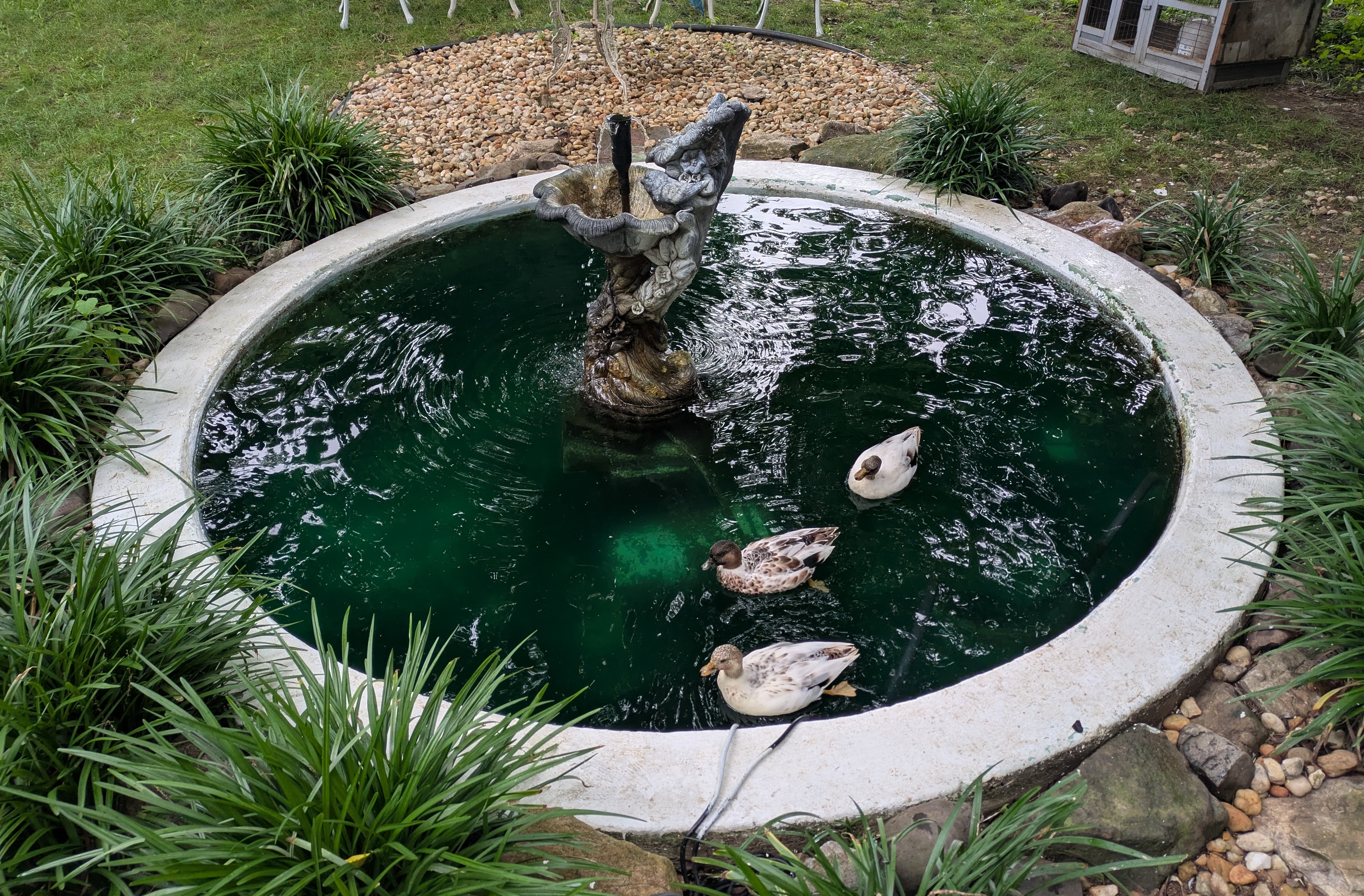
Shallow Water is Dangerous Too
Content warning: risk to children Julia and I know drowning is the biggest risk to US kids 1-4, and we try to take this seriously. But yesterday our 4yo came very close to drowning in a fountain. (She
jefftk.com
159 points · by surprisetalk · 1y ago · 162 comments
Cars, dogs, and water.
These are the big three common things that children interact with regularly that can, and will, cause irreparable harm or death with functionally no warning and virtually instantaneously. Kids also don't have the experience or the intuition to figure out if a situation is dangerous; cars move too fast, dogs are too hard to read, and water danger is hard to grasp even for adults (the number of people, including grown adults, I've seen panic and had to get pulled out after gleefully jumping into water where it turns out they can't reliably touch the bottom is fairly high).
The first two require some strictness (i.e. being very clear about rules like never going near a road without an adult, and never hitting a dog or pulling it's ears), but water basically requires regular swimming lessons from qualified instructors. It's something I wish happened earlier, and that more families had easy access to.
If you just float to open sea (typical tourist in a dingy or paddle board) you might need to get a "fun" helicopter ride from the friendly sea rescue services. Most people tend not to know that if the emergency is due to gross stupidity they will be billed afterwards (they are kind - so that is rare). Their rates are however significantly higher than regular tour operators.
So I do agree the lack of awareness is frustrating. If the locals stop swimming you should too.
But... Send me down under to Australia.and I would probably die in 5 minutes. Everything seems to be dangerous and/or poisonous there.
We are all to some degree "tourists" at some point in time with all that entails.
You may not fight it, you must use it and step out to the side.
4th according to that confusing chart (confusing because mosquitos are off to the side).
> Dogs seldom kill humans directly. Rather, they are primarily a vector that transmits rabies
I'm pretty sure the rural county in which I work hasn't seen rabies in a dog since like 1986.
I work in an emergency room (frequently caring for dog bites) in an area with numerous packs of strays. Dog rabies is always a concern, but I've never seen a confirmed case.
Just to go off of this, springs as well. Usually it's garage door springs or suspension of a car springs. People will DIY thinking it's a small thing but they can easily decapitate you. Some garage door springs have been known to level the families of entire neighborhoods or small townships. Garage door spring related deaths are far more common that you will ever know. Garage door springs also are known to be the main transmission vector for tetanus so if you survive the unspringing be advised there's a 90% chance it flung a deadly dose of tetatus and botulism (also grows on springs) into your every bodily orifice. You may think "well why is a kid fixing a car's suspension" but of course kids like poke around and explore because they're curious or they could be exploring your shop or your garage door mechanism.
Then it kinda devolved into nonsense and obviously fake info.
Was it meant to all be tongue in cheek? Sorry if it's a woosh moment.
From 1 to 10, falls are by the far the biggest risk.
If you live in the US, firearms trump all of the above, but only in the US.
A learned fear, like the rest. There's no innate fear of falling.
I got my kids into swimming lessons on their first spring (was advised to avoid it during the winter).
And it's part of primary education in my municipality, with the express purpose of reducing drownings: it's not sport, the curriculum is 100% geared towards familiarity and safety.
Everyone's holidays are at a beach, so water safety is a constant concern, and looking at Our World in Data, Portugal had far worse numbers for drownings than the US in the 80s, but are much better now.
A lot more rural people know how to swim because of all the natural bodies of water around, but our population overall has been consistently skewing urban for a number of generations now.
Setting those aside, the canals for irrigation are more dangerous than rivers. The southern half is also filled with dry riverbeds that turn into raging rivers in storms. Finally, Phoenix itself has something like 4 lakes within an hour drive and the salt river that people float.
The heat of Arizona makes water recreation a huge part of life.
And that all the Western European countries have 0 deaths per 100,000 people must also be a distortion. A brief online search found this article according to which 4 million people where expected to visit Greece only from the UK in 2023:
https://www.ekathimerini.com/news/1209183/british-visitors-t...
P.S. I can't find if the data is counting deaths of citizens of a country or deaths reported in a country or what.
In 2021 The Netherlands had ~17.5 million inhabitants[1]. 99 people drowned[2], of which 19 were from different countries. Per 100 000 that's either 0.56 or 0.45.
In 2020 The Netherlands had ~17.4 million inhabitants[1]. 138 people drowned[2], of which 31 were from different countries. Per 100 000 that's either 0.79 or 0.61.
This is of course dependent on the per 100 000 being inhabitants. If it includes tourists the rates go way down, because millions of people visit. For 2020 and 2021 it adds 7.2 and 6.2 million people respectively, for non-pandemic years closer to 20 million[3].
[1]: https://www.cbs.nl/nl-nl/visualisaties/dashboard-bevolking/b...
[2]: https://www.cbs.nl/item?sc_itemid=7491f794-6e63-4556-bdcc-d9...
[3]: https://opendata.cbs.nl/#/CBS/nl/dataset/82059NED/table?dl=C...
That explains the discrepancy just fine to me. Most families in the US who expect to be around water a lot get swimming lessons for their kids, and most families who don't, don't. I had swimming lessons growing up and mostly they just reaffirmed my belief that I hate the beach more than life itself and will never, ever, ever step foot in nature's latrine.
A ballpark estimate for Portugal is that it costs the government probably 50 euros-ish per pupil for basic swimming lessons? Given that they cut drowning deaths by almost an order of magnitude in children, that seems like pretty good ROI.
I grew up poor in a trailer too but my mom made sure I swam. Never even had official lessons. We’d use public pools or visit a friends apartment pool, or sometimes just crash one. I just learned by exposure and playing with other kids. First in floaty then without. I’m better off now and have a pool in my yard but I also taught my kid early on, no lessons. It’s an important life skill and a huge hobby/activity that I feel most white peoples engage in across all economic cohorts
Summer camps are expensive, like common.
That swim ring was a bit loose. I was standing in the water, probably jumping up and down like kids do. Somehow, I lost balance and as my upper body fell to the side the swim ring moved from my waist toward feet. It stayed there and pulled my feet upward while my head went below the water. I was powerless to return to the surface as feet were stuck in that floating ring, forcing me upside down. Fortunately, a family friend noticed the situation and pulled me from the water. Near-death situation, and it looked perfectly safe.
A wave took me underwater and there were too many people in the pool for me to easily get back up. I don't fully remember how I got out of it, only that I was pushed underwater (I think I managed to get to the shallower end)
9-year old just died last Thursday at wave pool in Pennsylvania: https://archive.ph/vlSad
You should try this. I was a lifeguard for several years, and I think the key is that there are almost always signs a person can’t actually swim. They cling to a flotation device, they stand up to their tip toes in shallow water, they seem visibly uneasy in the deep. They’re the ones who are going to get in trouble, it’s comparatively quite rare for a strong swimmer to suddenly start drowning.
He somehow jumped from the side and "capsized" ending up with his head underwater, so the ring kept him in that position.
I was playing with my daughter facing the other direction and didn't notice until she pointed him out, I fished him out and he had somehow kept his breath (it was some seconds, not minutes) and kept playing as if nothing happened soon after.
I was scared shitless.
Little kids can drown in as little as 2 inches of water. They can drown a bathtub that's mostly empty.
Years later, when I was taking the lifeguard class in high school, one of the first things we were taught is that you can drown on dry land with a tablespoon of water. I remember that to this day (that was back in 1980).
These days, my head is on swivel at the pool. . . And I'm not the guard. Just paying attention to all the little people. And during water aerobics, I watch the adults in the pool who are not good swimmers.
Water is scary. I have a healthy respect for it.
I know you can down in very little water, but really a tablespoon? How does that work? Is this a literal claim, or more of a cautionary hyperbole?
Similarly, intoxication vastly degrades the instincts that would otherwise keep you alive. I will never understand how people think getting drunk is _fun_.
And, for oceans, rivers, and flood water: remember that 1m³ of water weighs 1.1 ton/1 tonne.
Also dangerous: low head dams. https://practical.engineering/blog/2019/3/16/drowning-machin...
Finally, don't sleep in or build homes in flash flood areas: (US): https://msc.fema.gov/portal/home
Children drowning is tragic, but this is nanny-state stuff. Are we to wrap literally any pond, lake, stream, fountain, etc. with a four-foot tall fence, because children exist? Imagine Central Park, but with the ponds surrounded by chain-link fences -- now that I think about it, I'm sort of amazed that New York City (where every other building is perpetually surrounded by ugly and useless scaffolding because one person died from falling bricks once) hasn't actually done this.
At some point, parents have to take personal responsibility for where their children run off to. Per TFA, the state the story took place in already had a law stricter than the one you're saying should exist [1]. It didn't prevent this incident. To the author's credit, this is not a plea for better laws, but rather, one for better parental supervision -- they knew there was a water feature, and still let the child run free.
So, PSA: teach your children to swim, and keep a close leash on the ones who don't know how yet.
[1] In many states (including PA, apparently, per TFA), it's already required that you wrap any standing water greater than 24" deep with a fence, even if you don't have children or ever intend them to be there.
If you as an owner, a professional, or even the labourer circumvent these rules and a child dies in the pool, you will likely be criminally charged.
These laws started to be introduced in the late eighties as pools started to be more common place. So I was curious about how these laws had effected drowning deaths since they were introduced. Turns out that drowning deaths in pools for kids under 4 have decreased 5% per year for the last 20 years [0]. That's about 500 kids lives saved in twenty years at the expense of every pool in the country being fenced - about 1.6 million pools. (Australia has the highest per capita private pools in the world.)
At an average cost of about $5k for a pool fence, you could suggest saving each child cost about $16m.
Drowning deaths in other age groups and other locations have not really changed in that time.
Even then, I have never seen any natural waterway, river, creek, beach or whatever being fenced, not even man made natural ponds in public parks.
[0] https://www.sciencedirect.com/science/article/pii/S132602002...
> Turns out that drowning deaths in pools for kids under 4 have decreased 5% per year for the last 20 years [0]. That's about 500 kids lives saved in twenty years at the expense of every pool in the country being fenced - about 1.6 million pools.
OK, well...it's a (big) assumption that the laws are the reason for the decline, and moreover, that every part of every rule you described is necessary for the declines.
That's the fundamental problem with these kinds of things -- the "if it saves even N>1 lives!" crowd appears, ignores causation, and ratchets up the strictness of rules -- never the other way around. So you end up with fencing rules around 11" inch-deep puddles of water, and full-employment programs for lifeguards, when maybe one or the other would have been sufficient. Or something else. And maybe next time, they will want to fence the fountain at the local park.
Beyond that, I don't like to engage in "value of a life" debates, because there's no upper bound on emotion. But I should say that your numbers left out the cost of the lifeguards.
[1] Because heaven forbid that a motivated child climbs said fence. If your fence is insufficiently slippery, you will be liable! I'm not joking.
Sorry if I'm being too literal here but are you saying that, for half of the houses in New York, it's true that someone died because a brick fell on their head from that house?
Half of all the houses? That sounds like a real problem that should be fixed somehow.
[1] there might have been two, but they were separated by years, if not decades. It wasn't a common occurrence.
Er, no?
Learning about dangerous things is a critical part of growing up. Fencing off dangerous things does nothing. Education and care and relevant, proportionate ideas about safety is what’s needed here, not nanny state over-reach.
(Source: parent of 2 boys who grew up in North Cornwall, where the community reaction to the (insanely dangerous) local sea is to learn about it, get in it and be aware of your limitations)
Theres a saying that comes to my mind, I think it used to be a lot more common.
"it only takes 6 inches of water to drown"
Fall funny, get nocked out and land in a puddle or whatever, or cant lift your head out of it for whatever reason etc etc.
I am VERY conscious of water & my kids, being a scuba diver myself I have a fair respect for the sea as well, and still we have had experiences that left us a little shook.
[0] https://slate.com/technology/2013/06/rescuing-drowning-child...
If you are taking care of someone with autism around water, be super aware of that.
A child with autism is 160x more likely to die from drowning vs the general population [1]
[1] https://nationalautismassociation.org/resources/autism-safet...
You still shouldn't let them be around water unsupervised, but it can buy precious minutes when it matters and give parents some peace of mind.
Learning how to be careful is really important, and weaker swimmers are often more cautious.
The other big problem is that you might be safe but someone less skilled copies you. I was being very careful in knee high shallows near a well sign-posted rip in South America, and some teens got in and got taken out by it. Fortunately they made it back (nobody near could have helped them).
Or even in the USA: "TikTok discovered scenic Eagle Falls; then 12 people drowned" https://news.ycombinator.com/item?id=44446535
I've definitely had some close calls from poor decisions in rivers and the sea (I can be reckless at times).
[1]: https://www.midilibre.fr/2022/08/01/un-enfant-de-3-ans-se-no...
I let my four year old do this because I didn't realize how dangerous it was. I've since learned more about the risks, both through personal experience and from reading more after, and I most certainly wouldn't make the same choice now.
Why didn't the aunt think to just go get her instead of calling you over to say "Hey so I know you told her to stay away from the fountain, but what about her walking around the rim of it, is that dangerous or not?"
HN isn't just for tech, it's for anything that satisfies intellectual curiosity. It's not always obvious in advance what will turn out to satisfy intellectual curiosity, but if a good discussion develops, that ends up being the most important signal.
It does not take a genius to figure this out. Would he have left his daughter in the bathtub unsupervised? Would he have let his daughter walk around the rim of the bathtub if it were up to her elbows?
I can almost guarantee that he would not have let her go freely at a place with a 2 foot deep kiddie pool, so why let her run freely around the yard with the 2 foot deep mossy pit?
To me, it’s a signal that this person should not ever be involved in any safety decisions in any product that interfaces with humans and the real world. They simply don’t have the proper risk assessment faculties.
My aunt is in her 70s, and no longer very fast or loud. She was also much closer to me than to my daughter (but my view was blocked by vegetation). Even if she had seen my daughter fall in, getting me to respond would still have been much faster and more effective.