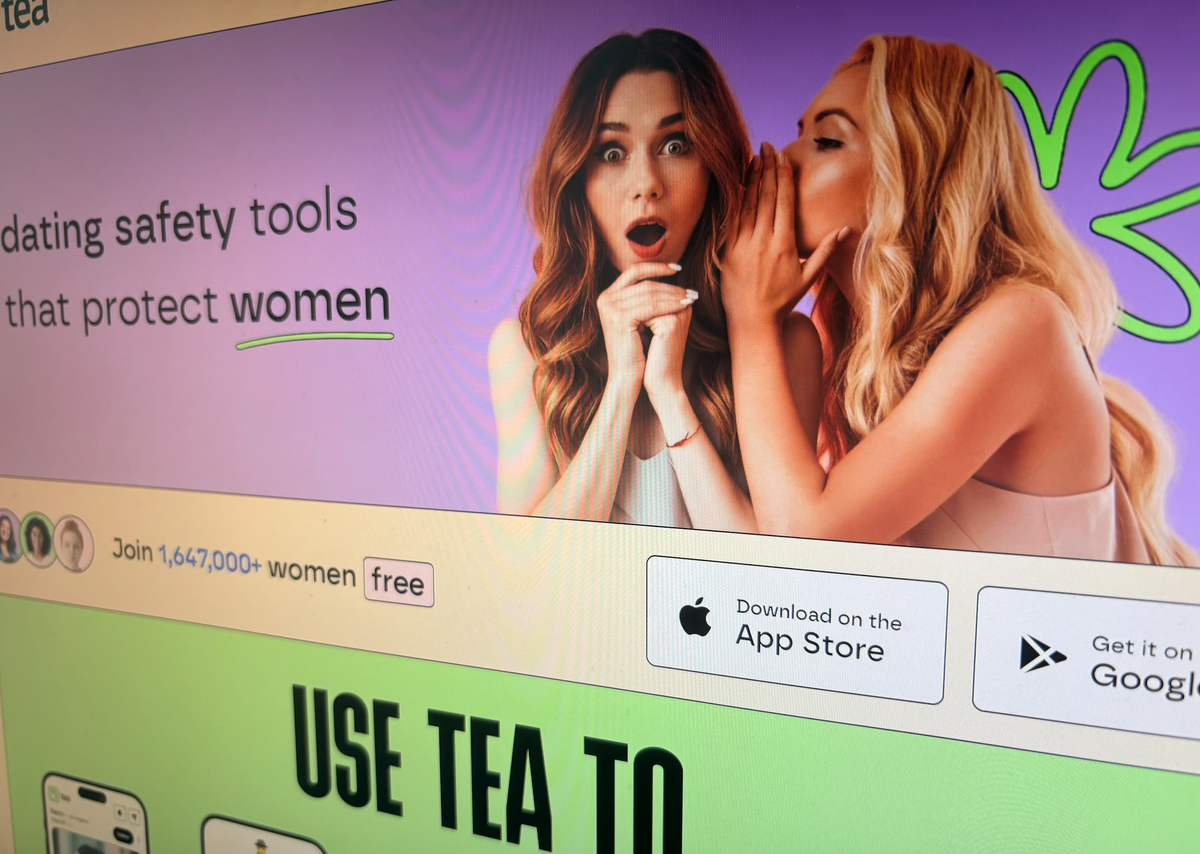
Women Dating Safety App 'Tea' Breached, Users' IDs Posted to 4chan
“DRIVERS LICENSES AND FACE PICS! GET THE FUCK IN HERE BEFORE THEY SHUT IT DOWN!” the thread read before being deleted.
404 Media
567 points · by gloxkiqcza · 1y ago · 789 comments
Freewalled
I linked the plain HTTP version... which seems to rely on a series of redirects; potentially TOR:
    ~ $ curl -vLsq http://archive.today/U5Tah |& grep -Ei 'location:|title'
    < Location: https://archive.today/U5Tah
    < onion-location: http://archiveiya74codqgiixo33q62qlrqtkgmcitqx5u2oeqnmn5bpcbiyd.onion/U5Tah
    < location: https://archive.ph/U5Tah
    <title>archive.ph</title>
How is Tea even legal? Isn't this just a legal libel timebomb waiting to happen?
"This guy is a creeper and treats romantic partners terribly" is pure opinion, and cannot be defamatory. The (rare) kinds of opinion statements that can be defamatory generally take the form of "I believe (subjective thing) about this person because I observed (objective thing)", where "(objective thing)" is itself false. "The vibe I get about this person is that they hunt humans for sport" does not take that form and is almost certainly not defamatory.
Under US law, providers are generally not liable for defamatory content generated by users unless you can show they materially encouraged that content in its specifics, which is a high bar app providers are unlikely to clear.
Standard disclaimer that law varies by jurisdiction. However, that limited list typically includes claims that the person committed a crime. Many juristictions also include accusing someone of having a contagious disease, engaging in sexual misconduct, or engaging is misconduct that is inconsistent with proper conduct in their profession.
In other words, the types of things I would expect people to be talking about on tea overlap heavily with defamation per-se.
If the users were careful to make all of their statements opinions, that defense would work. However, I doubt that is the case. Instead, I expect many users to include example of what their ex did that led to their opinion; which gets directly into the realm of factual statements.
The provider protections are real, and likely protect the app from direct lawsuits (or, at least from losing them), but do not protect the app's users. A few news stories about an abusive ex going after their former partner based on what they posted in the app could be enough to scare users away. You don't even need to win the lawsuit if your goal is to harass the other person.
That is true. But i think untrained and emotionaly involved individuals will have trouble navigating the boundaries of defamation. Instead of writing opinions like “treats romantic partners terribly” they will write statements purporting facts like “this creep lured me to his house, raped me, and gave me the clap”. This is not an opinion but three individually provable statements of facts. Plus the third would be considered “defamation per se” in most jurisdictions if it were false. (The false allegation that someone has an STD is considered so loathsome that in most places the person wouldn’t need to prove damages.)
Unles specifically coached people would write this second way. Both because it is rethoricaly more powerfull, but also because they would report on their own personal experience. To be able to say “treats romantic partners terribly” they would need to canvas multiple former partners and then put their emotionaly charged stories into calm terms. That requires a lot of work. While the kind of message i’m suggesting only requires the commenter to report things they personaly know about. And in an emotionaly charged situation, like a breakup, people would be more likely to exagarate in their descriptions, making defamatory claims more likely.
> Under US law, providers are generally not liable for defamatory content generated by users…
This is true, and i believe this is the real key. Even if the commenters would be liable, the site themselves would be unlikely to become liable with them.
1. To prove that the factual claims made by the defendant were false, and that the defendant should have known they were false
2. That you suffered actual damages from those claims
Very hard to make happen on a dating app.
"Cofee App" for males only, that allows them to post pictures of woman they have dated, rate them and include green/red flags.
"She is not good enough in bed", "She is too fat", "She has a high body count",..
Arguing over the legal definition of the word "Defamation" is missing the forest for the trees.
Do modern men need an app to understand this?
The claim that it provides safety really is just that, an empty claim.
A better way would have been to charge a small subscription fee - like $2/month or something. The fee filters out 99% of the trolls out there (who wants to pay to troll) and also gives the app/website admins access to billing info - name, mailing address, phone number, etc - without the need for a full ID scan. So the tiny amount of trolls that do pay to troll would have to enter accurate deanonymizing payment information to even get on the system in the first place.
And it can be made so only admins know peoples' true identities. For the user facing parts, pseudonyms and usernames are still very possible - again so long as everyone understands up front that such a platform would ultimately not be anonymous on the back end.
But oh no, that won't hypergrow the company and dominate the internet! Think of all the people in India and China you're missing out on! /sarcasm
That's Pure. And they have more than 5$ I believe.
Have you seen who has the blue checkmarks on Twitter/X now? I'll give you a hint, it's not the people who argue in good faith.
The issue is they decided to roll their own extremely questionable service and insecurely store sensitive images in a public bucket
Multiple SAAS vendors provide ID verification for ~$2/each. They should have eaten that fee when it was small and then found a way pass it onto the users later
You've never visited X (formerly known as Twitter)?
By this logic: I suppose glassdoor, yelp, or Google reviews aren't legal either?
What about identity verification as part of any employment offer?
Even the open platforms creep me out. I don’t like seeing unverified accounts of crime in Nextdoor, I think if you see some crime you go to the police. I had a series of in person interactions with a woman which seemed creepy in retrospect, her Nextdoor was full of creepy stuff including screenshots of creepy online interactions. At least this gives everyone clear evidence they should keep away.
Where you come from, people arent allowed to share their own experiences interacting with third parties without the third parties consent?
Sounds pretty oppressive, but there are absolutely many jurisdictions where that is not the case.
…is clearly not the US, which has probably the most expansive understanding of “freedom of speech” in the world.
Or in this case, sharing personal information about yourself...
Men's driver licenses were not distributed online. Only women's driver licenses were distributed online.
Imagining a future where I have to pay Tea to promote and astroturf my profile or they lower my rating, and pay bot farms to post glowing reviews
Yes, as far as I understand, you upload pictures of men, either taken in the wild or from dating sites (Tinder) against their will. I am pretty sure that this would be illegal in some jurisdictions. Especially EU.
It gets shut down, everyone forgets, then someone eventually has a brilliant idea...
It come from a place of sincerity but defenders imagine everyone would use it for the same reasons they would: Warning people of genuine threats in the dating world. They would never use it for gossip, or revenge, or creative writing, etc. so they don't imagine others would.
But at scale, if generously only 0.1% of women in America are bad actors that would weaponize this app, that's over 150k people (not to mention men slipping past security). And the thing about bad actors is that one bad actor can have an outsized effect.
The problem is the demand is there for such groups and I see posts that range from, “this guy tried to get me to get in his car”, or “man exposed himself to me”, to “man has twice approached children at my child’s school” or “I was drugged and raped after meeting with X on Y dating app”.
Lots of sexual attackers are known to multiple women.
Fact is that in lots of countries rape kits don’t get processed, it’s hard to secure a conviction, many serial sex offenders walk free and many women don’t want to go through a reliving of their trauma in court.
As a result these kinds of groups are very useful, not just for women who are actively dating, but for women who are simply existing in day-to-day public life. We have a president and a supreme court judge who both have been accused of serious sex offenses and nothing happened.
Is there a chance that some man who has done nothing wrong, gets accused by a woman in these groups? Yes of course there is a chance that could happen, but many would prefer to not take the risk of dating someone that has been accused of being a sex offender and the vast majority of posts with confirmation by multiple women confirm that bias.
These groups help keep women safer than without them. There’s a good reason why many women just don’t date at all any more. Covid lockdowns reminded them that they don’t really need it and it’s more hassle than it’s worth.
Sadly the vast majority of men are fine (not all men), but not enough call out the bad and dangerous behavior of a minority of their friends and peers. Until that happens women will be drawn to these apps and groups to try to be safer and not be a part of a sex crime statistic.
Without bias and gossip, who would even want to use the app?
The answer to your last two questions is found within section 230 of the Communications Decency Act.
It's only not a thing because, in the U.S., it's redundant. In other jurisdictions, it might be a thing, because there are places where a claim can be both defamatory and true.
There are countries where "false defamation" could be a term of art. Japan, for instance, where spreading rumors about someone that hurt their reputation is actionable even if those rumors are true. If your boss is having an affair, for instance, and you tell all your coworkers, he can successfully sue you.
2020 USA Per Capita Count of Mortality Event: Assault(Homicide), Female: 0.00139%
https://datacommons.org/tools/visualization#visType%3Dtimeli...
Edit: 100% are murder victims
https://bjs.ojp.gov/female-murder-victims-and-victim-offende...
If such a service exists and isn’t being too effective, shouldn’t that be worked on?
My guess is that there’s more to the reasons for why Tea is popular but the safety argument is largely being used to defend it
I think this is called "the police"
Sure any individual discussion about an individual might justifiably refer to that person as "crazy" or "ghetto trash". But the nature of online spaces, and the nature of the public discourse that tends to bring these phrases and discussions into the public eye very quickly starts painting people with broad brushes.
People also feel attacked because often times discussions tend to confuse useful rhetorical devices for conveying a point with justification for a behavior that has harmful impacts on the broader group. For example, it was pretty common to here the "bowl of M&Ms where one M&M is poisoned" analogy in the height of the "Me Too" movement. It's a useful rhetorical device for explaining why someone would fell cautious about a strange man, and why they wouldn't start from a position of trust. But it's also a terrible way of generally treating men in your life, and a terrible broad philosophy for organizations and governments to follow.
And we know this rhetorical device makes bad policy and at large is harmful to innocent people because another time in recent history when that analogy was really popular was immediately after the Sept 11 attacks when talking about Muslims in general and immigrants from Muslim countries. Surely no one would find it strange that Muslims might dislike and feel personally attacked by "people talking about crimes and terrorism done by other Muslims" in the same way that many online spaces talk about "sexual abuse/harassment done by other men". Surely we wouldn't be surprised if people felt attacked or disliked an app for sharing anonymous and private information about suspicious Muslims right? Or let's say someone noticed that black people are statistically 2x as likely relative to their population to be the offender of a violent crime[1]. You'd reasonably expect people to be bothered by an app that excluded black people from signing up and was entirely about strangers providing un-verified experiences with black people under the premise of keeping people safe.
Ultimately, people are bad at statistics and really bad at understanding the degree to which a small minority of individuals can affect a large majority of people by virtue of repeat offending. So it can be true both that lots of people have completely valid awful experiences with members of a given broad group, and that members of that group feel unfairly maligned when discussion about those experiences paints with broad, unqualified strokes.
A narrowing of section 230 would not be good for Apple or Google, though they wouldn’t face any liability for the Tea apps conduct.
https://www.techdirt.com/2020/06/23/hello-youve-been-referre...
To me this feels as if people widely thought that the Apollo Program was intended to prevent people from traveling to the moon, or Magna Carta was meant to prevent barons from limiting the king's power, or Impressionism was all about using technical artistic skills to depict scenes in a realistically detailed way.
I think sometimes confusion about Section 230 maybe points to some legal soft spots.
I think there's a trend — good or bad — for courts to see websites as accountable for users' activities on the site when those activities are systematic and collectively illegal or jeopardized, when the website is seen as encouraging the activity.
It's not hard for me to imagine a court deciding that the intrinsic nature of the website encourages systematic libel, and is therefore is somehow involved in the creation of post content.
Even more specifically, I'm not sure the "good faith" clause of Section 230 even applies to something like Tea in the case of libel, should libel be there.
Now, actually showing libel is another thing, but that's also easier for me to imagine today than even a year ago, especially in the presence of a data breach where posters are exposed.
I guess I don't see Tea as being held legally responsible for anything about the content of user posts, in the US at least, for the reasons outlined in that article. But I also wouldn't be surprised if it did happen.
Facebook shouldn't legally be allowed to demand an ID any more than this disaster of an "app."
Now tens of thousands of people will be subject to identity theft because someone thought this was a neat growth hacking pattern for their ethically dubious idea of a social networking site.
https://theconversation.com/porn-websites-now-require-age-ve...
A private way of doing this is absolutely 100% viable with some cryptography and government support. Apparently nobody gives enough of a fuck to even try.
As for the UK's new 'porn ID' law, people are going to die. People will take their own lives when their porn browsing habits are inevitably leaked. Private companies cannot be trusted to keep their hand out of the cookie jar, they WILL link peoples' histories to their real IDs.
Link to the related web standard https://www.w3.org/TR/vc-data-model-2.0/
It can be done with fairly basic cryptography. But the infrastructure around it would grow only if there's a demand. Otherwise people go with lowest denominator.
Simple solution: decriminalize uttering to any person who is not an employee of the government or a regulated bank.
Ideally you'd see fines in the 10%s of revenue. In egregious cases (gross negligence) like this, you should be able to go outside the LLC and recoup from equity holders' personal assets.
Alas, if only we had consumer protections.
A somewhat embarrassing but relevant example: my friends and I used Grindr for years (many still do), and we remained loyal despite the company's terrible track record with user data, privacy, and security as there simply wasn't (and still isn't) a viable alternative offering the same service at the expected level.
It appears Tea saw a pretty large pop in discussion across social channels over the last few days so I'm pretty hopeful this will lend itself to widespread discussion where the users can understand just how poorly this reflects on the company and determine if they want to stick around or jump ship.
That cuts to the issue some other comments have pointed out, that user trust is really their most important capital – and with short attention spans and short news cycles, it may rebound surprisingly fast.
The GDPR in Europe attempts to reset this but it’s still an uphill battle
And some kind of legal penalty for the engineers as well. Just fining the company does nothing to change the behavior of the people who built it in the first place.
Joining in with some other comments on this thread, if the stamp of a certified person was required to submit/sign apps with more than 10K or 100K users and came with personal risk and potential loss of licensure, I imagine things would change quickly.
I'm personally not for introducing more gatekeeping and control over software distribution (Apple/Google already have too much power). Also not sure how you'd make it work in an international context, but would be simple to implement for US based companies if Apple/Google wanted to tackle the problem.
I think the broader issue is that we as a society don't see data exposure or bad development practices as real harm. However, exposing the addresses and personal info of people talking about potentially violent, aggressive or unsafe people seems very dangerous.
They don't seem to value privacy.
How was this app going to monetize?
I'm guessing by selling user data, namely drivers license info to phone number.
There would be a morbid irony in the idea of a tool marketed as increasing safety for women actually being a honeypot operation to accumulate very sensitive personal information on those very women.
Nothing happens to these companies if there are no laws to keep them accountable, most companies I've worked with store everything forever because it's cheap and you never know what might become useful or what you might be able to sell to third parties later
>DRIVERS LICENSES AND FACE PICS! GET THE FUCK IN HERE BEFORE THEY SHUT IT DOWN!
>Tea App uploads all user verification submissions to this public firebase storage bucket with the prefix "attachments/": [link, now offline]
>Yes, if you sent Tea App your face and drivers license, they doxxed you publicly! No authentication, no nothing. It's a public bucket. I have written a Python script which scrapes the bucket and downloads all the images, page by page, so you can see if you're in it: [pastebin link]
>The censoring in picrel was added by me. The images in the bucket are raw and uncensored. Nice "anonymous" app. This is what happens when you entrust your personal information to a bunch of vibe-coding DEI hires.
>I won't be replying to this or making any more threads about it. I did my part, God bless you all. Regards, anon
Being so careless with people's personal data should be a major crime, tbh. If I manipulated thousands of people to let me scan their passports and various other bits of personal info, then just left the copies around the city for people to find, I'd be prosecuted, and rightfully so.
If they find any driver license photo copies, even turned over inside an unlocked desk drawer, the fine to a dealership is $10k per occurrence.
Good analogy. Also, this is the main point of the EU GDPR.
Any bad behavior should be legal if the victim should have realized the warning signs.
People should not have to understand every technical field in order to participate in society. This is what regulatory bodies are for.
You upload other people’s personal information on it to run background checks on them.
So, many of the victims probably haven’t heard of the company.
With tech savvy it is possible to understand the dangers well enough to dismiss the common advice in certain cases, but if you don't have it — you had better listen to what others are telling you. If you wish to dismiss it, you are on your own.
The solution is that we need to make it so that the majority no longer trusts anything people say.
There will be no negative knock-on effects for this, I'm sure.
--
To be less glib, I don't really see a good outcome of this in the long term. If everyone developed the right level of op-sec given the amount of bad actors on the internet, we'd effectively never communicate with another person again.
But this case is more like you sticking your fingers into an electrical socket, after being warned continuously not to do that, and then crying that it was the utility company's fault for putting something dangerous in your face.
We've been told since the advent of the internet to not share personal information online. If you want to take the risk, you have to accept the consequences. However, in this case the story is even worse as the intent of these people was to violate that rule not just for themselves but for other people as well.
So if you upload your id to a flash in the pan website, who's fault is it when the rookie website turns out to have expectedly low security?
> The app aims to provide a space for women to exchange information about men in order to stay safe, and verifies that new users are women by asking them to upload a selfie.
What exactly does this mean? Which information is exchanged without consent of these people? This seems to me more problematic than the actual topic of the data breach.
1) you dated a guy on tinder, he became all pushy on your first date, touched you inappropriately even though you said no. Or some guy became violent during your relationship and you even found out he has a history of that.
2) you dated a nice guy but he dumped you for whatever reason, and now you want to get back at him so you make up stuff like mentioned above, and post it there.
This case couldn't be more clear cut. It's horrid, and the people running the sites should be held accountable. Two wrongs don't make a right, especially when it will inevitably cost innocent lives, sooner or later.
Now if someone says something online it can be read for years and often without context of when it was originally written.
That said, you;re right to raise concerns about consent and the ethics of sharing information about people without their knowledge. These systems inherently involve trade-offs. When the risk is violence or death, the cost of a false negative (saying nothing) is obvious. So people naturally lean toward maximizing sensitivity, even if that means lower specificity. That;s not ideal, but it's understandable in a world where formal accountability is inconsistent at best, and finding out after the fact isn't an option.
Their existence reflects a failure elsewhere. If we want to reduce the need for them, the solution isn't to shut them down but to make them obsolete. The solution is building systems and cultural norms where violence and coercion are reliably called out and acted upon.
If that idea feels scary or unfair, that's the emotional context many women are already living in. Understanding that is the first step toward addressing why these networks exist in the first place.
* App Store review requires a lightweight security audit / checklist on the backend protections.
* App Store CTF Kill Switch. Publisher has to share a private CTF token with Apple with a public name (e.g. /etc/apple-ctf-token ). The app store can automatically kill the app if the token is ever breached.
* Publisher is required to include their own sensitive records ( access to a high-value bank account) within their backend . Apple audits that these secrets are in the same storage as the consumer records.
If you want companies to care about security then you need to make it affect their bottom line.
This wasn't the work of some super hacker. They literally just posted the info in public.
You could: - make Software Engineer a protected title that requires formal engineering education and mentorship as well as membership to your country's professional engineering body (Canada already does this) - make collecting and storing PII illegal unless done by a certified Software Engineer - add legal responsibility to certified Software Engineers. If a beach like this happens they lose their license or go to jail. And you easily know who is responsible for it because it's the PEng's name on the project - magically, nobody wants to collect PII insecurely anymore or hire vibe coders or give idiots access to push insecure stuff - bonus: being a certified Software Engineer now boosts your salary by 5x and the only people that will do it actually know WTF they are doing instead of cowboys, and that company will never hire a cowboy because of liability. The entire Internet is now more secure, more profitable for professionals, and dumb AI junk goes in the trash
Its not like anyone intentionally posts their entire DB to the internet.
Without personal and professional consequences, the default 1 year of credit monitoring for weak security is just the cost of doing business.
My SSN / private information has been leaked 10+ now. I had identify fraud once, resulting in ~8 hours of phone calls to various banks resulting in everything being removed.
What are my damages?
This won't be enough, you have to make PEOPLE liable for breach.
Making a corporation being liable is useless, it's a legal Person and it can simply declare bankruptcy and move on.
> We can reduce the latency of discovery and resolution by adding software protocols.
Can we? What does this even mean?
[Edit: i guess you mean the things in your parent comment about requiring including some sort of canary token in the DB. I'm skeptical about that as it assumes certain db structure and is difficult to verify compliance.
More importantly i don't really see how it would have stopped this specific situation. It seems like the leak was published to 4chan pretty immediately. More generally how do you discover if the token is leaked, in general? Its not like the hackers are going to self-report.]
That is why Tea did not operate in Europe.
The onus is on users to protect themselves, not the OS. As long as the OS enables the users to do what they want, no security policy will totally protect the user from themselves.
Meanwhile, in the UK, new legislation requires me to upload my face and driver's license just to browse Reddit.
It isn't just gossip websites requiring this, and it isn't just gossip websites suffering breaches.
"use your brain" is no substitute for security. This is a hacker forum. We think about how to protect apps. Even smart people have slipped up
Oh wait—no such thing exists!
It's up to us to teach this to our children. There's no hope of getting the current generations of Internet users to grasp the simple idea that app/website backends are black boxes to you, the user, such that there is absolutely nothing preventing them from selling the personal information you gave them to anyone they see fit, or even just failing to secure it properly.
Without being a developer yourself or having this information drilled into you at a young age, you're just going to grow up naively thinking that there's nothing wrong with giving personal information such as photos of your driver's license to random third parties that you have no reason to trust whatsoever, just because they have a form in their app or on their website that requests it from you.
even the most savvy consumers slip up, or are in a hurry. it's impossible to make a perfect security decision every time
Sorry, well deserved ladies. It just made my day. ROTFL.
And please provide an app with all the names and pictures of the ladies who used it. So that I can easily check who not to date.
Presumably the risk/reward still favors risky practices.
Now that's a creative solution! Every admin must have a table called `MY_PERSONAL_INFO` in their DB.
* App publishing process includes signatures that the publisher must embed in their database. When those signatures end up on the dark web, App Store is notified and the App is revoked
You have a lot of interesting suggestions.
I would love to see some kind of forced transparency. Too bad back-end code doesn’t run under any App/Play Store control, so it’s harder to force an (accurate) audit.
The idea has merit. You have to relinquish some control to establish security. Look at App Store, Microsoft Store , MacOS App store -- they all sandbox and reduce API scope in order to improve security for consumers.
I'm more on the side of autonomy and trust, but then we have reckless developers doing stuff like this, putting the whole industry on watch.
We could do better in our trade at encouraging best practices in this space. Every time there's a breach , the community shames the publisher . But the real shame is on us for not establishing better auditing protocols. Security best practices are just the start. You have to have transparent, ongoing auditing and pen-testing to sustain it.
You also need to consider the fact that Epic Games is big enough that they could have just used an exploit to sideload Fortnite back on the iPhone, and the lawsuit was basically PR to draw attention to the App Store's ambiguities. That in itself shows App Stores are slowly on their way out.
There will always be lowest-common-denominator users, but there is clearly some demand for an alternative to the biggest 5 websites...
How do you enforce the token actually exists? Do app developers have to hire some auditing firm to attest all their infra actually have the token available? Seems expensive.
1st sentence: "exposed database"
We need a more nuanced headline here. They did nothing responsible. 404 should title this story with something that will blame them first and the 'hackers' 2nd.
If i leave my house unlocked and someone walks in and takes my TV, they still committed a crime!
Just because it was irresponsible of me, they still BREACHED MY PRIVACY.
The correct ethical behaviour in situations like this is to report to the site that this information is exposed, not download it and archive and repost it.
EVEN IF you believe that the app is itself unethical, you cannot tell from just the drivers licenses of the users who signed up that they have themselves done anything unethical justifying reprisal.
Drivers licenses can be faked. Moreover, someone can just pretend to be someone else on this app with real drivers licenses.
The whole premise, implementation and process of Tea as a social media app is flawed, and a legal liability for the devs.
The internet went from 'YouTube asking users to never use your real name' to 'you have to submit your ID to some random app' in 10 years. Crazy!
It's the only way they will push companies to STOP storing them long term.
I've been in several companies (mostly FinTech) that store personal sensitive documents "just in case". They should be used for whatever is needed and deleted. But lazy compliance and operations VPs would push to keep them... or worse, the marketing people
This absolutely should not be normalized. If I'm ever prompted to submit photos of a government ID to some service, I'm turning heel. I'll try to use their phone service (which I just did successfully this week), correspond via mail or maybe, as you've said, handle it in person but I'm probably content to go without.
My driver's license is scanned every time I buy beer. I'm under no illusions that it's not quite readily available in any number of leaks or disclosures.
If that sounds defeatist, maybe it is. Nothing online is private. Once it's in a database, it's only a matter of time before it's exposed. History has proven this again and again.
Because we couldn't get anyone to take the internet seriously if it was just a bunch of anonymous pseudonyms trolling each other. And maybe that was a mistake.
Just look at Facebook. Users with real names sharing all kinds of inane schizo nonsense, extremism, building echo chambers without realizing it, becoming completely divorced from reality as perceived by the majority of people around them in meatspace, because they section themselves off in cyberspace.
If they have a problem with it then I will gradually remove pieces until they’re okay. But I haven’t had to do this the few times I’ve used this tactic – it causes issues with automated scans but eventually some human manually reviews it and says it’s okay.
What I don’t like is the “live verification” apps that leave me no choice but to take a photo of it.
That's becoming the norm now, presumably because of concern that people are taking leaked scans from one site, and using it to commit identify fraud (eg. getting KYC scans from crypto exchanges and using it to apply for accounts at other crypto changes, for money laundering purposes).
These are actually still very hard to do. I don't know anyone who would let me use their license for this purpose.
I take doxing, stalking, revenge porn and cyber bullying very seriously! And I would pay good money for a background check, to stay away from such people.
* Out of every 1,000 sexual assaults, approximately 310 are reported to the police.
* Of those reported, only about 13 cases are referred to a prosecutor.
* Ultimately, only about 7 cases lead to a felony conviction.
* For every 100 rapes reported, only 18 result in an arrest.
* Fewer than 7% of reported rape cases lead to a conviction.
* In some studies, the conviction rate for rape has been reported as low as 3.2% in certain jurisdictions.
Sources:
https://rainn.org/articles/what-expect-criminal-justice-syst...
https://www.uml.edu/news/stories/2019/sexual_assault_researc...
If you could imagine what girls and women go through, some on a daily basis, for years, since childhood, I think you might have a better understanding of why a "gossip app" might actually be a pretty sensible option for avoiding sexual assault and worse.
You get laughed at. Hard.
So yeah, I'd like to see these broken down between cis-, hetero-, homo-, and trans-.
And why are cis-lesbian-women also reporting higher numbers of sexual assault than man/woman relationship? No men in that relationship.
https://pmc.ncbi.nlm.nih.gov/articles/PMC5511765/
The rainn articles are propaganda with a specific slant.
I think you've misread that paper. The sexual assault survey wasn't limited to sexual assaults within a relationship or limited to one's sexual orientation.
Lesbians can be sexually assaulted by men.
There is a much higher concern for data validation and no one used HTTPS 20 years ago. Literally there were social networks with people uploading photos and personal stuff which didn't even have HTTPS.
I check all CVE's of the software my clients use because we need to figure out why things are broken and often this is a start -> unpatched CVE's. Most (by far) CVE's are not 'honest mistakes' or missed corner cases because rocket-science; they are just sloppy programming. Something that should never pass review. We DO know better but people ship things and hope for the best (including the case in this post etc).
That's precisely my point.
> Most (by far) CVE's are not 'honest mistakes' or missed corner cases because rocket-science; they are just sloppy programming.
This is actually true, but it's true because we have way better tooling and safer languages, which means we don't see nearly as many buffer overflows or memory management issues.
It's not that you didn't have negligent programmers back then.
> Something that should never pass review. We DO know better but people ship things and hope for the best (including the case in this post etc).
That's not new though. We've seen similar things happen in the past multiple times.
20 years ago code review was literally a bunch of meetings in a room or talk with another developer in person. Having something like github where you make a pull request, passes the automated test suite and requires a code review, etc. simply wasn't done. If in 2005 that already existed it was extremely bleeding edge.
I do have concerns about the code quality issues introduced by the abuse of LLMs, but until right before that was a thing, definitely the code quality in general has improved a lot.
It's not just that this database was accessible via the internet. It was all public data. Storing people's IDs in a public database is just... wow.
Yeah, we’ve finally, nearly, just got to the point where realizing that treating IT and security and such as simply a cost centre to be minimised maybe quite wasn’t leading to optimal security outcomes - to throwing it all away again.
We have a couple of decades more until we lock tech up, up until now it was all fun and games, but now and in the future tech will be everywhere and will be load bearing
I bet on greed. It always wins.
https://www.bleepingcomputer.com/news/security/misconfigured...
Why do people want to live in a panopticon of their own creation, with random anonymous strangers morally policing, judging each other with zero consequence to them?
Don't think we'll ever learn our lesson when it comes to privacy, it will be Eternal September forever.
The irony in this case being that this app operates like a lot of creep subreddits and forums out there with people posting photos of other people without their permission and gossiping / telling stories about them...
Witch Hunt as a Service, with a delightful UX, a little gamification, and soon integration with your favorite apps. Coming to an App Store near you.
So much for the "anonymous" app.
However there is something to be said about the crowd you find yourself with. If you assume this app to be necessary, I would assume your social standards are not high enough.
What's the bar they cannot clear?
Just as Parieto indicates that the bulk of male sexual assaults are done by a few, also indicates that the bulk of female assaults and claims of sexual assault are also done by a few.
Apps like Tea only paint all men as abusive thugs. If this were done, say to black people, this app would have been shut down and a lawsuit in federal court filed. But men are OK to harass, libel, and demean.
Good on anonymous for exposing this obvious double standard. And I hope they get sued by everyone.
But regardless i do understand the appeal. Dating apps suffer from basically being a low-information market place. There are of course the malicious people, which everyone has an interest in removing from the app. However even ignoroing that its a bit of a lemons market (if you excuse how dehumanizing the metaphor is). Its very hard to tell if someone is a good date just from their profile, and people who are good dates end up in relationships and exit the market quickly while bad dates stay in the market for a much longer time. Allowing some sort of review system does solve that problem - its worked in other domains, like uber drivers or what resturant to go to. So i certainly understand the appeal of why people would want this.
I don't have a fix for this, it is entirely fair to want justice for the defenseless. At the same time I have a strong hunch that there is no problem-solution fit here, at least not with this sort of app.
Women are anonymously spilling tea about men in their cities on viral app - https://news.ycombinator.com/item?id=44682914 - July 2025 (17 comments)
This has evolutionary origins. A man can, theoretically, father around a thousand children or more in the time it takes a woman to bear one. Sperm are cheap so those who need sperm (i.e. women) don't need to fight with each other. There's plenty to go around. Eggs are scarce so males of myriad species fight each other to the death over them.
It's just biology.
It's funny because many people, even some women would say you have the genders flipped here
Apple had no issue mass censoring Parlor and others, how is an app like this able to reach #1 under all?
Truth.
"Don't let Toyota's 'reliable car at a reasonable price' marketing fool you, they're all about money." Yeah, but does that preclude them from selling me an actually reliable car at a reasonable price?
https://www.bet.com/article/pe65fc/apple-s-black-diversity-c...
That seems about right.
But then again, can't convince people as a whole that men are, on average, good and decent people with normal flaws just like women, and therefore deserve to be protected, loved, and appreciated equally.
This app operates just like an app some creep online would use, people post pictures (permission or not) and gossip about them.
This will prove security in IT coding is necessary, so enjoy watching the drama unfold.
IT security bonanza time. It wont be long.
The first sentence is already a lie as there was never authorization in place followed by more lies.
No it ain't.
RIP
- This creates distorted market supply and demand where those small group of men/women become sought after and its only human nature in that they value their supply less than the rest.
- Toxic behavior is expected from that small group of highly attractive people that do all the dating.
- It was only a matter of time before such app would run into legal issues or attract angry individuals. Now the damage to the leaked identities will be prolonged. With the AI tech today, the extent to which a damage can be done is unknown (ex. deepfake, impersonations, further doxxing).
- Tea user's driver licenses as well as selfies, usernames, emails, posts about their dates will drastically increase the surface area for lawsuits, fraud and exploitation by malicious agents.
- The users of this site and those that have directly posted images, details have opened themselves up to significant legal and criminal liability. Given these apps were probably popular in large city centers like California, NY have heavy punishment for digital harassment and privacy violations on top of the damages that can be claimed against them by the men who's information and details were posted.
- Tea is largely insulated from what the users post which means that their biggest exposure might be just neglect and failure to secure data which comes with a slap on the wrist. Which will make it harder for Tea's userbase to claim large damages against it.
I read more details about this case and its beyond egregious. Unencrypted firebase and full public buckets. There is no hacking involved, the tokens were being used to pull data from roughly all 30,000 users of Tea and were only blocked short while ago.
Allegedly, 60GB of photos, user personal information, driver license, gps data being shared on torrent. A map of all 30,000 users tied to GPS data is being posted as well.
Given the extreme neglect to secure their data, I now believe Tea will be open to even bigger legal liability possibly criminal even.
Yeah, I wouldn't worry about the allegedly part, 4chan is dissecting that torrent as we speak, it's quite the party.
Let me share a message I got from a woman I met a couple years ago on a dating site: "Just a side note about the dating thing on here. I get very annoyed with how horribly men take care of themselves or even try to communicate. Most men today on these sites are repulsive. It was refreshing to see you smile, and look nice. Thank you for that."
So it's not a bunch of red-pill alpha guys. I'm an average guy with basic manners and a lack of creepiness. Heck I was near my all time high weight at the time. Every single woman on those things has at least one story about a guy she met that will make you cringe from his behavior. My fav was the guy who sent a woman flowers before even meeting her - at her workplace! Dude the cyberstalking you need to do to pull that off is CREEPY AF - not romantic.
If you want to be in that top 10 percent of men the bar is incredibly low.
In some cultures, mentioning dating apps will immediately lead to negative assumptions and connections are done through vetted networks and specific establishments where "hunting" activity is allowed, some with even more boundary pushing that would be impossible in Western culture.
Let ladies have some of their own medicine.
Edit: Nevermind, looks like Tea has been around for quite some time already. But it kinda flew under the radar with a fairly small user base.
Not a great look here.
However, Tea could have done a modicum of cybersecurity work (or hired an outside firm) to prevent this. If they are claiming to want to keep women safe (and not just running a gossip board) then this should be a red alert for them. No public acknowledgement is concerning...
I don't know how can anyone feel wrong about this without feeling even worse for what was already taking place.
I have no doubt in my mind that this is what they did. An "outside firm" vibe coded this and delivered the results.
Ugh. I’m clearly getting old. I don’t even remember the last time I went to 4chan.
https://support.google.com/googleplay/android-developer/answ...
So...they were storing people's information long term in a publically accessible bucket when users did not know. In fact, I believe users were told their IDs/selfies were immediately deleted(not stored), then Tea turned around and says they were legally required to store those photos. Tea had to address this in their press release, apparently.
Conceivably these storage endpoints might’ve never been directly exposed to mobile clients, instead going through other proxies or CDNs.
Not that apple should enforce minimum security, but that the app shouldn't be allowed on the App Store in the first place. For obvious reasons.
Supposedly, if your photo is posted on Tea you can contact Apple. Then Apple will force Tea to take your information down.
Violence again women is very real and men have been the main inflictors of it. However violence against men isn't physical because just biology. So it takes more insidious forms which combined with expectations of masculinity makes it so much more worse.
If we chose to selectively condemn the former kind of visible violence without protesting the more hidden kind, it is equally toxic as condoning violence against women.
Proudly lauding an app that enables scaling up of this kind of toxicity without any recourse by giving women carte blanche is another form of extremism.
But yeah please tell me how "we care about your privacy"
I mean, it's fun to throw baseless accusations around, but do you have any actual reason to suspect this?
They have geo-mapped all the users - https://imgur.com/bRAJ2nU
Some of the users photo's are AI, which is interesting.
They got all the chat logs - https://x.com/NEElimit/status/1948766332503130562
60 Gig torrent said to be out with all the data - https://x.com/cremieuxrecueil/status/1948787086493901097 data structure - https://files.catbox.moe/c6ej81.json
For those who wish for the old days - "Vibe Coding" - shonky websites with shonky security, doxxing on all sides, 4chan pops back into relevance. You get your early internet redo.
HN 'Tea' thread discussing the ethics of the doxxing app - https://news.ycombinator.com/item?id=44682914
I just hope they can pursue legal action for this, whether it was a deliberate trap or not.
- The fact that this app exists solidifies the data that a small group of men/women do most of the dating on tinder etc while the vast majority land dates far less if none at all.
- This creates distorted market supply and demand where those small group of men/women become sought after and its only human nature in that they value their supply less than the rest.
- Toxic behavior is expected from that small group of highly attractive people that do all the dating.
- It was only a matter of time before such app would run into legal issues or attract angry individuals. Now the damage to the leaked identities will be prolonged. With the AI tech today, the extent to which a damage can be doned with the information from the leaks is unknown.
- As for the company behind Tea, they are done. They face a monumental class action lawsuit as well as ongoing individual civil/criminal cases that will arise from the leaked identities, in particular the photo of driver licenses as well as selfies, usernames, emails drastically increase the surface area for damages.
- The users of this site and those that have directly posted images, details have opened themselves up to significant liability from not only the men they have targeted but from law enforcement.
- We'll see some new laws being formed from this case. Once again, we see the hidden dangers of blindly trusting large popular platforms with sensitive data but the twist with Tea here is the defamation activity that opens up its users to both civil and criminal liability.
I don't follow.
> This creates distorted market supply and demand where those small group of men/women become sought after
Isn't that true in the real world as well? I'm not exactly a hunk; people weren't tripping over themselves to ask me out, whereas some of my friends and acquaintances did have to figuratively beat people off with a stick.
I suspect the folks complaining about "markets" in online dating are not the kind of people who can connect offline.
To be fair, I think online dating has gotten worse -- sites like OkCupid used to match you based on shared affinity... the issue there is you could be a very high match on shared values but not someone's "type" visually -- imagine being shown the girl of your dreams only to find out the feeling is not mutual :-)
Conversely, I feel like people sometimes forget that they opted into these interactions, it's not like someone strolled up in a bar and began talking at them.
Anyways... if you're frustrated with apps, I'd suggest doing just that. Talk to people.
I met my last girlfriend at a bus stop. Before that, on a porch -- I was walking by and struck up a convo.
If you can't connect with people organically, no amount of tech can save you.