73 points · by throw0101c · 1y ago · 104 comments
[1]: https://en.wikipedia.org/wiki/Railroad_land_grants_in_the_Un...
[2]: https://www.amtrak.com/content/dam/projects/dotcom/english/p...
Note that only a small portion of the US rail network was built with land grants, about 18k miles out of ~250k miles in the peak of the US rail network. Also, most of the land-grant railroads are in the Western states, which is actually generally the least-dense portion of the rail network (in large part because the population density of that area is quite low--which is a large part of the reason for the land grants in the first place!).
The main dichotomy in political geography you have in the US is the opposite sides of the Mississippi River. You do have a transitional zone in Illinois (which nowadays as migrated to Chicago), but to a coarse approximation, even the rail magnates of the Gilded Age are unable to build systems that truly cross the transitional zone. In the West, the big prize is connecting the ports on the West Coast with ultimately Chicago, with lesser prizes for feeder lines to bring the products to Chicago. One of the big purposes of the land grants, after all, is to encourage settlement of agricultural lands in the area.
But in the East, the prizes are connecting to the Northeast ports (or Chicago, or to a lesser degree, the other major cities in the Mississippi River). And most of these lines aren't affected by the existence of the Western US. The commercial center, say, an Ohioan is looking towards isn't San Francisco, it's New York City. Rip out the land grant system, and you wouldn't reduce the viability of all of the lines being added in Ohio; although the lines people are working in, say, Indian Territory, will suffer mightily. But the latter are already in the not-dense portion of the network, whereas the former are in the dense part of the network.
It's really not until the mid-20th century that the Pacific Coast takes on the commercial significance that it has nowadays, by which time the railroad trackage of the US is beginning to decline as consolidation takes place.
Among the G8 we probably have the least-electrified, slowest rail network with the worst Positive Train Control. Probably the most dangerous, too, given how disastrous Precision Railroad Scheduling has been for safety. We also likely have the highest crash and derailment rates.
This is a sad joke: https://en.wikipedia.org/wiki/Positive_train_control#Deploym...
ASES, ACSES, ETMS, CBTM, CBOSS, E-ATC, ITCS, and whatever Union Pacific is using. That's over half a dozen different systems and none of them are inherently compatible with each other - specialized systems are required to tie the systems together on railways that might have trains with different systems.
I'm guessing no other country in the G8 has issues with freight train movement such that trains routinely bisect towns and entire counties for hours or more and force police, fire, and medical services to reroute, as well as require children to crawl underneath the trains (which could start moving without warning) to get to/from school.
Why? Because the feds are not regulating train lengths nor mandating that trains cannot block road intersections for more than a certain amount of time, so the railways do whatever they please.
I'm guessing no other G8 country has problems with the government (federal, state, or local) having no idea what hazardous materials are being shipped and where...no way to look it up, not noticed by the railroad, nothing.
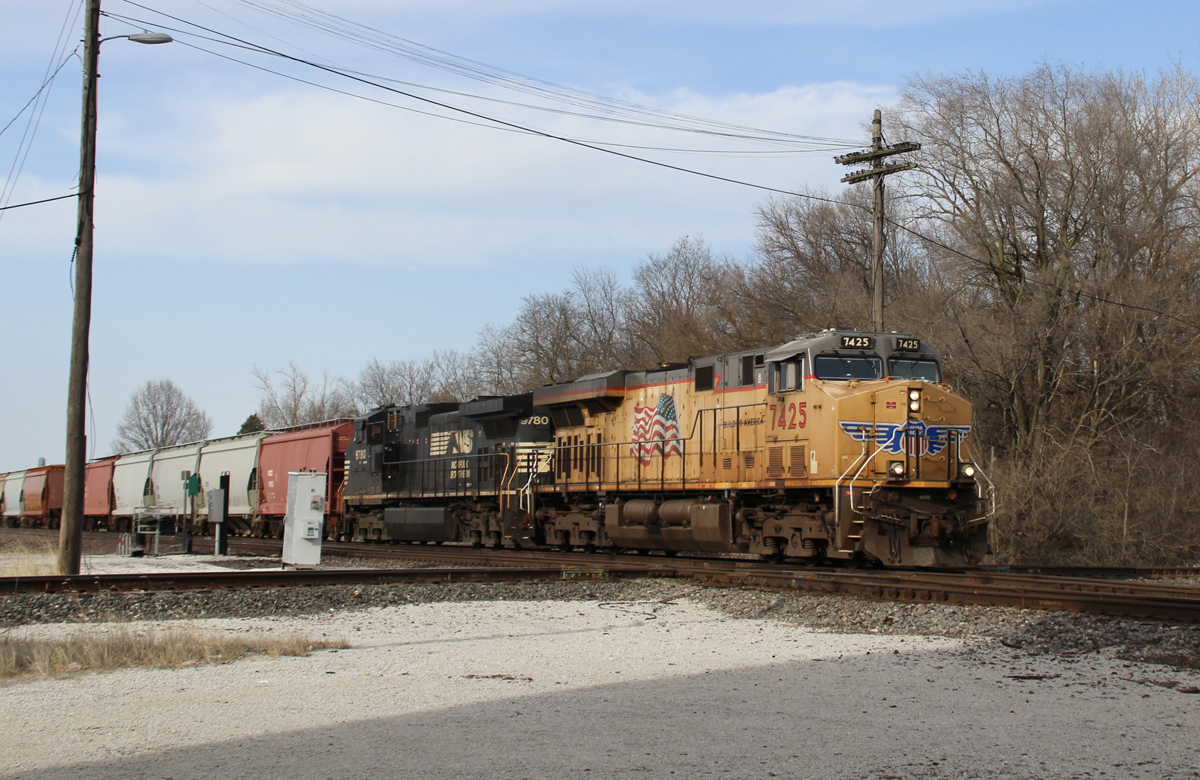
But then, I don't think quality wise I don't think you'd encounter a track like this: https://www.youtube.com/watch?v=9X2A2f6E5DI anywhere in Europe. Or the comparison of high speed tracks 9600km in Europe vs 70 km in the US.
The reason for this is obviously the completely different priorities US is freight, Europe is passenger. So I don't think you can really compare the two networks and say one is clearly better.
I don't think, therefore, that "total track length" has any useful meaning in Europe.
Here is some maps to illustrate my point:
https://commons.wikimedia.org/wiki/File:Europe_rail_electrif...
https://en.wikipedia.org/wiki/Track_gauge_in_Europe#/media/F...
I can't believe that the train can actually travel down that track. If I had just come upon that track, there's no way I would have ever thought that it was still an operational track. I'm sure the engineers navigating that track have a lot of colorful opinions about it as well
(I've crossed borders several times on European trains, and it was never a problem. By contrast, crossing the US-Canada border by train is an exercise in boredom and frustration.)
The Northeast Corridor is the only viable rail corridor in the US. It could be better, but we absolutely use it. Comparing the US to Europe is a mistake because cities aren't dense enough and are too far apart for European style rail to work.
In cities big enough for a bus service it'd be all right, but you don't usually see that until you get 100k or so people.
[1] https://www.reuters.com/world/us/union-pacific-talks-advance...
Generally I'm heavily against both monopolies and state-controlled companies, but railways seem to be a corner-case where all the downsides and inefficiencies are outweighted by a nation-wide system that actually works.
that way the state can give priority to passenger rail, and prioritize maintenance and building of rails according to the needs of the people.
it also makes much smaller train operators possible and compete on the same routes.
No freight customer is deciding "Oh I can either ship from LA to Seattle, or Miami to DC." They are shipping from one fixed location to a different fixed location. These railroads merging does not reduce their choices or give the combined entity more leverage.
If someone on the US west coast wants to ship to the US east (or vice versa) they can pit UP against BNSF, and then NS against CSX. There are a few pairs up because of the two negotiating points:
* UP-NS
* UP-CSX
* BNSF-NS
* BNSP-CSX
If the merger goes through you're now at:
* merged-UPNS
* BNSF-CSX
Do you think UPNS will give a cheaper price for a 'half-trip' and you go to their competitor the other half?
You don't think BNSF/CN/CP aren't looking at CSX right now?
'Cost savings through synergies which will be passed down to customers.'
(And certainly not shareholders and suits making more money.)
Which doesn't mean that a rational regulator would not turn it down anyway. But rational regulators may not be running the show at the moment. UP sees that there may be an opportunity during the Trump administration. (Note "may" - nobody knows whether there is an opportunity, but there is more of a chance than there was under Biden.)
How about oligopoly then.
If UP/NS happens, we're down from six to five Class Is (ignoring Amtrak):
* https://en.wikipedia.org/wiki/List_of_U.S._Class_I_railroads
Then BNSF/CSX? Or CN or CP go after CSX? That's four.
Do we start seeing the acquiring of Class IIs?
Or maybe all trackage should be government-owned, like streets and highways are. Then any operator can pay a toll and run their trains on any tracks. Traffic coordination is left as an exercise for the reader.
Let's say you want to ship from Denver to Atlanta. In Denver, you hand your stuff over to either Union Pacific or BNSF. In Atlanta, you receive it from either NS or CSX. You only have two options in Denver, and only two in Atlanta. The merger doesn't change that at all.
I think of Portland, Oregon, where the tracks run north/south along the river. You can see them sitting there empty while you're stuck in traffic on I-5, which runs parallel. Running a commuter rail or light rail on those things would make life a lot less miserable trying to get around the city.
I do think an S-Bahn style service would be interesting to pursue. Or even just regular commuter rail. The MAX is too slow for long distance commuting (it's usually faster just to sit in traffic), and it crucially doesn't go into Vancouver yet.
> people like you are still not satisfied
> wanted to control people’s freedom of movement and/or can’t stand that people would have freedom of movement you don’t have
You can't comment like this on HN and we have to ban accounts that do it repeatedly. This style of commenting is not what HN is for and it destroys what it is for. HN is only a place where people want to participate because other people make an effort to keep the standards up. If you wouldn't mind reviewing https://news.ycombinator.com/newsguidelines.html and taking the intended spirit of the site more to heart, we'd be grateful.
This isn’t the problem- the real problem is that in dense cities, transporting everyone where they want to go via private vehicles just doesn’t work geometrically- see the traffic and parking needs that grow as cities grow assuming private vehicle use only.You end up needing a more space-efficient form of moving people, namely public transit.
The point is, moving people inherently is bad. Shifting from cars to public transit reduces the badness a little, but you still need infrastructure that scales O(p * s * f), where p is the number of people, s is the average distance travelled per journey, and f is the frequency of journeys. Scaling doesn't change the slightest bit with public transit, you just have a different constant factor which is irrelevant for scalability.
So the solution isn't public transit. It is the avoidance of any unnecessary travel, meaning that we actually need something like a tax on non-home-office jobs and stores that you personally have to visit (as opposed to shopping online). We need better delivery infrastructure so people don't need to travel. We need close-to-home shopping options. Because actually moving goods instead of people scales logarithmically, the network of countrywide, regional, local distribution centers, bigger shops, smaller shops behaves like a tree.
I was just ideating on Portland traffic, dawg
Neither company is so inefficient that you can save much of anything by combining the two, and there is only so far you can raise prices before customers switch to trucks or send container ships to different ports of call. With no overlapping territory, you aren't going to cut the number of trains you run and you can't get rid of half your maintenance staff (can you?).
Investment banks will do well running the merger and surely they'll issue debt to finance it. But what kind of growth can we really expect?
https://en.wikipedia.org/wiki/File:Union_Pacific_and_Norfolk...
https://www.eia.gov/dnav/pet/pet_move_railNA_a_EPOOXE_RAIL_m...
The railroads kept reducing their workforce to get an uptick in profitability, so much so that there wasn't enough spare capacity for railroad workers to get paid sick leave of any kind. The railroad workforce were taking industrial action to get paid sick leave. What happened? Congress stepped in to use legislation to end a labor dispute for essential workers to side with the company. Oh and this was under Biden. As an aside, a later deal was made to give them a handful of paid sick days, quietly.
If the railroad caved to 100% of the union's demands it would've cost 6% of the company's profits. Not revenue. Profits.
The other is an industry wide effort called Precision Scheduled Railroads ("PSR"). Basically this means having trains with twice as many carriages and skipping safety chcecks because that costs money.
There are over 1000 train derailments a year. Most of these aren't a big deal. Others are like East Palestine, Ohio a few years ago, which caused a toxic spill in a populated area, something that continues to be an issue [1]. A lot of toxic chemicals are transported by rail. What was insane was the media didn't report on the East Palestine derailment for a week to 10 days despite there being a black toxic plume that could be seen from space. They were finally embarrassed into covering it by social media, particularly Tiktok.
All railroad companies do to maintain and increase profits is cut costs, pretty much like every other company. That means suppressing wages, skimping on maintenance and safety and not investing in fixing anything.
[1]: https://www.npr.org/2024/02/05/1228772709/east-palestine-tra...
Their competition was subsidized by the general government, and continues to be every year.
If you want to argue that nationalizing railroads should be done for the public good, do that - dont just demonize them, because its not a fully winning argument.
No surprise when the rails are utter dogshit. Something like [1] - you can clearly see how incredibly uneven the track is - which flies over my youtube feed way too much for my liking would yield immediate regulatory action here in Germany.
We got a new route (well, a new train running on a segment of an existing route, offering more flexibility for scheduling) from MSP to CHI recently, which has been great.
The UK started out with railroads in private ownership. They were nationalized in 1948, as British Rail. Then they were de-nationalized in the 1980s and 1990s. Now, they're being re-nationalized.
None of this is considered a huge success.
(It's a little different in the case of commuter rail, where there's a contractual arrangement.)
So, the statements about improved operational efficiency are not totally implausible.
And cable companies also don't have overlapping territory, so from the consumer point of view it did not reduce competition. But from the 'other side' when there are fewer ISPs then tech companies can be squeezed because there are fewer paths to eye-balls overall and each path has more influence because instead of two ISPs have 10% of Netflix customers, now one has 20%:
* https://qz.com/256586/the-inside-story-of-how-netflix-came-t...
Similarly with Amazon and books: while cheap consumer prices may look great, from the book publishers' perspective there's a choke point to readers, and so now the publishers have to consolidate to get market power over Amazon.
And if this goes through, do you think the other Class Is will sit around?
* https://en.wikipedia.org/wiki/List_of_U.S._Class_I_railroads
CSX is mostly east of the Mississippi, while BNSF is west: what about that kind of merger? Or CN or CP doing the same thing?
Freight rail is not an eyeball market, the customers are the ones paying.
""" If someone on the west coast wants to ship to the east (or vice versa) they can pit UP against BNSF, and then NS against CSX. There are several pairs up because of the two negotiating points:
* UP-NS
* UP-CSX
* BNSF-NS
* BNSP-CSX
If the merger goes through you're now at:
* merged-UPNS
* BNSF-CSX
Do you think UPNS will give a cheaper price for a 'half-trip' and you go to their competitor the other half? """
In this case it's not even about non-overlap, it's a straight reduction of competition. You don't think BNSF/CN/CP aren't looking at CSX right now?
That said, they're obviously reluctant to criticize the larger railroads.
For those that have never heard of that game, please enjoy:
ref: https://boardgamegeek.com/thread/94883/rail-baron-comparing-...
I'm not sure whether there is digitized data for railroad performance from the era, but it seemed like it'd be a neat dataset to assemble and research.
https://www.abebooks.com/first-edition/Poors-1925-Railroad-S...