474 points · by nickslaughter02 · 1y ago · 356 comments
You have to, individually - find a representative, their contact info, state your case, hope it's the correct person, hope your mail doesn't go unnoticed, hope that it will be properly read, hope it changes their mind.
This is "lobbying" by the people in a disorganised way, trying to fight organised lobbying.
This is a barrier that puts lots of people off, even if they have strong feelings about it.
I wish there was an easier way for people to say they are against this
A law that costs 100M people $1 and benefits 100 people with $1M.
Would be, as you noted, costly to oppose, not worth the $1 nor the time.
And at the same time, very profitable for the 100 to spend hundreds of thousands and great effort lobbying for.
It's just the power structure of any representative legislature.
"In vain do we fly to the many"...
Now we act like it's not good because Athens got its shit pushed in by Sparta during the Peloponnesian war.
Direct democracy is good. One person one vote, on all legislation, actually could work. We haven't even tried at scale in thousands of years.
It's telling that my boy Smedly Butler (ask your US marine friends who he is and they will recite his story perfectly or else their bootcamp will have smoked them for it) advocated for a military draft where the draft eligible are only drawn up from the list of folks who voted yes on the war.
Direct democracy would get you solutions that sound emotionally appealing but do not work. That or gridlock where you can't get 50% to agree on anything.
If you ask people "do you want A, B, C, or D" a majority may well say to do each. If you only have budget for one, getting them to come to consensus is impossible at the scale of direct democracy.
Anyway, I'm all for putting the sons of politicians on the front line, but don't think that will stop wars. The British Empire was infamous for putting nobleborn men directly in harms way, they would proudly stand up right in the thick of combat making themselves tempting targets and were routinely cut down. In a society with a strong martial tradition this doesn't turn people into peaceniks, if anything it gets people even more excited for wars.
So are you proposing people vote on them without reading them? Or that we write very short bills aimed at a non-lawyer audience, effectively leaving most decisions up to the interpretation by courts? Or something else?
I really like this position from an ethical point of view.
But in reality you will be conquered by a neighboring country with different principles in about 3 days.
It’s not a bad idea but it’s funny we need a funded people’s organisation to represent us to the democratic government!
I wonder if we need direct voting rights (for legislation etc) - now that we live in the internet age it may be feasible. Not sure how else to have the many overwhelming the few.
Such laws are adopted precisely so that society cannot influence politicians and their decisions.
That is, if society does not have the ability to do something about it now, then they will be even less able to do something about it later.
I see this problem over and over again - people start from "the politicians" (the other) is not listening to us (and we obviously represent everyone).
It leads to extremely unconstructive messaging ideas, where you assume no one can ever change their minds and if they do they are to be forever considered "lesser" for not being "right" the first time.
They're untouchable by the plebs, they have zero accountability.
Maybe outright outlawing lobbying would help. Also, I think campaign donations and monetary influence should be extremely limited (to not make someone have too much influence *cough cough Elon Musk cough*), maybe to $100 or so. If lobbying is to be allowed, probably something like that should hold as well: each individual could give at most something like $100/yr to a special interest group, and those should be closely watched.
From wiki:
> Lobbying takes place at every level of government: federal, state, county, municipal, and local governments. In Washington, D.C., lobbyists usually target members of Congress, although there have been efforts to influence executive agency officials as well as Supreme Court appointees. Lobbying can have a strong influence on the political system; for example, a study in 2014 suggested that special interest lobbying enhanced the power of elite groups and was a factor shifting the nation's political structure toward an oligarchy in which average citizens have "little or no independent influence"
Campaign donations, per this website:
https://www.fec.gov/help-candidates-and-committees/candidate...
It seems individuals can total $132k "per account per year" (I assume there can be multiple accounts for different roles?). Even the $3500 per person per candidate per election seem a bit oversized to me.
Of course, legislators also have an incentive to allow lobbying to make their lives easier and earn all sorts of benefits, further complicating things.
It's really not clear to me lobby should exist at all. Like probably legislators could simply fund their own apparatus to understand the issues of their country/region in an equitable way.
Outlaw communicating with legislators to try to get them to adopt a position on legislation?
Or do you mean outlawing paid lobbying on behalf of third parties?
The first would obviously be deeply problematic even if it was possible to police, the latter would probably generally be ineffective however you managed to operationalize it.
I doubt it. The cure is way worse than the disease and is a direct path to totalitarianism. The influence of capital will not go to the people, it will go to the government, and the government will use it to depend even less on the will of the people.
... Under capitalism.
PS. Maybe there's something there ...
At the federal level in the US we have the annoying problem that effectively everything is interstate commerce.
You can toss some money to the European Digital Rights initiative (EDRi) as well: https://edri.org/
All of those are doing good work in the digital rights space
(Edit: there is probably more but those are the ones that came to mind)
Whereas the West has predominantly negative rights, the USSR had positive rights. And due to their campaign, even got the UN declaration of human rights to mostly include USSR's positive rights.
https://spice.fsi.stanford.edu/docs/regional_perspectives_on...
Part of USSR constition indicating positive rights: https://www.departments.bucknell.edu/russian/const/77cons02....
Women and men have equal rights in the USSR.
Citizens of the USSR of different races and nationalities have equal rights.
Citizens of the USSR have the right to work (that is, to guaranteed employment and pay in accordance wit the quantity and quality of their work, and not below the state-established minimum), including the right to choose their trade or profession, type of job and work in accordance with their inclinations, abilities, training and education, with due account of the needs of society.
Citizens of the USSR have the right to rest and leisure.
Now, that isn't to say the USSR was blameless. We know it wasn't. However, we can take their successes and failures in what we propose and build next. Negative and positive rights both are needed. But the West is allergic to those.
Same for a "right to a house", where the State provided you with a filthy, overcrowded slum and call it a day.
> Citizens of the USSR of different races and nationalities have equal rights
This rings pretty hollow when you look at the history of Russification. And no doubt this clause is in the constitution because of the Russification policies of the Russian Empire, yet that didn't stop the Soviet Union from doing very much the same thing. https://en.wikipedia.org/wiki/Russification
https://english.www.gov.cn/archive/lawsregulations/201911/20...
Constitutions are just paper. It doesn't matter how they're written if the guys with the guns don't care to respect it.
"No more something!" "We have seen your petition. Fuck off, peasants".
So in theory, they should be paying as much heed to lobbyists as to their constituents.
The question arises, then, as to why they do not. There's no ground swell of public opinion in favour of being continually monitored.
There are huge bodies of research out there on voting behaviour. If you look at it, it's a lot less surprising.
The means by which we're supposed to hold the elected officials accountable for not representing our best interests is voting. It doesn't work.
Most people don't, as individuals, hold any sort of stable policy positions to begin with. People have a poor understanding of the candidates' position on various topics (strongly correlated with not having a stable policy position themselves). Candidates themselves have influence on people's view of subjects. People tend to take some of their views from the candidate they've decided to support, and project their own views onto the candidate in other cases making them seem more aligned/preferable.
The entire model is basically set up assuming that:
1. People have a view on policy which they decided on.
2. People will understand the candidates' positions and vote for the ones most closely aligned with them.
3. If an elected representative does not follow through on their positions and views, the people will hold them accountable by voting them out of office.
4. Therefore, in aggregate and over the long term, the elected representatives represent and enact the will of the people.
For the vast majority of issues in the vast majority of cases... one and two do not hold true to a level that's meaningful or significant.
That means the third step falls apart. In practice, there's little accountability to the electorate for the elected representatives.
Which means the fourth falls apart.
Given the elected officials aren't really beholden to the electorate, what else would guide their position? On an individual basis, there are a lot of opportunities for wealth and power. Unless it's anything particularly egregious, the only real impediment to them taking advantage is their own personal ethics and morals. The kinds of people that want to put their life on hold to run a campaign so they can maybe take a shit job with mediocre pay where a bunch of people will be pissed at them no matter what they do... are unfortunately often not in for the mediocre pay and anger.
And here we are. It's not whether there are enough people that support being continually monitored, it's about whether there's enough people and enough money _against_ it to stir up enough people to care to stop them. There's almost definitely not.
And just to make it entirely hopeless--even if you are a well-informed voter with considered and consistent views on policy... Many countries have very little in the way of options for who else to vote for. Is this important enough to enough people to make them a single issue voter? Would they vote for the hypothetical "We Support Murdering Kittens" party if they were against the spying? Probably not--they'll probably hold their nose and vote for the "We Love Kittens" party as the lesser evil.
However, democracy is not as feeble as this analysis would suggest. After all, we can see that major shifts in political support for policy positions are possible, and these do require public support (democracy) to occur.
For example, in the US the civil rights movements of the 1960's and 1970's. Or more recently the Brexit referendum in the UK or populist anti-immigrant positions that have arisen in recent years and acquired major political support. Whether you agree with these or not, they are politically impactful, and democratically supported.
Issues surrounding civil liberties have often attracted strong political and popular support. So the question here is how such support can be generated for privacy, which itself a right under numerous legal regimens including the US constitution and the UN Declaration on Human Rights.
That's gighting against an organized crime syndicate. It requires coordination, resources and aim.
1984 is coming in its worst scenarious.
There will be no win for the people, no hope. Freedom is gone.
In a sense citizens also have legitimate lobby groups, they are the political parties we know.
Foreign countries also lobby. Now recently what should worry Europeans is they don't bother anymore and just wipe the floor with the EU representative in front of everybody like Xi and Trump did last week.
So you can vote and lobby but I don't think it is enough today. We should first opt out of a lot of things and defend ourselves digitally:
- Buy some cheap LoRa devices and give some to your friends. Get into meshtastic and reticulum
- Buy some cheap HaLow WiFi devices and get into things like OpenWrt and B.A.T.M.A.N
- Self host as much as you can (It is worth doing just to avoid the Cloudflare " verify you are human" thing)
- Look back into things like Ethereum and good projects, they slowly made some real progress. Crypto is not only about price, annoying bitcoin bros and memecoins. It is still bad but banks and credit card companies are worst.
- Get some useful skills.
We have entered some kind of world war already and it will most likely include some ugly cyberattacks. In that context ChatControl matters much less and you can kill two birds with one stone.
I am still looking for a realistic solution to the email problem. If you have a suggestion I am really listening.
One has to admit the system is fundamentally broken. Once this is accepted, and people stop investing themselves further in the political system, then we will see change.
Sadly, the change is already planned for and will likely be a jump to some sort of communistic, ai-managed technocracy. However, it is also an opportunity to make the point that force should be no part of a future system. People should be able to opt-in or opt-out. That's freedom.
Wherever someone attacks public education or free libraries, you know where they stand on government by the people.
Original:
https://netzpolitik.org/2025/internes-protokoll-eu-juristen-...
Translated to English:
https://netzpolitik-org.translate.goog/2025/internes-protoko...
Peter Hummelgaard basically says yes to every new tool that the police asks for. He also is a staunch advocate of increasing punishment for every type of crime that happens to catch his attention, even in a time where our prison system is in shambles and has way too many inmates. A true authoritarian.
Kinda like in Spain tons of people learnt to either burn cards with microcontrollers in order to pirate TV top boxes or run Nagra and satellite decoders with keys dumped fron sketchy sites to be read with Kaffeine. And, often, it was more fun to decode the signal than to watch the actual TV schedule.
That server is going to get a detection order and then the operators have to spy against their own users. This is in the chat control bill.
No. On the contrary, our crime rates are some of the lowest in the world.
According to proponents, this is untrue. The intent of that database is that looking into it will still require a warrent, and will thusly require the suspect to already have been identified.
I'm no expert, but that sounds reasonably similar to how we treat other investigative means.
Also, this is still nothing like getting a warrant to a wire tap - any suspicion will reveal YEARS of private information about you to the investigators. Furthermore, knowing that this can be used to identify suspects, surely it will have an effect on peoples behaviors.
They propose to include health records! What if you like to read about bomb making out of curiosity, have a relative who is in jail for violence, and you start seeing a psychiatrist? How many boxes have to be ticked before a flag is raised, and how is that going to affect what you tell the psychiatrist about how you really feel?
I also don't trust the police to not make mistakes or behave unethically enough to be comfortable with this. Denmark is not a very corrupt country, but we still see misuse of power. Just recently it was revealed how a police handler explicitly instructed an informant to lie in court and frame someone else, just so the handler could keep his source. Are these the kind of people who should have access to my search history and health data? No fucking thanks.
Experience shows, that humans cannot be trusted to remain vigilant forever.
Judges will be lenient and prosecutors find ways to give them, if at all community service and an inconsequential fine for the gravest of crimes.
But hey, we absolutely need 1984 like surveillance. A cam in every home, if it's up to these schmucks.
Maybe what we need are machines to calculate sentences. I am intentionally not saying AI. I mean stupid simple machines, where you input raw facts and each wrongdoing has a coefficient assigned to it, that modifies the sentence. Someone embezzled so and so much money? OK money times factor. Someone didn't reveal their side income as a politician? OK plus coefficient so and so. Just really dumb machines or programs that add up and their result is the sentence, period. No wriggling, no bs, no nothing.
But I guess that would just move the problem to "Who inputs the crimes into the machines?" and then they would cheat their way out of trouble there. It's all so maddening.
And to people like you that oppose this and propose even more authoritarian laws that prevent me as a citizen from protecting myself: You don't speak for all of us.
Perhaps potential for misuse?
Because as I understand the world, the people who hold the most power are generally not the best people.
Other crime types exist that are crime only within a structure. The crime of sharing copyrighted files is a crime within a framework of intellectual rights but then training AI on the same files and and producing alternative files bypassing the IP is not a crime. Then you get into political crimes, i.e. it can be a crime to deny the Armenian genocide, denying the Jewish genicide and protesting against the extermination of the Palestinians at this very moment. It can be crime to hide from the US embassy that you are not completely in support of extermination of Gaza people. Your government might cut a deal to save Greenland from US invasion that makes certain things a crime that the current US administration doesn't like.
This all can change as politics evolves. Do you intend to support whatever the current position the current government has?
https://en.wikipedia.org/wiki/Regulation_to_Prevent_and_Comb...
Question is, how do we get ourselves out of this tar pit?
I feel like it might be impossible. The people agree with the tar pit makers.
Pass a mass surveillance law, 10% will be outraged, 80% will say "Well I don't have anything to hide. Oh well."
Pass a censorship law targeting legal but unpopular/controversial material. 10% outraged, 80% say "Good, I never liked it anyway."
Pass a preemptive policing law, 10% outraged, 80% claim "If it makes me safer, I like it. I'm not a criminal after all, I don't have anything to fear."
Pass a law that codifies your nation's most popular religion as something to be promoted and enforced. 10% outraged, 80% cheer it on, because it agrees with their views.
The 80% is illustrative here, but it seems like the people who agree with the above statements are a very solid and overwhelming majority. So why it did take us so much time to creep up to deliberate censorship and surveillance? As someone who was born in the 21st century, the freedom to access and do things on the internet had only ever been on the downhill, any small wins are overwritten by inevitable losses that make things more controlled, more 'safe'.
Generally the more democratic a country is, the less hostile the government is against the people, from my observations.
If you decentralise, any damage will be localised and would affect fewer people.
A part of the problem today is that there are massive autocratic powers that have the resources, means and channels to influence any democratic powers. Decentralization in this case means less unity in opinion, and more opportunity for foreign influence.
I dont see a way out of this, because essentially as a decentralized democracy, you are playing with your hands open to the whole world, and trusting that your decentralized people will filter out the noise/influence and make rational choices when they are open to any foreign influence.
This is why we are seeing EU go more authoritarian. There is (rightfully so given the average technological literacy), no trust in that the individual will be able to see through foreign influence. Control of the individual is the only short-term solution.
I think having a mostly crippled central government is probably the most realistic alternative but you can see how that is taken advantage of in the US and how it fosters unnecessary discord between people whose interests are generally aligned.
Simple:
A Cypherpunk's Manifesto
by Eric Hughes
written 9 March 1993
Among all candidates, it seems the least likely here. It didn't even happen at the same speed the internet grew.
(The issues with monopolized editorial powers are still valid, it's just this one that I think is wrong.)
Boom-bust cycles, including environmental ones don't do anything to harm capitalism. Rather, they just make it stronger. AI systems have locked in existing power structures forever and guarantee that we will technologically advance fast enough to solve for or at least adapt to climate change.
I'd argue that the whole climate movement for the last 20 years stymed and significantly harmed the left as a result. The anti-nuclear and some anti-vax positions taken by parts of the green left in particular were anti-scientific and have cost that portion of the party the support of many scientist types.
Scare porn about what will happen if you don't de-develop society and reduce your CO2 footprint just makes folks want to eat even more burgers. Same reason why the majority of non cyclists hate cyclists.
It's the same thing when you show a ton of kids how a chicken nugget is made. They all go "eww" for a moment, then you ask them "who wants chicken nuggets?" and literally every hand goes up[1] . We want our slop. We don't care that it's slop, and these days, emotions of cruelty, subjugation, and schadenfreude are political dominant and in the zeitgeist.
It’s a dangerous and destructive worldview, because they benefit immensely from the small percentage of society that absolutely does need privacy.
It's teleco vendors, ISPs and govn't agencies are advocating this.
What seems to be happening elsewhere is an organized robbery of state institutions by politicians and oligarchs, with oppression and censorship used to keep people from pointing out the obvious.
Maybe they're not paying attention to the part of that cycle where they start falling out of windows.
but firstly the policies of the very same party put millions into poverty and famine
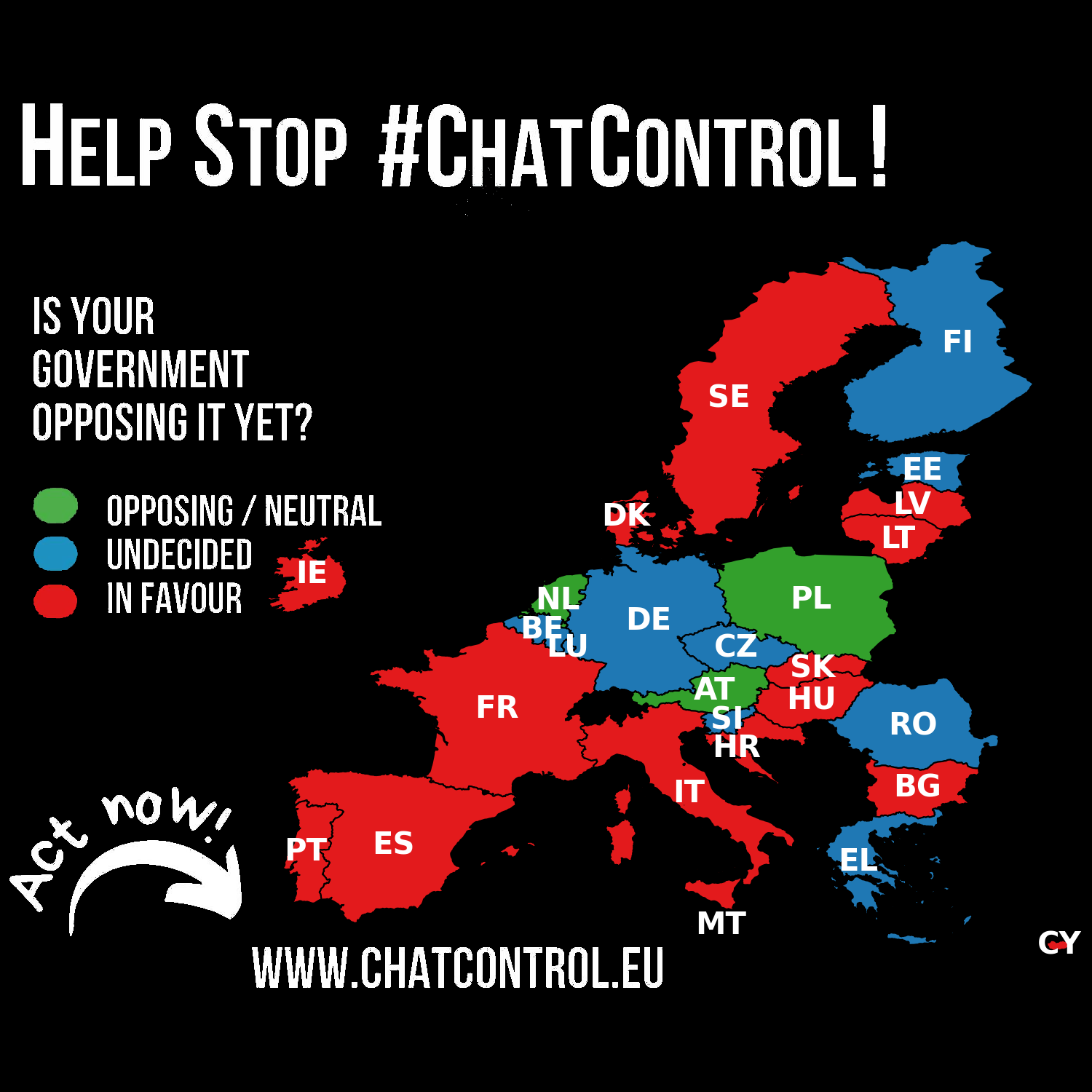
Leak: Many countries that said NO to #ChatControl in 2024 are now undecided—even though the 2025 plan is even more extreme!
The vote is THIS October.
Tell your government to #StopChatControl!
Act now: https://chatcontrol.eu
"Ask your government not to do that" means absolutely nothing.
There should be a list of what people should do step by step based on their country.
1. Redirects to someone's personal-name Web site.
2. The top heading on the page is their personal name and what seems to be personal logo.
3. Immediately below that logo the navbar entry for "ABOUT ME / CONTACT".
4. The last entry in the navbar is "GET INVOLVED", and the first entry of that menu is "Follow Me".
5. The first entry in the navbar is "WELCOME" and redirects to a page with a huge photo of him, followed by a heading that starts "Patrick Breyer – Digital freedom fighter and former Member of European Parliament for the German and the European Pirate Party" subheading "Europe’s voice of privacy and the free Internet".
6. Then the page below all this has some information.
I think this is one reason that positive revolutions can't happen anymore: the potential leaders/actors see no non-corrupt role models for how to operate. It's a very fuzzy line between self-promotion in service of the mission somehow, and self-promotion in service of power/influence for its own sake.
Who else is fighting chat control and informing the population as well?
https://community.qbix.com/t/the-global-war-on-end-to-end-en...
It is very unlikely that E2E encryption will be available anywhere except decentralized protocols. You should already have been assuming any centralized actors are just pinkyswearing. The real question is — what do you really need E2E encryption for, in the sense of being resilient against ALL actors?
It's like the IRA said to Thatcher: you have to be lucky every time, we just have to be lucky once.
In fact I think all of these impending doom articles are particularly counter productive because they de-sensitize people before it even gets to the parliament which (1) has already expressed opposition to this and (2) is a bit more starving for approval and thus potentially more receptive to this kind of stuff
But that's beyond the point regarding the "keep trying" part because I really can't imagine a way to "fix" that which isn't going to negatively impact the quality of legislation in the long run
Also I'm fairly sure that if there was a limit on how many times it can be considered in committee it'd already have been approved by council, so be careful what you wish for
I've been fighting for our right to online privacy since the late 90s. And frankly, I feel burnt out. Politicians keep coming up with the same harebrained ideas. Their slippery slope is never as slippery as that of the oppressive regimes of yore. They will always use their powers for good. They will protect us, whereas the evil regimes wanted to control us. Sigh. And who knows, maybe they actually mean well .... but the slope remains just as slippery.
It seems to be a problem with the whole 'Western' world - we're all on way with increasing authoritarianism and our leaders wanting to create police states...
I was expecting to find a big CTA button that I could click to sign some message to my representatives. Instead I found a giant wall of text with "ideas on how to take action" followed by a list of points along the lines of "Is your government in favour? Ask for an explanation" OK, ask how? No links, no email addresses... basically it's just a page saying "if you care about this thing do your own homework and find a way to act"
Whoever made that page needs to look into the concept of conversion rate. As it is right now it's basically useless
The sad truth is that it's so much easier, cheaper and faster to have these laws than actually doing "police" work.
What happens when the constitution clashes with EU law?
Can the constitution be amended and is it likely if there is a clash with EU law on this issue?
Enormous pressure can be brought to bear in politicians over something like this. The most prominent British politician to oppose the Online Safety Act in the UK is being labelled as "helping people like Jimmy Saville" by the government (Saville was a TV presenter and notorious child abuser) .
Usually a standoff based on whether the EU was delegated authority on the topic. If the delegation happened then EU law has precedence but depending on the topic national constitutional courts might ignore that which becomes a constitutional crisis
In this specific case it's much more likely that the ECJ shoots down the chat control part of the law before it gets to that anyway
If you now say this is not applicable as this is about storing connection data you don't understand the issue in full: This is a deeper incision than just storing connection logs. This violates a more fundamental right. We are talking about chats here. Not what IPs you connected to at what time (and that law was canned as violating the entire constitution, which i cited with the state's decision above). There is no middleground here.
tldr: A US based surveillance company called Thorn has been lobbying for this for years.
‘Who Benefits?’ Inside the EU’s Fight over Scanning for Child Sex Content https://balkaninsight.com/2023/09/25/who-benefits-inside-the...
Chat control & Kutcher: Ombudsman criticizes secrecy https://www.heise.de/en/news/Chat-control-Kutcher-Ombudsman-...
Actually, I think they are aware of that, which is why they keep trying to do the paperwork properly.
No one cares. Like anywhere in the world.
Rule of law is aided by laws that people know how to follow.
And politicians complain that democracy is losing it's appeal! What's the difference between what the EU wants to do and what is being done in autocracies like China and Russia?
Snooping on all messages and conversations, even the Stasi did not have this much power!
That works only if all your contacts are technically educated enough. It's more important to look for political solutions than technical workarounds. We need to protect the communication of everyone by preventing this law from passing.
More important, yes, but we still need the technical workarounds, and to educate people about them, for when preventing these laws ultimately fail. It's becoming crystal clear that "we the people" have no power anymore, and the way we can take some of that power back is by not participating in their laws - self hosting, use services outside of the jurisdictions where backdoors are mandatory, educating and helping others do the same.
Make the internet a digital no man's land. Make alternative networks, stuff like Yggdrasil and meshtastic.
When preventing the laws from passing fails, we still need to make it as difficult as possible to enforce.
I agree. But for now, we still have a window of opportunity to stop the law on the political level.
The overwhelming majority will be swept into a Neo-Dark Ages where truth is locked away and Dogma rules supreme. For a time the lockdown will be universal and complete but after the system is in place for a time I believe people will find a solution and break off the shackles.
If even these states agree that surveilling their entire population 24/7 after 50 years of communist rule is good then where do you see a political solution emerge from?
You would think that Eastern European countries would have learned their lesson but no, it seems that we are just trading one surveillance state for another.
If you use an app that connects to your own xmpp server, there will be no snopping.
Same if you encrypt your message and post it in Whatsapp.
Given that the private malware providers aren't accountable for it, I guess that it will noticeably degrade the average battery life for phones in the EU.
Only charging your phones if you have 3+ AI subscriptions and comply with all anti encryption laws of course
"The EU Commission proposes... ...Mass surveillance by means of fully automated real-time surveillance of messaging and chats and the end of privacy of digital correspondence... ...network blocking, screening of personal cloud storage including private photos, mandatory age verification resulting in the end of anonymous communication, appstore censorship and excluding minors from the digital world..."
It is client side scanning embedded in the apps themselves. Each app will have to deploy their own mechanism to intercept the messages. This is not (yet) an OS level scan so there is no AI bot watching your moves on your device yet. Furthermore the AI part will run on their own servers, not on the device.
Precisely, the way it has been described, is when you hit the send button, it will the send the message in clear text to the authorities and then send the encrypted message to the recipient, hence the stupid narrative from the proponents of Chat control that it does not break encryption because it was never encrypted in the first place.
This is not a conspiracy theory. This is not a UK/US only problem. The EU nanny statism isn't a good thing nor is the loss of sovereignty associated with it.
But hey, the left right binary choice strawman made it so that people basically pushed for more gov power no matter what and now it's too late to stop the inertia.
The next time you need to vote against accumulation of power they'll scare you again with extremists, terrorists, drug dealers, children safety, disinformation (which is basically calling for suppression of freespeech and criminalization of wrongthink), etc.
If you're still labeling people as "disinformation spreaders" that are dangerous then you can't complain.
https://en.wikipedia.org/wiki/Paradox_of_tolerance
It's all about the paradox of tolerance.
That chat control attempt is a direct result of the paradox of tolerance.
The thing that makes me sick to my stomach is that some of the worst of worst intolerant discourse is going to be allowed and protected because it's "religious": because we are open, tolerant, societies we are tolerant with intolerance.
If you have a holy book that calls for killing non-believers and taking their wive and daughters as sex slaves: that's fine because, see, it's religious.
If you want to discuss that holy book online with your fellow believers: that's fine because, see, it's religious.
But any talk criticizing that is going to be criminalized, crushed, pointed out as "far right" or any non-sense like that.
It's shooting the messenger.
Guess what's one of the issue concerning many people in a great many european cities at the moment? People feeling that religious extremism and obscurantism, middle-age style, is making a comeback.
And people are organizing marches all over the EU.
The last thing the EU wants is people on social media organizing themselves and protesting because they don't want the EU to become the next Syria or Somalia: most in the EU do not want the EU to become an intolerant continent.
You could say that any chat control is bad. But that chat control is going to be used prevent the criticism of intolerance.
It's really sad: I already moved three times, lived over four different countries (all in the EU) and now I'm planning to leave the EU while I still can (not that there are that many great places where I can realistically go).
P.S: for those in the US you should cherish your first amendment