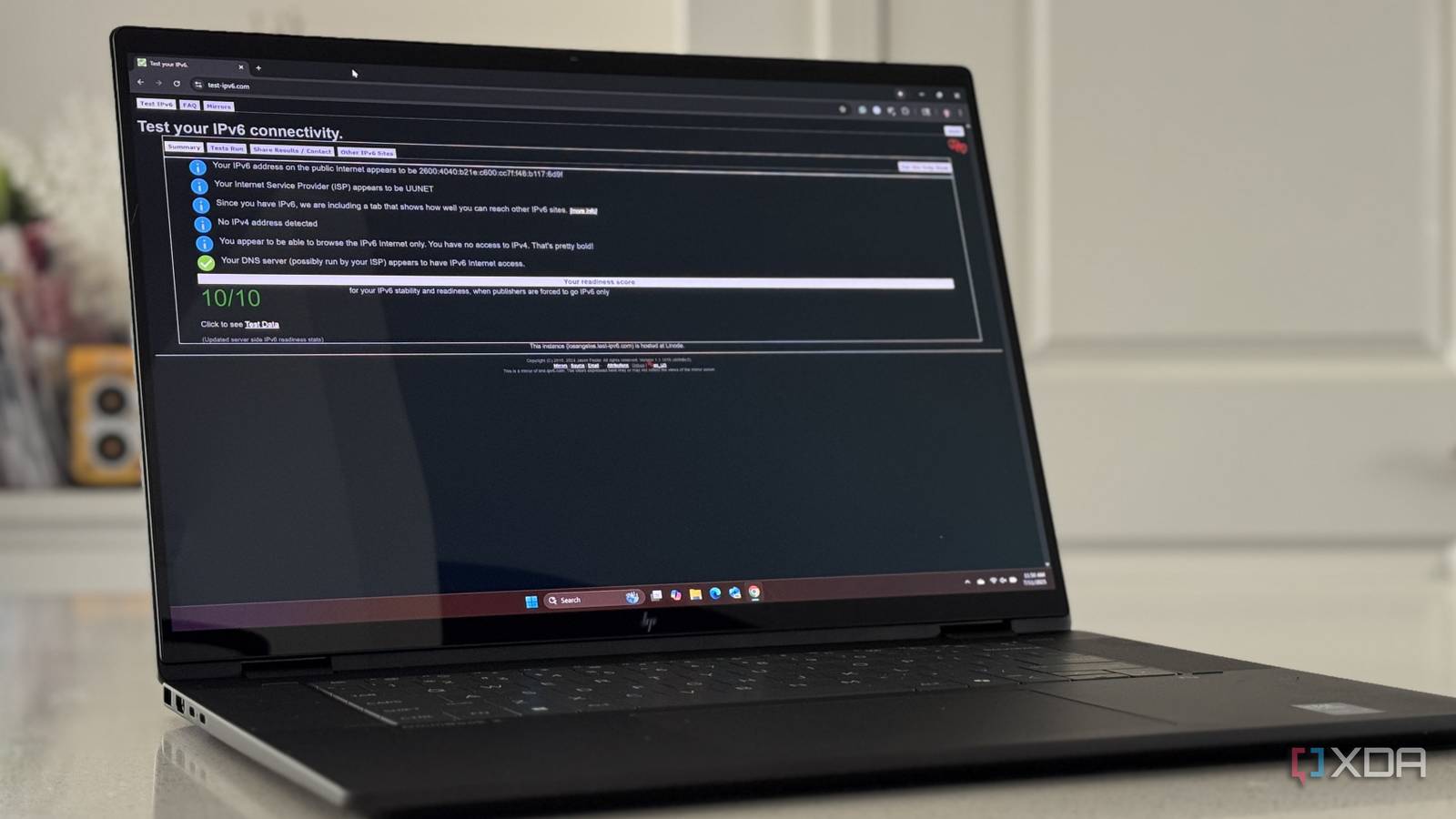
I tried living entirely on IPv6 for a day, and here's what happened
They've been promising IPv6 will take over, but when, exactly?
XDA
107 points · by speckx · 1y ago · 181 comments
So get out there and p2p
This was considered likely when IPng was being discussed in 1990s:
      Furthermore, we note that, in all probability, there will be IPv4
      hosts on the Internet effectively forever.  IPng must provide
      mechanisms to allow these hosts to communicate, even after IPng
      has become the dominant network layer protocol in the Internet.
Skype was originally P2P, but because of NAT there had to exist "supernodes" which did STUN/TURN/ICE shenanigans to make it work (which caused scaling issues since there weren't enough of them):
* https://spectrum.ieee.org/skype-scuppered-by-problem-with-su...
* https://www.zdnet.com/article/skype-ditched-peer-to-peer-sup...
Hurricane Electric (for one) offers IPv6 tunnels:
You can configure it on your router:
* https://openwrt.org/docs/guide-user/network/ipv6/ipv6_henet
* https://docs.netgate.com/pfsense/en/latest/recipes/ipv6-tunn...
* https://docs.opnsense.org/manual/how-tos/ipv6_tunnelbroker.h...
Or an individual host:
* https://wiki.archlinux.org/title/IPv6_tunnel_broker_setup
* https://docs.rockylinux.org/guides/network/hurricane_electri...
* https://genneko.github.io/playing-with-bsd/networking/freebs...
1: I'd prefer to have stayed with the local ISP despite the lack of ipv6, but they wanted $8,000 to bring fiber to my new place and that was not worth it with at&t fiber being present.
- Cloudflare won't route to them. - Streaming services, such as Netflix, block them - They trigger extra validation all over the Internet
I used to have these on select hosts on my network and it was never a good experience.
That said, if it isn’t blocked for the services you use, I found it pretty straightforward to use.
Sure ipv6 has some better features, but dual-stack means you are doubling all of your config (ACLs, naming, firewalls, routing) test cases and vulnerability surface. Moreover, ipv6 is not as intuitive.
Shaming people into ipv6 will never work. More effort should be invested into best practices, patterns, migration guides, support communities & more to assist in operating in a dual-stack environment for the foreseeable future.
Pure ipv6 will never happen because the weak link breaks the chain. How many people set up an ipv6 VPC with great excitement, and late in the project they deploy from github with "NS lookup failed".
Define "pure". Jen Linkova has been running IPv6-only networks on Google's corporate networks for several years now:
* https://www.youtube.com/watch?v=UTRsi6mbAWM
She is a chair of the 6man WG (and involved in the v6ops WG), and has authored ten RFCs:
* https://datatracker.ietf.org/person/furry13@gmail.com
Microsoft also is IPv6-only on corporate networks (so more of their IPv4 addresses can be moved to Azure to produce revenue):
* https://www.arin.net/blog/2019/04/03/microsoft-works-toward-...
The author of that article, Veronika McKillop, is head of the UK IPv6 Council:
* https://www.youtube.com/@ukipv6council468/videos
where you'll find lots of videos on ISPs and other institutions doing IPv6-only or IPv6-mostly (especially nowadays with DHCPv4 Option 108, RFC 8925).
You're not selling me on it's viability.
> So IPv6 is about 30 years old, and the testimony being shared is the chair of the group spending years of research and millions of dollars, finally launching ipv6 corporate lans in 2023.
And how many years of research and millions of dollars was spent in the 1990s on IPv4? People used to use workstations as routers (e.g., see SunOS routeadm(1M)) and DNS caching servers before a lot of money was poured into ASICs for routing (and switching).
There are all sorts of dumbass things with IPv4: how much time has been wasted on engineering solutions around NAT (e.g., STUN/TURN/ICE)? But because IPv4 just happens to be the default we accept them as 'normal' and anything that is different is treated as 'abnormal'.
> You're not selling me on it's viability.
I'm not sure how it's not viable given there are mobile telco networks with tens (hundreds?) of millions of people getting only IPv6 addresses on their devices.
* https://www.youtube.com/watch?v=nNMNglk_CvE
* https://www.youtube.com/watch?v=QGbxCKAqNUE
There are some folks who (a) were lucky enough to get in early on the IPv4 address land rush, or (b) are rich enough to be able to purchase IPv4 addresses, but there are also (c) plenty of folks who are left with scraps for IPv4 connectivity. The fact that you happen to fall into (a) or (b) does not mean you get to dismiss the folks in (c) who need IPv6, as otherwise they'd have no connectivity at all.
It's not even double the config. For e.g. my firewall, which is a 300-line config that I've already designed and implemented, making it dual stack mostly involves writing "domain (ip ip6)" instead of "domain ip". That's simply not double.
It's not less intuitive than v4 either. That's a lack of experience talking. Meanwhile, trying to use v4 quickly devolves into needing to use NAT, which is less intuitive.
> Pure ipv6 will never happen because the weak link breaks the chain. How many people set up an ipv6 VPC with great excitement, and late in the project they deploy from github with "NS lookup failed".
My desktop is pure v6 and GitHub works fine, which I think disproves the "never" part.
I'm having an issue with ipv6 sockets not receiving ipv4 traffic. setsockopt IPV6_V6ONLY = 0 is supposed to make ipv6 sockets listen on ipv4 as well
Can you take a look at this and see why it's not working
https://gist.github.com/tonymet/a85b43831179055d16403a9d9be1...
how?
You can argue "it's only one line" but that one line is a new socket and new test variant needing testing. something that worked perfectly well for 5-10 years now needing a re-test.
I'm not arguing against ipv6 . I'm arguing for honest assessments of the effort needing to migrate a network , especially residential networks, to IPv6 -- as the only way to make it happen. Shaming people with "it's so easy and simple" is just dishonest and doesn't help the cause.
It's not no work. I'm just saying it's not double the work. You'd think knowing that would make people more likely to do it, but...
Tried explaining it to several customer support techs but they all just gave up eventually.
Was fixed when I ended up getting my own modem and router/AP.
But those were an interesting few days. My partner was annoyed they couldn't use Pinterest but YouTube loaded fine. Google search worked but our local pizza joint's site didn't.
It had very little benefits at the beginning, but having dedicated publicly routed addresses started to become really conevinent.
IPv6 with a regulary changing dynamic prefix still sucks though to this day ... :-(
The (occasionally, on Comcast) changing dynamic prefix was a pain for me too, when accessing things externally. For internal use I additionally set up a fixed ULA prefix.
The way I do this, my internal DNS resolves hosts to their fixed ULA addresses. For the handful that are accessible externally, public DNS resolves to their address on the current public prefix.
* https://datatracker.ietf.org/doc/html/draft-ietf-6man-rfc672...
I personally think it is absurd that the ISPs that do actually support IPv6 are being so difficult and stingy about assigning static v6 prefixes.
* https://datatracker.ietf.org/doc/html/rfc8978
And "Improving the Reaction of Customer Edge Routers to IPv6 Renumbering Events":
* https://datatracker.ietf.org/doc/html/rfc9096
Also maybe "IPv6 Multihoming without Network Address Translation":
* https://datatracker.ietf.org/doc/html/rfc7157
Lots of good presentation at the IETF meeting for the 6man and 6ops WGs.
But I have to admit, that I ended up buying my own IPv6 block from a local ISP and tunnel to them. They have great interconnections, so bandwidth is not an issue, and latency penalty is less then 2 ms an average.
I’ll have a proper read of that tomorrow morning :)
You just update the IP (or just the prefix) when the IP changes
Perhaps keep in mind that the interface id of the device the DNS entry should point is different for every device in the network.
Some use the router to update the IP and put the interface id of the router into the update url...
I can configure the ISC dhcpd for IPv6 but I wouldn’t know what prefix to use in any automated way. So whenever the modem disconnects/reconnects, for whatever reason, I then need to somehow manually update the DHCP server.
Not an issue for ipv4 with NAT. But enough of a problem with IPv6 that I gave up on it. However I do accept that this is a problem of my own making (ie not using ISP provided equipment).
The real godsend of IPv4 is that it accidentally forced NAT.
This saved, through the decades, hundreds of millions of vulnerable machines from being directly exposed and owned.
I consider IPv4 saved us from Windows botnets affecting nearly the entire world.
No, NAT is not security. But accidentally it prevented oh-so-many machines from getting owned.
When I got my first Internet connection I could literally access other people's Windows machine for my ISP was putting me on the same LAN as other people. I'd do silly things like have "Your Windows machine is insecure" printed on their printers. This was in IPv4 times: my ISP would put me on a subnet with 256 other machines (I'm talking about times where a 28.8 modem was still a thing btw).
I cannot being to imagine the total and complete chaos had IPv6 existed back then.
People don't understand how insecure and wild things were back in the days.
IPv4 saved the Internet, accidentally, thanks to NAT.
Any Firewall can simply block all incoming traffic and it would have the same effect as NAT, without the computational overhead that NAT incurs...
If we just stop listing 240/4 as a bogon we could be allocating from it in a few years.
If it’s for security then most of the actual security provided by NAT routing is actually just the routers firewall itself. So a good ipv6 firewall provides the same level of security.
If it’s just because you’re a bit of a control freak and like to manage the assignment of IP addresses (and I fall into that category too) then my understanding is that you can also do this with ipv6 as ISPs typically hand you a wider subnet range (unlike ipv4 where you get just 1 IP). However I’ve tried a couple of times to adopt ipv6 into my stupidly bespoke home networking stack and failed each time.
I really do want to adopt IPv6, if only because I like fiddling with tech, but, like yourself, I keep getting stuck on the “how do I integrate IPv6 into the infrastructure I already have” problem.
Edit: if anyone has any recommended guides to configuring IPv6 using ISC dhcpd and unknown addresses supplied by your ISP, then I’d be interested to read them.
In other words, you want things to work like this?
  ISP-provided-PD-prefix 2001::/64 + Host address ::22 = Assigned address 2001::22
  ISP-provided-PD-prefix 2001:1:/64 + Host address ::22 = Assigned address 2001:1::22
But -honestly- what I've done is just relied on SLAAC to handle the globally-routable addresses, and advertised a ULA prefix for stable addresses. These go into my local DNS, but you could just as easily use that for DHCPd.
I’m just using an off the shelf ASUS router because it’s actually surprisingly good at the basics. But I wanted PXE booting so set up ISC dhcpd on a home server.
To be fair, it might actually be possible to do this on my ASUS router. I’ve not actually checked. I’ve had the same setup up for years. Easily more than a decade. Only updating hardware when necessary. So I might be missing a trick with these latest ASUS routers.
Nitpicky, but I think this is not true. NAT's security is based on the router not knowing where to route the traffic and dropping it, where the firewall intentionally drops the traffic.
Agreed that it's functionally equivalent, though.
-A INPUT -i wan-interface -m conntrack --ctstate RELATED,ESTABLISHED -j ACCEPT
-A POSTROUTING -o wan-interface -j MASQUERADE
It is true that without the firewall's involvement the router would drop all traffic destined to the LAN. [0] But it's the decisions made in the firewall that both make the NAT work, and ensure that WAN traffic that hasn't been requested stays out.
[0] Unless the router were "excitingly" misconfigured!
Nope, the router does know where to route the traffic for obvious reasons. At least for Linux if it's able to do NAT then it's ipso facto able to forward packets from one interface to another, and will do so unless explicitly told not to.
NAT can be fine, but why would it be a feature? (I guess maybe some privacy by way of sharing a public IP?)
IPv6 requires a stateful firewall on the router to provide the same protection. Then if you turn that on, it kinda defeats the point.
So you don’t actually need anything different nor special to have the same level of security with IPv6 vs IPv4 + NAT.
If you actually want to block inbound connections when you're doing NAT, you need the stateful firewall anyway. At that point, pretty much the only thing NAT is doing for your security is making it harder to understand what's going on.
- RFC 1631
Anecdotally, during weekday working hours, the percentage of IPv6 is higher than (typically over 50%).
This is followed by reasonable reasons they struggled to unwind themselves from IPv4 (for the experiment) - but eventually got it worked out.
Conversely: When I hotspot from my phone, T-Mobile frequently makes that an IPv6-only experience.
I was previously with an ISP that support IPv6 and had zero problems.
In fact IPv6 worked "too well" at one point: I had put "facebook.com" in my /etc/hosts file pointing to 0.0.0.0 at one point to reduce tracking. I then noticed I got the little FB icons again at some point and couldn't figure out why things were 'broken' (i.e., not blocking).
Turned out that after IPv6 was enabled I had to add ::1. That blocked FB again. IPv6 made connectivity to FB work again.
I dont think any normal person thinks about IPv6 or IPv4 here.
The parent poster's case is unusual. Normal people here don't think about v6 either, and the majority of people have a v6 connection.
A lot of servers have somehow managed to screw up their path MTU discovery. People have been using client-side workarounds for this for many years, but I suspect the workarounds are often forgotten on v6. Unfortunately the resulting problems then get blamed on v6.
The other possibility is broken multicast on your local network. Some Wifi mesh APs and "range extenders" just don't work properly. The test for this would probably be to take them out of the network path by connecting directly to the main router via Ethernet and seeing if you can talk to Internet hosts properly.
Have experienced this issue myself a few times. Really annoying.
I have a IPv6 checker and have a list of broken domains here. https://v6check.miyuru.lk/failed
centurylink ipv6 via their tunnel
So I started digging in, and there's definitely a lot to like.
But I see two big problems that are showstoppers in my opinion, at least for my home network (not even considering the fact that very few residential ISPs even support v6 at this point):
1. Generally speaking, the IPs of your LAN are based on the prefix assigned by the ISP. Most residential ISPs don't offer static prefixes. This means that every time your prefix changes, the IPs of all your devices on your LAN change. Seems like this "feature" was developed in a more idealistic era when people probably thought everyone would be getting static IPv6 addresses, since shortages would never be an issue. Unfortuantely, they failed to foresee the fact that most major ISPs are terrible, greedy organizations that either outright refuse to offer static assignments, or continue treating them as if they were scarce IPv4 resources, charging a premium or requiring business-class service to even get them.
2. The ISPs that do support v6, like Comcast/Xfinity in the USA, are only allocating one /64 prefix. This means you can only have one subnet (VLAN) on your LAN! Why are they being so stingy?
I would love to migrate to IPv6, but these two issues alone make it feel like a clown show for home users.
Using DNS to resolve everything solves part of the problem, but firewall rules are another issue. The router would need to have the capability to update everything dynamically when the prefix changes. I think this in the works for pfSense, but I'm not sure if its actually supported yet. It looks like you might have to mess around with some 3rd-party script to make it work.
I guess I'm just generally disappointed that the whole process seems unnecessarily messy. I don't have a v6-compatible ISP right now anyway. I was thinking about trying a tunnel, but I'm not seeing the benefit in it right now.
2. Lots of ISPs only assign a /64 by default, but if you configure your router to request a /56 via DHCPv6 prefix delegation, you'll usually get the larger prefix.
FWIW, I'm using both of these on my home network, via a router running OpenWRT.
When I was reading up on everything, I also learned that your router can request a bigger prefix, but I ran across several posts from various folks stating they could only get a /64 from Comcast no matter what they tried, so I'm not sure how universally supported DHCPv6-PD requests are.
The nice thing with IPv6 is that devices have no problem with being assigned multiple addresses on the same interface. So most of my devices actually have 5 IPv6 addresses [0]: a globally-routable DHCPv6 address (the default), a globally-routable SLAAC address, a ULA DHCPv6 address, a ULA SLAAC address, and a link-local address. So you can have a globally-routable IP and a locally-stable IP at the same time. And this is arguably a good thing, since it would be annoying to have to renumber your local network if you ever changed ISPs.
> I ran across several posts from various folks stating they could only get a /64 from Comcast no matter what they tried, so I'm not sure how universally supported DHCPv6-PD requests are.
That's annoying, and also means that you probably won't be able to get NPT to work either. FWIW, both Shaw and Telus (in Canada) will assign you a /56 via DHCPv6-PD if you request it.
[0]: I don't actually want this many addresses, but a link-local address is required for IPv6, I want my devices to have constant/easily-memorable IP addresses so I need DHCPv6, Android only supports SLAAC so I have to keep that enabled too, devices will prefer IPv4 over a v6 ULA so I need to keep the globally-routable addresses, and I want to use static addresses in my LAN so I need ULA enabled as well.
There are supposedly so many IPv6 addresses that you could assign every grain of sand on earth on the order of quintillion addresses.
So, yeah, there’s no excuse.
Advertising for example, was essential. Spewing garbage I don't want, absolutely critical to Microsoft's bottom line apparently. But registration so that I can turn off that advertising? Not important, so that was not available until I gave the machine IPv4.
Like how 2-byte Unicode was struggling and UTF-8 saved it.
You don't state why you think this, but this is almost always due to the flawed thinking that the IP address is a simple identifier, and then looking at "how many IPs does the world need?" → "64 bits is enough". (IPs are like street addresses, in that they're routing instructions. Having the space not fragment — like v4's space is doing — is part of it, and helps things like routing tables remain small.)
> and somewhat backward compatible with IPv4.
The pigeon-hole principle makes backwards compatibility impossible. No matter what concrete scheme you might propose, it is effectively equivalent to IPv6.
8 versus 16 bytes barely matters for using the addresses, especially because if you're assigning IPs to your devices you can have the second half of the address start with 6-7 zero bytes and collapse them all with ::
And I challenge you to name a way to be "somewhat backward compatible" that would actually function and IPv6 doesn't already do.
Edit: And not only can you make your own addresses short, if I look up some IPv6 addresses meant to be said/remembered (public DNS IPs), none of them make you type more than 8 bytes (and that one repeats a cluster to make it easier) and some make you type as little as 4 bytes.
Remembering and communicating mildly complex byte sequences should be an issue which is solved already.
Google and other big players go to huge lengths to build new Internet protocols on top of UDP because enough of the internet drops or mangles anything other than TCP or UDP that it's effectively impossible to use anything else on the Greater Internet. IPvNext by way of backwards-compatible IPv4 was (and continues to be) no easier than doing something that's backwards-incompatible.
As a bonus, doing the backwards-incompatible thing bypasses all the bad behavior of existing shitty middleboxes and crummy ASICs.
> backwards-compatible would have gotten us there that much sooner
v6 is already backwards compatible. Between dual stack, Teredo, 6to4, 6rd, 6over4, ISATAP, 6in4/4in6, NAT64/DNS64, 464xlat, DS-lite, MAP-T/E, 4rd, LW4over6 and probably other things I'm forgetting, you could make a reasonable argument that it's too backwards compatible, even.
If you meant "v4 being forwards-compatible would have gotten us there sooner", then yes, I agree. It's unfortunate it's not. That's entirely v4's fault though, not v6's.
How would it be at all backward compatible other than what NAT64 already does?
Any time you would reference an IPv4 address when v6 enabled, the stack would simply fill in the remaining bits and forward your packets down the line.
This had to have been thought about though, and I suspect the architects of v6 felt it would've been sub-par to what we have. No idea if that's true though.
They actually went with 64:ff9b::/96 as the default (though IPv6 is so big that you can just pick another area if you want in ULA space or whatever).
> Any time you would reference an IPv4 address when v6 enabled, the stack would simply fill in the remaining bits and forward your packets down the line.
There are actually multiple implementations, depending on OS and whether you want it in kernel space or user space.
> This had to have been thought about though, and I suspect the architects of v6 felt it would've been sub-par to what we have. No idea if that's true though.
They thought about it, named it NAT64 ( https://en.wikipedia.org/wiki/NAT64 ), published it, and it's in wide use. It frequently is combined with 464XLAT ( https://en.wikipedia.org/wiki/IPv6_transition_mechanism#464X... ) to make the transition mostly invisible to users/applications.