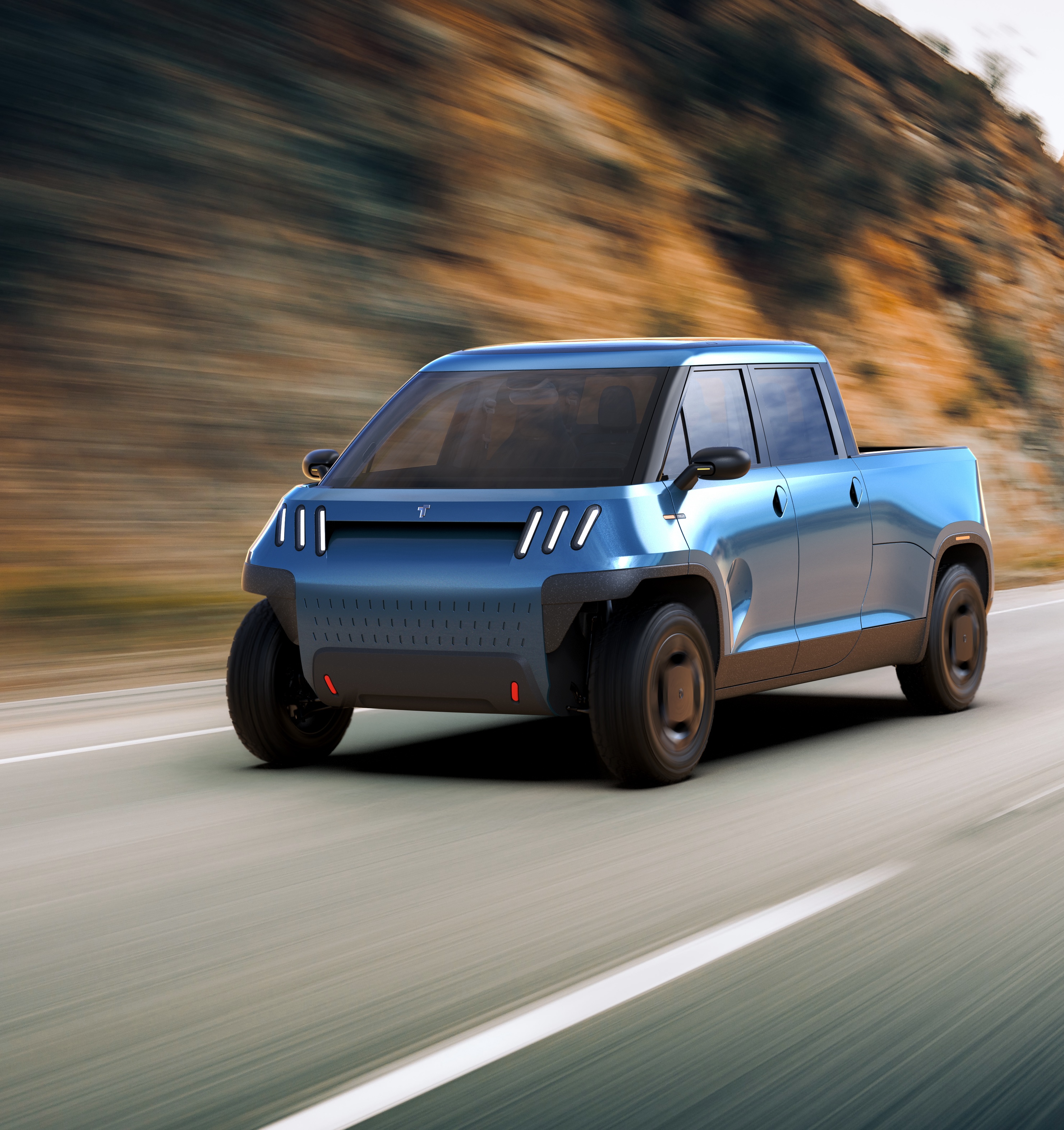
TELO Trucks | The All-Electric Mini Truck
Say hello to TELO, the all-electric mini truck. Designed from the ground up for efficiency and practicality.
telotrucks.com
627 points · by turtleyacht · 1y ago · 622 comments
- The body panels were composite but they want to go to stamped metal for production. - It's based off of the subaru ascent; at least most of the frame and suspension is. - NMC chemistry, didn't get an OEM name for the actual cell/pouch though. - Mostly off the shelf Bosch power-train components. Will be interesting to see a tear-down once they're for sale. - No commitment on how "open" the vehicle will be to modifications. They have designed in attachment points for upgrades but it didn't seem to be anywhere as extensive as what Slate is doing. This makes some sense; they have a more "finished" vision where Slate is intentionally taking the "our vision is for you to buy the canvas from us and then make it your own" approach.
On that last point, I don't think Slate has released anything substantial either w/r/t the CAN bus either. As far as I know, their plan is still a BYOD approach for the head-unit so here's hoping that it'll be relatively straight forward to interrogate the busses from an android or linux device. The Telo had a head-unit integrated so who knows how much control you'll have over the vehicle.
This is similar to what lotus did to help bootstrap tesla...
And hey, maybe tesla's going to have some spare capacity lying around so they could be that FAB... ?
I personally really want this truck to succeed. I'd happily trade in my 10 year old model S for this; it'd make dump runs and trips to the garden / home centers a lot easier than in the S...
I do wish they'd go full eccentric and use a citroen inspired oil suspension...
Desktop Metal are developing a sheet forming solution that requires no bespoke tooling, but it's a slow process with fairly poor surface finish.
What are the relative costs of the making die set, the press, and setting up and doing a run of stampings, and the facility and employees to actually house the whole kit?
As of right now, if you need to make a car and you don't have a NUMI or similar retired automotive plant sitting around, it's going to be expensive.
What about the hydroforming process?
I guess smaller car makers from the 60s that did make low volume sheet metal cars didn't need to pass crash tests.
Probably The Telo people should just team up with ineos....
I can think of one possibility. At Tesla’s scale, production becomes feasible only if they can produce X million units. This is because setting up production tooling, supply chain channels, and other associated costs is prohibitively expensive. Additionally, the demand for these vehicles will be relatively low until influential YouTubers in the construction, farming, and rural sectors become advocates and start promoting them.
In my opinion, electric vehicles (EVs) are perfectly suited for this task. They are ideal for transporting heavy items between nearby destinations, such as moving Home Depot supplies to a construction site or Costco products to a restaurant or store. A range of even 200 miles is practical for this use-case and keeps the cost low (MT1 is a beast by my standard).
For clarification, I am all for more competition. But I am also selfish and I really want this segment to become wildly successful . In any case, I really and truly hope they can make the business case work and be profitable/sustainable.
At the best maybe it was some sort of misguided attempt to encourage the American right to buy EVs?
If so it royally backfired and just decimated his own customer base right at the time real competition was entering the market. The Equinox EV roundly beats the Model Y head to head on range, price, AWD, etc. The Ioniq 5 is more expensive but is lovely.
No doubt Elon is destroying the profitability of his company by being a public asshole, but the Cybertruck is a fundamentally flawed vehicle (almost) nobody asked for, which is why it's a flop. By comparison, (refreshed) 3 and Y sales are not off by nearly as much, and some of that is just because they're just refreshes of existing vehicles people have been buying for many years, and there's a lot more competition in the EV market, and overall EV sales are slowing.
The Y is the best vehicle I’ve ever owned. To me, it took over what the Prius used to be - the best overall vehicle for most people.
You don’t even mention FSD here, I assume strategically. That, to me, is the most important feature. Does Equinox or Ioniq even have FSD?
The cybertruck fell flat long before Musk's true identity was revealed (maga/nazi affiliations).
Even if tesla was headed up by the most beloved CEO ever, I reckon the CT would still have sold poorly. It's just objectively a very bad, poorly designed and even worse built vehicle. And surprisingly, I feel like it's design aged very very quickly. It does not look next-gen or futuristic to me at all anymore.
A kei truck will give a VW Golf a run for it's money size wise!
I'm actually wondering why pickups are so popular elsewhere. A van makes so much more sense for a travelling tradie IMO - we need more electric vans!
This is a surprising claim to me. Can you point to any other vehicles (even something from John Deere or a competitor) whose demand significantly rose in a way directly attributable to influential youtubers in those niches, and which influencers in particular you think would be particularly influential?
Exterior designs.
The interior has no design - design and UI were given over to a touchscreen. Go look at the interior renderings to see for yourself ...
hopefully the success of the ford maverick can allay some of this concern - i don't think anybody was really expecting it to be as successful as it has been, but it seems like there's actually pretty decent demand for a smaller truck.
Like with most cars they have made it is because Tesla has no taste.
I get your point but I also think you are being dismissive of their ongoing contributions to cutting carbon use.
I was legit considering getting an F150 lighting for a little while but when I saw how much your range decreases when towing something it became obvious that it’s not really practical. It’s just objectively worse at hauling than a gas car.
Hopefully we see more battery tech breakthroughs that make electric trucks viable work vehicles.
For everyday driving, I pay about $8.50 for a “full tank” of charge that gets me around 300 miles. That’s about $100 worth of gas in an equivalent gas truck.
That’s being said I think the ideal truck would have about 2x-3x the current battery capacity of the extended range lightning.
In a couple of recent youtube videos, "Aging Wheels" thoroughly tested a variety of trailers towed behind a variety of vehicles and then also added weight to the trailer to see the efficiency impact of towing a trailer with a lot more weight. They found a 4.3% efficiency drop by adding weight to max out the towing, compared to towing without the extra weight. Weight isn't what matters on towing impact, it's the wind resistance of the trailer that matters much more.
They did a long series of comparison drives (in the about 30 mins video) with different trailers and then loaded them with extra weight to see the impact. It was smaller than you expect. The video with all the tests is https://www.youtube.com/watch?v=UmKf8smvGsA.
I heard about this on the batteries included podcast where they interview the author of the video above, and kind of give high level summary with some details, https://www.youtube.com/watch?v=wGJv-xAqcTI.
Aging wheels has a recent video on the subject: https://youtu.be/UmKf8smvGsA
At least they kept the stalks on the steering column ...
This is 3860 x 1854 x 1676mm, or 14% x 25% x -16% bigger than Japanese Kei car specifications(3400 x 1480 x 2000mm max.) Closest match in features among Kei cars would be Daihatsu Hijet Deck Van, except that one is 465mm / 18" shorter that this having an awkwardly short 880mm / 35" long bed.
The entire point of the Slate truck is to try to come in under 20K or around it, and without the EV subsidies that's probably not going to happen.
That said, $41K is still a big jump in comparison and it makes the Telo much closer to the price of a Model Y starting around $45K.
Good overviews of the truck https://youtu.be/aEq-vTLimrQ?si=fS-UhjndoWuxwBip
When I was off-roading and traveling a lot of dirt trails with my truck I would also wash it, wax it, and keep it in pristine condition when I got back home.
What did you expect? That we’d leave the mud on it forever, never wash it, and all of the side panels would be bashed in? If you’d climb under the truck (as I do for oil changes) you could see a lot of scrapes and dings from rocks, but I avoid damaging the side and front because that’s very expensive to repair.
Anyway, most of the trucks sold today aren’t sold in the off-road trim. They’re sold with features like lower clearance air dams up front for better fuel economy, on-road tires for better road noise and fuel economy, and commonly in 2WD trims. A new F150 can get 25mpg on the freeway even without the hybrid option.
I work remote so my truck isn’t used for commutes. I frequently haul things in the bed. I off road with friends.
Yet that doesn’t stop some people from making snide remarks about driving a truck. Some people love being angry at truck drivers and imagining they’re all just making irrational choices. They won’t be happy until we’re driving to Home Depot or UHaul every other weekend to rent a truck or trailer instead of parking one in our driveways.
It doesn’t stop them from calling me up and asking for help moving furniture when they need it, though. :)
It is a known fact that the vast majority of truck owners rarely ever use the truck bed. Millions of school pickups happening on massive trucks - and SUVs - are not ceasing to happen because you loaded your own with a pile of grass. People buy them because they’re “safer”, comfortable and look good. This is coming from research data for years now, and not only in the USA.
It can be hard to relate to changes happening at societal scale that don’t affect your own microcosm, but how else can we be aware of it, and act on, if not through data, averages and trends?
What's worse? A not in use bed, or a not in use back seat?
I have a truck, because I find it more convenient to have a truck bed anytime I need it, than to have to arrange to borrow or rent one. The bed doesn't get used often, but it's also a reasonable vehicle for driving solo or with one passenger; two in a pinch. Much better visibility than any other vehicle I have, too. Unfortunately, the single cab, 6-ft bed small truck market disappeared, and I got this one used with too big of an engine, so the mileage is poor... when I had a 4-cylinder small truck, mileage was better, but I don't drive that much anymore anyway.
But, I have lots of space, so I can keep a car for transporting a car pool in comfort, a PHEV with good mileage for longer trips that don't need anything special, a small truck for doing small truck things, and an old van with removed back seats that's fun to work on and can carry things that shouldn't get wet when it's raining. The van visibility towards the front is even better than the truck, because it's cabover, but visibility to the back isn't as good... None of those modern pillars that make it hard to see out the sides though.
That was changed so adding rear seats meant you could no longer class it as a company vehicle (the setup that was most common).
Just want to point out that big pickups are really about the hauling capacity, it's not like their beds are much bigger than a modern Ford Ranger. An F250 can safely pull 10 tons, and a dually F450 can pull 20t. Usually you aren't towing...but when you need to haul nontrivial loads you need a big truck.
I was pointing out that you don’t know what you’re talking about.
You cannot conclude that a truck never goes off-road by observing them on city streets. That was your claim, and I explained why it didn’t make sense. I also explained why trucks are not primarily sold as off-road vehicles anyway.
> It is a known fact that the vast majority of truck owners rarely ever use the truck bed
If you read the “studies” that make these claims they use two tricks:
First, they specifically exclude a truck defined as a work truck.
Second, they redefine “using the bed” to some arbitrary threshold, like hauling a large load of loose dirt or hauling something over so many hundred pounds.
If you actually believe that truck owners aren’t putting anything in the truck bed, you’re out of touch.
But why does this one point trigger you so much? If I showed you a similar study that the majority of people with back seats rarely had more than 2 people in their cars, would you become similarly enraged at the people buying 5-seat cars instead of a compact 2-seater?
If I showed you a study that the majority of people rarely use more than 200 horsepower would you start getting triggered by all of the 300, 400, or even 500 horsepower cars so wastefully driving around?
There’s something about pickup trucks, specifically, that makes a vocal minority irrationally angry and triggered. It’s a funny meme to watch because so many comments in this thread are absolutely sure that they understand the situation but they don’t understand basic facts about how you can’t tell if someone goes off-road by judging the condition of their paint, or that using a truck for work purposes doesn’t render it visibly damaged in a way that they can see. They just see trucks, get triggered, mix it with misleading “studies”, and come to believe odd conclusions like “truck drivers don’t use their beds”
I'm not here to defend brodozers, but you cannot possibly prove this statement. That a _pickup truck_ isn't hauling the majority of the time it is on the road is not some new thing. But of course there are more pickup trucks on the road than ever, so if you argument is aggregate time of all pickup trucks not doing truck things is the highest its ever been is certainly true, but you'd probably have to go back to before the 80s for that number to actually be meaningfully different per truck.
That's exactly how we always did it growing up.
As a non-American it's super weird that this is considered a good thing. That'd be considered utterly atrocious in most parts of the developed world.
I completely get that a truck is absolutely the best tool for the job for many people. But it's pretty obvious the OP was pointing out the people who own a truck and use it to get from home to their desk job.
It's not good in 2025. The fuel economy of a modern sedan (eg. a Toyota Camry) is around 50. It's just this one poster who is defending trucks saying it's good.
You can also get a 40-50mpg brand new sedan here if you want, but they serve different purposes.
You can also get a hybrid F150 that gets better mileage.
You can also get a fully electric F150 that doesn’t use any gas at all.
I was trying to make a point to counter the silly assumptions throughout this thread, such as the person who keeps claiming trucks are “incompetent” at being normal vehicles.
Why should we subsidize truck (and SUV) ownership? They ruin roads, are vastly more dangerous, require wider lanes, have worse visibility of pedestrians, pollute more, are louder, and take up more space than other options. Yet we don’t make SUV owners pay for any of that. We subsidize their gas, their road repairs and expansions, their car insurance, their storage space, their car payments, not to mention ignore the injuries, deaths and discomforts they cause.
My 2011 VW Golf gets 40mpg… so I’m not very impressed by an F150 that 99.9% of the time performs the same job (carrying one person and no cargo) getting 25. (Even if this isn’t your experience, the facts show that for most people it is)
You should be free to make your own decisions! I support you in that. I can believe that your lifestyle justifies owning a truck, even though that doesn’t generalize to most SUV owners. I just don’t want to pay for other people’s lifestyle decisions. It’s like we have socialism for truck owners, but market capitalism for people who need healthcare
It gets washed maybe twice a year, as it ends up filthy within 20 minutes anyway - and the panels all have scratches and dents from forging through brush.
For car shit, I have an (electric) car which I park on the main road.
The idea of waxing my truck is up there with the idea of waxing my legs.
A proven preference they're born with and unrelated to the culture they grow up in? Please do link to that study!
It’s about having one vehicle that can do it all. Maybe you’re noticing when there’s one human but you don’t really know how else that person is using the vehicle at other times. Trucks can haul people, things, do road trips, etc. pretty well.
https://news.ycombinator.com/item?id=42638394 - January 2025
https://news.ycombinator.com/item?id=21631704 - November 2019
Ray Delahanty | CityNerd: Rural Cosplay is, Unfortunately, A Thing - https://www.youtube.com/watch?v=6q_BE5KPp18
(Americans buy trucks out of emotion and cosplay, not realized utility and rational TCO, based on the evidence and data)
And if you're thinking "why not just rent?" I'll ask when was the last time you saw an equipment trailer rental with a winch capable of hauling logs up onto it?
Paradoxically, at least in the context of this thread, my motivation to own a truck is safety and efficiency. A 12 valve Cummins pulling the GCVWR of a 1994-1998.5 3/4 ton Dodge will get right around 10mpg and do it safely.
This is a hilarious take for anyone who has spent any time living outside of a big city.
Yes, there are some people who buy trucks because they want one but don’t actually use the truck features.
Generalizing to “Americans are cosplaying” is just trolling.
I really wonder what kind of world people live in who write such articles and what kind of world people live in who seriously read them. It's hard to believe that they live among us, there must be some separate island in the ocean or something like that where they can write their articles in complete isolation from the rest of the world.
You don't need anything besides tent and food!
Every person buys almost everything for emotion.
If you buy something for one of its features and don’t use the others, it doesn’t have anything to do with cosplay.
This is like saying people who buy electric cars should just buy race car driver costumes instead. Unbridled ignorance.
Also, check out the underside of most of these monster vehicles. The approach, breakover, and departure angles may be awesome, but that’s only because the definitions assume uniform height transverse to the driving direction. If you drive these things over any substantial bump that the wheels don’t go over, the differential will bottom out. Oops. This means that, for many practical purposes, the height of the vehicle and the absurd suspensions don’t buy nearly as much capability as they might appear to.
95% of big trucks I see on the road have one person in them and beyond my anecdotal experience we know statistically that most vehicle trips involve 1 person. It's not super hard to extrapolate from there.
I'm not even particularly "anti" truck, though I do think the increase in size and weight has gotten totally ridiculous.
Yes, as can most vehicles?
The main objection is the buffoonish size. Look at trucks in the 1990s and compare the size.
There is absolutely an element of clownish machismo involved.
If you actually compare similiar configurations, you'll find basically no difference in size.
Compared to a 90's F-150, a modern f-150 is
* 1" wider
* Either 0' longer or 1' longer depending on the exact configuration
* 1" taller
* Nearly 1k lbs less heavy (lots of weight optimization in the past ~35 years)
The old, small rangers used to have a 7 ft bed option! I believe the longest you can get today is 6. So if you want a longer bed, you're kinda forced into the full size fold.
I don't know how well they'd actually sell, but it'd be neat if they at least offered something maybe a hair bigger than maverick sized with a 7 ft bed.
If you want to actually tow with your truck, you need to allot a good portion of your payload to trailer weight (and hitches) that rests on the truck (tongue weight). This can range from 200lbs to 1k+ lbs, but is typically in the 500 to 600lb range for something like a boat or travel trailer. It can easily go higher if you load the trailer up with stuff.
A typical light duty truck might have 1500 lbs of payload capacity. Four people and their belongings can easily add up to 800lbs. Add pets, bikes, travel gear, food, etc and your suddenly well over 1k lbs of payload. You literally have no capacity to tow anything but the smallest of trailers.
So what do you do, well you get a bigger truck. You don’t need it all of the time, but it just doesn’t make sense to own a vehicle that cannot legally handle a family road trip.
Before people say “rent”. That comes with its own major set of issues. The biggest being little to no ability to tow with a rental vehicle. Most rentals flat out prohibit towing (even if technically capable and equipped). Those that do allow towing, generally limit it to 1st party trailers (U-Haul truck can only tow u-haul trailer).
Not to mention Christmas trees, moving, helping friends out, etc.
If you specifically exclude work trucks and define “haul a load” as filling up the bed with loose dirt or gravel or something then I could believe this.
I haven’t put a cubic yard of anything in my truck bed this year but hauling a cubic yard of anything is a rare occurrence for someone who isn’t doing landscaping.
But you have to really stretch the definitions if you believe that people never put anything in the bed to haul.
I noticed the lack of a "crumple zone" the instant I saw the image.
...and a moment later, I also realized it's usually a solid engine block that sits there. I shudder to think of what actually happens when that zone "crumples".
Back to the Telo MT1, it's great that they redesigned it from the ground up, around it being an EV -- it's like the Phelps Tractor having reins, and then somebody asking "why does it need to have reins if there's no horse?"
If you off-road with a truck and keep it clean afterwards, this is exactly what it looks like on the street.
But for $41,000? To me that's an automatic nope... I can import a used Kei truck that works just fine from Japan for less than $10,000.
Americans generally don’t want tiny vehicles. The option that leaves them is trucks and, increasingly, SUVs.
I'm writing this on a macbook air that sizes up to <2.5% of the weight and volume of a desktop computer you're describing (screen, case and peripherals). It's also idling at about 2-3 watt, which is also <10% of the computer you're describing. It also produces much less sound, it's entirely quiet.
So size, weight and power usage and noise are way down.
The idea that I'd use a pentium 3 instead is ridiculous for these very reasons (heavier, bigger, noisier, using more energy), even in private use, and especially in public use.
It's also the reason why bigger, heavier, noisier and more energy-consuming cars, are also ridiculous to many people, particularly those not driving them and having to face them in the public sphere.
I’d like a small truck for DIY house projects in a suburb, but even the “small” Ford Maverick is nearly a foot longer than a 2000 Tacoma and the 2025 Tacoma is about two feet longer, both of which would be awkward to park and maneuver on the tight streets around here. Their increased height is dangeorus with all the kids running around, too. So, well, I don’t have a truck.
The Telo and maybe Slate are the first two modern trucks that I could realistically consider. Hoping for an R3T that’s sized similarly to Rivian’s upcoming R3 (which is comparable in size to a VW Golf) but that’s probably not going to happen.
Still those have basically caught up with full-sized vehicles from ~15 years ago..
The side compartment under the bed / in front of the rear wheel is pretty cool too.
Unless these are priced at under $30,000 for the AWD, these will flop commercially.
If the CAFE standards could be fixed, we could get ICE and hybrid trucks that are smaller and more affordable, the EV route is too expensive and the products are strange.
There’s something to be said for being distinctive, but you can do that while not looking silly (Lucid is a good example). And simply being a small electric truck is enough differentiation anyway
Maybe it is me being the from European Alps and having close contact with people who actually have to drive vehicles in challenging terain (for forest work and hunting). And those cars are typically the polar opposite of the pseudo-masculine big truck: You want them small, because where you go there are trees and rocks that won't move out of the way just because your car looks masculine. You want them light because you are moving across badly maintained forest roads, etc. You want them ugly because you will be scraping more things than you like. And unless you have need for moving bulk loads like water containers for alpine cows regularly a closed back is much more practical, at least in this climate (if you need to move such a thing, get a trailer).
Over here these trucks are relatively rare, and likely smaller than their American variants, and mostly driven by a certain type of man as what appears to be a fashion choice.
Maybe it is a cultural or generational thing, but to me a car is a tool and I don't connect a lot of my identity to it. That doesn't mean I don't like a specific car or don't like to be able to mainrain one myself etc. It is just that I like functional efficient machines and a big tank weighing many tons that you drive in mostly alone is the opposite of that.
That said, mountainous forest work is obviously a more prominent use case in the alps than it is in the US.
US trucks that are owned by individuals are not primarily seen as tools. 70% of US truck owners have only one vehicle, so their primary purpose is to be used as a luxury barge and family hauler. Not much different than the huge cars that Americans preferred to drive in the 1950s and 1970s. There has always been a thread of huge cruiser style vehicles in American auto culture and this continues today.
When it comes to work, towing capacity and generic American suburbia workloads tend to dominate (large houses with big projects, longer drives, etc).
Not saying that these tanks are a "practical choice", but they are perhaps better viewed through the lens of luxury barges.
Hunting is a good point, but from what I've gleaned it's a subculture that sort of stands alone and has a huge "gear" component. I think that it's somewhat common to have small specialized vehicles for that use case, like ATV style vehicles of various sorts. Ex: last time I was in North Carolina I saw someone with this dune buggy thing suited for that... and it was being hauled around behind a massive truck, naturally. Off-roading and hunting culture also overlaps a bit, and there is a legitimate off-road culture that is quite separate from the Big Truck culture. These people will often have two vehicles, so the Big Truck would be used for the aforementioned luxury cruising and status, while as you said, a more suitable vehicle is used for the actual rough terrain.
They do have a fairly unique status power in much of the US. If a small business owner drives up in a sports car, they may get jokes, but for some reason driving up in a new GMC 2500HD is sort of seen as a mark of a "working man's success" instead of being flashy and showing off. It's something you can drive up and meet clients without about how you are going to look. That said, I'm speaking from experience in southern and midwest culture, but that's where the majority of the US population lives. When I was in New York you would see these monster trucks much less often, and as you said the driver was often much more ostentatious I'm trying to flagrantly stand out rather than subtly rise above without getting called out as one does in the midwest.
Honestly, if you look at the truck market, it's dominated by masculine designs like the F-150. Arguably this has created a gap in the market for designs that are more compact and approachable. It may never be the majority, but TELO looks perfectly suited to address that niche.
I agree there should be more approachable designs, just seems like this went way too far in the direction of toy-like
I had a stick shift one in high school. Absolutely loved it.
Personally I find the increasingly large bulbous noses tacked on to the front of US trucks ridiculous. The fact that these "codpieces" are empty on EVs is such a wild metaphor that it seems like an intentional parody.
I'll grant that the Telo may have gone a little too far in the other direction given that they have issues with the aerodynamic drag of the front wheelwells, but it still looks slightly more sensible than a normal truck.
Seriously though, it has the same shape and look of any kei I've seen. Like others, I wish for a 90s era Ford Ranger or Tacoma, but between safety requirements and capability demand from people that's probably not practical.
Maybe a few people get some functionality out of the design.
Somehow, most EVs have curves and "bounciness" (and why such odd headlights??) in all the right places to make it look childish. I find the Tesla sedan extremely aesthetic though, that might be the one exception. The bigger Teslas (especially in color white) remind me of pandas for some reason.
I wonder though if the interior trim can be ordered without this felt-like material. I can easily see that being stained or dirty in a short period of time. I am sure there is.
It is a 10-15k/year product at best. How does an independent maker get that profitable at <$50k, despite all the costs of setting up a sales and service network?
On the other hand, electric cars seem to be relatively "easy" to build. Sure, Fisker went bankrupt, but Rivian seems to do sort of fine. Xiaomi even managed to build a car, and I actually saw one of them by chance charging next to me today.
Seems to me like a lot more newcomers succeed in getting cars built, than was and is the case with ICE cars.
that said, the problem with these utilitarian vehicles is that they appeal to people who buy cars once every 20 years, whereas most of the industry is serving the very large, very abundant population of Americans buying 2 cars every 2 years
https://www.motorbiscuit.com/remembering-fiat-multipla-quite...
Besides the way it looks, of course. But if you're inside a Multipla, at least you don't have to look at its exterior?
Towing range is an issue with all EVs and the battery on this one isn't that big, but if you're regularly doing long distance towing I'm not sure why you'd start with a city truck
But $42k is just so much money to me. I've never spent more than ~$15k (financed) on a vehicle and I feel like I'm fairly well off...
As you increase each of those, a larger motor will probably be more efficient for propelling a heavier load with a larger battery.
Because of the instant torque plus high speeds of an EV motor, it's not hard at all to have high HP figures.
but if you really need a pickup truck, this cannot compare to a Tacoma
That said I dont think anyone buying a Tacoma will be tempted by this vehicle, and I dont think the buyers of the MT1 will be comparison checking the Tacoma either.
Separate markets the way I see it, as do they
""EV pickup for urban living and weekend adventuring""
So why the comparison?
Can you elaborate? This has the same bed size, same crew capacity and greater horsepower than a tacoma.
I really want a modern version of a mid-90s Tacoma.
I just fail to see how anyone sane would try and enter this market right now.
I wonder if Telo is attempting to define a new category. Substance in a truck, in my lived opinion, is about utility. Towing capacity, ruggedness, ability to go (very) off road. An electric power train shows promise, but is limited by infra.
If that’s not the target, then maybe it’s a different target, such as San Francisco residents where space is limited and a slight nod to utility is adequate.
Further down the peninsula, and specifically in the Santa Cruz mountains, this is less interesting. I can’t imagine this for outdoor (e.g. mountain biking) or project oriented (e.g. landscaping) people.
So back to the top: if they’re marketing substance over show, maybe they’re really marketing to people who desire show over substance.
Edit: let me also throw in my drive down to the bottom tip of Baja a few months ago. The roads were rough in places, and I definitely went off road to reach some interesting places. It reminded me of some rough terrain and roads in Wyoming and Oklahoma - truck states. Without big wheels and tough suspension - I wouldn’t take a Telo.
There's a divide in needs between off-roading and moving things around, and this seems oriented in the moving things around direction. I can easily see it working for a landscaper in a suburban environment, for example, where the driving miles per day are really not that high and 6,600 is plenty for a typical landscaper's trailer.
From everything I've seen, true off-roading applications are a pretty small portion of the overall truck market, and one that many popular trucks right now are also poorly optimized for (popular 2WD configurations, middling clearances, etc).
Looks like this will do all the things I need OK. I would like to drive something small and easy to park, that I could offroad a bit, carry my family a bit, haul stuff a bit.
And I've always liked the weird aesthetic of kei trucks and things like the Jeep Forward Control.
It's a Kei truck. That's not a new thing. Online discourses categorizing Telo as one leads to people pointing out Kei are equipped with weaker engines for legal reasons, that doesn't matter. US finally started making its own Kei truck.
I’m unsure why people think they need such big vehicles for outdoors sports. We drove thousands of miles around Europe with 4 kayaks on the roof of a Ford Fiesta. Or you can easily fit three mountain bikes on a rear bike rack.
I’ve also seen a motorcyclist having a bike mounted on a hitch!
Optimization for tiny isn’t a factor in the big outdoors. Indeed, I see more people in Sprinter vans than Teslas by mountain biking hot spots. So it’s not about “could you”, it’s about comfort and practicality of anything / everything else you may want to do beyond just lugging a bike to a trail. Such as: the optionality to go truly off road - in the vehicle not on the bike.
(Check out Montana, Wyoming, Alaska, etc.)
I realize Europeans have a much different understanding of distance and cargo needs; I do. But, 300 miles and 6 passengers is a pretty common requirement here in the US.
I often find that I want to take a break after a couple hours of driving, and even when I drove a gas vehicle, those breaks would be 30-40 minutes long unless it was an exceptionally long day of driving. With a little planning I’ve found that I can do 90% of the trips in my EV that I used to do in my gas car. I probably can’t replicate the couple 1000-mile-in-one-day trips I did in my previous vehicle, but those experiences also made me not want to.
FWIW, in the last two years alone I have driven my EV from MA to Nova Scotia and back, MA to Iowa and back, MA to MD and back, and all over the eastern seaboard (trips to the Adirondacks, WV, etc). Lately I have not even had to plan anymore. It was surprising to discover that I could plug my car (a Bolt) into a GM charger in Indiana this summer and not even need to fiddle with an app. Things have improved dramatically for road trips in the last two years, and I have probably one of the slowest charging cars out there. Really, the only thing stopping me from buying an EV pickup is that I don’t want to pay that much for a vehicle with such an absurdly small bed. My Bolt can pull a small trailer just fine.
I don't think it's possible to buy a new 6 passenger vehicle rated for towing 5000lb in the US for under $30K.
Europe allows towing with much smaller vehicles. There you can do 4400lb in a Golf and 4850lb in Passat though you might still struggle for 6 passengers for $30k new.
Then you need a used diesel pickup truck. 6 people is a stretch unless at least one of those is an infant or you have people on laps.
That's a 4-5 hour trip and you don't want to stop to charge for thirty minutes? One bathroom break or stop for food and you've already spent probably half of those 30m stopped anyway.
> fit 6 passengers
This truck does? It has a third row.
But I'm curious what truck you think will comfortably fit six passengers for under $30k. If the second row fits three people and the front row fits two passengers (and frankly, having a person ride in the middle of the front row is ridiculous), you only seat five passengers. Even if you count the driver as a passenger, at best you've got one uncomfortable occupant.
- Ram 1500 starts at 40k
- F150 starts at 38k
- Silverado 1500 starts at 37k
- Ford Superduty starts above 40k
- Sierra 1500 starts at 38k
And most of these are just bench seats in the front, not a third row.
Towing is possible but limited-- this is a weak point for all electric vehicles-- but good enough to haul a trailer to the dump or a boat a small distance.
But the bed is better in some ways than the Tacoma.
Big question is whether they can reach production and really deliver for this pricing, etc. They have ~11k preorders and could develop a lot more.
Last I checked Telo has... one prototype?
Telo's doomed, anyways.
https://www.snopes.com/fact-check/chevrolet-nova-name-spanis...
Honestly feels so far from an actual product I wouldn't expect to see it for another 3 years, in which time there will certainly be better options for $50,000.
You can see them up close in the prototype model here:
It's the second electric vehicle I actually like (Rivian being the first - but it's a full-size).
Eight passengers while driving? Where? I don't see any pictures of that.
What sort of ANCAP rating do they get with such a short front hood?
It's 3860 x 1854mm, there are vehicles smaller than that being sold in europe right now (in the A segment, not quadricycles): the fiat 500e is 3632x1683, the suzuki ignis is 3700x1660. The citroen c1 (discontinued 2022) used to be just 3470x1620.
Hell there are B segment cars which aren't much bigger, the R5 e-tech is 3920x1770, the yaris is 3940x1745.
If anything, small vehicles aren't a thing in NA, but extremely popular still in Europe, even though SUVification is also happening here.
There's plenty of small cars left, like the Toyota Aygo X. Renault is also working on a new electric Twingo, and the new 5 isn't huge either.
I love the look of the front wheels though!
The second I saw that touchscreen garbage dashboard I closed the window. I'll never buy a vehicle with that nonsense.
EDIT> Price is $50k 350m range . Nearly London -> Edinburgh
> $41,520 | 260 mi | 300 hp
> Copyright © 2024 TELO Trucks. All rights reserved.
The results were:
1. Adding weight to the bed, if it doesn't affect aerodynamics, doesn't affect highway range much. For stop-and-go traffic I assume the range would get worse, but he didn't test it.
2. Adding a big air pusher to an otherwise empty trailer murders the range
3. Adding an aerodynamic car or truck on a trailer is better for your range than the air pusher
I do wish it was a hybrid. Maybe small companies don't have the knowledge built up to make a good hybrid drivetrain but hell, Edison is going for it. They're planning to build logging trucks with a diesel generator under the hood as prime mover for a series plug-in hybrid drivetrain. It looks very practical and their initial tests show it tows great. (Since that's their entire selling point, they'd have to fold if it couldn't haul logs)
With their distribution and service centers, this would sell like hot cakes.
If you want more people to buy sensible vehicles, make them look nice i.e. not like something NASA would send to Mars.
Also, why is this goofy little truck so powerful and so expensive? Can I please just get a modestly powered EV work truck with capacity for sheet goods, a few tools, and a single passenger other than the driver? Can it not cost $50k?
What makes you say that?
I'm cautious anytime a brand compares themselves.
The point of a truck for 90% of American pickup truck drivers is that it signals to the world around them what team they’re on. This truck is a signal for the wrong team.
It's really, really disheartening to see; not in the parent comment, but generally in life.
I wish an electric truck could alleviate even a small bit of that.
Have they never heard of a crumple zone?
I would love a small truck like this, but I would honestly buy an old Tacoma or Ranger before even considering buying this on spec.
*edit: digging around I did find some footage on YouTube with actual vehicles. I'm definitely skeptical on the safety now.
* Purely subjective opinion: It's ugly as hell. The front of vehicles isn't just for engines, it's also for aerodynamics.
* It's crazy expensive.
* The bed looks too short to be practically useful.
* The wheels look comically small.
* The ground clearance doesn't seem to make it useful for more than suburban and urban road environments.
- I think it looks fine
- I don't need a full sized bed for anything I'd be transporting
- Tricked out it's a little over half the cost of an R1T Dual and $10K less than a comparable F150 Lightning upgraded to the long range battery
- The wheels are small because it's a small truck. Big wheels would look ridiculous.
- This isn't a truck for off roading or unmaintained dirt roads.
What would I use this truck for?
- towing a motorcycle trailer
- Picking up stuff from Costco that won't fit in my trunk
- Buying and transporting dirt, gravel, and stone for my yard
- Going up to my cabin with my partner and two friends and having enough room to seat everyone and have room for all the luggage
A friend of mine who works at a tech company doing charging tech is urging me to hold out for a year, so I might delay a decision another year. We'll see.
So is a Ford Transit van? Who cares. This is a work truck.
> The bed looks too short to be practically useful.
The bed is 5 ft long. From TF website: "Same truck bed length as the Toyota Tacoma. Larger than a Rivian R1T."
> The wheels look comically small.
They look fine? How big should they be?
> The ground clearance doesn't seem to make it useful for more than suburban and urban road environments.
Oh, so they designed it for the environments it was...designed to be used in? And the same environments most macho big boy trucks spend 99% of their life in? What's the problem here?
Honestly, what's your problem? Why is your comment so harshly negative? You can't fathom a target market for this because you don't seem to be in it?
Have you looked at the mainstream 'small' truck market lately?
Small in quotes, because actual small trucks disappeared, and we're left with mid sized trucks as the smallest. Used to be you could get a 6-ft bed standard and an optional longer bed on a small truck. Fuel efficiency standards now dictate you can't have that without a larger truck and worse fuel efficency.
I hope this makes it to market because if I was buying a car today, and this was available today, I'd pick this.
Yet to talk about the amount of mining, its carbon footprint and pretty much irreversible or really high cost extraction/restoration of batteries apart.
Longevity and carbon footprint - If that's not your yardstick than other than that the EVs are great. Have more power than any combustion engine can ever have, have more torque, more acceleration and pretty much zero maintenance as far as the "engine" is concerned. No noise, no emissions, no vibrations either.
What's unreliable on a modern EV? And what do you mean by "long life", because you now have 10-15 year old EVs that are fine.
Obviously some cars aged poorly, like some Tesla which had poor build quality (not an EV problem, but a company problem) or cars like the Nissan Leaf that didn't have battery cooling for years, but what's exactly unreliable on a modern Polestar or a Hyundai?
It's all pretty evident.
The cars had more accidents, probably because some were not used to the speed or would get an EV just to test the speed. Why buy Tesla in that case then, when their repairs are known to be super expensive and slow? Then you had people who are not used to EVs and charging trying to use EVs and the companies themselves didn't build the charging infrastructure so customers left with a full battery, but that has nothing to do with reliability. Vehicle depreciation? Again, a Tesla problem because they sold them the cars at a high price before dropping prices (the covid years were very weird).
So again, what makes EVs unreliable? It's a simple question.
In an ideal world you could instantly get your battery replaced with a full one at a recharging station and settle the difference in depreciation.
The EV ownership model only works right now if you charge it yourself and use it to drive around your own town
Do you also have similar thoughts on all the infrastructure needed for oil, or is that not to be discussed?
I always wonder with the "all the mineral-mining!!!" crowd, do they think the oil infrastructure just arrived overnight? And there was no cost (money and long-term ecological) to it all?
The only thing the batteries need is lithium, which isn't the most uncommon element. And there will be other battery chemistries in the future.