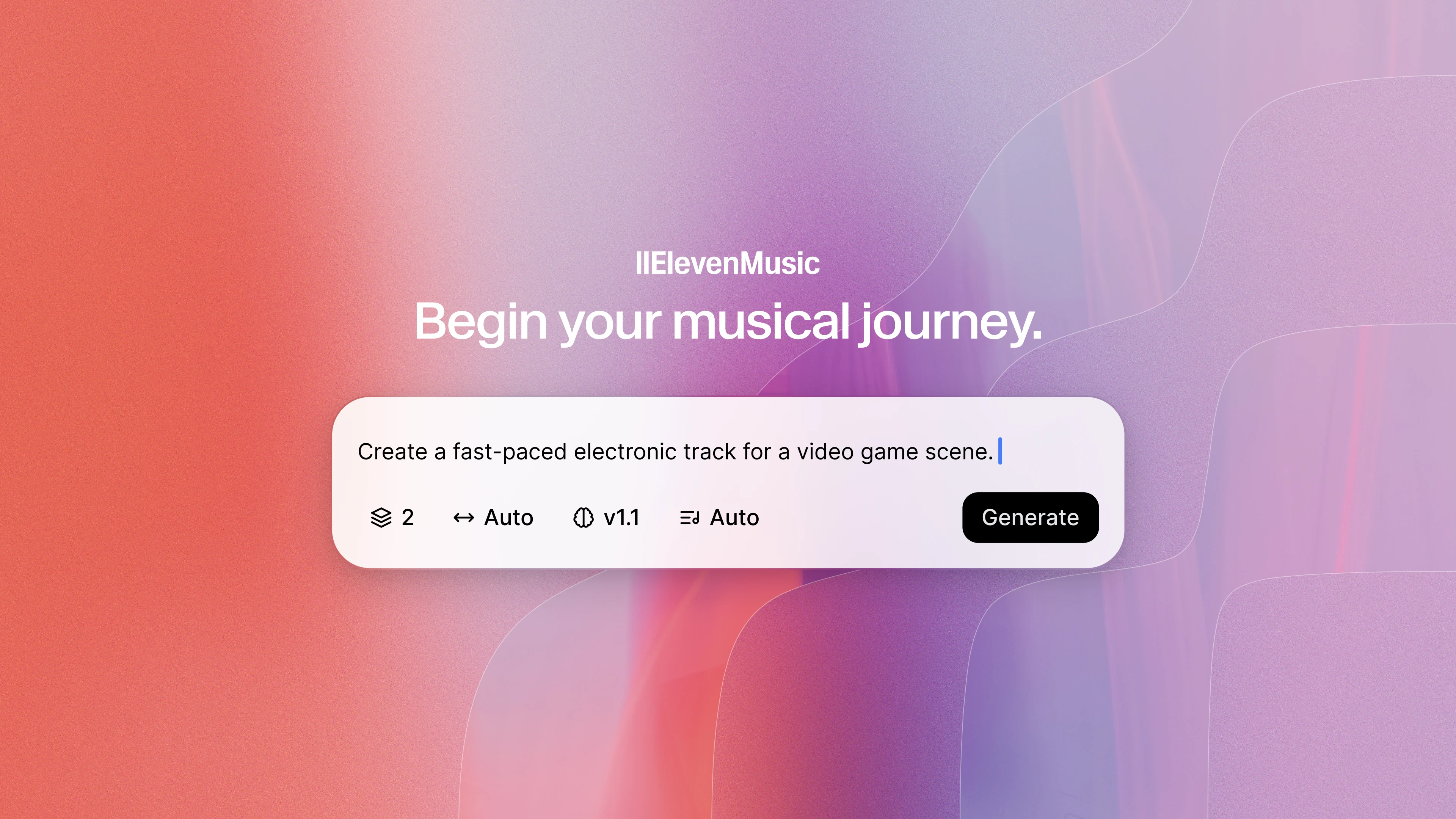
Eleven Music is Here
Studio-grade music generated with natural language prompts in any style and for countless uses
ElevenLabs
207 points · by meetpateltech · 1y ago · 271 comments
The guitar solo sounds very unnatural, especially the phrasing, which is totally random. Blues musicians are actually attempting to say something through their instrument. This was just a random number generated solo played by a 6 finger three handed robot. No thanks, lol.
I have no proof but I'm convinced that the song here is AI made: https://www.youtube.com/watch?v=hL1Fg1QnDig
I liked it but it still feels like AI to me.
[1] often being 'modern song lyrics set to a historical style of music'. I don't know how to describe them exactly but they feel 'wrong', in the same way AI text is hard to critique but feels wrong.
And those guitar solos were terrible.
Chess players are more like athletes. You need to be top 0.01% to make a living. You also need to start at a very, very young age.
If the future for commercial artists/composers is comparable to chess players then the GP is doom already.
I'm actually a little excited to see what happens.
(For reference, I'm responding with such a long post because I have a pretty unique perspective to share compared to the hacker news crowd, and also, I wish someone had told me this too, when I was a teenager.)
I heard it five years ago and hated it because it sounds like slop, I heard it today and hated it because it sounds like slop. Game devs (the ones you actually want to work for that aren't just pulling asset flips), by and large hate AI art, and gamers by and large hate it too (There's a whole movement about not using it in games lol).
On top of that, professional musicians are so, so guilty of using music libraries to produce music — Guy Michelmore on Youtube (@ThinkSpaceEducation) has a really, really good video that I can't find right now, where he demonstrates using music libraries to bootstrap a composition. It's really unlikely to be the case that if you're working as a professional musician, that you're going to be producing all of the work of a given composition (even though it is very, very valuable to do that as a beginner because it helps you learn a shitload). Finally adding to this point, there's a cottage industry of people on Youtube who spend time pulling apart world-famous songs and figuring out who they're reusing for the bassline, what bands they sample parts of the audio segments from, etc. Hell, there's a whole browsable library of this: https://www.whosampled.com/
Separately, as a burned out folk+classical musician whose friends and family went on to be nationally recognized musicians (I dropped out of the folk scene due to gender dysphoria and presentation woes lol, but one family member did tour the world playing music when i was a wee bab), music has never, ever, ever been super profitable for anyone other than the very lucky or the very, very wealthy. You are very, very lucky to break even on the amount of time you spend, let along equipment costs. Even the internationally recognized composer John Cage had his main living selling mushrooms to Michelin star restaurants. Everything else I can say about this already has a really, really good write up about this here: https://klangmag.co/lifers-dayjobbers-and-the-independently-...
So between "You're unlikely to actually make money solely off music", "Professionals rarely write the entire piece themselves and will reuse things from other artists, either from a music library, a sample bank, or making their own samples", and "There's a whole slew of game developers out there that want real, human-made music, with all the soul and artistry that that entails", I don't really see a reason why this would take the wind out of anyone's sails.
But even if all of that wasn't the case, the question is ultimately: Why are you engaging in a hobby if it not being profitable, or you not being successful, causes you to lose any motivation? Why is that the main source of motivation for you, such that the possibility of losing that motivation causes you to lose all pleasure from the wonderful, unique experience of writing, composing, and performing music? I think this comes down to like, is your motivation for making music external, or internal. Does your joy of making something come from making the thing, expressing yourself and being artistic (ultimately being human in the process, because Art seems integral to us as a species, and engaging in it is stepping into and pushing forward this wonderful, complex history of self-expression), or some ephemeral possible future reward? Ultimately, it shouldn't matter whether or not you become a professional game musician (Which, by the way, is *absolutely* doable, and a worthy *goal* to have. I really hope you succeed!!), because the motivation to express yourself through a certain medium should ideally come from the joy you doing that and learning how to do it.
Essentially, it all comes back to the age-old, often stated: do you love learning because you love the idea of having knowledge at the end of it, or because you love the process itself. Learning to love the process is always, always going to be a stronger source of motivation and will last you through times when the progress and process are incredibly difficult.
I suppose my next question to yourself and anyone else who listens and says "this is AI slop" would be thus; if it was presented on Spotify or some other platform and not advertised as AI generated, would you still be able to tell the difference? Would your target audience?
This is where it gets fuzzy, for me. Lets say I make an album with 10 tracks of low-fi hiphop and want to sell it for $15USD with a liberal license that allows for use in commercial product. Let's also say that Bob uses GenAI to make a low-fi hiphop album that sells for $8USD assuming the same license. Which do you think the solo unpaid game dev who needs vibe music for her new cozy urban farming game is going to go for?
It's not just about consumers being able to tell the difference between GenAI product and human product, which they have proven pretty terrible at when we look at code, visual art and writing. The HN crowd is perhaps more adept at it, but as much as I enjoy this site, the HN crowd represents a tiny fraction of the available market despite what certain egos around here may think.
That is what takes the wind out of my sails; not that the GenAI can easily produce electronic music that sounds like mine, but that it can do it on a speed and scale that renders me not competitive.
To clarify, I never intended to make it my full time job. I like electronic music, saw a lot of artists on Bandcamp selling albums and doing music for games and figured hey, I think I can do that and maybe supplement my primary income a wee bit...you know, because here in the US, rather than fixing the predatory economy, we just push everyone into turning every hobby into a side-hustle. To your point about why I am engaging in a hobby where motivation is so easily lost, well...I will need to chew on that a bit. I am the type of person who enjoys trying different things to learn what I like and what I don't before investing in it more. I also wonder if there's a difference in the fact that I make electronic music with, well, electronics (into a bit of circuit bending, as well), versus someone who plays a guitar or oboe, which takes significantly more dedication and practice than what I enjoy doing.
Was I relying on making money off music? Nah. I am not even remotely close to that level, yet. But would it have been nice to put up a few albums to sell on platforms like Bandcamp? Sure! But the advent of GenAI makes me wonder if my limited free time would be best spent on other hobbies that stand a better chance of both satisfying my desire to create and putting a few extra bucks for lunch in my pocket once in awhile.
The solo was pretty funny though.
I would've believed he's real, just passionate about music on his big yellow bus.
As a drummer keeps time, the band reacts by looking at the drummer’s hands and the sway in their posture. A drummer intensifies their playing as they respond to the feeling of air being pushed from guitar cabinets. A lead guitarist looks back at their friends and smiles when they are about to play that sweet lick that the bass player likes to play along with.
These are just simple examples that make all the difference when you listen back. I also can't imagine paying hundreds of dollars to go see an AI "perform" this solo at a concert. When I listen to music, I'm remembering the moment, the feeling, what the artist was doing to create their art. So still... no thanks!
When I see AI salesmen thinking they can attack into art, I think they naively see it as inherently imprecise or arbitrary, and they think because their technology has these properties it will easily cross over. This is going to lead to a lot of faux pas (remember NFTs?); it would be prudent to attack problems where some kind of correctness can be mechanically judged... OCR and software development are reasonable verticals at opposite ends of complexity to focus on, and pursue artistic rendition in a more experimental way letting artists approach the technology and show how it is useful.
I was live-reading lyrics sheets to some songs I’d never heard while jamming with a big group. Hit a chorus with some really great phrasing and bungled it the first time through. But the second time, the other guy singing and I just automatically made eye contact and had a whole conversation through body language.
“I’ve got it this time” “Yeah?” “Yeah” “Oh fuck yeah” “Fuck yeah indeed, my good fellow”
it's okay to just say you're not that interested in music
If you are an artist you could always slice, embellish, or otherwise process outputs into something so I guess it's not totally silly. But I get at best real estate video vibes, or unironic early '90s clip art and Comic Sans vibes and presumably some team of expensive marketers worked hard to select these examples, which is doubly hilarious.
I can generally understand that music has moods, but don’t think I could distinguish human-generated music from silicon-generated music at this point (unless I recognize a specific artist, of which there are vanishingly few I’m capable of)
For example, a podcaster/youtuber may want a short intro track. An entertainer or a marketer may want some generic or silly background music.
Does it have a use case for a producer/musician? Maybe. It might give them ideas for chord progressions, melodies, etc. But real music does that too, and much more effectively.
And if you're focused on chopping up samples and sounds on an ableton push or similar this can be a tool of endless possibilities.
But most studio-bunnies already have memorised catalogues of sample libraries like Omnisphere for that
Maybe the fundamental issue is that this shouldn't compete with a human picking up a guitar and having fun with it, and the only reason it does is because we keep tying questions like "survival" to whether someone can make woodchip earnings reports less boring to read instead of trying some other way to be a community?
So the audience doesn't get bored.
If you look at Taylor Swift's first 12 number one hits, each of them was written by a different writer. Compare that to bands from 30 years ago, many of whom wrote and recorded all the songs themselves.
Labels don't sign rock bands anymore because actually recording a rock band well in a studio is 10x the cost of just using a sampler and a single artist singing. I know folks want to blame AI, but it's really just enabling the latest iteration of this trend.
I'm not defending the whole thing. It's a shame, and I love going back and listening to my old Rush albums. But AI is not the problem here. It's the incentives.
Any decent studio can make a U87 on vocals, DI bass, Fender amp and several SM57s on drums sound as good as almost any album from 1970-2010
Hell I’ve seen a five part band get away with three mics total including drums and it was a smash hit
Rock “died” because culture moved on, not because of it being inherently expensive to record (which it’s not)
All kinds of indie, all kinds of metal, all kinds of rock, all kinds of everything.
The main difference is no MTV or rock radio. Prog rock? There is probably more prog being made now than ever.
That is not the issue. The issue is how incredibly generic the music is.
It also doesn't let you combine genres to make really strange sounds like audioLM can do.
This is just another Muzak generator like they use to play at Dennys. As generic music as possible to the appeal to the most average of average listener.
I think you really need to train your own model if you want to explore creative sound design or algorithmic composition. It just isn't going to be a mass market product worth venture capital money.
What it gave me was some horrible ballroom-tango like abomination with prominent tempo, like a paso doble. The typical Ballroom tango sound that gives you ear cancer. I.e. it completely failed (Argentine tango sounds nothing like this).
P.S.: You can't mention any names btw, I asked for D'Arienzo (instead of "golden era") but it refused the prompt on copyright grounds.
It also refused for edad d'oro, with the same reasoning, i.e. it seemed to think this was an artist of some sort ("edad d'oro [de tango]" is just the Spanish name for golden era of tango -- go figure).
And re. copyright: as of 2024, all of Juan D'Arienzo's recordings from the 1940s are in the public domain in Argentina.
[1] https://www.youtube.com/results?search_query=drummer+replica...
And then I found this live version here that I'm studying: https://www.youtube.com/watch?v=pPQZsp59szo
I was having a conversation with a former bandmate. He was talking about a bunch of songs he is working on. He can play guitar, a bit of bass and can sing. That leaves drums. He wants a model where he can upload a demo and it either returns a stem for a drum track or just combines his demo with some drums.
Right now these models are more like slot machines than tools. If you have the money and the time/patience, perhaps you can do something with it. But I am looking forward to when we start getting collaborative, interactive and iterative models.
Currently, all these AI tools generate the whole song which I'm not at all interested in given songwriting is so much fun
For collaboration I believe that _lineage_ is important. Not just a one-shot output artifact but a series of outputs connected in some kind of connected graph. It is the difference between a single intervention/change vs. a _process_. This provides a record which can act as an audit trail. In this "lineage" as I would call it, there are conversations with LLMs (prompts + context) and there are outputs.
Let's imagine the original topic, audio, with the understanding that the abstract idea could apply to anything (including mental health). I have a conversation with an LLM about some melodic ideas and the output is a score. I take the score and add it as context to a new conversation with an LLM and the output is a demo. I take the demo and the score then add it to a new conversation with an LLM and the output is a rhythm section. etc.
What we are describing here is an evolving _process_ of collaboration. We change our view from "I did this one thing, here is the result" to "I am _doing_ this set of things over time".
The output of that "doing" is literally a graph. You have multiple inputs to each node (conversation/context) which can be traced back to initial "seed" elements.
From a collaborative perspective, each node in this graph is somewhat independent. One person can create the score. Another person can take the score and create a demo. etc.
I believe there is massive room for improvement over what is currently available.
However, my larger point isn't "I want to do this one particular thing" and rather: I wish the music model companies would divert some attention away from "prompt a complete song in one shot" and towards "provide tools to iteratively improve songs in collaboration with a musician/producer".
Of course, because automation serves the interests of capital (being created by, and invested in, by the capitalist class,) the end result was just that workers worked more, and more often, and got paid less, and the capitalist class captured the extra value. The Luddites were right about everything.
I don't know why people expect the automation of intellect and creativity to be any different. Working at a keyboard instead of on a factory floor doesn't exempt you from the incentives of capitalism.
Subsistence farmers weren't cramped in filthy disease ridden workhouses, getting paid in company scrip, getting mangled by machines (OK they were but probably not as often) or being locked into burning buildings because preventing theft of stock was more important to owners than the lives of employees. And subsistence farmers owned what they produced and the means by which it was produced, whereas industrial workers owned nothing but the pennies in their pocket, and likely owed more than that to the company.
It took years of often violent protest for workers to return to even the basic level of dignity and rights once afforded to craftsmen and farmers. Not that the lives of subsistence farmers and craftsmen were good, but they were better than what the dehumanization of mass production and automation created.
But then comparing farmers and workers in this context is a bit specious. It would be more fair to compare, say, textile workers before the automated loom and textile workers after. Obviously the former had it much better off, which was precisely the problem automation was intended to solve.
Why was that the American dream at the time if farming was the worse option?
people are, unfortunately, and collectively, not ready to seriously interrogate the economic or political situations in which we find ourselves. we will never see the utopian promise of automation under capitalism. there will always be an underclass to exploit.
> that requires recognizing the humanity of 99.9% of people
I will go as far as to say there was never a time in history when people got rights because some other group “recognized the humanity in them” or something. No, it was through necessity. The plague in Europe caused a shortage of workers and brought an end to feudalism. Unions got us Saturdays off through collective action. The post-war boom and middle class prosperity happened because employers had no other options. Software engineering was lucrative because there was a shortage of supply.
Even if there is some future where robots do chores, that’ll only leave time for more work, not poetry writing time, unless there is a fundamental change in how the economy is structured, like I outlined above.
But it's the fun thing about being humans, I suppose. Our insatiable greed means we demand endlessly more.
As a musician, that's what I find most compelling about Suno. It's become a tool to collaborate with, to help test out musical ideas and inspire new creativity. I listen to its output and then take the parts I like to weave into my own creations.
The AI music tools that generate whole songs out of prompts are a curious gimmick, but are sorely lacking in the above.
I haven't used the elevnlabs one, but I've checked out suno and udio, and to be honest the tech is amazing. But like with a lot of genai images, the current music models have the same smell to it.
These models can def be used to crank out commercially sounding music, but I have yet to hear any output that sounds fresh and exciting. If your goal is to create bro country, these models are a god-send.
With that said, I do believe that musicians will start to create music with these tools as aid. I've tried to use them for generating samples and ideas, and they do work well enough.
The more tech advances the cooler it is to bury your head in the sand. Studying by paper & candlelight has never been more of a flex.
Unless you're talking about EDM people and those adjacent. Not that they're not "real musicians" but they're much more about tech and gadgets so I can see them using it more.
While there will no doubt be many that feel they're above using tools like these, the reality is that if you want to make money out of music - you're going to make music for the masses.
And if there's one thing these models really excel at, it is to make commercial sounding music. Everything sounds nice and bland.
The tech here is fantastic. I love that such things are possible now and they're an exciting frontier in creation.
It's very dystopian to feel that the robots are making generic human-music with indescribably lifeless properties. I'm not an artist, so I don't feel personally attacked. Much like image gen, this seems to be aimed at replacing the bare-minimum artist (visual or auditory) with a "fill in the blanks" entertainment piece.
This is a fruitless and snobby dichotomy that was attempted so many times in human history, and it makes no sense.
There will always be art made for success and/or money, but drawing a line is futile.
Händel used to be a bit like a pop musician.
And intellectual snobbishness or noble ideas do not make art more valuable.
A kid singing Wonderwall can be art, too. As can be a depressed person recording experimental field sounds.
Feel free to call art bad, but assuming an obvious and clear separation between art and entertainment is the exact opposite of the spirit that enables people to make or appreciate art, in whatever form, culture or shape.
Handel was never a "bit like a pop musician." This fundamentally misunderstands how music during his time, mostly funded and enjoyed under religion and wealthy patronage contexts, was listened to. Mostly only the wealthy listened to his works, and those elite audiences were prone to viciously enforcing stylistic norms. The only real way the working class heard his works were in the occasional public concert and occasionally in church. At no point in any of these settings was there a lack of stylistic gatekeeping or snobbery.
I know this kind of nihilistic "everything is good, I guess, good doesn't even mean anything" attitude is popular in some spaces, but this lack of standards or gatekeeping in favor of a tasteless desire for increasing slop production regardless of quality is how we got poptimism and the current state of music. No longer is there any taste making, just taste production via algorithms.
Sometimes we need a bit of snobbery to separate the wheat from the chaff, and being a gatekeeping snob against AI music is what our current day and age needs more of!
Nobody cares. I've heard the same thing when electronic music came up. The old ones couldn't stop complaining about this "computer music" where nobody does real handwork anymore.
I see it as democratisation of art. Everybody can do it now and this is a good thing.
Let's face reality. There is no way back. We'll see what comes of it. I've seen fascinating videos recently on reddit. Things people came up with and would have never gotten the budget to be made. It's great.
Regarding Händel, I think you are misunderstanding my argument.
What I meant is that, to my knowledge, his music was, at his times, a lot more pleasing to the popular tastes among his audience than, for example, Bach's.
The size or class of that audience was not my point, or that the production and commissioning of music was happening under different circumstances than today. I am well aware of that, and not sure why you think I wouldn't be.
In the end, there still was a metric of success, elite or not.
And it is simply not true that the main purpose of art is to "challenge". That can be a part of good art, but is not the primary purpose.
Art is also for enjoyment, by an audience (even if it is an elite audience), and also by the artist! I say that as a person who enjoys a lot of music that others might find obscure or unenjoyable.
But being "challenging" is not a value in itself. Twelve-tone music is as challenging as Freejazz or IDM or baroque music, all in different ways.
Some art is "challenging", but still artistically uninteresting and uninspired.
I was not making an argument for AI-generated slop, I was making an argument against ungrounded snobbery in defining what "art" is.
The societal circumstances you describe are not changing anything about my point. Among the wealthy, Händel was famous and a "crowd-pleaser" (for the wealthy elites, the royals, the clerical elites, it doesn't make a difference here), not a "challenger".
That was my point.
There was a discussion of "E-Musik" vs "U-Musik" recently on here, when a list was posted that reduced electronic music to Stockhausen and academic electroacoustic music.
https://de.wikipedia.org/wiki/E-_und_U-Musik
There is no translation of these German terms, as far as I know. But that's no loss.
It attempts to split music into "serious music" and "entertainment".
"E-Musik" was meant to differentiate classical music from music aimed at being easy to listen to. And while efforts to create new "E-musik" in the 20th century led to some interesting music and experimentation, it also led to the funding of loads of boring snobbery (in my ears).
It's a good example for what I consider wrong about the definition I was answering to.
1. Marcel Duchamp. 1917
2. Andres Serrano. 1987
3. Maurizio Cattelan. 2019
4. Darren Aronofsky. 2017
5. John Cage. 1952
6. Vito Acconci. 1972
The framing is dependent on the content
But the art isn’t in the content, it was in the statement it was making about the absurdity surrounding the fact you could pay to put anything in an art exhibition. Swap out the white urinal for a blue one, it’s the same point.
It is reminiscent of Fountain. Not sure if there was an intentional connection.
That "generic" and "indescribably lifeless" feeling you get is because the only thing communicated by a model-and-prompt generation is the model identity and the prompt.
Art is, above all, subjective.
> It's very dystopian to feel that the robots are making generic human-music with indescribably lifeless properties.
Painters said the same thing about the camera. Photographers said the same thing about Photoshop.
Personally, music is sacred for me so making money is not a part of my process. I am not worried about job loss. But I am worried about the cultural malaise that emerges from the natural passivity of industrial scale consumerism.
I'm hoping it will eventually become better, or maybe I haven't quite seen stuff prompted properly yet, but all I've heard coming from an AI feels aggressively mediocre and average, not in a "bad" way but in the "optimizing towards being palatable to the average person" way. Like the perfect McDonalds meal that the algorithm has found out can be 30% sawdust and still feel appetizing. I don't want that boundary being pushed. I feel we will live in a worse world if we do.
> oh now they won't have to do that boring mindless stuff like playing cover versions any more
That's how most musicians make their first $, doing covers or making something generic enough to be saleable as background music
For all of human civilization the future has been built on the backs of those the came before (on the backs of giants). But that climb is slowing, maybe halting. Which then compounds when the new giants that would have risen up don't. AI replaces the messy, slow process of becoming with instant regurgitation, replaces those that would have grown. The future, built on the backs of giants, stalls when those giants never get the chance to rise.
AI is entropy weaponized against every layer of future progress. But everyone is too busy salivating at potential cost savings to see it.
In image gen: comfyUI gives a node-based workflow that gives a lot of room for 'creative' control, of mixing, and mathematically combining masks, filters, and prompts (and starting images / noise {at any node in that process}).
I would expect the same interface for audio to emerge for 'power users'.
It's actually a bit like photography. A bunch of randomly taken pictures piled together is not art. It needs to be done with purpose and refinement.
Basically, in my own opinion, art ≠ a function of technical difficulty.
Art = Curation, Refinement, and Taste
This is taking a monkeys on a typewriter approach to all music. Click a button, see what the monkeys made and then click another button to publish to Spotify while you figure out a way to either market the music or just game search and digital assistants by creating an artist with a similar or slightly misspelled name as someone popular. Rinse and repeat.
This phrase though could be plunked down at any point in the last hundred years and you'd find someone making it.
About autotune or electric guitars or rock or jazz or punk or disco or Philp Glass or Stravinsky... one could go on for a long time.
If anything, this is a lateral move.
Yes there are smaller creators who are trying to make something net new, but unfortunately 99.9% of the small artists are also derivative and lack originality.
I see AI music as just continuation of the sad state of the industry at the moment. Hopefully it accelerates the demise of the industry as we know it and restarts the cycle of creation.
This wouldn't necessarily be a problem as long as people were still free to create on their own. But instead, everyone is forced to spend more hours in menial bullshit jobs for less and less (relative) pay just to survive. Give everyone enough resources to live at least a simple life, and both human creativity and AI creativity can blossom at the same time. But of course that means fewer yachts and hookers and drugs for the billionaires, so it is verboten.
Eventually, the reason why became obvious. I grew up listening to all that music with my closest friends. It's the memories I associate with that music that keeps me coming back. I moved away 30 years ago and never established friendships like that again. New music feels hollow to me because I don't have buddies to share it with and build associated memories.
It just feels so profoundly wrong and exploitative of both the artists work the models have been trained on, and the users actually using these services, that some generative AI uses a few cents worth of electricity and a few more cents of allocated overhead to spit out a song, yet the user is then expected to pay $20 a month or whatever, forever, if they want to use that song in a say a YouTube video.
If I pay an algorithm to make me a song, I should own the copyright to that song, not the company that made the algorithm, and it should cost like a dollar at most. Until someone can offer a service that works this way, or I can implement my own self-hosted algorithm that can do this for me, I have less than zero interest in these kinds of services. They are a ripoff of the highest order, and actively hostile to their users in terms of their predatory pricing models.
I'm a bedroom hobby musician with no dreams of ever making it big, but even so, I'm looking at the hours I'm spending trying to improve my skills and thinking what's the point, really, when I could just type in 'heavy metal guitar solo at 160bpm, A minor' and get something much much better?
I know there is value in creating art for art's sake. I've always been up against a sea of internet musicians, even when I started back in 2000. But there's just something about this that's much more depressing, when it's not even other people competing with me, but a machine which hasn't had to invest years of its life in practice to beat me.
The next slide was labeled "pro," and it was just a picture of Jimi Hendrix on-stage mid-performance.
I'd submit to you the notion that even if the machine can create a billion billion iterations of music, it still cannot create what you will create, for the reasons you will create it, and that's reason enough to continue. Hendrix wasn't just "a guy who played guitar good." And a machine that could word-for-word and bar-for-bar synthesize "Foxy Lady" wouldn't be Hendrix.
Hendrix, also, can't be you. Nor you him.
There are hundreds of bands who play three-chord doom or mindless-shredding grind who just learned one thing and do it well, and who play to hundreds of people multiple times a week (often including me). We go to see these bands not to see what they can play, but to see what they are saying with what they play.
This is why I feel that I can never describe LLM-generated content as 'art'. Art is about the story. People will go and see a punk band who only know three chords if they play songs about things that resonate with them. Bit of a tangent, but this is the same reason that I genuinely believe that if you could bio-engineer a steak that tastes exactly like one from a well-looked-after cow from a notable breed and a good farm, most people would still prefer the cow. The story matters - the fact that a person put effort and experience into something really is important.
"This solo is sick" is a fun plus-point, but it doesn't matter if the song doesn't mean anything to you. If proficiency was the only thing that mattered then we'd all be listening to the worst kind of prog.
Open mics, music circles and concerts also remain untouched for the moment.
Do you regularly play with other people? That is a good way to disabuse yourself of the notion that all that matters is technique.
"That is not allowed by our terms of service"
I think the rebellious nature of art inherently has boundaries these people won't cross.
The vocals are definitely not that.
But did you really make it? Or was it the AI? If someone commissions a piece of art from an artist, I don't think the commissioner would be able to truthfully say they made it, even if they had a specific vision for what the piece of art should look like. But if you've edited or changed the track enough yourself, maybe it would be fair to call yourself a co-author...
while we spin our wheels trying to displace those of us who have decided to produce culture, our adversaries will invest in medicine, energy production, transportation, etc...
what profound contempt for humanity a culture must have to produce tools such as these
I am less interested in the "one-shot" approach here with text-to-prompt. I see seamless transitions but that seems like an afterthought.
It will probably also extinguish quite a few mad musicians and mediocre artists.
Suno's version of Mandate of Heaven [0]. This is my baseline, it was generated with their v4 model and so far it has remained my favorite AI generated song. I regularly listen to this one track and it brings me joy. There's many places where I think it could be drastically improved, but none of the competitors have managed to surpass it nor have they provided tools to improve upon it. The pronunciation is a bit bad sometimes and it fails to hold notes as long as I wish, but overall it has gotten the closest to my vision.
Eleven Music's version of Mandate of Heaven [1]. They don't allow free accounts to export or share the full song so you can only try a small fragment. It has much crisper instruments and vocals, but it has terrible pacing issues and pronunciation. The track is 4 minutes long, but the singer is just rushing through the track at wildly unexpected speeds. I cannot even play the song after it finished generating, so I haven't even been able to listen to the whole thing, it just gets stuck when I press play. Maybe some kind of release-day bug. The only tool that Eleven Music gives you for refining and modifying sections is "Edit Style", which feels pretty limiting. But I can't even try it because the track won't play.
Producer.ai's version of Mandate of Heaven [2][3]. This one has slightly worse instruments than Eleven Music, but the vocals are a bit better than Suno v4. It also has severe timing issues. I tried asking it to generate the track without a vibe reference [2] and also with a vibe reference [3]. Both versions have terrible pacing issues; somehow the one with the vibe reference is particularly egregious, like it's trying to follow the input vibe but getting confused.
It feels like AI song generation is just in a really awkward place, where you don't get enough customization capabilities to really refine tracks into the perfect direction that you're imagining. You can get something sorta generic that sounds vaguely reasonable, but once you want to take more control you hit a wall.
If one is willing to bite the bullet, there's a paid program for generating high quality synthetic voices while maintaining fine-grained controls: Synthesizer V Studio 2. But I haven't been able to try it out because I'm cheap and there's no Linux support.
The ideal workflow I'm imagining would probably allow me to generate a few song variations as a starting point, while integrating into a tool like Synthesizer V Studio 2 so I can refine and iterate on the details. This makes a lot of sense too, because that's basically how we are using AI tools for programming: for anything serious you're generating some code and iterating on it or making tweaks for your specific program. I would like to specify which parts of the track are actually important to me, and which ones can be filled with sausage in reaction to my changes.
Overall, Eleven Music generates instruments that sounds nice, but the singing leaves a lot to be desired (n=1). Eleven Labs is doing a ton of great product work so I'm really excited for the direction they'll take this once they're able to iterate on it a few times. A very strong showing for an initial release.
[0] https://suno.com/s/HfDUqRp0ca2gwwAx
[1] https://elevenlabs.io/music/songs/TGyOFpwJsHdS3MTiHFUP
[2] https://www.producer.ai/song/aa1f3cc4-f3e4-40ce-9832-47dc300...
[3] https://www.producer.ai/song/3d02dd17-69f1-41ba-a3ea-967902f...
Overall still quite impressive progress, though I'd prefer it if AI could remix existing artists songs that I already liked instead of being focused on tepid original content.
I'm wondering if the LLM is failing to emulate the odd and even harmonics of real recordings and that's why it seems so unnatural. It makes me feel sick. It's different than the sterile straight to digital recordings of the late 80s early 90s too.
Do any of these let people download the individual track stems? I'd be curious if taking all the stems and running them through analog hardware would remedy it. The LLM needs a producer.
What do you mean? If you screw up even/odd harmonics it will sound far less natural, like confusing flutes and clarinets.
It's amazing that the songs sound pretty natural
I draw a distinction here from LLMs used for writing code. Plenty of people freely put their code on Github or in Stack Overflow with the expectation that people could freely copy and use it. Relatively little music is shared so permissively.
(And before someone cries "fair use", I'm making an ethical argument, not a legal one. A fair use defense can protect you from a copyright claim, but it doesn't make it any less shitty to take other people's art, blend it all together, and use the result to threaten their livelihoods.)
Not sure what that actually means but it suggests they at least tried to get their training material legally.
First, where are you seeing that? And where does the "head here" link point? I'm not seeing it on the linked page or on https://elevenlabs.io/music-terms.
Second, that language is not saying "we got permission to use all the music we trained on". It seems more directly addressed at the rights they're giving you, as opposed to the rights they have to the training material. It could just as well be based on an opinion from their general counsel that it's fair use to train on all the music they downloaded, so it's "legal enough".
Third, and as I tried to emphasize above, legal is not the same as ethical. Even if they win the legal argument about fair use, it would still be shitty to take someone else's work and use it to train a model that put them out of business.
This is like the dotcom era of where every idiotic idea that ended with, "but on the internet", would get a pile of cash thrown at it. We are officially at the beginning of the end. It's only going to get dumber from here.
What is going on at ElevenLabs? Is everything vibe coded now? Is there nobody testing these products before pushing them out? This is the first time I'd characterize a product from a top AI company as complete slop from a conceptual and implementation perspective.
I feel like there's some sort of disconnect between the minds of tech CEOs and the general population's wants/needs especially in regards to creative domains. What kind of human wants this? Is there some grudge of tech people who never learned music/art/etc so their solution is to optimize it and create models so they can feel something?
Oh wait.