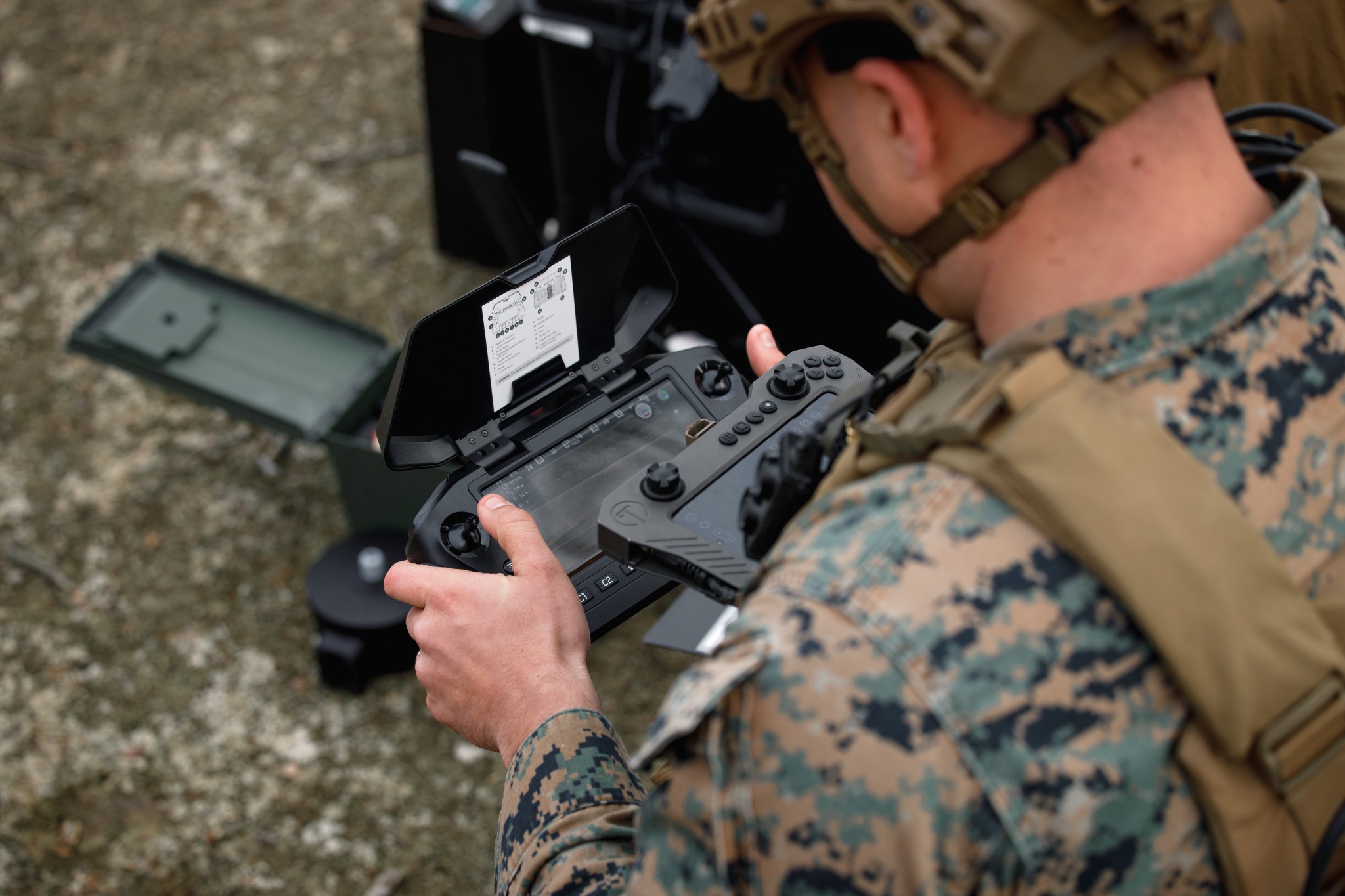
The Marines now have an official drone-fighting handbook
The manual’s publication comes amid a clear shift in defense priorities to favor drone warfare and emphasize proficiency with small attack drones.
Marine Corps Times
121 points · by Gaishan · 1y ago · 179 comments
In the Pacific theatre, Taiwan is very close to China, so possibly, attack drones will be useful similar to the Ukraine/Russia war.
There are also many different types of drones being employed. The short-range small quadcopters, all the way up to large Predator drones. Shaheds are kind of in the middle in terms of size. The boundary can be blurred too between loitering munitions (Switchblade) and drones.
For the suicide quadcopter drones, there is a realization that Skynet is the next step in the arms race. Full edge autonomy over the kill chain. No need for data link (susceptible to electronic warfare) or trained pilots or added round-trip latency.
Anti-drone tech is also changing. Interceptor drones, net-dropping drones, ground-based laser, electronic warfare, and small guided ground- or air-launched interceptors.
Also have to consider the combined arms picture, none of this can be reasoned about in a vacuum.
But I suppose my main takeaway is - no two theatres are the same, AND there is a diversity in drones. So to collectivize a takeaway around "drones" would be a reasoning error.
One thing will be certain when it comes to wars between nearby countries. You need to knock out the enemy's industrial production quickly with bombers. Or have your own industrial production that can maintain pacing and avoid culmination in a war of attrition.
Pacific theater / operation/strategic scale, IMO bigger drones and traditional loitering munitions kind of just blend together. A shaheed is just a poor man's cruise missile. Iran didn't have #s or ability to coordinate / mass #s for any strategic effect. I think Israel has like magazine depth of ~800 interceptors for low tier / subsonic threats and 1000s in stockpile. Iran was (E: *NOT) capable of saturating that.
Depending on relative size / force balance, can still drag on war of attrition after factories turn with sufficient stockpiles. I'm kind of thinking nation state actors, the hedge is really storing a few 10-100,000 loitering munition tier drones in tunnels to ensure some sort of conventional MAD with neighbours. But really that's for... competent / connected nation state actors who has backup ISR, i.e. piggy off US/ eventually PRC global ISR for targeting. I imagine a resourced nation can build out shaheed tier manufacturing underground.
Incidentally, we had news earlier this year that PRC/Polytech is acquiring 1M, as in 1,000,000 loitering drones. Presuming shaheed tier (2000km sky moped) since Polytech has show shaheed clones in past. That's enough to easily saturate all defenses in first island chain even if US+co prepositions every piece of interception hardware ever made or plan to acquire in next 10+ years. That's strategic level shaheed spam.
My main takeaway is cheap loitering munition/drones can reasonable replace potentially short range fires (~2000km), if there's enough of them to casually bleed interceptors, AND if there's survivable theater level kill chain. Last part is really... what separates Ukraine, Iran... maybe Russia's current... hobbyist tier efforts. RU launching 500+ salvos are still trying to evade anti air, with many interceptions because they don't have ISR / killchain to eliminate antiair. It's easy to build a lot of shooters, it's hard to build out the sensors to hit important things. In a highend fight, at least one side (and possibly both) side is going has the ISR and magazine depth to ensure antiair becomes irrelevant and then it will be matter of munitions + concrete attrition math
I think we're due to a cambrian explosion of drone types and counter-measures in the coming decade, in your mass-drone scenario I think smaller drones will probably be possible to counter with cheap "technical"-like vechicles armed with cheap enough sensors/radars and automatic-/machine- shotguns (there has always been experiments but no pressing use for them in the past).
So a stockpile of Shaheeds can be largely countered by launching something very similar provided you can detect it. You could very much imagine having a vehicle which can simply leave the payload behind for better air speed when used in interception mode.
This is quite different to most conventional missile threats where the time between detection and interception, as well as the performance characteristics, necessitates extremely high performance interceptors.
An analogy would be that you can hit a baseball with a bat, but not a bullet even though they're both just ballistic projectiles.
In my mind I'm calling it "squad-level-airpower" , regular airpower started with spotters, then fighters and CAS in WW1. By WW2 it had expanded the role to achieve operation and theater levels goals, and finally with nukes also a strategic level, and still remains required to achieve goals on larger levels.
However with air-defences creeping down to MANPADS, CAS became more problematic and adding then the cost of planes and pilots made it far from universally useful in a close war.
Drones being man-luggable and -operatable and cheap with hardly any infrastructure more or less flooded a that useful niche, and it's not like that niche was unsurprising, just not successfully exploited previously as the US army tried with the VZ-1 and HZ-1.
Like you mentioned with the Iran conflict, classic air superiority still holds the crown to achieve larger goals on strategic levels (even if drones helped out on an tactical level).
It's huge, though. Many tiers of equipment, doctrine, vehicles, product time to market improvements, RF equipment, radars, stealth tech, software, battle drills, and even new job specializations of various levels. It's intense, and a constant iteration cycle at a pace we haven't seen for at least a long time, but possibly forever.
I wonder how susceptible these would be to Potemkin targets (https://en.m.wikipedia.org/wiki/Dummy_tank)
Things could get very MGS V very fast.
This works pretty well for fighting limited wars where part of the justification is to develop and maintain military readiness. Would it still be true in a large scale war against China - could you pump out a million drones a day - or would you wish for a doctrine that included reusable drones?
Since at least WWI, the US military has been very aware of their dependence on the industrial base:
https://en.wikipedia.org/wiki/Dwight_D._Eisenhower_School_fo...
(That I know of, their awareness of high-capacity supply line issues goes back to at least the Civil War.)
Historically, the US military had a considerable industrial base of its own - arsenals, navy yards, etc. - which could manufacture anything from a pistol cartridge up to an aircraft carrier. Unfortunately, Congress shut all of that down in the later 1900's, in favor of defense contractors. Gov't-owned facilities just couldn't compete at greasing Congressional palms.
And how many US can actually produce, i.e. bluntly, US military has _never_ fought any adversary on the scale of modern PRC. WW2 JP+DE had like <50% of US economic and industrial power, while being ganged up by multiple other allies with reasonably large militaries. Peak cold war USSR also similar scale (1/2 US) and realistically US war plan for NATO invasion was to stall and nuke the Fulda gap. Asymmetrically stomping Iraq still took 5 carriers on high tempo operations (not sustainable for more than 1-2 months), favourable coalition basing, completely compromised IADs... multiple months to dismantle power charitability 1/100th size of modern PRC. Even Korean war vs peasant PRC fought US+UN to stand still. Vs modern PRC with 150% US GDP by PPP and and industrial gap like current shipbuilding #s, in their backyard, I suppose the answer is, get defense spending back to 10%-15% of GDP (at least Korean or Vietnamese wartime economy) and go figure out form there.
I think something to keep in mind, the US hasn't fought a war on the home front since 1865. The Spanish American war, WWI and WWII, Vietnam, Korea, the Gulf war, Afghanistan, Iraq - none of these were fought on American soil, with the exception of Pearl harbor, which was a navy base, not a major manufacturing site. So we haven't really had to reckon with what happens if our homeland is under fire - sure, we drilled for it during WWII, worrying about Nazi bombers and Japanese sabotage but neither actually happened.
It doesn't look like our wars are going to get closer anytime soon, but modern planes and rocketry have much greater range than in the 1940s the last time we were at war with countries with significant resources. If we ever come head to head with China, their missile capabilities could be a real concern.
I think all this talk of who would win often ignores that factor to. There is no realistic total war scenario between China and the US - China doesn't have any desire or capacity to role tanks into Washington and the US doesn't have any desire to role tanks into Beijing.
The war, if it comes will be China trying to take control of Taiwan and the US intervening on the side of Taiwan. Victory for China looks like Taiwan under PRC rule, victory for the US looks like Taiwanese independence.
With that in mind "all" the US needs to be able to do is make the cost of the invasion/maintaining the supply lines too high. If I was China the drones I might worry about the most would be underwater!
"Sir, we have successfully culled the enemy deer population by 30%. Thei Department of Wildlife is issuing no further permits for this season, and their hunters are emotionally devastated. The impact on their civilian morale cannot be overstated. Where should we direct our next billion dollars? I was thinking maybe drones with long-range microwave to boil off their swimming pools...?"
The problem with the "drones will do it!" narrative people put out there is that it's anything and everything but what the drone is, what it weighs, it's volume and current production are all absent figures which simply fill in as "better then whatever you just said".
For example, a reasonably portable drone capable of ISR and limited infantry scale strike would be the Switchblade 300, already provided to Ukraine. This has a range of 30km a top speed of 161km/h and 20 minutes of flight time, with a 1.6 kg explosive payload - which is respectable. You could carry quite a lot of these to the front if you wanted to.
That particular system cost about $50,000 a unit - optimistically. It's likely that price could be bought down, but it does include the drone, launcher and ground control system. A reasonable price today would be closer to $15,000 judging from more recent products being offered.
If I hunt around a little then locally I could buy something like this[1] locally for $1,300 which has a 1kg drop payload...but only 10km of range, and a 45 minute flight time - and let's remember better radios will eat into that payload and flight time.
Now obviously different drones can do different things, but the core point is the same: drones don't magically not have logistical "mass". You can't fly a bunch of drones to the front for free - you need to either recharge or refuel them at the destination. Which means you need to stockpile them. Which means they can be spotted and destroyed on the ground. The loiter times aren't "days", they're still better measured in minutes counting hours at most.
All of these disadvantages apply to artillery too, of course but the point is that once you start considering the actual range brackets involved and the parameters of real systems built with current technology, including limiting technologies like energy storage, payload and physics of real explosives, the generic superweapon slips away. Ukraine is using a lot of drones because Ukraine can buy drones but can't easily get artillery and gun barrels for it. But Ukraine was also having a lot of trouble with Russia's considerable artillery advantage up until quite recently, and still is because of North Korean shell resupply.
The word "drone" gets substituted in for a superweapon fulfilling every role perfectly, with no actual physical parameters which would make it imperfect - and that type of thinking should give a lot of people pause particularly in the context of Ukraine where any number of systems have had their moment in the spotlight before either falling out of favor due to adaptation or simply no longer being the most applicable to the task (i.e. the various anti-tank weapons are still doing excellent anti-tank work...there's just very few Russian tanks any more).
Maybe ironically, I wonder if we won't see things like the Bofors 40mm guns continue to be prolific if they get successfully retasked to fighting drones (and they would end up like the M2, fighting long after it was initially conceived).
Furthermore, drones are generally difficult to detect at 400 meters unless you're using a synthetic detection system. By the time you spot them, it's too late.
camp out at the top of a 5 story building and don't move or shoot and no one will even gaze at you. 300m straight up? might as well be in orbit.
Also, swarms.
This, btw, is also why claims that some side is targeting civilians in otherwise 'productive' warfare (e.g. actually achieving things instead of bombing for the sake of fear/terrorism/headlines/photo ops) is usually just lying propaganda. Civilians are a worse than 0 value target meaning you completely wasted your munitions.
M79/M203/M320/etc
https://en.wikipedia.org/wiki/M576_40_mm_grenade
AK would be a different story, but Ukraine has a lot of 3d printers and those shells are one time use and not hard to make.
https://www.reddit.com/r/WarCollege/comments/1b0u0k0/how_eff...
Now imagine a swarm coming at you, each with explosives.
Covered in Kill Decision by Daniel Suarez
I believe both Russia and Ukraine train some soldiers via shooting target/dummy drones and skeet.[1]
And there are videos out there of Ukrainians and Russians successfully shooting down fpv drones. [2][3][4]
(Content warning: war videos but there shouldn't be any gore in them)
[1] https://xcancel.com/RALee85/status/1948675201983553864
[2] https://xcancel.com/RALee85/status/1920365175766483080
That said, if you're out in the field and there's one above you, you're boned. Can't imagine the horrors of vibing, then having a grenade plop down next to you.
They are literally posted there, stop spreading fud.
it's like the dudes that throw their rifle at the drone 6 feet away, hit it, cause it explode... but they still take shrapnel to the head and neck anyway because it's only 6 feet away.
plus what happens if you miss?
and the ammo is big, heavy, and requires special tanks. non-starter of an idea.
The US seems behind in comparison.
this handbook is public but i cant find it. Maybe one of you has it? If so, can you send it? I would be very grateful
I don't think that at this point there's ever any winning a war, not unless you brainwash three generations (NK) or genocide the population and remove any trace of them like in Gaza at the moment. And that's a relatively small stretch of land.
[1] https://www.marines.mil/News/Publications/MCPEL/Electronic-L...
But in their defense, they never anticipated having to fight a near peer adversary on land to the extent Ukraine has. But I would argue no one really saw this coming to this degree. The Bayraktar for instance, was much along the lines of US drone philosophy, costing several million a piece, The drones used in the Azerbaijan-Armenia conflict were mostly used along that philosophy as well