Move fast and don't break (safety critical) things
How Boom Supersonic uses software to accelerate hardware development
bscholl.substack.com
108 points · by flabber · 1y ago · 107 comments
[0] https://en.wikipedia.org/wiki/Multidisciplinary_design_optim...
That's how SNOPT, IPOPT, presumably KNITRO and nonlinear programming optimizers work.
Yes MDAO is "just" constrained nonlinear optimization.
You come up with a model for your thing, which often involves multiple "disciplines" like mass, propulsion, aerodynamics, loads, trajectory/equations of motion, and then usually use some framework to calculate the constraints values and objective value and their gradients
Honestly, the way the narrative reads, they're still sacrificing 1,000mi of range in the interests of an improved cabin experience. They've just found an optimisation that enables them to reach a net neutral state.
Given we're effectively talking about fuel efficiency here, it's hard to imagine airlines wanting an improved cabin vs less fuel consumption. All the incentives are on them already to meet a "barest minimum" cabin experience that they can get away with, because every bit of luxury costs them in numbers of passengers, and fuel costs.
This is the reason Delta and United and doing well right now and Southwest and the LCCs are struggling.
It wasn't true just a few years ago, but if this continues as a trend, I could see an airline sacrificing fuel efficiency for a dramatically improved onboard experience.
That said, Boom's customers - if they ever exist - will be a new business class pay extra for supersonic flights category anyway.
Most of the profit on a plane is made in business class. If airlines could fly an all-business configuration, they would. The problem is the smallest planes that can do high-paying routes like LON-NYC are bigger than that customer set. So the airline throws in economy seats, often barely breaking even on those, to fill space.
In a world with small airliner planes that can make those transoceanic and transcontinental journeys, I suspect we’ll see more all-business class flights.
People aren't usually paying 4x for first, but they will pay $10 more for Y, $30 for Z, etc.
The future of airlines is fully adjustable planes!
They’re citing historic data. It absolutely is a trend that premium travel is an increasing slice of post-Covid American air travel.
Yeah I found your problem :P.
As an engineer I find "leveraging AI" to be a very troubling idea. I'd want to know detailed specifics of just what management believes AI should be used for before I accepted such a job.
As a passenger, I damn well don't want to fly on an airplane designed with software that can't count the number of bs in blueberry.
He seemed almost proud of his inexperience, and nearly said that it gave him an "advantage" because existing engineers weren't willing to "innovate."
Incidentally, Ray Kroc, the guy who made McDonalds the $200B company it is today, didn’t know anything about running a restaurant. His closest experience was selling blenders.
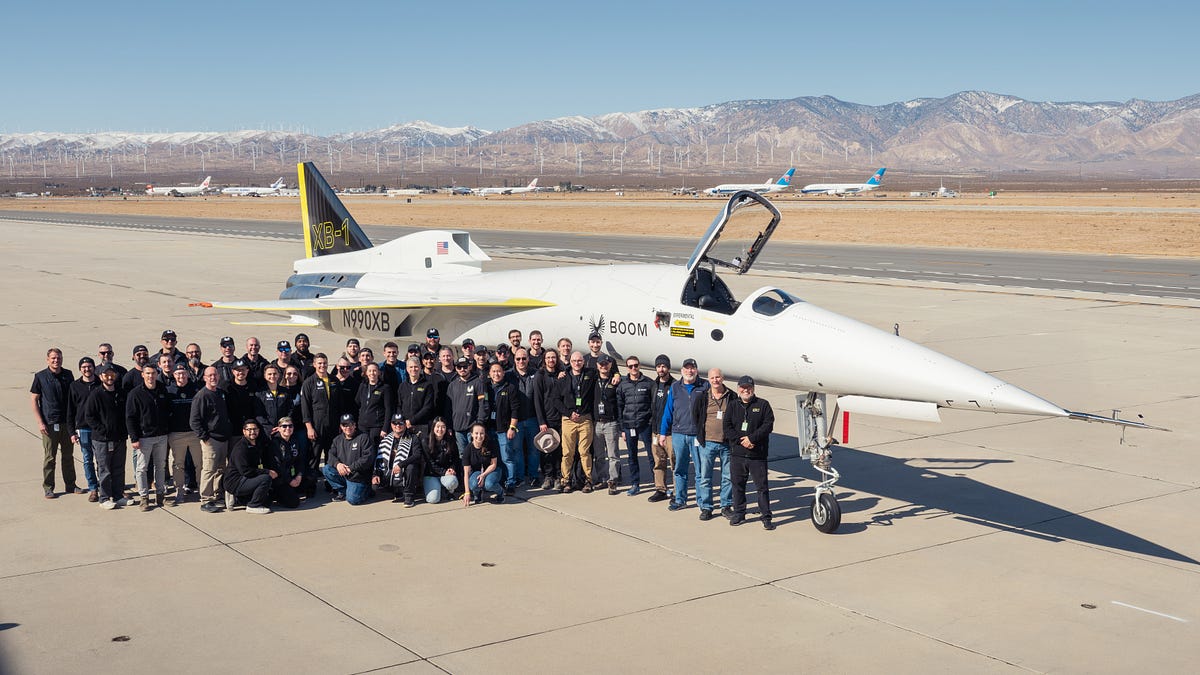
This is a great headline and very impressive. However, it’s also somewhat puzzling to see the company spend so much investment money to build a small prototype plane that doesn’t resemble a commercial airliner in any way, break the sound barrier 6 times, retire it, and then conclude they’re on their way to delivering commercial supersonic passenger planes in five years
Boom Aero is one of those companies I want to see succeed, but everything I read about them tickles my vaporware senses. Snowing off a one-off prototype that doesn’t resemble the final product in any way (other than speed) is a classic sign of a company spending money to appeal to investors.
Retiring the plane after only a few flights is also a puzzling move. Wouldn’t they be making changes and collecting data as much as possible on their one prototype?
That being said, I share your skepticism of Boom as a company. As far as I know, they still don't have an engine for their production aircraft design.
The demonstrator was to validate some basic concepts they were promoting about being able to achieve supersonic flight without supersonic booms. It achieved that at relatively low cost, and gave them something to brag about, an indication of baseline competence at certifying airframes and possibly ticked off some investor boxes. There wasn't much more to be learned about large passenger jets using their intended custom engines from a small GEJ85 powered platform, so its not surprising they haven't gone to the expense of continuing to fly it. It's not going to be useful for most other stuff they might want to test, apart from perhaps their intended custom engines which are probably years away from being certified for flight tests, never mind hitting performance and reliability targets.
This is key to me.
I'm a layman in Aviation, so I'll unpack that.
The Boom XB-1 demonstrator (1) uses GEJ85: the General Electric J85 engines, as seen on military jets (2).
This is not the desired production jet's "Symphony" engine (3), which at a guess has to be both larger and more efficient?
So whatever is to be learned from the demonstrator, it doesn't tell us much about the final engine design.
In fact, all I know about this desired engine, is that Rolls-Royce isn't making it. (4)
Are they still planning to design the engines in-house? If they're making good progress, why are we hearing about how they're replacing excel as a design tool.
As I said in the other comment:
I'm not an expert, but this seems like the engine is on the critical path to success, and also high chance of failure. i.e. Without engines, they have nothing but a glider.
And if Rolls-Royce thinks that it's either not technically or commercially feasible, then who can do it?
1) https://en.wikipedia.org/wiki/Boom_XB-1
2) https://en.wikipedia.org/wiki/General_Electric_J85
3) https://en.wikipedia.org/wiki/Boom_Symphony
4) https://www.space.com/boom-supersonic-rolls-royce-engine-spl...
[1] https://en.wikipedia.org/wiki/Handley_Page_HP.115 [2] https://en.wikipedia.org/wiki/Fairey_Delta_2#BAC_221
I share your skepticism, especially with their timeline. It has been some time since I looked at them closely, but they originally pitched developing their own supersonic capable turbofan to power their eventual production model. Especially with such a small team that seemed overly ambitious to me.
"This flight we're validating our model by pushing the real world to the limit. It should explode about 38s into the test and crash. We've cleared the expected area"
Airlines can optimise for this. Digital ID virtually eliminates security lines. Paying up for gate, t/o and landing spots takes care of the latter. There is a cost tradeoff for service in the airline business. An all-business airline flying Booms would almost necessarily have to pay up to negate these issues. (That or fly out of the FBO terminal.)
You cannot simply add gates to airports with even an infinite pile of money. It doesn't matter, unless you're going to make flights from nowhere to nowhere. Doesn't sound like a business strategy to me.
So when Boom makes a commercial airliner that hits 1000+ mph with the same availability and turnaround time as a typical passenger plane then I'll pay attention. Until then, it's for rich people who can buy their own plane.
What is the market for Boom?
In fact the chase plane for the Boom XB-1 is a T-38, derived from the N-156F. It can outrun the XB-1.
The XB-1 made use of an atmospheric trick to minimise boom propagation to ground level on one test flight, so well-known in fact that Concorde sometimes used it to accelerate as it coasted-out without an audible ground-level boom. Unfortunately that trick runs out at about M1.17.
Awesome stuff! Allows large scale exploration across all dimensions of plane design to jointly optimize all components and their interactions.
When they say simulate, so they actually mean just using ideal mathematical models in Matlab?
Fast forward to today, there's been no aerodynamically novel aircraft developed in the past decades, and from what I read, wind tunnel and glider tests are still necessary to validate aerodynamics during complex conditions, like manuevering.
There's a ton of legacy in overall airline/aircraft operations that discourages big changes.
A 2% improvement that costs 200% more to manufacture would be nonsensical to seriously propose.
"It was designed, built, and flown successfully by a team of just 50 people—compared to the hundreds or even thousands that would have been employed by a traditional big aerospace company. And we did this with roughly a tenth of the budget that would traditionally be required. People have marveled at how our small team of just 50 people at Boom designed, built, and successfully flew the XB-1, the world’s first independently developed supersonic jet. And we did this with about a tenth the capital as any other supersonic program."
Is the repetition a sign of AI writing the article?
IIRC, the last news was that Rolls-Royce noped out of that (1), which is an indicator that it's either not technically or commercially feasible.
Are they still planning to design the engines in-house?
I'm not an expert, but this seems like it's on the critical path to success, and also high chance of failure.
i.e. Without engines, they have nothing, and if Rolls-Royce can't do it, then who can?
1) https://www.space.com/boom-supersonic-rolls-royce-engine-spl...
I guess maybe it’s a recliner with feet pointing to the outside (maybe just two seats per row)? That’s the only new configuration I can imagine that would require reshaping the hull.
I saw Reed Solomon codes were invented for fast, accurate missile guidance and (in my head) that's the connection I made to his super sonic startup
Which makes perfect sense. Software is about automating things. And the more you automate, the faster you go.
A bit like how Jane Street operates I think.
This article is just another from what are fundamentally hardware companies proclaiming how they're implementing "ai" and it's doing so much to help to gather more stock/venture investors but with no actual substance.
Everything he discusses taking into account are things that airplane/engine manufacturers already do and it doesn't require ai, just some python or god forbid, an excel sheet.
His statement about the relationship between airplane and engine manufacturers is factual correct but so blatantly wrong. You think GE/PW and Boeing/Airbus engineering don't work closely with each other when a new model is being developed? You think either would risk hundreds of millions and years of development without talking to each other? How does anyone take this guy seriously enough to give him millions of dollars?
"This close approach gave rise to mkBoom, our proprietary airplane design software. Initially created in a simpler form for XB-1, mkBoom has evolved significantly and is now pivotal to designing our Overture airliner."
This is the same overture airframe that supposedly had it's final design released in July of 2022? And was supposed to be rolled out in 2025? And have it's first commercial passengers in 2029? (Ref. 1)
But apparently 18 months ago the structure was being redesigned in such a way that caused a 1000 mile range loss (that is described as "subtle" fuselage change)? And in response to that last year they completely redesigned the engines and regained that 1000 miles of lost range... Sure.
More importantly, given the FAA states they a new aircraft takes 5-9 years to certify (Ref 2.) it seems the 2029 target is not viable any longer right? So are you going to tell American or should I?
Ref. 1 https://news.aa.com/news/news-details/2022/American-Airlines...
Ref. 2 https://www.faa.gov/aircraft/air_cert/airworthiness_certific...