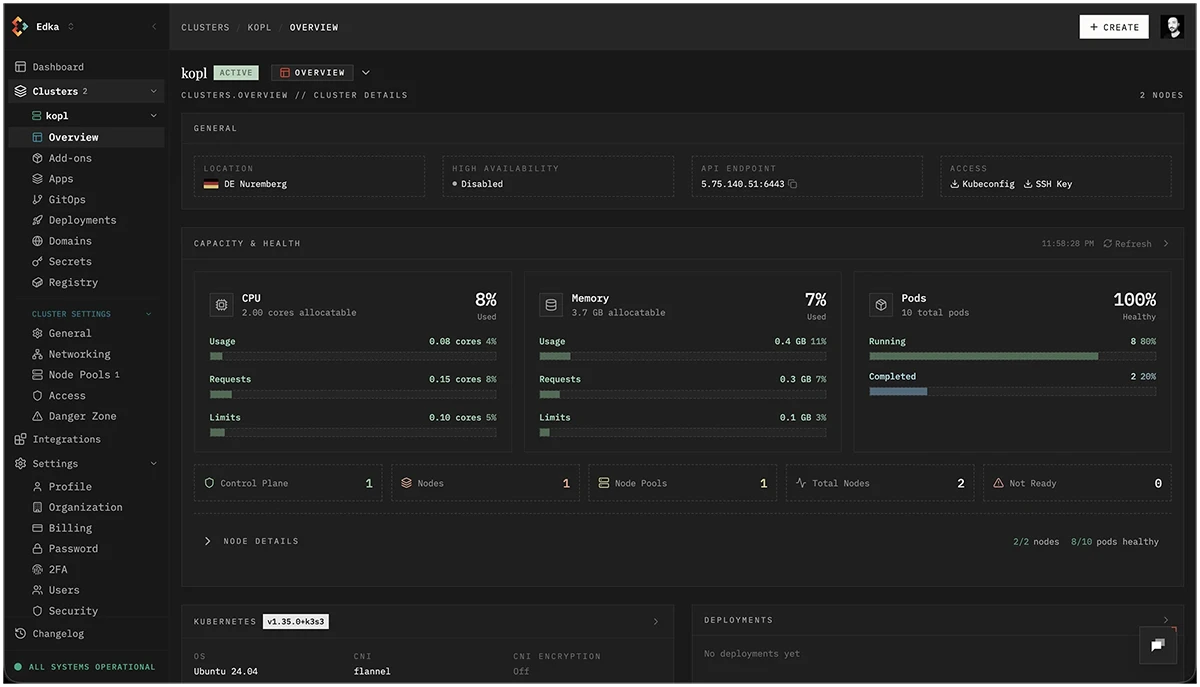
Apps, Databases & Agents on Infrastructure You Control | Edka
Edka provisions a Kubernetes platform in your own cloud account for apps, databases, observability, and private agent runtimes, without locking you in.
Edka
437 points · by camil · 1y ago · 130 comments
I’ve been working with Kubernetes for over a decade, since the alpha days, and was involved in kube-aws project before AWS launched EKS. For the past four years, I’ve been helping friends and small businesses cut costs by running Kubernetes on Hetzner Cloud, which I’ve found to be rock solid and by far the best priced provider.
Provisioning a cluster on Hetzner is now straightforward, thanks to tools like k3s and hetzner-k3s, but configuring it for your specific needs still takes time and expertise. I built Edka to make that part easy: spin up a production ready cluster in ~2 minutes, then choose how low level or automated you want to go.
How it works:
Layer 1 – Cluster provisioning - Creates a k3s-based Kubernetes cluster on Hetzner (lightweight, easy to manage, scales well).
Layer 2 – Add-ons - One-click deploy for metrics-server, cert-manager, and various operators; preconfigured for Hetzner, no extra setup needed.
Layer 3 – Applications - Minimal config UIs for apps built on top of add-ons. - Example: Need PostgreSQL? Fill a few fields → platform installs CloudNativePG → provisions HA PostgreSQL with PITR → gives ready to use endpoints. Backups can be restored to any point in time with a click. Quick demo: https://edka.io/apps/
Layer 4 – Deployments - Connect your CI to push container images to a public/private registry. - Edka updates deployments automatically (with semantic versioning rules), supports instant rollbacks, autoscaling, persistent volumes, secrets/env imports, and quick public exposure. Quick demo: https://edka.io/deployments/
Tech stack: TypeScript, React + Tailwind CSS, PostgreSQL, Redis, BullMQ, Vault + AWS KMS to encrypted sensitive data.
The platform is still in beta and I’m building it in my spare time, so there are some rough edges, but I’d love feedback from anyone running Kubernetes on Hetzner, exploring alternatives to EKS/GKE/AKS or looking to automate their infrastructure with Kubernetes.
More details: https://edka.io/
Thank you!
[1] https://www.talos.dev/v1.10/talos-guides/install/cloud-platf...
I do notice that this deploys onto their cloud offering, which we've (https://lithus.eu) found to be a little shaky in a few places. We deploy clients onto their bare metal line-up which we find to be pretty rock solid. The worst that typically happens is the scheduled restart of an upstream router, which we mitigate via multi-AZ deployments.
That being said, there is a base cluster size under which a custom bare-metal deployment isn't really viable in terms of economics/effort. So I'll definitely keep an eye on this.
But the TF and other tools are using the API to add and kill nodes, if you could pass a class of nodes to those tools that they know can't create but are able to wipe and rebuild, this would be ideal.
For me it does not pass the smell test. No physical address, no idea who is running it, no idea if company is indeed registered or not. The pricing FAQ at least talks about VAT and I assume it is EU VAT but could be anything.
I'm not familiar with Spanish S.L. (Sociedad Limitada) but it seems to be a private, share-based legal entity with minimum 3000 EUR share capital and at least one director. It seems the share capital does not need to be paid in full [3] which is a risk for potential customers if things go wrong.
If you're based in a EU country I'd suggest to also clearly communicate all these legal information, because it's easier for potential customers to build trust into your services.
[1] https://www.hola.com/aviso-legal/ [2] https://www.hetzner.com/legal/legal-notice/ [3] https://www.lawants.com/en/sl-spain/#:~:text=minimum%20share...
Also here: https://ceo.oepm.es/detalleExpediente?numExp=N0486066
It's not the smoothest thing I've ever used, but it's all self hosted and everything can be fixed with some Terraform or SSH.
Great to see some managed Kubernetes on Hetzner!
I'm using it right now
kube-hetzner seems to be a bit stuck, they have a big backlog for the next major release, but it might never happen.
A similar approach I’ve been using is using Syself (running it for about half a year now with no issues). They contributed the Cluster API provider for Hetzner, which is obviously Chad. Of course, I wish CAPI were a bit less involved, but that’s exactly where external help makes sense. I am totally fully sold on CAPI, but then again always need your base cluster.
I still want to set up CAPI on my own, but still preferred having “someone else” host the control plane. With CAPI, though, you have the flexibility to do either.
Also Talos and Omni are cool and pretty chill on Hetzner. Fantastic tools. Still though I just like the "raw-ish" feel to kubeadm and CAPI feels the most "native" solution.
In terms of addons, I have my very curated yaml manifestos. And ArgoCD Application sets. That part is hard for me to replace, but that should defenitely be married with a UI.
Join the waiting list here: https://shipacademy.dev
Feels like there should be a PV daemon that can do local, and transparent migrations and is lightweight enough to run on a single machine. Once my PV has been migrated to Ceph, the proxy could configure itself away from that job.
I would have never guessed that there's an overlap between the circle of people wanting to run a prod workload on a K8s cluster and folks that need a GUI to set up and manage a K8s cluster would be that big but looks like I might be wrong.
Count how many GKE ad EKS users are out there?
We considered reaching out in May, but held back because we want to run on bare metal.
Any chance to get this provisioned on bare metal at Hetzner?
We have K8S running on bare metal there. It's a slog to get it all working, but for our use case, having a dedicated 10G LAN between nodes (and a bare metal Cassandra cluster in the same rack) makes a big difference in performance.
Also, from a cost perspective. We run AX41-NVMe dedicated servers that cost us about EUR 64 per server with a 10G LAN, all in the same rack. Getting the same horsepower using Cloud instances I guess would be a CCX43, which costs almost double.
I use wireguard to have those nodes connected together
I haven't really thought it through yet, whether that even makes sense.
Setting up kubernetes yourself with k3s and deploying a HA database with cnpg is so simple nowadays. It works great until some day you face an issue that you can't fix without diving deep into the details e.g. debugging your CNI or the implementations of specific operators to understand reconciliation errors. I faced countless of these issues such as:
- your Postgres CNPG failed during failover and can't recover on it's own - Postgres WAL archiving suddenly doesn't work anymore after an update. - Cluster networking on some nodes doesn't work anymore due to an incompatibility of kube-proxy and Cilium after an update
Unless it's your core business I'd limit myself to deploying applications on Kubernetes instead of managing Kubernetes itself. At least for use cases where reliability matters.
There are some reasonably priced managed Kubernetes offerings out there. For example syself (https://syself.com) built a managed Kubernetes on Hetzner. The prices are super reasonable. For 300 Euros per month you can enjoy Hetzner prices with an experience that beats AWS.
We're running our entire PaaS platform (Sherpa.sh) on top of Hetzner with Syself. We are 5x more affordable than Vercel and a big piece of that is because Syself allows us to operate autoscaling k8s clusters without an army of ops engineers.
We tried hetzner-k3s, and many other solutions. But ran into many of these same problems. Syself on the other hand, has solved all the sticky hardware and networking challenges at scale with their own customer operators. Plus they're support is super responsive and helpful.
The one downside, is they don't have a dashboard yet, so you need to be comfortable in the CLI. But I'm sure they are working on it.
I don't think I would manage kubernetes any other way at this point.
Well, I guess from a platform that has no intrinsic IAM offering, I take that back, I guess keeping track of whose special console password is the current one is, in fact, hard work
Honestly I’m kindof surprised that something like rook it not used instead, but I guess it is easier to trust hetzner storage and hope for the best.
We host in various bare metal providers, including Hetzner. (I am the lead engineer building Ubicloud PostgreSQL, so if you have questions I can answer them)
https://www.reddit.com/r/hetzner/comments/18yhy89/seems_like...
That way we can use Raku as a scripting language for deployment.
Anyway, if you're proud of your toy, do its own Show HN
1) What are the limitations of the scaling you do? Can I do this programmatically? I.e. send some requests to get additional pods of a specific type online?
2) What have you done in terms of security hardening? you mention hardened pods/cluster, but specifically, did you do pentest? Just follow best practice? Periodic scans? Stress tests?
Setup dropbear, and have another encrypted instance that runs a cron that runs a script every minute to check for the dropbear port on all instances and sshes in and passes the key to boot.
This is what I do for fastcomments anyway for ovh and hetzner
Nowadays, Hetzner has many Kubernetes providers. One that I really like is Syself.com. They provide production-ready Kubernetes including self-healing, bare-metal support, OIDC integration and many more.
As a cloud and migration expert, I have evaluated them and they turned out to perform very well.
My theory is that with terraform and a container based infra, that it should be pretty easier with Claude Code to migrate wherever.
I will say that there is a fair bit of lifting required to spin up a k8s cluster on bare metal, particularly for things such as monitoring and distributed block storage (we use OpenEBS). I would ballpark it as a small number of months.
It is likely easier on their cloud offering, but we've found that to be a little less reliable than we would hope.
Happy to chat more: adam@...
Is there are plans to support Gitlab and gitlab registry (or any registry) ?
Would make a lot of sense, especially if you can combine it with the hardware servers. You could get a lot of grunt in your cluster for a lot less than for example AWS.
From there it was much easier just using it for whatever I wanted, including K3S
I really loved this talk about using Let's Encrypt for IAM Anywhere https://www.youtube.com/watch?v=M1hXUcBMf1Q
I have personally also set up EKS Anywhere <https://github.com/aws/eks-anywhere#readme> with OIDC, so one need not have a "smart cloud" to get that done, but it places the burden upon security the cluster's identity upon the operator https://gitlab.com/-/snippets/2302594
I created for me some scripts to add node (Hetzner instance with Ubuntu) in a Docker Swarm, and I would really love to find something as you did but for Docker Swarm
So in reality you would pay €20 per month for the standard plan and also extra for control plane nodes.
Also, with this Terraform module I can setup a similar setup without paying any extra fee for your service: https://github.com/hcloud-k8s/terraform-hcloud-kubernetes/tr...
The Terraform module takes care of ingress, certificates, metrics etc
Anyway, congrats for shipping
Triple. 1 and 2 nodes will give failure allowance of zero.