59 points · by Anon84 · 1y ago · 44 comments
There really is no free lunch!
I wonder how much damage that did to me, to have that lack of physical activity during my formative years.
As soon as you get near people, if there is a enough, a Karen will rat the kid out as soon as they touch public property and maybe before it. They are only safe from CPS tyrants when they are out of sight.
One thing I see, is that people in urban environments typically opt-in to exercise (like voluntarily going on a run). Whereas those in more rural areas have more physical demanding jobs and responsibilities.
I’m an urban-based desk jockey who exercises a lot but it doesn’t really compare to my more rurally-based friends who are on their feet working blue collar jobs 5 days a week.
Suburbanites who are only active while engaging in intentional exercise because they need to get in their car to go anywhere are in the worst situation.
Be right back. I just have to look for a completely quiet treadmill for the open office where I spend my life.
I don’t think it’s so much a matter of banning “bad” development as allowing all kinds.
I can understand the desire to reduce through-traffic which sometimes comes with speeding or aggressive drivers. But walking and cycling to your friends house shouldn't mean going a mile out to the entrance of your neighborhood, down the busy highway, then a mile back in to their house when they were only half a mile away to begin with.
https://en.wikipedia.org/wiki/United_States_Bicycle_Route_Sy...
Here’s the first Wikipedia photo of USBR 1:
https://en.m.wikipedia.org/wiki/U.S._Bicycle_Route_1#/media/...
Look, it’s a road on which is possible, but not necessarily desirable, to ride a bike.
The Netherlands has at least two systems:
https://en.m.wikipedia.org/wiki/LF-routes
https://en.m.wikipedia.org/wiki/Numbered-node_cycle_network
and neither article emphasizes the dramatic difference between these and the US system, possibly because it’s utterly obvious to anyone who has ever used the Dutch system: the Dutch bike routes are far, far higher quality. You can bike from almost anywhere to almost anywhere with the bulk of the route (at least outside of a city center) on paths are well separated from cars or even nowhere near a road at all. A lot of them even separate pedestrians from bikes or separate fast bikes from slow bikes. Even the worse bike paths are better than most bike paths in the US. If you ride the bike paths to a major store or a mall, you will generally find that the dedicated bike parking is closer than the car parking. If you go to a smaller store, a cafe or a house, you will be able to get from the nearest bike path to the building without crossing a traffic lane. If you go to a busy area, you might find a double decker bike parking lot!
This works well in a country with more bikes than people. Those paths are heavily utilized.
The US has excellent bike paths as well, but they are largely the exception, not the norm, and the almost entirely fail to connect into a cohesive system on which you can safely bike from point A to point B without ending up on nasty roads for large fractions of the trip.
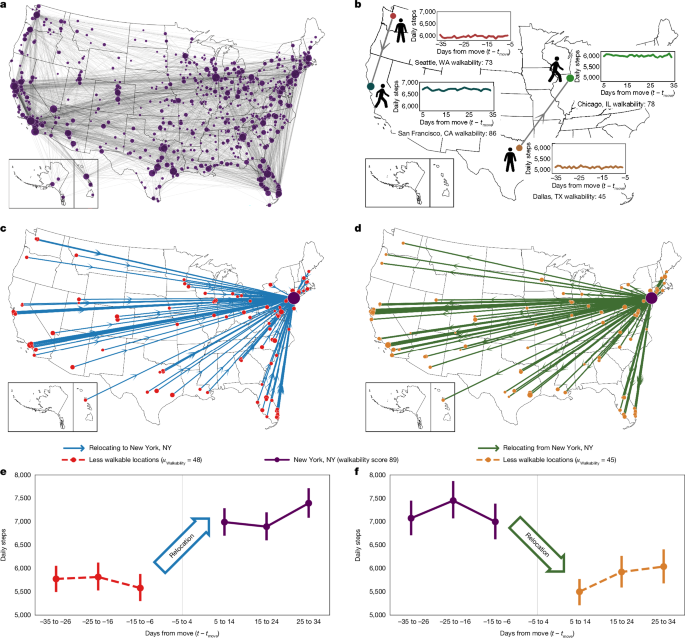
It's really strange that they just jump into the paper and keep saying "natural experiment" over and over again without any justification that they actually have one. They do eventually get to this in the "Selection effects in relocation and mobile app usage" section, but I think they really downplay the seriousness of the issue.