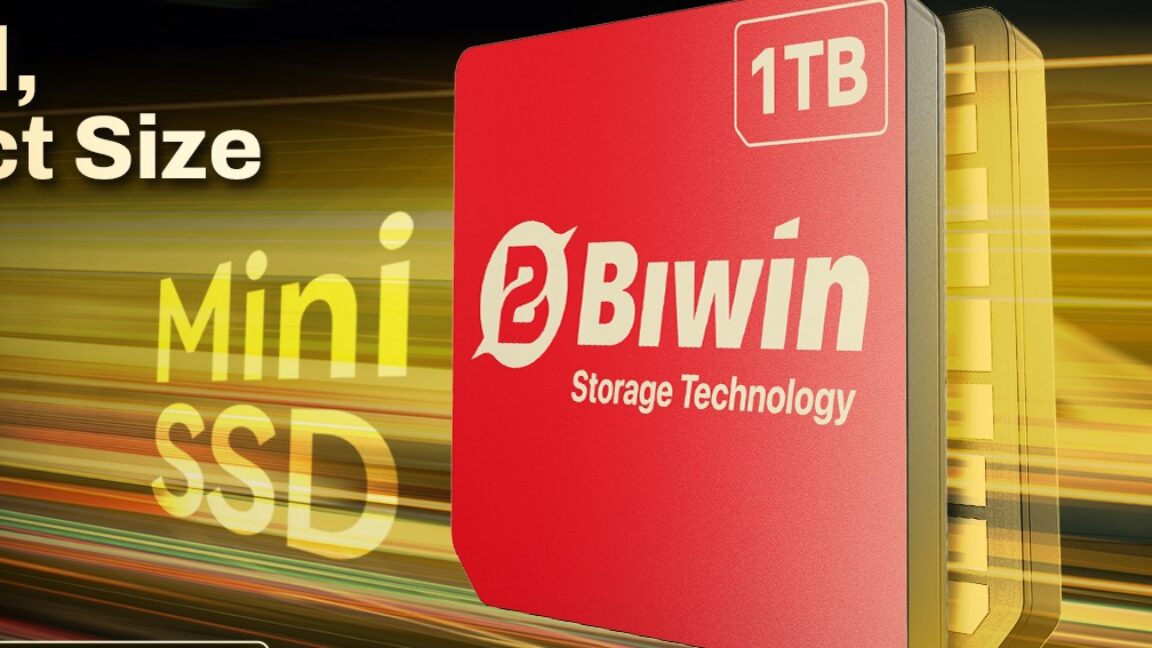
Tiny, removable “mini SSD” could eventually be a big deal for gaming handhelds
Fast, removable storage could be one way to address soaring game install sizes.
Ars Technica
78 points · by quantummagic · 1y ago · 109 comments
And since, underneath, it becomes a standard PCI-E NVME with standard lanes, there is no inherent speed limit from the bus itself, only from the fact that SD cards are tiny and any real controller is going to cook.
Laying is transitive and requires an object.
That's entirely a function of NAND quality and controller sophistication. Why would a different form factor make a difference here?
Also, for an apples to apples comparison, you'd have to compare this new standard to microSD Express cards, not regular ones.
> I feel like the connector is not reliable enough.
Have you actually had a connector wear out? I'm not the biggest fan of the spring loading myself (I've had devices catapult microSD cards into the next room in the past!), but it seems pretty reliable in terms of actually making and keeping a connection to me.
Same applies to SSD drives, there are consumer drives that have colorful boxes with claims like speed or size, and there are specialized SSD drives based on MLC chips that are still available here and there
I don't know the specifics but SD express might be patent/license encumbered so why pay when you can make your own for free?
I'm guessing this drive will eventually percolate down in the form of an SD Express card, and SD express is now in the Switch 2. The Biwin drive is currently too big to fit the SD spec, but that might not be true in the future.
I think Nintendo just sealed the deal against any SD Express competitors. This article is (probably) planted PR to promote this drive to Western buyers interested in maximizing their SD Express slots in a "Hey, why do these Chinese gamers get this amazing card and I'm stuck with this junk?" Now that lights a fire under a lot of people and Biwin can start licensing the technology or selling directly to the Western market.
Storage upgrades in handhelds seems to be a real problem. I was surprised my Steam Deck didn't have an easy to access M2 slot because of Valve's "pro-gamer" reputation. You have to take the entire thing apart to get to the SSD and the plain-jane SD slot you do get will never feel fast enough, especially since its hardware capped at 104 MB/s. Gabe didn't become a billionaire by not being ruthless I suppose, but it is disappointing.
I'm guessing a lot of these devices are sold at a premium for more storage so they don't want to make it easy to upgrade fast storage on your own. Instead we're just forced into the SD card ghetto. Maybe Biwin can change that, or the handheld makers will push against that if it means hurting their margins because the higher storage models are more profitable. Nintendo at least seems to signaling, "Do whatever you want with this fast SD slot," which is a breath of fresh air. What a time in gaming, where Nintendo is more progressive and pro-consumer than Valve.
Lets say its a brand new 4.0 card that implements x2 lanes, that is 3.93GB/s maximum speed (there aren't any 5.0 cards yet, afaik, but double that for 5.0).
Want to know where that 900MB/s figure came from? A 3.0 x1 card is 984MB/s. That is the first gen SD Express cards when the spec was launched, but not the currently available ones.
In other words, this is a PR release, this isn't news. It's marketing. They chose the worst case of their competitors, the best case of their own, and lied by omission.
Also, re: Valve's position on M2: they didn't support even swapping them when it first came out, although obviously allowed and expected, because you can put M2s in the device that are outside of the thermal parameters allowed by the design due to proximity to the battery and other heat producing items. This is also why they specifically used a 2230, as those are usually the lower power models meant for ultrathin laptops.
That said, Valve has worked with a few companies to get some officially blessed 2230s that actually do fit the intended use case and are also performant.
Like, if you think the Steam Deck sucks for actually doing the swap job, a) the new OLED replacement internally is a lot saner, with both construction and PCB layout, b) go try dealing with the really nasty designed laptops that don't have an externally accessible panel covering the drive bay; they're worse.
The entry level deck is $399 but the 1TB one is $649. Almost $800 with tax and shipping for something that can't even play Unreal 5 games and has no proper expansion is inexcusable, not to mention the bizarre and shortsighted decision to have only one USB-C port on the device, and being locked onto the 15-watt mode of the chipset.
Some of that cost is the OLED update but frankly its deceptive and dishonest customer hostile pricing. The storage limitations are intentional to sell the higher tier Deck. Gabe didn't get 5 super yachts by being a "good guy." He's just maximizing his profit. There are no "good guys" in capitalism, instead its purely transactional and game theory dictated from top to bottom.
I do find it a little depressing that Chinese and Japanese companies are eating US companies lunches because they somehow are more open, more pro-consumer, and more affordable the US offerings. When in the past the US products were the more open and hackable ones and the imports were the proprietary and locked down customer-hostile messes. Not just this but a lot of electronics now. The hackable, learnable, fun, etc ones are foreign while the US domestic ones are overly 'not repairable' and 'not hackable' and by design to maximize profit. What a shame. How far we've fallen.
It's a really weak claim when you frame it properly. If you have a good controller you can use either form factor just fine, at PCIe gen 4 x2 speed.
> maximizing their SD Express slots [...] Now that lights a fire under a lot of people and Biwin can start licensing the technology or selling directly to the Western market.
That would be nice!
I think this whole issue shouldn't exist in the first place.
I do understand that full voice over and 4k ready textures comes at a price but some devs are getting lazy and some games are just ridiculous.
We're talking about handhelds like Steam Deck. Even if I plug it in as a console it won't have the juice to run at full resolution.
When I want to quickly grab an episode of a tv series to watch on my mobile I'll be super happy with 300mb 720p version. I don't need a 50gb rip in 4k in HDR with Atmos sound. Same option should be available for games.
I bought the cheapest one, and upgraded the SSD. I also have an SD card. I use this for more than just playing games.
I would love to be able to just upgrade the storage and it be as fast as the internal storage. I could install a Windows install on it, and switch when it makes sense.
* Arch-by-the-way
Though I also did the SSD upgrade and haven't really been bothered by space, so haven't bothered. I have that setup on a spare parts PC with HDDs instead of microSD, since that's an older 1/2 TB SSD.
That said, I do wish Valve would implement something like this first class in SteamOS.
The problem isn't that either of those things are inherently bad. A game being "large" doesn't mean anything as long as it works, and a storage device being fast/large is good. The problem is when both of those things conspire to spiral out of control and we end up having to invent faster/larger storage devices without any need other than "well this size worked".
I guess it's a problem of incentives. The developer of the game doesn't pay when the game is larger, I do.
This is everywhere in computing but there's a better reason for it than you're giving. It's a cheaper/easier for companies to develop "bloated" software that runs on more powerful hardware. That includes uncompressed textures/sound (because why bother finding a codec or fine tuning quality tradeoff when you can just get give uncompressed data). But the end result, for you, is more software is available and more developers exist (because writing efficient and performant code is much harder).
A game like Stardew Valley, for instance, probably doesn't exist. I've put a ton of hours into that game and I think it's excellent but, not to cast any shade, the game isn't exactly a masterclass in efficiency. It's only slightly more advanced than a SNES game but it consumes many many time more resources.
The benefit to you is that an inexperienced software engineer with a great idea can bring their idea to fruition using all sorts of bloated tools.
But talking your AAA kind of titles that seem to be the norm, not your chess games, though even then, graphics sure has gained space in those programs. Though I'm sure somebody active in the industry could paint a better picture.
Anybody active in the industry able to offer or point to better breakdown?
Executable code is pretty tiny relative to everything else, including libraries. Libraries only get really big when they include media assets. When it comes to media, even high fidelity audio is relatively small. 44kHz stereo 16-bit sample audio, uncompressed, is 176kb per second of audio. A 1024x1024 texture, at 32bpp, is 4mb, uncompressed. Video depends heavily on codec, but roughly consider that 4k video is something like 4096x2160, so eight times the size of our static texture for a single frame. Encodings don't just store every frame whole, of course, but keyframes add up quick.
So this is basically a smaller NVMe SSD?
Yes, but so is microSD Express, which already has a significant shipped base of supporting devices including the Nintendo Switch 2!
Even if not user replaceable without opening the device it would make it possible to have replaceable drives at a tiny fraction of the current minimum size.
Even just for relatability compared to soldered on storage it would be a plus.
The manufacturers don't seem to want that. Even the small Chinese companies which were the last holdouts have gone full forced-obsolescence.
- water tightness. Yes, seals are a thing, a few Samsung models (Tab Active 3) support that... but guess where I had damage from water ingress on mine? Yup, through the SD card slot. Rubber seals eventually dry out.
- power. SD cards tend to require large amounts of power during writes and behave unpredictably when the power is jittery for whatever reason.
- thermals. Getting the heat away from an SD card, particularly a high-speed one, during writes is tough.
- quality. Even if you buy a brand name SD card, chances are too high you end up with counterfeits. Phone companies do not want the support effort associated with that any more. And with cheap SD cards, you have to account for delivering actually clean and stable power because they don't have enough onboard capacitors.
- BOM complexity and cost. SD card slots take up board space and parts - the card enclosure, capacitors, voltage regulators, fuses (you don't want a broken/dirty SD card to fry the main power rail), high-speed data lanes, at least one GPIO for card presence detection... best to avoid that.
In most of the world, physical SIM cards are still a thing, yet most phones have been waterproof for a while now.
> - quality. Even if you buy a brand name SD card, chances are too high you end up with counterfeits. Phone companies do not want the support effort associated with that any more.
Very solvable: Run a mandatory performance and "lying about storage size" benchmark upon formatting.
> - BOM complexity and cost.
I'd pay hundreds of dollars extra for being able to upgrade the storage on my phone.
The real reason is that device manufacturers would never willingly give up the privilege of being able to charge hefty premiums on storage capacity.
We had a lot of great games even when storage was spinning rust.
UHS-I cards easily go up to 100MB/s. This is the baseline for a modern SD card.
After that you can add more pins for UHS-II. This is used in a bunch of devices and goes up to 300MB/s, but you can't assume anything will have it. And UHS-III was dead on arrival.
Alternatively you can add a different set of more pins for SD Express. It can do gigabytes per second and is probably the future. It's backwards compatible with UHS-I, but not II or III.
And also SanDisk made their own spec for overclocking UHS-I which some things support. It can do about 200MB/s.
The steam deck supports none of those upgrade paths. You get about 100MB/s.
Considering the insane tempuratures the cards reach, and that it destroys brand new SD cards, I don't want them going any faster until it works safely.
The upside of course is that your original DS cartridge might never go bad, even if you lose it under the sofa for 30 years.
This is not true of modern switch cartridges.
Interesting, I didn't knew about this format. Curious picture selection on the Wikipedia, I didn't knew about this manufacturer until reading the Ars article above.
I'm reminded of XFMEXPRESS, a tech that had some justification to exist as a low profile replaceable and coolable main storage for small devices. But it doesn't look like it went anywhere.
The biggest issue with these small form memory is heat, they heat up a lot, but seem like no one care.