We're Not So Special
A new book boldly challenges the concept of human exceptionalism.
Democracy Journal
123 points · by nobet · 1y ago · 287 comments
Firstly, most humans who ever lived didn't do those things. Are they not exceptional? Are they lesser in some form? Did human exceptionalism only start when we invented computers or science? I assure you, many prior civilisations saw humans above animals (source: The Bible), yet hadn't done the things on your list.
Secondly, you listed outcomes. These are value judgements. As the article points out, humans did those things but we can't do basic things like smell water from miles away or see internal organs by just clicking. Animals don't value LLMs or mathematics, in fact many humans don't!
The challenges to human exceptionalism aren't based on outcomes (because that's subjective) but tries look at what makes humans unique in a way that can't be replicated in any form. This has to be more than "we're better at X" or "we can combine X and Y to achieve Z" because, unless trait X or Y only exist in humans, then another species could conceivably replicate it given enough time for evolution.
So problem solving wouldn't make us exceptional because we see it in other species. Language might but we do see rudimentary communication in other animals like corvids and cephalopods so perhaps humans just hyper-specialised in that. Hell, scientists have observed orca pods being unable to communicate across regions, hinting that there is a form of language.
Just being better at these traits doesn't suffice because there are plenty of things other animals are better than humans at. We don't consider that exceptional in the same way.
I addressed this in my earlier point: that's measuring an outcome. By this logic, humans before 1700AD were not exceptional. Humans who weren't involved in this are lesser.
Many people forget the animals feel emotions very much the same as us, that they act and feel very much like us, and what separates is our ability to work together- and specialise, our individual intelligence is not terribly far away - but we have specialised in education so we’ve optimised our minds to work in a collective society and to specialise in certain trade craft.
we think of animals as being “dumb” and we get surprised when they show signs of intelligence.
- sent from my iPhone, which I can’t build a single component of; using software I can’t write, using electricity I can’t generate, while sitting on a sofa I can’t manufacture in an apartment I can’t build.
We're pre-paradigmatic for qualia, we don't know what structures (brain or otherwise) give rise to it in order to guess what set of qualia can be had by any given system. Until we do, I can't even quantify my expectations on the variance from increased evolutionary distance, I don't even have a quantity to express the variance of.
This growth is clearly unsustainable, and the bubble, so to speak, will eventually pop. Other species have managed to survive for an exceptional time, e.g. the horseshoe crab, or most species of moss. There are species whose individuals might be older than human civilization, like the glass sponge. There are species that will survive in extreme conditions where humans would perish, such as tardigrades. Are we better than them?
Another point: evolution has caused living beings to reach equilibria where the whole system can thrive, where each species has a role. These systems have reached self-regulating states, where e.g. an overpopulation of predators will be cut down due to an absence of prey during the next generation.
Is human society better than that? Because humans are destroying this balance through unprecedented growth, which these systems cannot respond to. Our growth is not only unsustainable from the point of view of human survival, but unsustainable from the point of view of the earths ecological systems as a whole.
If so that is a relatively recent demonstration of exceptionalism. Given the long timeline of human existence it could even be argued that it is accidental that this proof of exceptionalism developed among the humans and not among some other species.
I actually believe in human exceptionalism, in that many of the features spread around various species are all found highly developed in the human, but really that is an argument for all species exceptionalism. There are very few species that do not some collection of interlocked traits that make them exceptional in some way, it just happens that our exceptionalism is one that allows for triumphalism at the same time.
Accepting death for me is a more mature way of understanding how life works, than trying to prolong life.
That said, I personally prefer prolonging life, but I do it only because I'm afraid.
But in general I think this is also reflective of a negative trend in Western culture, which is something like a collapse of the “divine potential” of man. I don’t mean it in the literal religious sense (although that’s where it came from), but in the sense that many people increasingly see themselves as just evolved apes, not as creative beings with limitless potential. There are many reasons for this cultural trend (evolution, secularism and the collapse of religion as a foundation for our idea of self), and so on.
The key, to me, is in understanding that this “evolved ape” narrative is a fundamentally a narrative. What’s needed is a new story that factors in these scientifically true facts of evolution etc. but isn’t so flat and unimaginative in placing them into an arch-narrative.
It probably needs to start with a shift from essence to process as foundational. In other words, the deflationary account of humanity sees itself as “just an evolved ape” because we categorize things as if they were unchanging, static entities. A shift to a process-oriented idea means that value can grow in complexity and develop over time, and so therefore there isn’t anything deflationary about being descended from microscopic organisms.
It reminds me of philosopher Feuerbach’s ideas on God, which are essentially that humanity has externalized its own qualities and greatness into an abstract being, and become estranged from our own potential.
We are accustomed to seeing our lives and the power of dictators and the influence of tiktok content creators etc as these enormous, reality-defining things. And then we look up at the sky — with extreme rarity thanks to light pollution — and often perceive little more than a tableau as if looking at an aesthetically pleasing poster in a waiting room.
Pale blue dot flips that on its head as it should, clarifying that everything we normally view as so important does not have to be confused with the fundamental nature of reality. If there is something wrong with our environment, the fact that it is small in a grander scheme means that we have a better chance of changing it than we might have otherwise supposed.
Tolkien offers a similar quote I'd like to offer to compare and contrast with Sagan:
``` Frodo sighed and was asleep almost before the words were spoken. Sam struggled with his own weariness, and he took Frodo’s hand; and there he sat silent till deep night fell. Then at last, to keep himself awake, he crawled from the hiding-place and looked out. The land seemed full of creaking and cracking and sly noises, but there was no sound of voice or of foot. Far above the Ephel Dúath in the West the night-sky was still dim and pale. There, peeping among the cloud-wrack above a dark tor high up in the mountains, Sam saw a white star twinkle for a while. The beauty of it smote his heart, as he looked up out of the forsaken land, and hope returned to him. For like a shaft, clear and cold, the thought pierced him that in the end the Shadow was only a small and passing thing: there was light and high beauty forever beyond its reach. His song in the Tower had been defiance rather than hope; for then he was thinking of himself. Now, for a moment, his own fate, and even his master’s, ceased to trouble him. He crawled back into the brambles and laid himself by Frodo’s side, and putting away all fear he cast himself into a deep untroubled sleep. ```
I mean, we are. Other apes also have creative potential. I'm probably better at it than most of them are, but they're probably better than me at climbing trees.
Humans are considered “evolved apes” because of our (culturally defined) system of categorization. Humans are just as related to every other species (itself a word that implies a static entity that actually isn’t) in our ancestry. It also isn’t really accurate to claim a microorganism ancestor of humans is some kind of proto-ape, or proto-human.
The point is that process is more accurate as a label. The choice of focusing on apes is a cultural one, not something inherent to the structure of biological reality.
This is just silly. We are significantly more related to chimps than fungi. Humans are scientifically classified as apes, because we share close similarities in characteristics and very recent evolutionary history.
So I’m not sure we know exactly what it is that makes us different, but we clearly are in some way. There is no other animal that has developed anything close to the capabilities we have.
Would any other species on earth, in a billion years, ever develop the ability to travel to other celestial bodies, let alone even know what they are?
Consider, horseshoe crabs are undeniably the best at doing all things horseshoe crab. No other animal comes close to behaving like a horseshoe crab!
IMHO, the almost tautological nature of this judgement is what makes it uninteresting at best and actively harmful at worst. It's just a stone's throw away from individual, group, and racial exceptionalism.
Yes, you could say this about any animal. It does not explain why, apparently, no other animal in the entire history of the Earth has done anything comparable to what humans have done.
Horseshoe crabs are good at horseshoe crab things, but convergent evolution has in the past created similar animals that are roughly equally good at doing horseshoe crab things.
There have been and are many animals good at doing horse-ish things. Many good at wolf-ish things. Even flight has evolved independently several times among both vertebrates and invertebrates (and while we can’t fly on our own, we regularly fly faster than any flying animal). We’re petty weak among all animals and yet the heaviest things that have been moved have been moved by humans. We’re pretty slow runners and yet we hold pretty much any speed record you can think of.
Why hasn’t there been any other animals similar to humans in our abilities? Why hasn’t spaceflight evolved several times? Why hasn’t metallurgy? Particle physics? Why can’t any other animal understand the basic chemistry of the universe as we do?
Neanderthals couldn't develop any of the things you mentioned because humans stopped them. If we hadn't been here or if they had gained the upper hand during some pivotal moments then they might be wondering about their own exceptionalism today.
Metallurgy? Spaceflight? Particle physics? Those are clearly unnaturally contrived reference classes. Why can't humans HorseshoeCrabTermA (i.e. scan the ocean floor upside down at a 30 degree for optimal benthic foraging and conspecific mingling?) Why hasn't HorseshoeCrabTermB (lunar-synchronized mass spawning timed with satellite male mating patterns)? Why can't other animals properly molt and feed with gnathobase ginding like horseshoe crabs do?
Don't get me wrong, I love chrome on cars and rockets and human intellectual curiosity. No other species has invented Python 2.7, but so what?
Calling something exceptional or special is generally an objective statement based on observed facts. Now whether something exceptional deserves special treatment is a value judgment.
> Consider, horseshoe crabs are undeniably the best at doing all things horseshoe crab. No other animal comes close to behaving like a horseshoe crab!
What are their exceptional traits? For example, we can say peregrine falcons or cheetahs are exceptionally fast. Or blue whales are exceptionally large. Saying horseshoe crabs are horseshoe crabs isn't saying much.
> IMHO, the almost tautological nature
You conjured up a false tautological argument.
> It's just a stone's throw away from individual, group, and racial exceptionalism.
But such exceptionalisms exist individually and group-wise/racially. We know that lebron james is exceptionally good at basketball. We know that tibetans do exceptionally well at high altitudes. Those are objective facts. Now whether they deserve special treatment is a value judgment.
A billion years is a very very long time. Humans and chimps diverged about 7-8 million years ago. Given no human competitors and a billion years there's no reason some other great apes or raccoons or something couldn't develop a space programme.
> And here’s another cool thing: a little over a billion years ago, life started experimenting with multicellularity. Imagine single cells deciding to team up and work together! A fossil discovered in Scotland, a tiny ball-shaped thing, is the oldest known example of a multicellular organism.
https://geoscience.blog/was-there-life-1-billion-years-ago/
I know OP was just kind of throwing out a big number but it's worth highlighting the orders of magnitude involved here. To put it in terms HN might grok more easily, if modern humans have existed for 300 kB we're talking about one gig.
https://www.lesswrong.com/posts/Cbqr9NcFDtjvM6zC4/time-bindi...
Even in pre-historic times, humans were herding prey to kill using earthworks, for example. We can also live in cold climates by wearing clothes and building houses and fires, as well as hot climates by not doing those things. We can build defenses against predators. We've been using technology to enhance our abilities since forever. That's exceptional. No ape poking a stick into a hole comes anywhere close to that.
I don't care that eagles can see better than humans. A camera can see better than an eagle and a plane can fly better than an eagle but we don't say that cameras or planes are anywhere close to being comparable to human life. Those abilities are easy ones. Hell even a rock can live longer than a sea sponge, and humans are obviously exceptional compared to rocks.
Bernard Lowe: So what's the difference between my pain and yours?
Dr. Robert Ford: Between you and me? This was the very question that consumed Arnold, filled him with guilt, eventually drove him mad. The answer always seemed obvious to me. There is no threshold that makes us greater than the sum of our parts, no inflection point at which we become fully alive. We can't define consciousness because consciousness does not exist. Humans fancy that there's something special about the way we perceive the world, and yet we live in loops as tight and as closed as the hosts do, seldom questioning our choices, content, for the most part, to be told what to do next. No, my friend, you're not missing anything at all.
from https://www.imdb.com/title/tt4458814/characters/nm0942482 and https://www.youtube.com/watch?v=F7TR50Mnwpw
1. language features we have and they don't understand
2. language features we both have
3. language features they have and we don't understand
Probably in that order.
Then it's just a question of gathering a couple of different species that are seemingly intelligent. Such as: corvids, octopuses, whales, etc. And see if the species can be reasoned with. If so, then you can set up schools where you can train them on human things and vice versa. Eventually you can form interspecies groups and really test the hell out of things.
Doing it that way will really challenge human exceptionalism, as well as the exceptionalism of that particular species.
I know it sounds a bit far off, but I figured that we might be able to get there with AI. I mean, we're getting better and better at giving machines tons and tons of data, and it somehow makes some sense of it.
So far, I think it's not necessarily the human species that is exceptional. It's the revolutionary periods it went through in order to become more exceptional hunters, so we could dominate and control the world in the way we want to. Things such as: discovery of fire, agriculture (+ creating defensive settlements) and antibiotics. We couldn't kill bacteria for a long time. We still have trouble with viruses and are getting into trouble with bacteria again. Could dolphins or whales have done it too, if they were land creatures?
If it's true, then we are exceptional but how can we truly know at this point? I mean, Michael the Gorilla told us about what poachers did [1].
If it isn't true, then it shows how in the prevailing consensus we are still too arrogant. In that case, we don't understand that well what sets us apart and what doesn't.
It will probably be a nuanced discussion either way regardless of what the truth is probably due to the definition of language. But in this particular case I'd want to characterize it: some way of communicating that is about as effective as whatever it is that humans do, when they speak out loud.
Also, when you look nowadays at some of the dog/cat videos and they press those buttons, they clearly are capable of communicating something. I remember one dog inventing a word for ambulance given the words he/she knew. Ah, found it! [2]
There's clearly a lot more research to be done here. I hope AI can accelerate it. I know AI is a tricky business, but one can hope.
[1] https://www.youtube.com/watch?v=DXKsPqQ0Ycc&ab_channel=kokof...
For example, I can issue a warning to another human by using the words "step back or there will be a problem." Assuming they also speak English, my structured sentence conveys the warning in a clear way.
My neighbor's dog can also issue a similar warning by growling as I move into it's space. It's not using any sort of structure or specific messaging, rather a universally understood sound that conveys some sort of feeling related to caution and fear.
I use the "warning" example since fear/caution are extremely powerful and seem easiest to convey across species. Again, not adept at this, so my example might be dumb. I'm super interested in understanding more about this, though.
Any suggestions of further reading?
All animals that we’ve studied — including great apes we’ve attempted to teach sign language — have so far failed to demonstrate the acquisition of grammar. This means the number of unique communications they can express is exactly limited to the number of utterances they know.
1. Satisfying curiosity / because it's fun
2. To build new technology
By virtue of that, my stance on whether I think we are or aren't exceptional is irrelevant.
I don't have any hope that any of this will be researched thoroughly enough in my lifetime though.
"Please don't post shallow dismissals, especially of other people's work. A good critical comment teaches us something."
That is false. If you gave a whale five digits and an opposable thumb and have them live on land, you'd strongly reconsider that. Even without this, it doesn't take very long when studying animals to see that they have a plethora of ideas. Orcas demonstrate strong examples of this all the time.
And how can you possibly claim that you know any animal's internal dialogue?
> If they develop, it's by accident.
Human evolution is no different.
"Please respond to the strongest plausible interpretation of what someone says, not a weaker one that's easier to criticize."
- because I think the article already addresses this "other species don't have literature" argument, though it doesn't talk about literature specifically.
If you value animals based on human traits, humans will always be better. Because you take your own good traits which other species don't have. But that's not the point. Animals have animal traits. For example, low factor of self-extinction is something we should be learning from from animals. Acceptance of death. Limiting the use of our own resources. Taking these aspects into consideration make humans a stupid race that destroy the environment they live in.
It seems obvious to me that this is a fairly useless definition of "exceptional" that would not be accepted in any context other than an ideological one.
Yes, HN is better without shallow dismissals. Perhaps we should extend that idea to shallow articles as well.
Many such cases: https://en.m.wikipedia.org/wiki/Speciesism
Oh yeah? But which one of those species is writing a book challenging their own exceptionalism.
I get the noble sentiment of wanting re-contextualize things to be less human-centric. But, for better or worse, we’ve taken control of the planet. It is our responsibility to take care of it. And if we do manage to, we’ll do so because the alternative is human suffering or extinction.
And in fact this sort of achievement will be critically necessary for the survival of any species. Earth has had numerous mass extinction events, and we're well overdue for another one. And on a long enough time frame, even the Sun itself will eventually engulf the Earth. The only way to 'win' this game is technology and expansion outward into the cosmos.
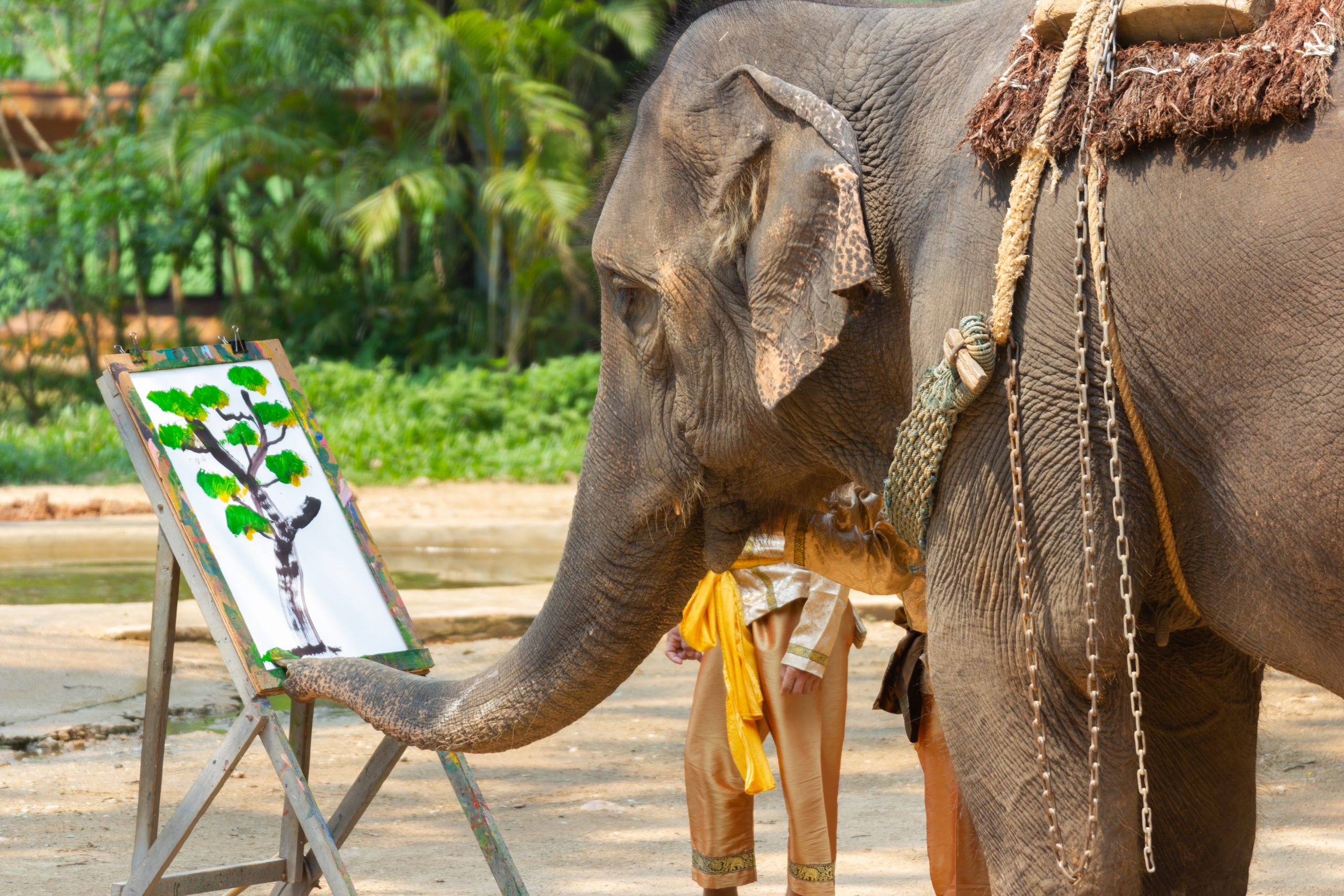
And it may well be that that elephant beaten into a parlor trick of painting from the article (seriously, don't look up how elephants are 'trained'), is brought along so that its species may too eventually continue to persist into the future, thanks to humanity.
Or we're just the cells of cultures, or religions, or corporations, or governments, or the ecosystem consisting of all biological life, or the universe.
Or each of us is the more-structurally-defined society or construction of a group of cells, or DNA, or molecules.
https://www.smithsonianmag.com/science-nature/how-cats-conqu...
One thing humans seem to be uniquely good at is picking goalposts that separate us from other species.
I would say very complex tools are one way to differentiate ourselves
The point is that no other animals can be stewards, historians, or guardians of this planet. If there is a mass extinction event, no other animal would be capable of escaping it consciously, except by random chance.
Humans are better off understanding everything else they inhabit this planet with, it’s better for them and the incidence of life and intelligence, which shouldn’t be taken for granted, IMO.
Dance, Monkey, Dance:
https://www.youtube.com/watch?v=xLNA7MRdjlw
The monkeys feel alone, all 6 billion of them...
The monkeys shave the hair off of their bodies in blatant denial of their true monkey nature...
The monkeys don't want to be monkeys, they want to be something else, but they're not...
Ernest Cline at his peak...
Similarly, the American philosophy of “manifest destiny” (ugly as it is), also carries that same scent of exceptionalism. And so does the “divine right of Kings” from our history. Modern prosperity gospel exploits those same flaws in our cognitive make-up.
In contemporary times we see these philosophies as egocentric and perhaps outdated. But just like children pass through very egocentric stages (well some never grow past that), so too does collective human consciousness evolve past exceptionalism and towards maturity and humility.
I'm confused by this one, because I am missing original thought. It sounds more like a collection of response patterns related to how various targets are supposed to be assessed in value.
I feel like the comment is meant to propose that exceptionalism is like a collective phase, by pointing out a bunch of places where exceptionalism has appeared historically.
To describe humans as exceptionalist, you must claim "animals are people too", but you didn't say that part. Or perhaps "rocks are people too", that would also work, but we don't tend to anthropomorphise rocks because they don't have faces. Or maybe "LLMs are people too". Whatever the claim is, it's an extraordinary claim, and yet you've chosen to present it in the form of a patronising telling off as if it was a foregone conclusion.
We cannot be sure pigs feel anything or have qualia, but from comparison to humans, and let's say, human babies, they at least exhibit the exteriorities of e.g. feeling pain, fear. So, I would assign a non-negligible probability that they do, in fact, have qualia and can feel pain.
Scale that up to a billion farmed pigs, the expected suffering inflicted is huge. Now yes, 'Pascal's wager' and so on, but for rocks, the argument does not work as well.
If you claim for example that rocks suffer when you walk on them, I can claim an equally substantiatex claim that rocks feel sublime extasy as you walk on them. As it stands, we don't have much reason to believe one more than the other, and they cancel out.
All that to say that you don't need to be certain that 'pigs are people too' for its consequences to be seriously considered. And each argument for why you consider pigs to not be people, ask yourself whether it is equally applicable to human babies.
As witnessed by worldwide developments over the last 15 years.
Or all of human history if I’m taking a broader scope.
I suppose this is the real answer to why we won't need UBI. The oligarchs will just wait in their bunkers while the world's population is eradicated by death bots.
That seems the more likely outcome to me than a post-scarcity utopia.
Or just say "some people are still nasty and self-centered, although others have at least have decency to care for others after their own needs are satisfied".
We are like vibe code to him. I think it's quite narcissist to think that there's an omnipotent being who cares about us, and values us as the next best thing since himself, worth of saving after death. Which is a ridiculous, but nevertheless quite a natural delusion for humans, because we are human.
I'm just saying that religions would be more realistic if God had some other purpose and humans are a side effect of that, or maybe just a hobby. The anthropocentric perspective is a dead giveaway that God is a human hallucination.
When you live in a country where routinely public servants steal over 50% of public money like Russia or Ukraine, Cuba, Venezuela, with oligarchs raking billions(from your money), it is not unethical to protect your money and not let them steal your work.
I had family members that protected their money from Argentinian Government years ago. Everybody did that there. They lost part of their savings(20% or so) but had they not made illegal things like not reporting their savings to the Government, the Government would have taken more than 99% of their savings by inflation.
In some places in the world, like South Africa, the Government is the one with criminal behaviour. Imagine you wanted to protect your money from Hitler after Austrian (illegal)occupation. They occupy your land by force, they kill rebels and change the law in order to confiscate asserts from nationalists or jews and use the money to invade new territories and propaganda. Not following the law is the ethical thing there.
The original article is of course by a primatologist, but in the "AI" context it is useful as agitprop.
It's not that simple due to power imbalances with automation and the eternal pursuit of better living standards, but that's kind of the goal. The world chooching away by itself like a Factorio map and people purely consuming.
    For instance, on the planet Earth, man had always assumed that he was more intelligent than dolphins because he had achieved so much -- the wheel, New York, wars and so on -- whilst all the dolphins had ever done was muck about in the water having a good time.
    But conversely, the dolphins had always believed that they were far more intelligent than man -- for precisely the same reasons.

- The Hitchhiker’s Guide to the GalaxyPeople can say random strangers are no better than animals no big deal, but random strangers have been getting little respect and the bad end of the deal for quite a while. It's different when it's someone you actually care about.
Or as someone summed up recent American exceptionalism - Americans will come to your country, blow it up and mangle it to an incredible degree, then make 10+ blockbuster movies about how it made their soldiers sad.
I’d like to add of course - while overlaying the scenes in your country with a sepia tone.
The psychological aspects of being cognitively surpassed by silicon on many dimensions are already happening.
Demis Hassabis said there's a paucity of philosophers who are helping us understand this moment. I think he's absolutely right. Hopefully, we can come out with a more human-centric viewpoint soon.
This “One of US” reference was quite strong in the iRobot movie :)