uv format: Code Formatting Comes to uv (experimentally!)
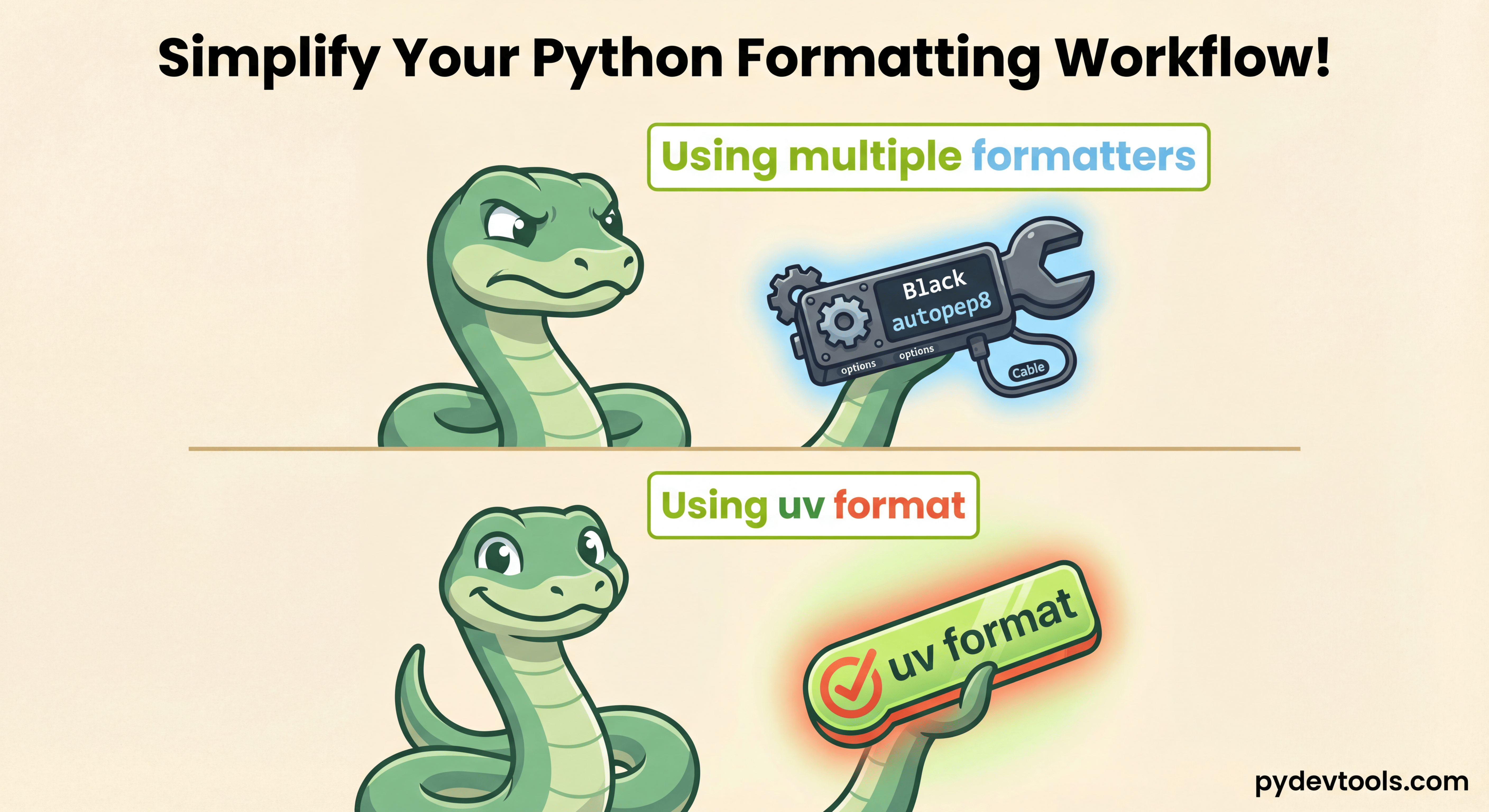
uv 0.8.13 adds experimental uv format command that runs Ruff's formatter, similar to how cargo fmt wraps rustfmt.
pydevtools.com
365 points · by tanelpoder · 1y ago · 245 comments
On the other hand, both `ruff` and `ty` are about code style. They both edit the code, either to format or fix typing / lint issues. They are good candidates to be merged.
The analogy would be to Cargo: `cargo fmt` just runs `rustfmt`, but you can also run `rustfmt` separately if you want.
The goal here is to see if users like a more streamlined experience with an opinionated default, like you have in Rust or Go: install uv, use `uv init` to create a project, use `uv run` to run your code, `uv format` to format it, etc. Maybe they won't like it! TBD.
(Ruff is installed when you invoke `uv format`, rather than bundled with the uv binary, so if you never use `uv format`, there aren't any material downsides to the experiment.)
The whole point is you just install `uv` and stop thinking about the pantheon of tools.
Stupidly I ran `uv format` without `--check` (no harm done and I can `git diff` it) so I didn't see the changes it made but `ruff check` does still show things that can be fixed with `ruff check --fix`. If I'm guessing correctly the difference is coming down to the fact that I have (in my submodule where all changes were made) a pyproject.toml file with ruff rules (there's also a .flake8 file. Repo is being converted). Either way, I find this a bit confusing userside. Not sure what to expect.
I think one thing I would like is that by default `uv format` spits out what files were changed like `uv format --check` does (s/Would reformat/Reformatted/g). Fine for the actual changes not to be displayed but I think this could help with error reduction. Running it again I can see it knows 68 files were changed. Where is that information being stored? It's pretty hard to grep out a number like that (`grep -R \<68\>`) and there's a lot of candidates (honestly there's nothing that looks like a good candidate).
Also, there's a `--quiet` flag, but the output is already pretty quiet. As far as I can tell the only difference is that quiet suppresses the warning (does `--quiet` also suppress errors?)
  uv format
  warning: `uv format` is experimental and may change without warning. Pass `--preview-features format` to disable this warning.
  36 files reformatted, 31 files left unchanged

  uv format --quiet
  36 files reformatted, 31 files left unchanged
Anyways, looking forward to seeing how this matures. Loved everything so far!
I'd imagine not, since `ruff format` and `ruff check` are separate things too.
ruff at least seems to be compiled into uv, as the format worked here without a local ruff. This is significant more than just an interface. Whether they are managed and developed as separate tools doesn't matter.
> This is more about providing a simpler experience for users that don't want to think about their formatter as a separate tool.
Then build a separate interface, some script/binary acting as a unified interface, maybe with its separate distribution of all tools. Pushing it into uv is just adding a burden to those who don't want this.
uv and ruff are poor names anyway, this could be used to at least introduce a good name for this everything-python-tool they seem to aim for.
To your analogy, it’d be like `cargo clippy`
Cargo cargo cult?
I prefer the plugin system. I don't like god programs like what the npm monstrosity became.
uv is like cargo for python.
If you only need a fast type checker you can just use ty, if you just need a fast formatter and linter you can just use ruff.
Combining ruff and ty doesn't make sense if you think about like this.
My understanding was that uv is for installing dependencies (e.g. like pip) with the added benefit of also installing/managing python interpreters (which can be reasonably thought of as a dependency). This makes sense. Adding more stuff doesn't make sense.
Think npm / go / cargo, not apt/yum/pip.
Translating this to uv, this will streamline having multiple python packages in the same directory/git repo, and leave e.g. vendored dependencies alone.
Also, since their goal really is "making cargo for python", it will likely support package-scoped ruff config files, instead of begin file- or directory-based.
That's probably the vision, given all from astral.sh, but `ty` isn't ready yet.
The reality is, ecosystems evolve. First, we had mypy. Then more type checkers came out: pyre, pyright, etc. Then basedpyright. The era of rust arrived and now we have `ty` and `pyrefly` being worked on heavily.
On the linter side we saw flake8, black, and then ruff.
Decoupling makes adapting to evolution much easier. As long as both continue to offer LSP integrations it allows engineers to pick and chose what's best.
`uv format` is similar (you don't need to know about `ruff format` / black / yapf ).
But formatting code is a completely new area that does not fit uv.
I would love to see a world where there is a single or a set of standard commands that would prepare your python project (format, lint, test, publish). Maybe that’s the vision here?
But it can't in general build torch-tensorrt or flash-attn because it has no way of knowing if Mercury was in retrograde when you ran pip. They are trying to thread a delicate an economically pivotal needle: the Python community prizes privatizing the profits and socializing the costs of "works on my box".
The cost of making the software deployable, secure, repeatable, reliable didn't go away! It just became someone else's problem at a later time in a different place with far fewer degrees of freedom.
Doing this in a way that satisfies serious operations people without alienating the "works on my box...sometimes" crowd is The Lord's Work.
This is a self-inflicted wound, since flash attention insist on building a native C++ extension which is completely unnecessary in this case.
What you can do is the following:
1) Compile your CUDA kernels offline. 2) Include those compiled kernels in a package you push to pypi. 3) Call into the kernels with pure Python, without going through a C++ extension.
I do this for the CUDA kernels I maintain and it works great.
Flash attention currently publishes 48 (!) different packages[1], for different combinations of pytorch and C++ ABI. With this approach it would have to only publish one, and it would work for every combination of Python and pytorch.
[1] - https://github.com/Dao-AILab/flash-attention/releases/tag/v2...
uv is already a complex tool, but it has excellent documentation. Adding a straightforward, self-explanatory subcommand like this doesn’t seem out of place.
It's simple:
- Everything I use and I see: good
- Everything I don't use and I see: bloat
- Everything I use and I don't see: good
- Everything I think I don't use and I don't see: Java
I think it is much worse to create a special case that obscures the actual formatter being run and how it is being run (is ruff now preinstalled, or is it downloaded and cached in the same way as other tools?)
> I don’t think additional complexity counts as being worse.
Yes, it does.
So when I moved several projects from black to ruff, there were no changes made to the code.
Also because of fun, if you reformat again with the older version it won't go back to as it was before :)
You cite good examples where other languages have chosen to standardise tooling. We can discuss the pros and cons of that choice. But it is a choice, and Python already made a different choice.
> There should be one-- and preferably only one --obvious way to do it.
- PEP20 - The Zen of Python
The impact of uv on our onboarding and utilisation of python has already been huge, and any way I can easily improve their code hygiene is a good one. Yes, I could get them to use ruff standalone, or set up pre-commit hooks etc for them, but the simple mental model that comes from `uv <do something>` is really beneficial.
Will have a play around with this and see how it goes. Would love to be able to hook into other formatters too, but not sure if that's easy or even possible already. For example, I would love it if `uv format` also formatted our SQL/dbt models.
Seriously, if uv becomes to Python what cargo is to Rust, the developer experience for Python is going to be vastly better than before. I've been writing Python professionally for more than 25 years, and getting paid to work around it's crummier parts, and I'm thrilled to be able to throw away all that knowledge and just use uv.
This smacks of feature-creep and I won't be incorporating it into any pipelines for the foreseeable future.
I know this is a hot take, but so much headache saved down the road to “force” this stuff up front.
Do you even read you write? Work is about efficiency, not catering to every special snowflake.
Given black's motto (any color as long as it's black), now I pick ruff and go with whatever formatting it produces.
I don't know much about go.
I am not sure I like this either. I think linter and formatter are more like developer dependencies, especially because both formatter and linters are generally things that you want to lock to a specific version to avoid e.g. CI failures or mass changes when a version is updated. But I can understand that having a formatter always available may be nice.
The astral team is pretty responsive to questions and feedback. If this type of change concerns you (as an actual user of the tool) please reach out to them. My big thing right now is integrations with workspaces. And if special case commands is the answer,,, well not ideal but I’ll take it.
uvx ruff format .Have developers really been waiting for this? What's wrong with ruff format?
uv is trying to deliver the same experience as cargo does for rust. Just install a single CLI and it's the only tool you have to worry about when working on your Python project.
There's nothing wrong with `ruff format`, but it's nice to have `uv` as a universal entrypoint.
So maybe nobody has been waiting for this and the feedback will be: we don’t need this.
Also it uses ruff under the hood. If it’s integrated with uv, an advantage is one less tool to juggle.
Being able to just to "go fmt", without needing any additional tools, is a really great thing about the language.
The only danger that I can see (and it is a big one) is that Python doesn't have the same kind of consistency that go does. It might end up failing just because so many people use Python in such different ways.
But let's appreciate that this will increase the use of formatters astronomically (or part thereof), which is an excellent thing.
That said, I may not have installed super complex packages, but for years now I have never ever experienced one situation (on Windows, ok) where pip did not just work. For me, pip is the way.
I also have the Python folder be a Git repo, and every `pip install` is a commit, and every project is a branch. Why so difficult?
ruff: Aww, you're sweet!
uv format: Hello, human resources?
Meanwhile, they provide identical functionality. (`Under the hood, it calls Ruff’s formatter to automatically style your code according to consistent standards.`)
Both tools are still evolving enough that I would not want their individual release cycles to impact each other.
A lot of users just want a simpler experience. They want to install uv, run `uv run` to run their project, `uv format` to format it, etc. The idea here is to experiment with providing that functionality and see if folks find it useful. Maybe they won't want it! It's experimental :)
- cargo fmt
- go fmt
- deno fmt
- dart format
too!
The great thing about uv is not that their choices are best, it's that the choices have been made, the gordian knots cut. There is a good enough standard to build upon. Future python projects will look a lot more like each other, and less time will be wasted on organizational minutiae.
There are/were definitely some weaker spots with Cargo (e.g. private registry support was meh for some time), but if one were tasked to build a package manager and were only allowed to pick a single one to take inspration from, Cargo is definitely the way to go.
https://peps.python.org/pep-0008/#a-foolish-consistency-is-t...
I wonder how a code formatting tool is going to implement that.
Wary of the vc funded aspect though…
I don't want my package manager to format anything.
I don't want my package manager to lint anything.
I don't want my package manager to `run` anything.
I don't want my package manager to even manage environments (yes yes this one is a bit extreme).
I want to have single purpose tools that work together well.
This way I can have a flexible, composable toolchain that can both adapt to me and my specific project.
For example, I like conda, pip, ruff, mypy, flake8. Someone else might like venv, pip, black, pyright, flake8.
This is the heart of the Unix Philosophy and I feel like it's a philosophy each software community has to reject, suffer due to that rejection, and re-adopt on a regular basis. I'd rather we skip the suffering bit.
Even moreso in the LLM age of tooling and coding agents.
Some languages (Go, Rust) have essentially solved this issue to the point where blindly running the formatters these languages have solves the problem and is uncontroversial.
Sadly, the language of choice for me (Kotlin) has a big unaddressed problem here where what the IDE does for formatting and what independent formatting tools do are two things that are hard to align for mostly the historical reasons that what the IDE does is fragmented over different bits of code that don't listen to the same configuration. There is a lot of variation in preferences for indentation, where to put new lines, line length, what order to put imports in, which imports to use wildcards for (if any at all), etc. Particularly imports are a problem because the bit of code that organizes imports is separate from the bit of code that formats code in the IDE.
The common solution of using IDE plugins to work around this is a bit of a kludge. The proper solution would be a more sane way to just make the IDE externally configurable so that build tools can make the IDE do exactly the same as what they do without requiring users to manually configure their IDEs just right by installing plugins or fiddling with configuration. This stuff should not be user controllable if there is a build file that defines the proper formatting.
Coding agents actually add to this problem. Because getting those to stick to formatting conventions is tricky. Unless you have tools that just fix that properly.
So good change in uv and probably something I'd be using on my next python project (I do those once in a while).
All major IDEs allow to save the format configurations, which can be stored on the repo alongside the code as the team official's configuration.
Coding agents solve this problem in that eventually all programming languages will be as relevant as mastering Assembly is nowadays.
I already do stuff in low code/no code, that in the past I would be manually writing code to sort out those issues.
In the meantime, you can also ask them to format generated code in whatever way one feels like it.
Your solution requires user discipline and fiddling with things that should just work right without fiddling. And it needs to happen on every development environment. You can't really enforce it except via annoying additional kludges in the form of failing builds.
I've never been on a team where this was done right. I've been on plenty of teams with convoluted half enforced formatting rules (and thousands of violations).
I know how to fix it for my own code. But being able to force everyone I have to work with to do the same thing over and over again is the problem that needs solving. Everybody just shrugs it off and does nothing about it. What are you going to do. It's always been this miserable this way. Industry wide apathy on this topic.
That's why I appreciate what Google did with Go here so much. Not a fan of the language necessarily. But they did the right thing with making code formatting not optional and a compile error to skip. Stuff like this should not be a debate or discussion or a follow this 20 step process to setup your work environment properly but just something that works right (for fuzzy definitions of right) as specified by the build file in the code repository.
It's a minor annoyance that I wish Jetbrains would just take more serious.