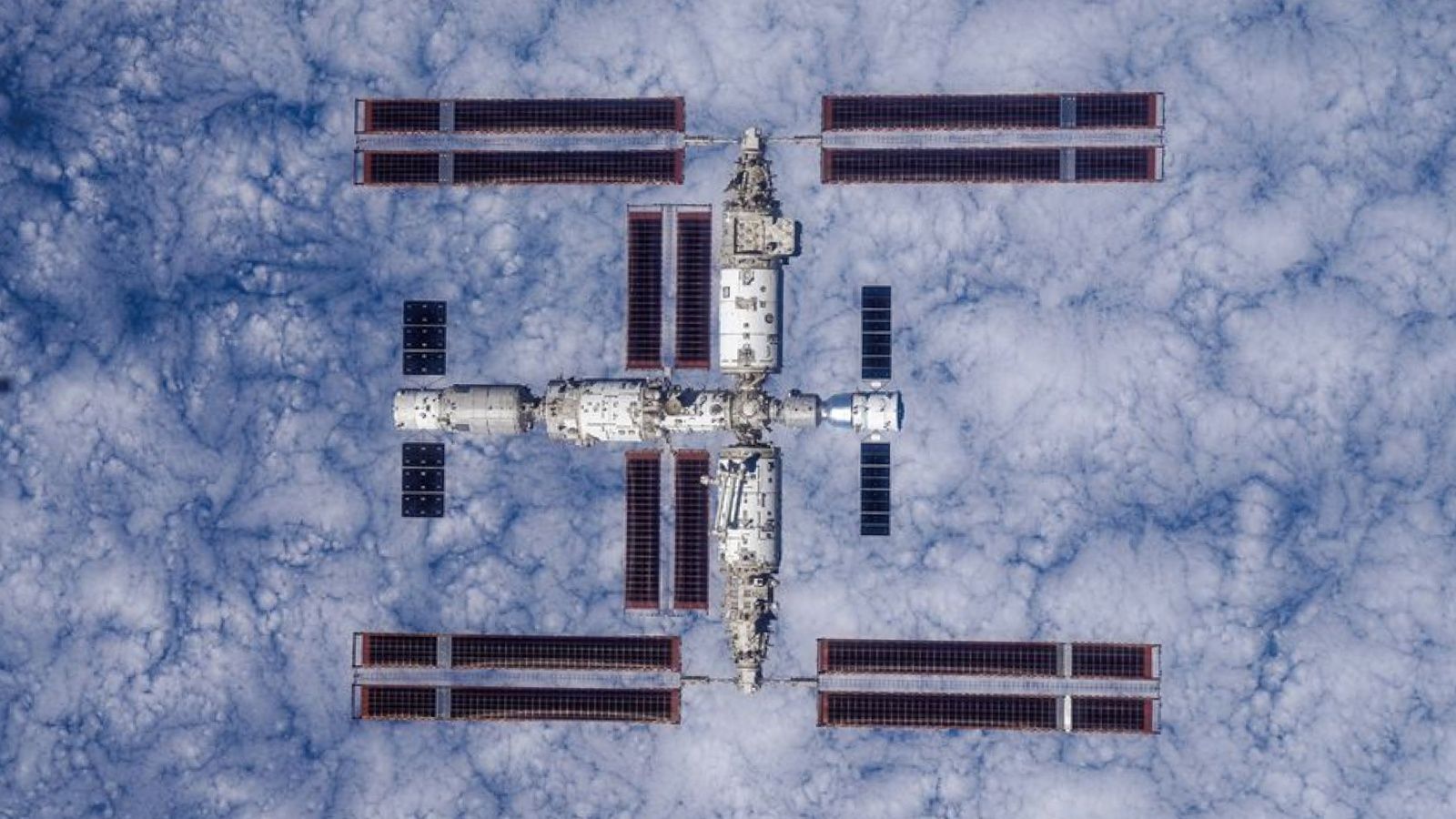
Chinese astronauts make rocket fuel and oxygen in space using 1st-of-its-kind
Astronauts on board China
Live Science
298 points · by Teever · 1y ago · 136 comments
This is silly, but also begs the sillier question why we aren't bioengineering plants to produce rocket fuel
Plants are self-assembling albeit inefficient photosynthesises.
On earth, where they can harvest their carbon in situ, that inefficiency outweighed by us not having to make them. Their main components by wet and dry mass, carbon and oxygen, are dissolved in atmosphere. In space, on the other hand, the major cost is lifting. (Even earth, farming quickly becomes uneconomical when just water costs balloon.)
In space you’re moving all the mass the plant is built out of at exorbitant cost. At that point, you might as well just assemble the machinery on the ground and get the efficiency boost.
I can only see an exception arising if lifting costs start scaling with volume more than mass, i.e. post chemical rocketry, at which point sending up compacted carbon and water and letting plants assemble themselves in space makes more sense than sending up panels and tiny labs. (That or you’re going somewhere with accessible carbon and/or oxygen.)
I don't know what the actual claim that is being made here is; This seems to redirect ultimately to a lay press release from a state space agency rather than to a scientific paper. There do seem to be a number of competing articles on electrochemical synthesis of ethylene from CO2.
https://www.carboncapturejournal.com/news/artificial-photsyn...
https://www.nature.com/articles/s41467-024-50522-7
https://lanzatech.com/lanzatech-produces-ethylene-from-co2-c...
https://techport.nasa.gov/projects/93860
https://news.umich.edu/in-step-toward-solar-fuels-durable-ar...
Alternatively, you can break it down into ethanol, which has been used as liquid rocket fuel since at least the first half of the '40s.
This classic book tells the story of liquid rocket fuel development
https://library.sciencemadness.org/library/books/ignition.pd...
You'd think that you could mix any of a wide range of fuels with a wide range of oxidizers and get a good rocket fuel but it does not really work that way, most combinations are pretty awful, including the ethanol + O2 used in the V2. There was a time when there was interest in "storable" liquid propellants but once solid propellants reached this level of maturity
https://en.wikipedia.org/wiki/LGM-30_Minuteman
those were obsolete.
It is hard to beat H2+oxygen or hydrocarbons+oxygen if you pick the right hydrocarbons (rocket kerosene isn't quite the kerosene you use in a lamp)
I'm not sure if ethylene is really that good of a rocket fuel. In the context of a space economy I see it as a "reactive carbon" substance which is easy to make other things out of, say,
https://en.wikipedia.org/wiki/Polyethylene
in the sense that glucose is reactive carbon you can build structural carbohydrates and all sorts of biological molecules out of. There is talk about SpaceX establishing a methane economy on Mars, methane is definitely an easy to synthesize rocket fuel but it not very reactive and not on the path to making other things you might want.
Sort of early 'RoundUp' with high contents of Sodium chlorate combined with powdered sugar. Very dangerous! But fun :-)
Even more fun, but potentially fatal very fast would be Potassium chlorate.
But I've been cautious, and limited myself to selfmade blackpowder mostly, during the times one 'did that' as young boys with toys.
Still have all my fingers, no burn scars, full eyesight & hearing, though. Phew! :-)
For now and the near future there are no ways of doing that part otherwise than by using living plants or fungi, possibly with genome modifications.
The part with capturing solar light and splitting water and reducing carbon dioxide to a very simple carbon compound can be done with artificial means much more efficiently than in plants, so there is little doubt that this will become commonly used in the near future.
Ethylene or methane are good for fuel or for making plastic, but when a slightly more complex organic substance were made, e.g. glycine or glycerol, that could be used to feed a culture of fungi, which could be used to make human food, especially if genetically-modified to make higher quality proteins.
Cyanobacteria that can exist in the vacuum of space AND produce oxygen... just not fast enough to be useful, but one day, a big hairy space ship will rule the universe!
See: https://www.reddit.com/r/space/comments/1acqxml/lichen_survi...
I'm sure the economics don't work out for it: solar panels are already cheap, the land could grow other crops, etc. But photosynthesis being lower-yield than photovoltaic generation isn't enough to rule it out. Perhaps as science fiction, on a future mission to an Earthlike planet that doesn't have the right resources to produce semiconductors at scale.
Measured how? If nothing else, they seem to be good at carbon capture. And I don't see how you it could account for engineered for plants engineered to store more of their energy as oil.
Stupidest possible thing to do with food. Especially since in some operations you put in more diesel than take ethanol out.
edit: Looked it up - Rice has the highest number of calories per square metre of farmland, just that it requires marshy/swamp land to grow.
It doesn't make economic and enviromental sense in most parts of the world (especially corn). In some places they are net-positive on carbon emissions compared to oil-derived gasoline. Tilling the fields, growing, harvesting, processing and transporting often emits more CO2 than the equivalent gasoline produced. Especially the initial tilling of the land to convert it to farmland releases A LOT of CO2 into the atmosphere (this is a one-time thing though).
In the US all (ground vehicle) gasoline sold needs to have 10% ethanol (corn-based), in Brazil it is 20% (sugar cane based). In Brazil almost all cars support 100% ethanol fuel and it is quite common to fuel with ethanol only.
https://en.wikipedia.org/wiki/Ethanol_fuel_in_Brazil
The whole bio-fuel industry is a very complex mix of economics (often requires subsidies to make sense), geopolitical (less imported oil), environmental concerns (mass scale farming soil degradation and CO2 emissions derived from it) and logistical (completely different transportation and refining process).
Fun fact ethanol freezes at a fairly high temperature and mixes with water which makes it not ideal for cold climates and boats. It is quite common for unaware boat owners to f-up their engines by buying car-grade fuel-station gasoline in Brazil.
30% in 2025 for cars (from 27%), 15% biodiesel in diesel for trucks (from 14%).
Source: https://www.em.com.br/politica/2025/06/7183470-governo-aumen...
> The whole bio-fuel industry is a very complex mix of economics (often requires subsidies to make sense), geopolitical (less imported oil), environmental concerns (mass scale farming soil degradation and CO2 emissions derived from it) and logistical (completely different transportation and refining process).
Don't forget lobyying by the relevant sectors!
Mythbusters: https://youtu.be/QEX1YFXYTdI
TopGear: https://youtu.be/GOFbsaNeZps
https://www.ers.usda.gov/publications/pub-details?pubid=1057...
In a more serious response almost all questions like yours can boil down to economics. You can be certain if there is a way make something at a profit someone will jump in and make it happen. If there is no money in it you can expect that even if it is more environmentally friendly it may be part of research but not going to be implemented unless it becomes profitable.
Very intriguing is the Primeval Code[0] in which plants and other life exposed to electrostatic fields changed significantly down to the genome.
Would be very interesting which other artificial settings and compositions affect life in which ways.
(I say this in the friendly spirit of a long-defeated fellow pedant who has hit people with your exact comment for decades)
Rockets need to eject particles to generate force. And to eject 1 kg of fuel, its photo synthesis system has to lose 1 km of mass in one way or another.
The solution is to find a way to generate thrust without rocket fuel ejection.
Solar sails are probably more practical.
Gather interstellar hydrogen, use it to run a fusion engine for propulsion and power. :)
Star Trek assumed that all warp class vehicles would require them for operation and in-situ fuel replenishment.
There's been a number of pure electric propulsion proposals or prototypes, but they've all turned out to be a hoax; the latest one I recall was the EmDrive [0], where any paper claiming it produced positive thrust was debunked with the measurements having been influenced by outside forces.
The TL;DR is that reactionless drives are not possible due to Newton's third law. This page / this website is always a great resource for things like this, it's in the context of writing science fiction but it has tons of research: [1]
[0] https://en.wikipedia.org/wiki/EmDrive
[1] https://www.projectrho.com/public_html/rocket/reactionlessdr...
At best we'll be able to send out probes. Maybe, but this still feels science fiction too, we can harness quantum entanglement for long distance instant communication.
There is exceptionally little material info in this article and so very much speculation
Americans don't like the idea that maybe China is actually rocketing past them technologically and infrastructurally, so news doesn't really report on it much.
The prevailing narrative, particularly around hacker news, is that China is a dangerous foe and it's technological progress is a sign that we need to give our own government more money and less oversight so that we don't lose our "technological advantage."
> Americans don't like the idea that maybe China is actually rocketing past them technologically and infrastructurally
I don't buy this explanation given it's value to American propagandists. American society is naturally competitive. There's only two likely reasons why it doesn't get reported.
It's either not as true as the Chinese would like you to believe or American industry is already profiting off of it.
Its also needlessly complicated to send the experiment to space. It would be equally valid science if made on earth. So there is a clear performance in the experiment not justifiable by any scientific reason.
Not to say china isn't ahead in space development right now. Artemis is going quite badly and china could certainly be faster to building usable moon outpost.
Its also very cool science, if its claims are true.
I personally have nothing against the Chinese and respect them being oddly far more interested in the wellbeing of their own people than remotely anything in any western country, but it sure is odd behavior by people who consider China a threat.
“China’s an enemy” … “let’s bring in 600,000 Chinese every single year to learn from us and take the knowledge back to China and the ones that remain will be embedded spies like the people of other foreign nations who have burrowed into America and its power structure”.