Google's Liquid Cooling at Hot Chips 2025
Datacenter-Scale Heat Management
chipsandcheese.com
400 points · by giuliomagnifico · 1y ago · 174 comments
Reading this article immediately made me think back to that.
I posed this further down in a reply-to-a-reply but I should call it out a little closer to the top: The innovation here is not “we are using water for cooling”. The innovation here is that they are direct cooling the servers with chillers that are outside of the facility. Most mainframes will use water cooling to get the heat from the core out to the edges where traditional where it can be picked up by the typical heatsink/cooling fans. Even home PCs do this by moving the heat to a reservoir that can be more effectively cooled.
What Google is doing is using the huge chillers that would normally be cooling the air in the facility to cool water which is directly pumped into every server. The return water is then cooled in the chiller tower. This eliminates ANY air based transfer besides the chiller tower. This is one being done a server or a rack.. its being done on the whole data center all at once.
I am super curious how they handle things like chiller maintenance or pump failures. I am sure they have redundancy but the system for that has to be super impressive because it can’t be offline long before you experience hardware failure!
[Edit: It was pointed out in another comment that AWS is doing this as well and honestly their pictures make it way clearer what is happening: https://www.aboutamazon.com/news/aws/aws-liquid-cooling-data...]
> What Google is doing is using the huge chillers that would normally be cooling the air in the facility to cool water which is directly pumped into every server.
From the article:
> CDUs exchange heat between coolant liquid and the facility-level water supply.
Also, I know from attaching them at some point that plenty of mainframes used this exact same approach (water to water exchange with facility water), not water to air to water like you describe in this comment and others, so I think you may have just not had experience there? https://www.electronics-cooling.com/2005/08/liquid-cooling-i... contains a diagram in Figure 1 of this exact CDU architecture, which it claims was in use in mainframes dating back to 1965 (!).
I also don't think "This eliminates ANY air based transfer besides the chiller tower." is strictly true; looking at the photo of the sled in the article, there are fans. The TPUs are cooled by the liquid loop but the ancillaries are still air cooled. This is typical for water cooling systems in my experience; while I wouldn't be surprised to be wrong (it sure would be more efficient, I'd think!), I've never seen a water cooling system which successfully works without forced air, because there are just too many ancillary components of varying shapes to successfully design a PCB-waterblock combination which does not also demand forced air cooling.
Oh interesting I missed that when I went through in the first pass. (I think I space bared to pass the image and managed to skip the entire paragraph in between the two images so that’s on me.
I was running off an informal discussion I had with a hardware ops person several years ago where he mentioned a push to unify cooling and eliminate thermal transfer points since they were one of the major elements of inefficiency in modern cooling solutions. By missing that as I browsed through it I think I leaned too heavily on my assumptions without realizing it!
Also, not all chips can be liquid cooled so there will always be an element of air cooling so the fans and stuff are still there for the “everything else” cases and I doubt anybody will really eliminate that effectively. The comment you quoted was mostly directed towards the idea that Cray-1 had liquid cooling, it did, but it transferred to air outside of the server which was an extremely common model for most older mainframe setups. It was rare for the heat to be kept liquid along the whole path.
The only ones I've ever seen do water to compressor (then gas to the outdoor condenser, obviously)
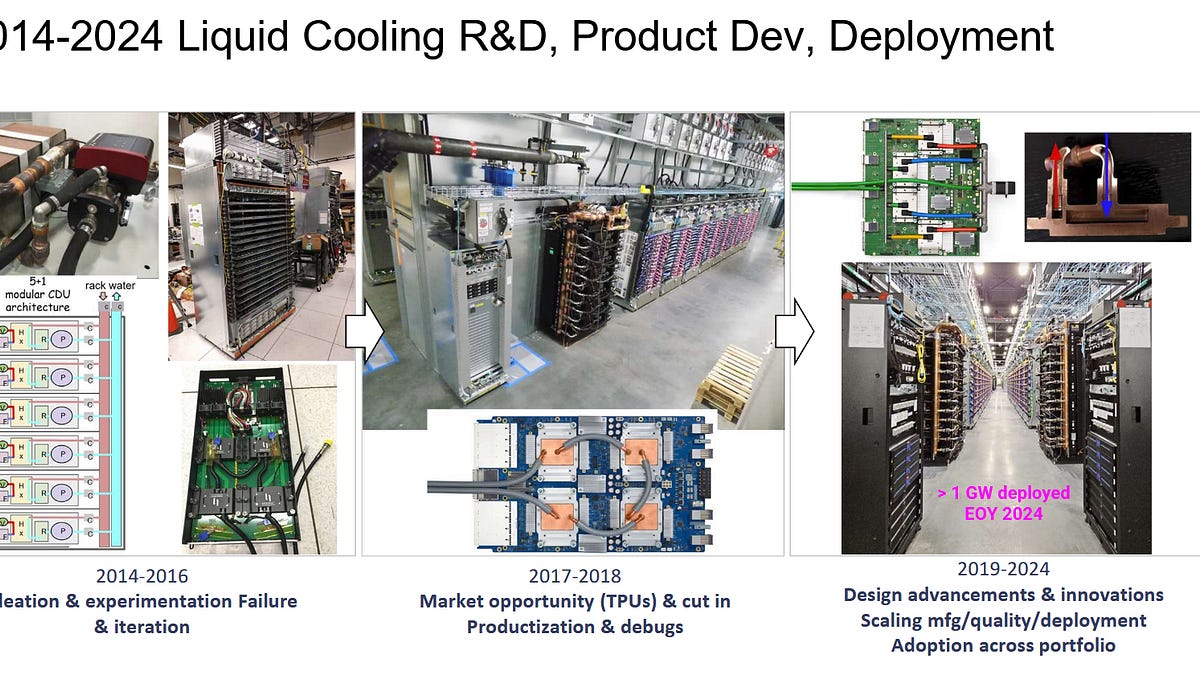
I don't know what surprises me about it so much, but having these rack-sized CDU heat-exchangers was quite a surprise, quite novel to me. Having a relatively small closed loop versus one big loop that has to go outside seems like a very big tradeoff, with a somewhat material and space intensive demand (a rack with 6x CDUs), but the fine grained control does seem obviously sweet to have. I wish there were a little more justification for the use of heat exchangers!
The way water is distributed within the server is also pretty amazing, with each server having it's own "bus bar" of water, and each chip having it's own active electro-mechanical valve to control it's specific water flow. The TPUv3 design where cooling happens serially, each chip in sequence getting hotter and hotter water seems common-ish, where-as with TPUv4 there's a fully parallel and controllable design.
Also the switch from lidded chips to bare chips, with a cold plate that comes down to just above, channeling water is one of those very detailed fine-grained optimizations that is just so sweet.
That is exactly what the Cray Y-MP EL that I worked with in the 90s/2000s did.
Yes. A supply and return line along with power. Though if I had to guess how its setup this would be done with some super slick “it just works” kind of mount that lets them just slide the case in and lock it in place. When I was there almost all hardware replacement was made downright trivial so it could just be more or less slide in place and walk away.
It does sound like connections do involve water lines though. As they are isolating different water circuits, in theory they could have a dry connection between heat exchanger plates, or one made through thermal paste. It doesn't sound like they're doing that though.
https://blog.codinghorror.com/building-a-computer-the-google...
> Liquid cooling is a familiar concept to PC enthusiasts, and has a long history in enterprise compute as well.
And the trend in data centers was to move towards more passive cooling at the individual servers and hotter operating temperatures for a while. This is interesting because it reverses that trend a lot, and possibly because of the per-row cooling.
Those style of jobs worked well but as Google has realized it has more high performance computing with unique workload characteristics that are mission-critical (https://cloud.google.com/blog/topics/systems/the-fifth-epoch...) their infrastructure has had to undergo a lot of evolution to adapt to that.
Google PR has always been full of "look we discovered something important and new and everybody should do it", often for things that were effectively solved using that approach a long time ago. MapReduce is a great example of that- Google certainly didn't invent the concepts of Map or Reduce, or even the idea of using those for doing high throughput computing (and the shuffle phase of MapReduce is more "interesting" from a high performance computing perspective than mapping or reducing anyway).
Liquid cooling at Google scale is different than mainframes as well. Mainframes needed to move heat from the core out to the edges of the server where traditional data center cooling would transfer it away to be conditioned. Google liquid cooling is moving the heat completely outside of the building while it’s still liquid. That’s never been done before as far as I am aware. Not at this scale at least.
Google isn't claiming to have invented water cooling. This article recaps their talk at Hot Chips where they showed some details of their implementation.
Data center cooling is also a different beast than supercomputer cooling. Datacenter cooling operates at a larger scale and has different needs for maintenance operations like maintenance cycles.
There are also some interesting notes in there about new things Google is doing, like the direct-die cooling.
Water cooling is a big field. Data center operations is a big field. There is interesting content in the article.
The “Map” in MapReduce does not originally stand for the map operation, it comes from the concept of “a map” (or, I guess, a multimap). MapReduce descends from “the ripper”, an older system that mostly did per-element processing, but wasn't very robust or flexible. I believe the map operation was called “Filter()” at the time, and reduce also was called something else. Eventually things were cleaned up and renamed into Map() and Reduce() (and much more complexity was added, such as combiners), in a sort of backnaming.
It may be tangential, but it's not like the MapReduce authors started with “aha, we can use functional programming here”; it's more like the concept fell out. The fundamental contribution of MapReduce is not to invent lambda calculus, but to show that with enough violence (and you should know there was a lot of violence in there!), you can actually make a robust distributed system that appears simple to the users.
Building out an idea for a bespoke supercomputer and making an iteration of that idea that applies to globally scaled workloads is a different thing. They are building computing factories, as is Amazon, MS, Facebook, etc.
That said, PR is PR, and companies always crow about something for their own reasons.
Google wants you to know it recycles its water. It's free points.
Edit: to clarify, normal social media is being flooded with stories about AI energy and water usage. Google isn't greenwashing, they're simply showing how things work and getting good press for something they already do.
Last year, U.S. data centers consumed 17 billion gallons of water. Which sounds like a lot, but the US as a whole uses 300 billion gallons of water every day. Water is not a scarce resource in much of the country.
It's mostly a play for density.
Hasn't this just been for things like rack doors and such?
In the last ~two generations of servers it seems like now there's finally DLC (direct liquid cooling) into the actual servers themselves (similar to the article). Intel kind of forced that one on us, with their high-end SKUs. This has been a pain becuase it doesn't fit into legacy datacenters as easily as the door/rack-based systems.
I won't say which server vendor it is, but I've put in more than one service ticket for leaking coolant bags (they hang them on the racks).
At least, if you look at them on streetview a lot of them seem to be in the middle of nowhere, surrounded by miles of undeveloped scrubland. If Google's Henderson, NV data centre [1] needed more space they could simply buy out the adjacent car wrecking yard or pet crematorium, or reconsider the gigantic gatehouse and vast expanses of beige gravel.
Even in Belgium, with its higher population density [2] the car park is bigger than the data centre.
The layout makes me think they were told they could only have a certain amount of power, but essentially as much land as they needed. So they're concerned about power and thermals, but maybe not about power and thermal density so much.
[1] https://www.google.com/maps/place/Google+Data+Center+-+Hende... [2] https://www.google.com/maps/place/Google+Data+Center/@55.557...
The problem with using air cooling to get it there is that the humans who run the data center have to enter and breathe the same air that's used to cool the computers, and if your working fluid gets too hot it's quite unhealthy for them. (we run our hot aisles at 100F, which is a bit toasty, and every third rack is a heat exchanger running off the chilled water lines from the outside evaporative cooler, modulo a heat exchanger to keep the bird shit out)
We're not going to be able to pump much heat into the outside world unless our working fluid is a decent amount hotter than ambient, so when it gets reasonably warm outside we need to put chillers (water-to-water AC units) in the loop, which consume energy to basically concentrate that heat into a higher-temperature exhaust. When it's really hot outside they consume quite a bit of energy.
If the entire data center was liquid cooled we could have coolant coming from the racks at a much higher temperature, and we'd be able to dump the heat outside on the hottest days without needing any chillers in the loop. As it is we have some liquid cooled racks running off the same chilled water lines as the in-aisle heat exchangers, but the coolant temp is limited by the temperature of our hot aisles, which are quite hot enough already, thank you.
This isn't how you think of heat flow. The CPUs run at a given power. Their temperature will depend on the ambient temperature, and on the thermal impedance between them and the ambient. If the thermal impedance is too high, they'll be too hot and die.
When properly cooled. If cooling is insufficient they can easily get much hotter.
Of course, it's worth noting that if you've got four chips, each putting out 250W of power, and a pump pushing 1 litres of water per minute through them, water at the outlet must be 14°C hotter than water at the inlet, because of the specific heat capacity of water. That's true whether the water flows through the chips in series, or in parallel.
>The Paris Olympic Pool is Heated by the Internet
So I am afraid I do not care about your liquid cooling on this day. I'm also not particularly impressed, I am sure the devil is in the details at this scale but there doesn't seem to be much novel here.
If a Googler happens to read this and it makes them sad, it's Google, not you. You might consider doing cool stuff somewhere else.
The whole AI-water conversation is sort of tiring, since water just moves to more or less efficient parts or locations in the water cycle - I think a "total runtime energy consumption" metric would be much more useful if it were possible to accurately price in water-related externalities (ie - is a massive amount of energy spent moving water because a datacenter evaporates it? or is it no big deal?). And the whole thing really just shows how inefficient and inaccurately priced the market for water is, especially in the US where water rights, price, and the actual utility of water in a given location are often shockingly uncorrelated.
The margin at which it makes sense to save water varies wildly by location, but the cultural dominance of the western USA infiltrates everything.
Here in Zürich, my office briefly installed water saving taps. This is a city of less than half a million where the government maintains 1,200 fountains that spew drinkable water 24/7. But someone at the California HQ said saving water is important and someone at the Swiss subsidiary said yes sir we'll look into it right away sir.
We live in an area surrounded by grass fed cows, so what does it matter if we throw away 3/4 of our steak?
Without regard to how plentiful resources are in our particular area, being needlessly wasteful is in bad taste more than anything. It's a lack of appreciation of the value of what we have.
For water specifically - it is generally speaking the most valuable resource available, we just don't appreciate it because we happen to have a lot of it.
https://www.aboutamazon.com/news/aws/aws-liquid-cooling-data...
In either case I cannot find out how they dump the heat from the output water before recycling it. That's a problem I find far more interesting.
The implication is clear that it is a waste, but I feel like if they had the data so support that, it wouldn't be left for the reader to infer.
I can see two models where you could say water is consumed. Either talking about drinkable water rendered undrinkable, or turning water into something else where it is not practically recaptured. Tuning it into steam, sequestering it in some sludge etc.
Are these things happening? If it is happening, is it bad? Why?
I'd love to see answers on this, because I have seen the figures used like a kudgel without specifying what the numbers actually refer to. It's frustrating as hell.
> ...actual water consumed by data centers is around 66 million gallons per day. By 2028, that’s estimated to rise by two to four times. This is a large amount of water when compared to the amount of water homes use, but it's not particularly large when compared to other large-scale industrial uses. 66 million gallons per day is about 6% of the water used by US golf courses, and it's about 3% of the water used to grow cotton in 2023.
Depending on what global average means, it seems like that's quite a lot of cycling of evaporation unless they are releasing steam at 800C
Looking up overall water usage, the US uses 27.4Billion gallons a day residential and 18.2 Billion gallons industrial. It surprised me that industrial was lower, but I guess the US manufactures less these days.
If the 1kwh per litre were accurate then judging by this calc https://www.google.com/search?q=(27.4billion+gallons+*365)*+... 37 857 903.3 terawatt hours
0.1% of The residential water use of the US would be enough to cool the entire Electicity output of the world (about 30,000TWh)
(of course, with these things it's easy to slip an order of magnitude(or several) so best check my numbers)
Here you go: https://en.m.wikipedia.org/wiki/Cooling_tower
Data centers use evaporative cooling towers which evaporate water to reject heat to the atmosphere.
Of course, if you're using dry cooling, it uses more electricity, so hopefully you're using solar, not a source that uses evaporative cooling to produce electricity (if in a dry climate).
Is it because chips are getting more expensive, so it is more economical to run them faster by liquid cooling them?
Or is it data center footprint is more expensive, so denser liquid cooling makes more sense?
Or is it that wiring distances (1ft = 1nanosecond) make dense computing faster and more efficient?
Contrary to other posters, I'd argue this effect is relatively small. A really good interconnect fabric might give you ping-pong times on the order of 1 microsecond, which is still 1000 times larger than a nanosecond. Most of the delay will be in the switches and the end nodes, not in the signal traveling over the wire or fiber. Say for a large-ish cluster with a diameter of, say, 100 feet (something like 7 rows of racks, each row 100 feet long, give or take), if liquid cooling allows you to double the density, you could condense it to a diameter of 100/sqrt(2) = 70 ft (about 5 rows of 70 ft each). As a ping-pong involves a signal going both ways, the worst-case increase in signal delay would be (100-70)*2 = 60 ft or 60 nanoseconds (in reality somewhat more since cables have to be routed). So about a 6% increase if we assume the baseline is 1 microsecond. Measurable, yes, but likely very small effect on application performance vs. a ping-pong microbenchmark.
Now where it can matter is that by packing the components more closely together, you can connect more chips via backplane and/or copper connectors vs. having to use optics.
People don't really complain about crappy shovels during a gold rush though unfortunately, they're just happy they got one before they ran out. They have no incentive to innovate in efficiency while the performance line keeps going up.
https://www.xlr8yourmac.com/systems/G5_CoolantLeak_Repair/G5...
It’s not a hospitable place.
I would have loved it if cooling was quieter and less extreme.
The reason interfaces are on the back is that’s the intake side. So, bring a sweater.
Or just go to the other side of the rack to warm your hands back up.
[1] https://www.informationweek.com/sustainability/reusing-waste... [2] https://www.techspot.com/news/97995-data-center-uses-waste-h...
www.aboutamazon.com/news/sustainability/the-super-efficient-heat-source-hidden-below-amazons-seattle-headquarters
The future is here.
See https://www.eneco.nl/en/about-us/what-we-do/sustainable-reso... for a basic overview.
How about the author compare it to MS, Meta, or AWS instead of Joe Blow buying parts online? I would hope that Google had extensive validation and clear protocols. [Roll-Eyes]
OVH has been using liquid cooling for many years:
https://blog.ovhcloud.com/new-hybrid-immersion-liquid-coolin...
OVH _do_ definitely use traditional water-loop/water-block liquid cooling like Google are presenting, described here: https://blog.ovhcloud.com/understanding-ovhclouds-data-centr... and visually in https://www.youtube.com/watch?v=RFzirpvTiOo , but while it looks very similar architecturally their setup seems almost comically inefficient compared to Google's according to their PUE disclosures.