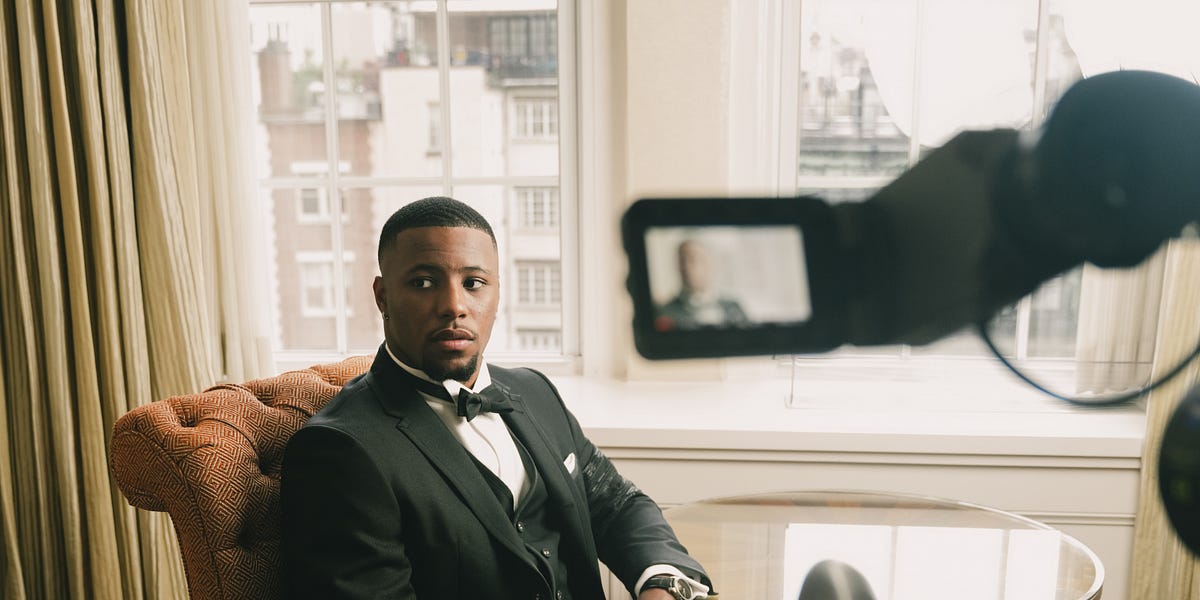
Saquon Barkley Is Playing for Equity
The NFL star running back is building a portfolio of startups and redefining what it means to be a modern athlete.
readtheprofile.com
97 points · by polinapompliano · 1y ago · 110 comments
Even a non-famous person with ~$20mm to invest (somewhere around the after-tax amount of his rookie contract) would not get a seat at the table at these VC firms.
I also see no real indication that Barkley is especially good at what he is doing here. Is there a reason to believe that anything but luck separates his investments, including in crypto, from deals his peers like Tom Brady and Steph Curry made with FTX that got those guys pulled into the company's legal problems?
He's a generational talent who signed a $30 million rookie contract.
I know guys who played in the NFL and they got paid a sliver of that, at best. They are out of the league. 99% of guys who make it aren't Saquon Barkley. Shit, 99% of guys in his position aren't at his level. RBs do not last at the NFL level for very long. There's always some young new hotshot out of the college game who is faster, younger, and not beat up.
The big issue is that most of those guys spent their entire lives to that point to play in the NFL. They didn't challenge themselves in high school or college from an academic standpoint - they focused on football. They took home through that 3 year rookie deal MAYBE $200k-300k total after tax, outside training expenses, agent expenses, etc.
A slightly different perspective: they weren't challenged academically, primarily because they excelled at footballs/sports. I had a friend in high school (back in the 80s) that was, coincidentally, also a star running back, broke rushing records, played for a good college, all that. However, he never made it to the NFL. He coasted through high school because everyone wanted him on the field and didn't care at all about his education. College was even worse. He told me for most semesters he didn't even know what his classes were; he was there only to play football, and that was made very clear to him from the start.
It's easy to point the finger, like, "You should've challenged yourself in high school!", and that's true. But for a lot of these kids, "the system" either simply looks the other way or actively discourages them from education.
Fortunately for my friend he landed a job in the football program at a small, private college, where he also was able to actually attend classes and eventually get a degree. I think he's retired now, though.
For some players, too, they know the allure of the NFL can outweigh anything else, especially if they can run like the wind and ain't too smart but come from a really poor background. The school might know football is their best way out. Sad but true.
Bold statement two hours before kickoff but I'm expecting a significant regression this year and for him to be out of the league in two years.
> His change of direction, elusiveness, and vision are all generational.
I hear he's pretty good at football too.
For players on the roster opening day, the average career is 6 years.
For players with 3 years of experience, the average career is 7 years.
First round picks have an average career of 9.3 years.
And if you make a Pro Bowl, your career average is 11.7 years.
League minimum is $840K. Cut it in half for taxes and agent fees and that's still $420K.
And making an opening day roster already puts you 2x longer than the overall average.
He won ROY, and last season was amazing, but the rest of his career is far from generational level production.
You would not 20X your investment in 8 years unless you got extremely lucky and avoided losing anything in risky bets that did not work out.
Many novice investors have gotten lucky on a trade or two and imagined what their return would be if they had invested 10X or 100X more. However, when you have 10X or 100X more capital on the line, you don't play the same game.
$100k invested in 2017 turning into $2m in 2025 implies a 46% annualized return over 8 years.
Those numbers are not realistic from even the world’s top hedge funds.
That begs the question of what magic well of oil you struck to yield those numbers? The only public investment I can see is TSLA. And I would not recommend an average Joe YOLO $100k into TSLA.
Bitcoin was around $1k in 2017 and, after jumping up to about $20k, was back at around $4k in 2018. It's recently been over $100k, and fairly reliably been over $40k for much of the time in-between.
Gamestop's share price was below $10, stock split-adjusted, for many years, bottoming at $1 ($4 unadjusted). It infamously rocketed to over $100 ($400) in January 2021, with several similar, seemingly-random bursts of upward volatility since. Even now, depending on your entry, buyers from before the high would have seen somewhere between 200% and 2000% returns. There are a number of other so-called "meme" stocks which briefly performed similarly, though most have not retained even a fraction of their increase.
Both could have been used to hit $2m or more with a single set of buy-sell transactions. That's not considering leveraged trading like options. Keith Gill infamously turned $50k (briefly) into a billion dollars (and is likely, more durably, a centimillionaire).
In short: crypto and options, buying early and holding long. 2017 was actually almost the perfect time to jump in. Someone who was looking in the right direction could easily have struck oil, as you say. (Let's not even talk about the guys who made $660m off the negative oil price incident in 2020.) ZIRP and lax oversight of the securities market structure make odd things happen.
Btc $2k -> $120k (60x held)
ETH 200 -> $4k (20x held)
Tesla 20 => 400 (sold), then bought back in on its recovery at $150 when it went to $100. Sold again at $300.
FB => DCAd my cost down to $120 in the late 2022 (6x now, all holding)
Nvidia => $5 after accounting for splits, now $170 (34x)
Infamous FAANG: Netflix is 8x, Microsoft is almost 10x, Amazon and Google are 5x, apple 7x
Those weren’t my only investments and I’m not pretending to be a genius but even SPY is 3X and QQQ is 5X. But just a little prudent investing would’ve gotten you a lot of money.
If you just held $100k of Microsoft you’d be a millionaire and it won’t need a magic well of oil.
Not all NFL athletes have a shot at getting any endorsements at all. In fact, most don't.
Be a star player or famous role player on a very successful team, that's way different than some backup lineman who is out of the league by the time their rookie contract ends.
American football is by and far the worst culprit - in all the other big or semi-relevant american sports - baseball, basketball, hockey, etc, you can make a decent living playing overseas. Not huge, but decent enough. Can't do that with football.
Then the expenses related to their jobs - food, training, etc. Shit ain't cheap. And before you ask - no, not all NFL teams really provide a ton to their players. My local team, Miami, has the best nutrition and food staff in the league. Players love it. Other teams don't provide much besides Gatorade on game days or other shitty protein snacks provided by league sponsors. Forget about full nutritious meals. Then you've got some teams with a great strength and conditioning staff. Other teams simply don't, which leaves players to find their own private solutions. This all adds up.
Seems like a lot for playing with a ball, while producing exactly zero in practical value (other than advertising and distraction, which is a net negative for society arguably).
Would you prefer they all do this work out of the goodness of their hearts, simply as fun hobbies? Gifts to society?
The vast majority of wealthy celebrities are such because they provide entertainment.
Back in the early 90s in my 10th grade econ class, the teacher spent a whole class examinging Michael Jordan's value through salary and endorsements, and whether or not he actually deserved it. By the end of the class, he made the point that not only did he deserve it, he was vastly under-compensated for the value he brought the NBA and the companies that endorsed him, and ultimately, society of a whole.
I do also have to remark on the irony of someone on the "250k a year to type prompts into a AI to get the wrong answer" website complaining that athletes are overpaid and don't contribute anything to society
Think about these fantasy sports gambling apps, your coworkers who distract themselves from the drudgery of work by discussing sports, the financial institutions that take a transaction fee from money being passed around, the infinite scroll of content on social media, all because of athletes.
Not me, I spend nothing and invest it all, but all these investments are basically leveraging what society truly wants, among which is leisure and art.
Functionally, as a curmudgeon, my value to the economy is near zero.
Reminds me of Steve Young
Dividing the entire rookie contract amount across so many investments and so many funds means relatively small investments in those funds.
No way any non-famous-athlete individual would be able to LP in those funds without athletic stardom attached. It's a selling point for those LPs to say he's part of their funds and they get to rub shoulders with a professional athlete.
Some of those big-name VC funds wouldn't even return your call if you wanted to invest several million dollars. Founders Fund brings in multiple billions of dollars when they raise a new fund.
His fame and status unlocked his access.
> Also I doubt that ex: Thrive LPs would care about this kind of thing.
Thrive has raised over ten billion dollars. If a normal moderately wealthy person showed up with a couple million dollars to invest they would not be invited to be an LP.
He was born and raised in Greenwich, CT. Hedge fund capital of the world. Went to school at BYU which is run by the Mormon ~Private Equity group~ Church. Played his pro career in Silicon Valley.
The stars were aligned from the start.
Fly Eagles Fly!
What I'm more interested in is how is he getting dealflow:
>The high-growth startups in his portfolio include Anthropic (currently valued at $183 billion), Anduril ($30.5 billion), Ramp ($22.5 billion), Cognition ($9.8 billion), Neuralink ($9 billion), Strike (~$1 billion), and Polymarket (~$1 billion). He’s also a limited partner in funds including Founders Fund, Thrive Capital, Silver Point Capital, and Multicoin Capital.
If he has sizable investments in these companies at an early-ish stage then one has to ask: is this guy nostradamus? Or is he doing the classic early stage playbook and investing everywhere? Is there someone else making the bets?
It's really easy to look in hindsight at this guy and said he did a good job with his money, but I'd argue for any angel that wasn't already tapped into the network, this would be an impressive portfolio. It's not like Anthropic was hurting for investors. And if it is the case that Anthropic said "why not, I'd love to have a check from 2024 superbowl champion Saquan Barkley", then it's not really repeatable.
I have plenty of friends who made quite a bit of money from previous exits and have also read Zero to One, and their angel portfolio isn't as lucrative.
Because he's Saquon Barkley. Other than your lead + maybe 1 or 2 others, everyone else is pretty interchangable. At least Saquon is interesting.
> To date, none of Barkley’s investments have flamed out or depreciated, largely because he prefers to come in at later stages of a company’s growth.
Starting with $30MM, and having who knows how many millions in endorsement deals to fall back on, makes it easier to absorb the misses. It's not necessarily about talent at this level...
for an aging star that's on the downhill side of their prime, it'd help with salary caps and letting them build new stars around them. and the franchise doesn't have to worry about shipping off a beloved player once they get too expensive.
besides, lets player take ownership of the teams that they're building just feels right.
Owners don't have to give up anything. Thanks to media deals and taking advantage of city-owned stadiums (with ridiculous parking fees and nacho prices, etc.), the teams print money no matter how good or bad they are, even if they let a beloved player go.
[1] https://collegefootballnetwork.com/how-rookie-contracts-work...
[2] https://www.statista.com/statistics/240102/average-player-ca...