1128 points · by xyzal · 1y ago · 359 comments
I recently heard a political discussion about this topic and was disappointed by the lack of technical competency among the participants. What we're talking about here is the requirement to run a non-auditable, non-transparent black box on any device to scan all communications. What could possibly go wrong with that?
Chat control has already been voted down more than once in the past.
They will keep at it until they succeed [1]. The playbook was copied from the tobacco & oil industry and perfected by hollywood.
1: https://en.wikipedia.org/wiki/Regulation_to_Prevent_and_Comb...
Is there any EU process to codify principles (e.g. Human Digital Rights) that need to be upheld in future attempts?
I wasn't exactly thrilled at the prospect of some kind of encryption backdoor, but hearing it put like this genuinely horrifies me. Like a vulnerable keylogger on every device.
We saw how laws completely failed to make encryption illegal in the 90s as open source encryption code spread rapidly on the internet. "Exporting" encryption software was illegal in many countries like USA and France but it became impossible to enforce those laws. A technical measure defeated the law.
Encryption is just maths. It is the law being unreasonable here, and it will be the law which will ultimately have to concede defeat. UK is the perfect example here - Online Safety Act's anti-E2EE clauses have been basically declared by Ofcom to be impossible to implement and they are not even trying anymore.
Like, breaking encryption is just not possible if the encryption is set using a proper algorithm. Governments try, and they try to pass laws, but it's literally impossible. No amount of political will can change that. Ultimately I can write an encryption algorithm or use GPG or something and nobody on Earth, no matter how motivated or how rich, can read what I encrypted, provided I do not let out the key. If I just keep the password in my head, it's impossible.
So, until we invent technology to extract secrets from a human brain, you cannot universally break encryption. Its just not possible. Doesn't matter if 7 billion people worldwide vote for that. Doesn't matter if Elon Musk wants it. Doesn't matter if the FBI, CIA, and the NSA all work together.
That said, I think doing both is sensible. Always good to have a fallback and feasibility of such surveillance attempts is part of the political discussion. Fait accompli through pervasive encryption, which some politicians might read as perverse encryption.
That said, chat control isn't the only problem. Removing anonymity through age or general ID checks is the other.
In the UK the public overwhelmingly support the age controls, so even political parties who would otherwise oppose it just stay silent, because the public narrative
You have to shift the narrative. Farage does this - he's finally after 20 years managed to get elected to parliament, he's head of a company with 4 MPs, same say as the Greens, about the same as the nationalists, yet for 20 years he has steered the conversation and got what he wants time after time
It is of course unfortunate that a big part of the population is heavily influenceable by almost anything that has some scary perspective, in whatever size, over-considering dangers to opportunities to the extremes (want to eliminate dangers, hopelessly), also can only hear what is too loud, so the real democratic conversations and resulting decisions are distorted a lot. Better focus on improving this, than put a self centered ass on the pedestal to follow!
The electoral system has been working against him. At the last general election Reform got a larger share of the vote than the Lib Dems, yet the result is that they got 5 MPs while the Lib Dems got 72.
The Brexit referendum and the current national polls that put Reform in first place at 27% (YouGov) show that they are not just "steering the conversation". When people's concerns keep being ignored at one point someone will come up to fill this "gap in the market", this is legitimate and how democracy works.
Actual election results:
2010: 3%
2015: 13%. He was the only party to endorse leaving the EU in that election.
2016: (52% vote to leave the EU)
2017: retired
2019: 2%
2024: 14%
Yet his prime policy was passed in 2016 and implemented in 2019.
You don't need people to vote for you to get your policies passed. You need people to just believe in what you say, and other politicians will see that and implement them. The most successful politicians see all sides "steal their policies" and implement them. That's assuming your goal is the policy, not the power.
This couldn't be further from the truth.
People usually support the idea if asked on the street in passing, but don't support the implementation at all.
> This couldn't be further from the truth.
> People usually support the idea if asked on the street in passing
So pretty close to the truth then?
The playbook that was overwhelmingly successful for making Brexit happen is being used again, but this time for immigration.
The fact he got elected as MP only serves to give credibility to his backers' narrative, given that he does not serve his constituency and is too busy schmoozing the US right wing. At one point in time he would have been forced to resign in disgrace for backroom dealing like this (as previous MPs have before).
I'll also note that nothing here is per se undemocratic. Both the Parliament and the Council are made up of elected members. The members of the Council (as members of the national governments) are indirectly elected, but elected all the same. Direct election is not a requirement for a democracy (see election of the US president or the US Senate prior to the 17th amendment or the Senate of Canada right now).
That does not mean that there isn't plenty of valid criticism of the EU's current structure, but claiming that it is not "actually democratic" falls far short of a meaningful critique.
You cannot just add 100 layers of indirection and call it as democratic as direct representatives of your smallest communal voting unit. Any mandate in more indirect position should become weaker if the only metric is indeed democracy.
Note they wrote "Start by removing...", not "Finish with". You could remove Council of the EU and then create another "upper house". But its personnel would have to be nominated differently. Perhaps directly elected? But that would be tough.
Re the direct vs indirect election, note that in some countries governments do not have to consist of MPs. Like currently in France, you have a directly elected president who then nominates whoever to be his head of government and ignore the parliament for a while. And that government has a say in the Council. And at that point it's good to answer the question, at which level of indirection can we say there is a deficit of democracy?
Also note that it's quite unusual for a democracy that the 'lower house' (EP) does not have legislative initiative, can't propose laws. Is that a deficit of democracy yet?
Of course I understand it's all because national governments do not want create another centre of power, but the issues are very real.
The founders of America were very much not fans of democracy beyond a loose similarity through representation of the will of the people, which is precisely why they had indirect elections of the US Senate and President that actually gave rural areas more power to balance and prevent power concentration in urban areas and the federal government. The federal government, what you think of as the USA, was never supposed to be this powerful.
It always baffles me that even in this programming, systems, networks, etc. focused community it seems that the majority of people have approaching zero ability to think through systems’ effects in a systematic manner.
Sure, call the EU democratic if you want to bend every characteristic, squint, ignore, stretch, and rationalize to the point of exhaustion; but no matter what, representative of the will let alone the interest of the people, the EU is not in any way. It is actually obviously and clearly a hostile and even an existential enemy of the various peoples and cultures of Europe.
Your category mistakes are made in things like calling the council the upper chamber. If you can ascribe that role to anything at all in the EU, you can squint hard and say that would be the Commission, but I even loathe saying that because it is also just so wrong because the EU is such a perversion of all systems associated with democracy. It’s basically all just a kabuki theater to give the illusion of authority through process. That is quite literally what it was designed for to defraud the people of control over their own government, as in the self-governance.
The council is a political body of coordination, it quite literally has no direct role on the legislative process and it also is largely comprised of people who are elected by several layers of abstraction and also basically just rubber stamp “laws” that went through the kabuki theater of fake democratic process.
It varies, but just take Germany as an example since there seem to beer many Germans here; Merz is the representative from Germany, he was not elected by the people, he was elected by representatives in the German lower chamber, which is comprised of people who are also not directly elected as Germany is a system of party politics where the best brown-nosers are elected among the party apparatchiks to represents the party in order of brown-nosing based on party election results. The people did not elect those representatives in the lower chamber.
For any Americans reading this, it would be like when you vote for your House Representative, you don’t actually vote for anyone who Is directly accountable to you as a person in the district, you vote either Democrat, Republican, {fill in the party} and then the party decides who it wants to send to the House after the election.
But it gets worse. That “election” of Merz was accomplished by an “alliance” of parties that include major losers of the last election and also excludes the major winners of that election in direct opposition of the will of the people, regardless of what you personally think of the parties or the electorate. So imagine if your party made major electoral advances, but it was still excluded from the government. And that’s just not even EU fake democracy, that’s just lower level German representative democracy veneer.
What you are trying to sell as democracy here, let alone representation of the will of the people, is basically nothing but the EU being democratic homeopathy, only it’s actually lethal and existential poison wrapped in delicious food… if I can extend and mix metaphors here.
America has its own problems and the current perversion of the government is a direct antithesis to what the founders created or at least tried to create; but at least for the time being in America, regardless of how perverted and polluted this subsystem has also become, Americans still can elect their representatives directly in the form of US House members that are directly accountable to the electorate.
The American system is many levels flatter than basically everything in the EU, not even to mention the several layers of abstraction from democracy on the country level, and ignoring the state level.
In effect, even though my EU friends seem to not want to believe their lying eyes because then it would make it true to them, the EU is an elaborate bait and switch to deliberately, methodically, and systematically disposed and depose the people of self-governance. It is why and how Europe is being at the same time dismantled and destroyed at its core, while at the same time being all polished and nice looking wrapped in all kinds of marketing propaganda/PR. It’s basically like a garbage construction mega-McMansion built on destroying several pristine, unique ecosystems that cause the extinction of thousands of species, but the conical owners who built it through loan fraud are extremely proud of their gaudy palace of decadence and self-destruction.
I'm strongly in favor of giving the parliament the ability to propose laws (directives). Currently only the comission can do that.
The way it seems to work in practice (here at least) is most partisan/normative legislation goes through the lower house upwards
And bipartisan (or broadly unpopular or highly technical) legislation goes from the upper house down
It’s more complicated than that, but a one way flow committee sounds extremely restrictive for meaningful reform
A small number of pathways is a good thing, one lone process is probably not (you risk over fitting on both sides)
Edit: Australian legislation has a lot of flaws, but this multimodal setup from my experience is not one of them
On the other hand, I'm thinking can we find 9 unpaid volunteers on HN to do the same?
And it has a major problem: There is no European public. Cultural differences ad language barrier make it hard to follow debates and issues. It is a lot simpler to follow my elected governments behavior.
Also the parliament would lose its style of working. Currently there is cooperation accross parties and a less strict "government vs opposition" than in most other parliaments, which means that MEPs actually got a vote (in the areas where the parliament matters) instead dof being whipped by party leaders.
And then: Most decision power is with the council, which is made of democratically elected governments (if we ignore the Hungary problem ...)
And every time I push a bit the answer seems to be "EU didn't follow my preferred decision". :P
The answer is simple. The EU institutions cannot be both directly elected and have executive authority over member states.
The reason is that by doing so one would create a conflict between the "democratic legitimacy" of the EU executive and the "democratic legitimacy" of national parliaments.
In the current model, the member states retain ultimate authority and democratic legitimacy through their delegates to the Council of Ministers.
Chat control should even be an EU issue. And few national states would be courageous enough to propose such legislation because the democratic accountability would be much stronger.
Each member state has a seat at the Council, and for almost all issues a veto. Each member state is democratic, therefore the EU itself is entirely democratic. That doesn't of course mean the right decisions are always made!
Notably ChatControl is not one of them.
We do have EP with directly elected MEPs; we have CoE which is indirectly elected but still represents the "will of the people" but on the state level; then we have the European Council which is also in a way representative of state interest and then we have indirectly elected by the aformentioned European Comission.
The concept of indirectly elected representatives is not new - in most democracies you vote for MPs and they then form the government and choose prime minister.
Given that the EU is "one level up" it complicates stuff. We could argue that we could make it completely democratic and only have the parliment but this would completely sidetrack any influence of the state.
So if we want to maintain the balance we have this convoluted system.
Ideally EP should have legislative initiative rights and the president of the EC should be elected more transparently (for example the vote in EP should be public).
Anything else is green washing.
Sure we can always still keep nuances in the many actual regimes which pretend to be democratic. But still the baseline is to sell bullshit democracy.
Democracy require well educated citizen which are given the relevant resources and were raised with will to take the burden of civil service for life and dedication to thrive the whole society.
- candidate needs to be proposed in country
- EU wide elections are held, candidates can only gather votes outside of their own country.
- Votes are weighted by amount of seats in EU parliament.
What we have right now does not work at all, EC has 0 responsibility(towards EU citizens) for their own actions and is basically a magical black box.
Few people would do the homework of researching hundreds of candidates from other countries.
EU is setup like it is on purpose. Parliament represents the people, council the member countries and commission EU itself.
The one with most power is the council as nothing really goes though without their (heads of state of the member countries) approval as EU has no legislative powers of its own but instead member countries have to implement the directives.
For goodness sake, you are sending people on goose chases instead of the real problem.
What happened here falls under the exact definition of representative democracy. There are some politicians from certain nation states pushing for the policy. They request the commission (the civil service type group) to work on the proposals, and then elected MEPs vote on it.
Again and again I have to keep repeating the same message:
This is NOT some random bureaucrats in some EU group deciding they want to push a policy. This is our elected politicians being influenced some some other agency to push chat control. They're pushing it through the EU commission, because that is how it works.
Please people, inform yourselves, or you're going to get this all wrong and fight the wrong fight.
The unpopular legislative processes are pushed through via the EU isn't something new. And it is a very serious flaw that needs to be fixed.
The US have that. The EU does not so as time passes the EU's power keeps creeping up.
Actually, the EU has the same concept of enumerated powers (called "competences" in the case of the EU). They are listed in articles 2-6 TFEU [1]. You may argue over whether the EU has too many competences or (in some areas) too little, but it's the same principle. The EU cannot legislate outside areas where power has been expressly conferred to it by the treaties.
This is in fact one point of contention over the "chat control" legislation. It is supposed to be enacted under the "internal market" competence, but similar to the US commerce clause, there is a legal debate over whether that competence is actually sufficient to enable such legislation or whether it is legal cover for encroachment on competences reserved to the member states.
This would of course be up to the ECJ to decide, just as the US Suprement Court would have to decide if any given US federal legislation is covered by the commerce clause.
In addition, there is the Charter of Fundamental Rights, and the ECJ could also strike down EU legislation (as it has done before) if it violates the rights protected by the Charter.
[1] https://en.wikisource.org/wiki/Consolidated_version_of_the_T...
The reason nothing gets done in the EU is because the power is too decentralized and we're not all pulling in the same direction. We're getting stuck in petty national interests instead of the European cause.
The fix is the exact opposite - take power from the nation states and centralize it in the EU. There's a reason the US became a single country and not loosely associated states.
A state is a monopoly on violence and EU member states overwhelmingly control their own.
My wild guess it will voted for with overwhelming majority using "times changed" argument.
That doesn’t seem likely, because every time this fails the new version is compromised from the previous one. For example, in the last revision you would be able to refuse the monitoring but it would mean you would be unable to send files or links. Still bad, but not worse.
Secrecy of Correspondence[1] is something that desperately needs to be extended fully to mobile devices.
Compare how many letters you get vs how many chat messages you send.
Secrecy of (mobile) communications should be recognized as a (natural?) right.
[1] https://en.wikipedia.org/wiki/Secrecy_of_correspondence
(edit: unbreak formatting)
No one shall be subjected to arbitrary interference with their privacy, family, home or correspondence, nor to attacks upon his honor and reputation. Everyone has the right to the protection of the law against such interference or attacks
Article 8: Right to privacy
1. Everyone has the right to respect for his private and family life, his home and his correspondence. 2. There shall be no interference by a public authority with the exercise of this right except such as is in accordance with the law and is necessary in a democratic society in the interests of national security, public safety or the economic well-being of the country, for the prevention of disorder or crime, for the protection of health or morals, or for the protection of the rights and freedoms of others.
Privacy needs to be an absolute right. Any invasion of privacy of any individual is a violation of their rights and needs to be treated as such with actual repercussions following misconduct.
"Everyone has a right to privacy expect for all cases where government decides for any reason for any that it should not apply."
The spirit of the laws is all fine and good but combing through them it's not uncommon to find these little loopholes.
Politicians (and probably family) plus Military comms are not intercepted, and i would make a bet that "protected persons" like the CEO of Rheinstahl would also not intercepted (states secrets blablabla).
I just find it hard to imagine the right to privacy encoded in to law in a way that would block this. For instance there is a right to privacy in the US, but it's in a completely idiotic way. The 14th Amendment doesn't talk about privacy in any way, and it's some legal contortions and mental gymnastics that are upholding any right to privacy there.
Let's take international law[1]. Right to privacy is defined as protection from arbitrary interference with privacy.
Is this definition problematic? Privacy itself has a short definition too: the ability of one to remove themselves or information about themselves from the public[2].
I don't see what is unclear or verbose here.
[1] https://en.wikipedia.org/wiki/Right_to_privacy#International [2] https://en.wikipedia.org/wiki/Privacy
Human rights are famously almost impossible to clearly define because they're an entirely abstract category relying very much on cultural consensus for their practical definition
> No one shall be subjected to arbitrary or unlawful interference with his privacy, family, home or correspondence, nor to unlawful attacks on his honour and reputation. > Everyone has the right to the protection of the law against such interference or attacks.
> Is this definition problematic?
Yes, very much so. By qualifying that the interference must not be unlawful it essentially makes any interference by law (like what was proposed here in the first place) fine
> privacy, family, home or correspondence
This is very restrictive, for instance there's nothing in it about online storage or your laptop / phone since they're neither your home, family or correspondence
> unlawful attacks on his honour and reputation
This manages to be so unclear that if applied strictly it'd ban any criticism of a politician or anyone else as long as you can construe it as "attacking their reputation"
So if it's non-arbitrary, but systematic and consistent then anything goes?
The linked article has a great anachronism providing protections against
> attacks upon his honor and reputation
haha
> the ability of one to remove themselves or information about themselves from the public
This is completely divorced from reality.. This is pure fantasy in the digital age...
That's not my questions at all. My question is, is there some good clear framework for what should and shouldn't be private. B/c otherwise it's kind of some meaningless platitude, like "everyone should be nice to each other"
>The BMI representative explained that they could not fully support the Danish position. They were, for example, opposed to breaking the encryption. The goal was to develop a unified compromise proposal – also to prevent the interim regulation from expiring. [0]
Edit: source [0] https://www.bundestag.de/presse/hib/kurzmeldungen-1108356
On-device scanning is a fabrication that Apple foolishly introduced to the mainstream, and one that rabid politicians bit into and refuse to let go.
If you as much as give the "think of the children" crowd an inch, they'll take a mile. And giving them on device scanning was way more than "an inch".
"Private communication needs to stay private"
I interprete this as not having a dumb police bot installed on my devices checking all my communication. That sometimes by misstake sends very private pictures away, because it missclassified.
This is what chat control means and I believe if most people would understand it, they would not be in support of it. It is no coincidence, that the outcry mainly happens in tech affine groups.
The first step really is just getting the politician to think about what they're voting on.
They also don't actually necessarily get _that_ many letters.
Yes, writing letters to these people is unlikely to help. The only language they speak is in votes. They have to be convinced that they will lose reelection over the issue. A conditional prediction market for their reelection given they vote a certain way would be the most effective tool.
Our government did this because they love control. A hard hand is what got us through COVID and it's been effective at curtailing a lot of the issues our neighbor to our north has faced with uncontrolled immigration of refugees. Our government has also been pushing through expansion of surveillance capabilities for our police, including predictive policing and expanded facial recognition.
Now kindly stop passing the buck and blame for us. This is on us, on Denmark. We are to blame.
https://www.euronews.com/next/2025/08/08/return-of-chat-cont...
A) held in contempt of court, if the authorities do not find what they expect for some reason and accuse you of using such techniques or
B) if you specify that such behaviour by law enforcement is overreach, have a clean way out for criminals, codified in law, heavily damaging the impact you may expect of such a law.
[^1]: Which I think was about car companies and pre-trump, pre-disel-gate. Also not the only time where it's known that the US engaged on industry espionage against close allies or Germany specifically.
She is not called Zensursula without a reason.
I remember all the nerds going "That's a slippery slope to blocking other stuff as well though", and being dismissed. Now we got the CUII blocking libgen, scihub, piracy sites and as I recently read on HN, russia today(that's not the cuii I'm pretty sure, but same mechanism).
It seems that public pressure pays off.
During the first iterations of Chat Control, I was pretty much the first source (a poor blogger with about ten thousand irregular readers!!) that wrote about it in Czech. It was surreal to break news on something THAT important (and blatantly unconstitutional in Czechia), while all the bigger media just slept ... and slept ... and slept ... Almost bizarre, I felt as if I was watching news from a parallel universe where that thing just does not exist.
The latest round was already much better covered by the media, including the publicly paid TV and radio. It took them three years, but they noticed. It was also more discussed on the Internet. Slovakia flipped its position precisely due to grassroots pressure.
Unfortunately it's the pyramid of Maslow. It's hard to make people care about something that seems academic when there are much more pressing political problems crushing people and making sure they don't have space to think about anything else.
It's hard to make people care about privacy principles when they can't afford a house anymore.
When informed about those plans, most people actually react with some disgust. But the European Commission was really trying to be low-key around this, and the media usually jump on loud scandals first. Too few journalists are willing to poke around in the huge undercurrent of not-very-public issues and fish for some deadly denizens there.
More publicity definitely helped the freedom's cause here.
"If it helps the good guys, I don't see a problem" is easy to say. And if you tell them "yeah but if it helps the good guys, it helps the bad guys", they will simply answer "well, make it such that it doesn't help the bad guys".
If we go by the idea that America should not either, then go ahead and do something about it, all this seems to me is just some weirdly motivated "activism" that may or may not be originated from the source that actually has access to said data at the moment. I am going to go with the belief that people are not naive and instead they are acting maliciously about this knowing very well that this already occurs, but only for a specific side.
See you next time.
And the proposal has not been worse, it’s more crippled with every attempt. Maybe we can’t stop the problem indefinitely, but we can mitigate the harm. Or maybe we can stop it long enough that the people making these proposals are replaced and we eventually win.
Don’t give up. You don’t have to fight along every one else, but if you’re not actively helping, I humbly ask that you also don’t actively make it worse.
"Bad guys" will always find a way around any attempt to stop them communicating privately. And the rest of the population will be left with governments spying on all of our interactions. The fact that this is even getting this far is absurd.
Obviously monitoring everyone's messages is making things way too easy for authoritarian dictatorships later on, but there does need to be some progress so these groups can't keep acting with complete impunity.
What this implies for the democratic values eu is supposed to represent is an interesting discussion.
Only way this can come into force in a member country is that country making their own law implementing it. It is at that point that constitutionality should be checked and the law stopped from being implemented.
> Primacy of European Union law
> European law has priority over any contravening national law, including the constitution of a member state itself
https://en.m.wikipedia.org/wiki/Primacy_of_European_Union_la...
One possible reason seems to be lobbyism and shady connections to surveillance tech companies and various shady non-profits
https://balkaninsight.com/2023/09/25/who-benefits-inside-the...
Literal "Won't anybody think of the children" moment.
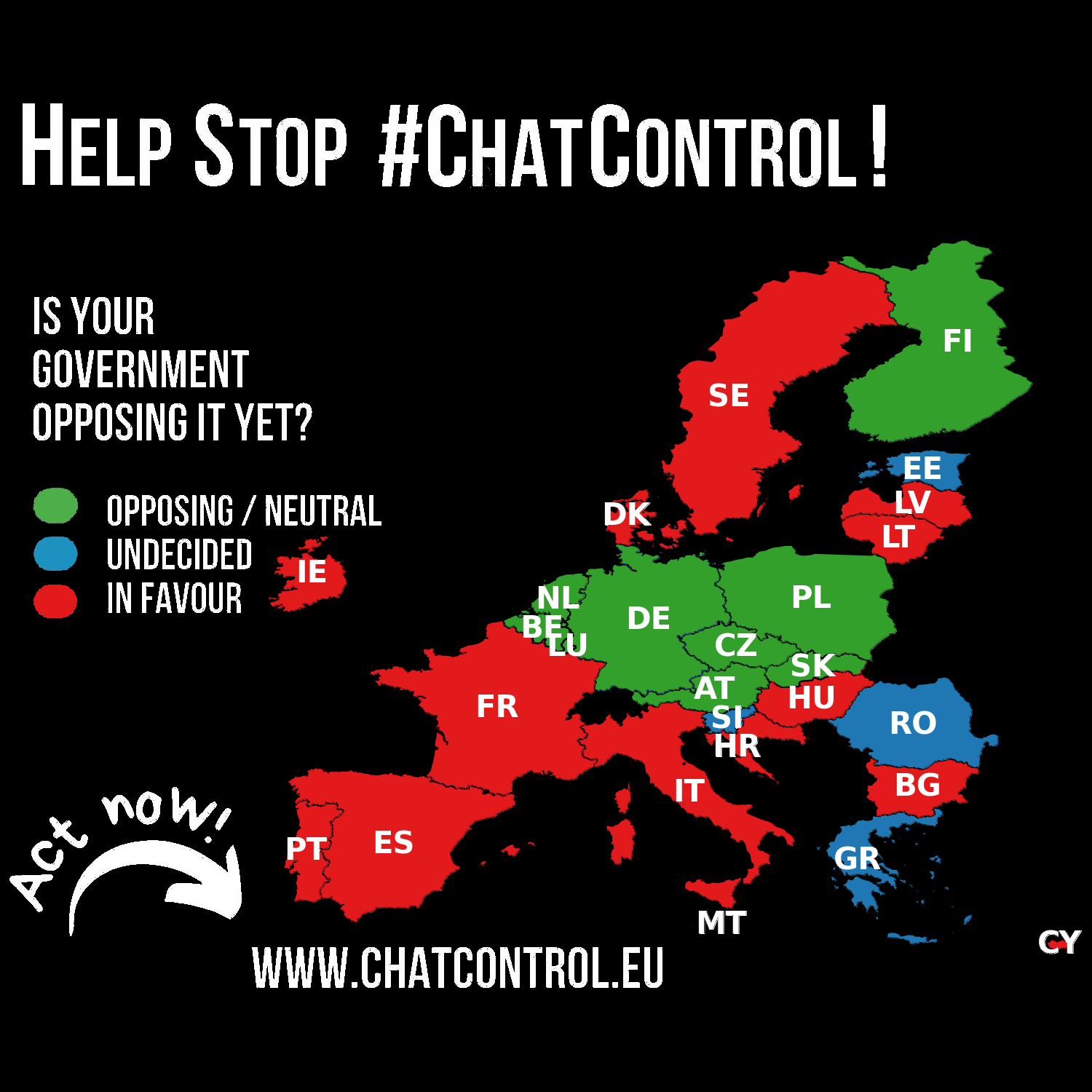
Why do you think the Baltics are in favour? Are there some announcements they have made?
8/27=0.296 (29.6%), and I thought it has to be 35% (65% supporters to pass)
(1) 55% of countries [15 atm] (2) representing 65% of EU population.
If one of the above is not met, a blocking minority (usually) needs >=4 countries to vote against a proposal. Germany voting against CSAR would mean (2) is not met in this case.
Source: https://www.consilium.europa.eu/en/council-eu/voting-system/...
Germany - Das Ministerium für Staatssicherheit (Stasi).
Poland - Służba Bezpieczeństwa (SB)
Czech and Slovakia - Státní bezpečnost (StB)
Looks like latin cultures don't really care about being spied on by they governments.
This is a map of the government's positions, not even the parliament much less the public, and therefore a picture of whatever happen to be the parties in charge at the current time.
* There is little to no faith in our elected officials, especially from _that_ side
* Also people don't seem to care, all invested in the "i have nothing to hide" mentality
Government is a job that self-selects for people who either want safety (non elected jobs) or power (elected jobs) more than anything else, given it pays far less than the private sector. Both the safety people and the power people want to reduce public freedom and the ability to do things.
The only way we keep these people from this is the threat of voting them out of their jobs. But they are more motivated than we are, so they usually win over time.
Not really, both things need to be done by a law. So it's the same signal and complexity as just rejecting the law when it's proposed
And the second option at least does away with the pretension of permanence people like to use as an excuse to wash their hands of interest in politics
Instead of discussing WHY "owned" mobile phones have a short lifespan and we can't truly do whatever we want with them (be at the hardware/software level) and forced to choose between the apple and google duopoly, we get into these lousy law debates about privacy.
Why doesn't the EU put effort in paving the way for a more open and free tech world when we rely 100% on propietary technology that comes from the other side of the Atlantic?
https://www.europarl.europa.eu/news/en/press-room/20240419IP...
https://commission.europa.eu/strategy-and-policy/priorities-...
This is a wet dream for governments.
"Think of the children" will never die.
That said, how come we haven't seen massive antitrust action against the likes of Google? You only have to follow the money here.
They just don't understand why it's technically not possible to achieve what they want without unacceptable risks.
Similar to the climate change issue: no politician is aiming at having their children die before retirement age from the consequences of climate change. They just don't understand that they are pushing us there (like most of the people, to be fair).
at the least the basic human rights and privacy laws should be on everyones' side ... except rapists, the many kinds of violent abusers, murderers, especially the genocidal kind, drug punchers, and these fuckers roofying kids in clubs and bars just to have sex ... I probably forgot some ... sorry I didn't stay on topic.
As Freud wanted to let us know, the ageing rich are perverts with enough means to hide any crime ... then they made him bend over and invent the Oedipus complex, ffs
the only way for them to create an argument for ChatControl is more terrorism or some fucked up crimes against children so this damn thing is a sure-fire shitstorm with recursive, bad yields.
It's unbelievable that we have allowed EU to spread into this all encompassing monster that deals with anything but economic cooperation among member countries.
-------------------
> European law has priority over any contravening national law, including the constitution of a member state itself
If a member state fails to block a proposal, all that simply means is that the qualified majority[1] of representatives of other member states believes the legislation to be so important that the union would not work without it. Dissenting member states can seek to reverse or temper the legislation later, or simply leave the union - see Brexit. No sovereignty is violated at any point.
[1]: https://en.wikipedia.org/wiki/Voting_in_the_Council_of_the_E...
> The primacy of European Union law (sometimes referred to as supremacy or precedence of European law[1]) is a legal principle of rule according to higher law establishing precedence of European Union law over conflicting national laws of EU member states.
The principle was derived from an interpretation of the European Court of Justice, which ruled that European law has priority over any contravening national law, including the constitution of a member state itself.[2][3][4] For the European Court of Justice, national courts and public officials must disapply a national norm that they consider not to be compliant with the EU law.
The only way that the European Union can 'force' compliance of a member state is for the EU Commission (or, exceptionally, the Parliament and Council) to withhold EU funds from that member state. Those funds were never the property of the member state in the first place though - again, no infringement on national sovereignty.
This will always be a problem at every level.
It matters because if it's that important to you then you have a sovereign right to leave the EU and do away with all the rules you don't want
Staying inside of it and accepting primacy of EU law when decisions are lawfully taken following the process you've agreed to of your own country's free will is a choice