245 points · by voxadam · 1y ago · 213 comments
We can also be concerned about the incentives for prison labor - for profit prisons and all the many service providers that get paid a mint. Phone calls in many prisons are like $10. Labor gangs and the such. It’s just horrible how badly we treat people in the US for some middleman to make money.
The only ethically-hard problem is which jurisdiction their vote should count in, since they cannot demonstrate it by choosing where to live. Perhaps a choice between:
1. The location of the prison, if their main interest is the conditions of their detention rather than anything outside.
2. The location of their property or close family, because they're still paying property-taxes or school levies etc. and they will be returning there later.
Many people live in an area, but keep their voting registration in another. They are even able to vote without having to return to their registered polling place. Allowing inmates to vote could just as easily be handled the same way.
If we're on the democratic reforms train, then this is all a silly discussion we're forced to have because the US doesn't have proportional representation.
https://www.brennancenter.org/sites/default/files/2023-03/20...
Places with a greater population tend to get more representatives in a state or federal legislature, all else being equal.
This makes sense for minors (part of voter-households, to be voters later) and noncitizens (either in voter-households, or at least with freedom of travel) but it becomes a perverse-incentive when we start talking about people forced to be in a specific region by a government that put them there and won't let them leave.
> Representatives and direct Taxes shall be apportioned among the several States which may be included within this Union, according to their respective Numbers, which shall be determined by adding to the whole Number of free Persons
"Free persons" in this case meant those not enslaved for life, so it includes incarcerated people. Representation apportionment also includes illegal immigrants under this clause.
Here in Brazil criminals are extremely dehumanized as well and used as electoral fodder. Leave them to rot in amounts proportional to the anger of the population against criminality as it rises again in the country, or at least the perception of it.
They are used to quickly let this social pressure out without actually solving anything and without making the population safer.
It would be really nice if remote work could serve as a viable vector for rehabilitation. Everyone involved would benefit from it, we just have to beware of the wrong kinds of incentives, so that people don't get thrown in jail only to serve as cheap remote labor later.
Ensuring they can communicate with their families at no charge would be a huge plus as well.
There's lots of evidence that maintaining connection to family, and providing skills training reduces recidivism. You should be asking for studies proving that what we're currently doing is effective or humane.
https://ora.ox.ac.uk/objects/uuid%3A42e604d8-31d0-4067-a08c-...
I don’t think many people in the US care about rehab. They seem viscerally invested in the concept of a prison as a place to store/segregate violent people, but have no interest in either helping those people learn to live safely in society or to have any advantages that the poorest non-prisoner gets.
Before we can jump straight to pointing to successful prison labor programs, I think we need to figure out how to message to those voters that it matters how we treat prisoners.
I think they exist quite widely among the population. Old, white republicans want more people in jail. Young, non-white democrats think we jail too many people.
50% of the country thinks we jail too many
s) https://today.yougov.com/politics/articles/45975-what-americ...
I only bring this up because it seems like the mental model most people have is that 50--90% of prisons are private - mainly because it gets discussed so much. But the problems with prisons by-and-large involve government administration, not for-profit companies running the amok (despite that also happening in a much smaller number of cases).
It's the same as paying someone to dig a hole, then paying someone to fill it back up. The money might as well have disappeared, as there's nothing to show for it (for the taxpayers that is - the hole digger is happy to have been paid)
https://legaljournal.princeton.edu/the-economic-impact-of-pr...
private prisons make money for their corporations. Look up Wackenhut.
~ https://abcnews.go.com/US/top-private-prison-companies-profi...
Prison Contracts: Profits & Politics
Two corporations, GEO Group, Inc. and CoreCivic, Inc. (CCA), manage over half of the private prison contracts in the US.
These contracts are extremely lucrative; in the 2017 fiscal year, GEO Group and CoreCivic earned a combined revenue of more than 4 billion dollars.
Corporations like GEO Group and CoreCivic are invested in mass incarceration because incarceration is profitable for them.
Such corporations ensure that correctional facilities are in demand through a variety of techniques, including minimum occupancy clauses and political lobbying efforts.
~ https://sites.tufts.edu/prisondivestment/prison-contracts/1. https://www.astralcodexten.com/p/prison-and-crime-much-more-...
Compare to Australia, where the employer doesn't see detail. They file the background check, but only get a "yes" or "no", based on that specific job and past offenses (if any).
"He figured Thorpe might have trouble clearing the company's background check and he says he prepared himself for that. But since it only searches back seven years and since Thorpe has been in prison for more than a decade, "He is actually our cleanest background check," Costa says."
"He doesn't have a parking ticket." What does a parking ticket, let alone a criminal conviction have to do with programming?
Let's just go ahead and get to the exploitation, the corporate scum offered him minimum wage and are taking advantage of his situation.
Criminals have to want to stop doing crime before they can be rehabilitated.
This is literally what rehabiliation entails. Convincing criminals that they have better options than crime.
It doesn't work for everyone. There are absolutely bad people who will just violate social contracts, or who can't control their rage turning into violence. Those people need to be incapacitated. But for the vast majority of criminals, particularly non-violent criminals, crime is an economic cost-benefit exercise.
Whenever a read a story about someone who's been to prison and then ends up a solid, productive member of society, I can't help but think: "This person must have extraordinary grit and determination!" Because when a criminal gets out of prison, the entire system and the entire society is set up to try to oppose his rehabilitation and get him back into prison. Overcoming this active hostility must take a remarkable person.
I think some people just haven't been exposed to the benefits of taking a path to life that doesn't involve crime. Some people also need to be convinced that there are viable alternatives to crime. And as someone else said, society needs to give them the chance to redeem themselves and pursue those alternate paths.
This just makes me feel like the entire modern process of matching workers to employers is a kafkaesque hell that has negative value.
The boss doesn’t even care that the guy obviously violates the intention of his companies process. Stay in jail long enough and you’ll pass one of our arbitrary steps!
What's the intent of the process?
I remember hiring a few years ago, where a deep background check uncovered an assault charge on a candidate I liked. The charges had been dropped. But they were violent in nature, and this spooked my team.
Fortunately, our GC once did family law. Between me pointing out this was a remote position and our GC showing that the facts of the case looked incredibly like domestic dispute in the midst of divorce, we wound up hiring her. And she was great!
>we wound up hiring her. And she was great!
Did you try firing her just to be sure?
Within the default biases of the american law enforcement and court systems an assault charge on a woman in divorce dropped usually means almost the opposite of assault charges on a man in divorce being dropped.
Gives new meaning to working in Mountain View.
So I searched and THEN I found the blog of the inmate from the article! https://pthorpe92.dev/
https://en.wikipedia.org/wiki/Kids_for_cash_scandal
How many others are profiting from keeping prison populations topped up? Perverse incentives, ensuring the US has one of the highest incarceration rates in the world, with only the People's Republic of China rivalling it for prison population. Make slavery legal again with this one weird trick called the 13th amendment's "except as punishment for a crime"
I am OK with prisoners being rehabilitated, this includes them working. I am not OK with their jailers profiting. Nor am I OK with employers profiting by having unfair power over pay and conditions they wouldn't have with free citizens.
And one of the judges [0] in the “kids for cash” scandal had the remainder of his federal sentence commuted by President Biden before he left office.
Especially with all the race issues in imprisonment.
So they take a cut of your pay. Totally not profit? They deserve it? Why not 20% why not 95%.
Do you have knowledge of, eg of New Hampshire (which is mentioned as a counter example in the article?)
https://www.criminon.org/where-we-work/united-states/new-ham...
https://usafacts.org/articles/how-many-states-use-private-pr...
I guess with knowledge work there is some protection because it’s hard to force. Though, it would be desirable to extend such programs into other forms of work.
> "We had 87 assaults on staff in 2017. Last year, we had seven assaults on staff [...] the officers that go to work everyday and don't feel like their life is at risk."
Putting aside the widespread reflexive discrimination against "criminals", I would think that most people in prison who someone might think twice about hiring due to their criminal history would get a second look if it was for a remote job.
Someone working remotely can't rob or murder you, nor can they try to sell you drugs without a much more elaborate setup.
Seems to me the only kinds of people in prison that most employers might justly hesitate to hire for a remote job are white-collar criminals.
https://www.corrections1.com/investigations/ga-inmate-accuse...
https://www.wltx.com/article/news/crime/south-carolina-inmat...
* People charged with something stupid (e.g. shoplifting) that turned into a larger problem (e.g. crossing state lines) which became an even larger problem (e.g. nonviolent, passive drug charges). One guy I worked with had lived on one side of the river in St. Lois but worked on the other side. Walmart decided that he'd "shoplifted" a $2 bottle of soda, legally he fled the state by going home, and his kid had hid a gram of weed in the shoebox by the door that nobody opened except of course the cops that flooded the house. He served 10 years after a plea deal that sunk his kid into juvie for 5 years.
* People who "did a crime" to prevent a crime. Another person I worked with shot his son 5 times in the chest after his son attempted to murder the wife. Because the only testimony they had was an asian woman who didn't speak great english and the court denied an interpreter for her native language (laoatian) because she "speaks good enough english", her description of the events was murky (having been asleep) and so he landed murder charges and a stint in prison.
* People who got racism'd into prison: Same work as the previous, the older latino guy in this group was framed for the death of a woman he spent the evening with; he had left after they hooked up and she ended up falling off the balcony of her apartment later on, but because time of death is like, +/- a few hours when it snows on top of you, he was the last one to see her. He spent 4 years in prison before he was released on a mistrial.
* Drug users of the nonviolent variety. Nose candy, heroin, weed, usually white collar or upper blue collar. Several folks like this, all who just wanted their past to be shoveled behind them.
* People who legitimately did a crime, did the time, and now they're out: Plenty of situations where legit crimes happened... Theft, assault, even a case of money laundering on occasion. They went in, did their time, and came out, and day labor was the one thing that didn't ask too many questions and paid regularly.
A fair number had degrees -- from associates and bachelor's degrees to even a PhD who was nailed for what the state called a "gambling ring" (some informal betting around the office that ended up snowballing into a massive pot). many of them could do remote work of some kind, be it customer support roles or tech work. The MBA that did nose candy? He stayed on the board of directors for a local nonprofit _while serving_ and would relay his comments through his lawyer, being entirely upfront as to why he was incarcerated, then ended up doing accounting for the day labor company after a while.
All this to say: our system is fucked up and needs rehabilitation systems for the murky area between those two extremes.
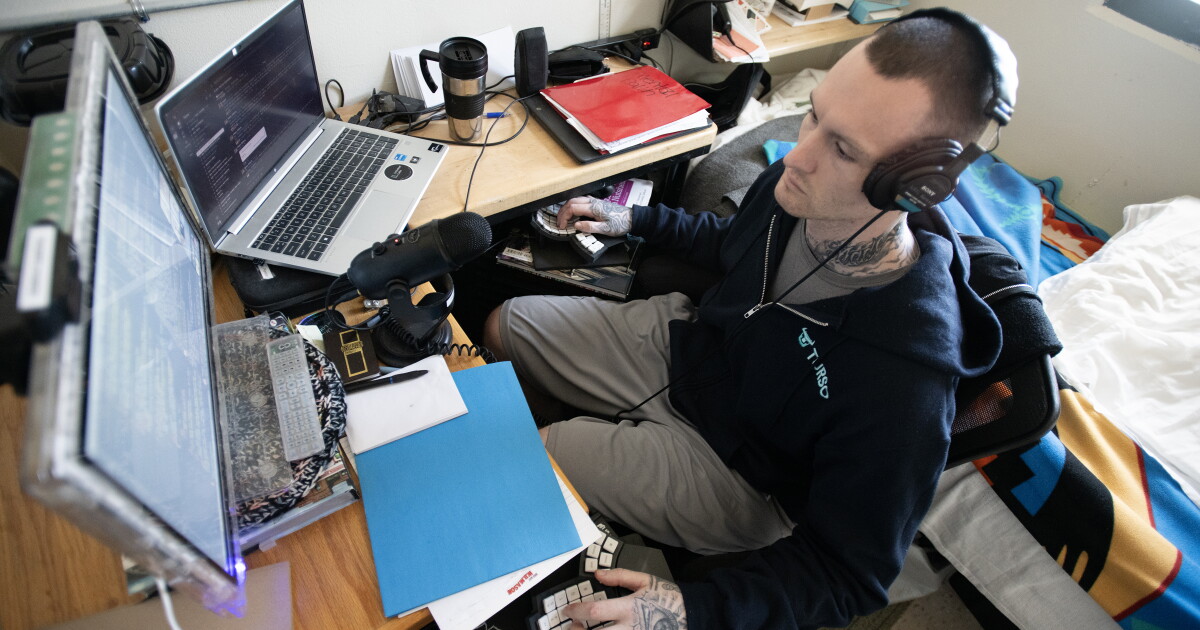
Perhaps high trust prisoners could be used for things like controlling delivery bots. Or maybe for content moderation!
Awesome. So so so awesome
This stuff truly is a disturbing view of the future of the US.
>earn above a certain amount, 10% goes to the Department of Corrections for room and board
Yep. There it is. Sounds nice now right? Until in 5 years they decide, well it really needs to be 20%. Then it 5 more years. Well they are in prison so 30% should be resonable. Then as tax deficits grow .....weeeellllll maybe 70%..... Then it will be well prisoners shouldn't really be getting rich in prison so we take 100% but when they get out they will still have that job to fall back on. Just wait and see.
To be clear I'm not against giving people a chance to reform. This is not that. If a person is reformed enough or behaved enough at a chance for reform then they should be on probation at worst. Not propping up a industrial prison complex for nonviolent crimes like 20+ year sentence selling drugs.
Simpler explanation: "slavery" never ended, it's just called something else now
What was gross margin per average (because the cook picks no cotton) of your typical plantation?
I'd bet it's a whole lot less than the federal .gov's margin on someone in one of the 20+% brackets. State .govs are probably all over the place.
Hard to account for because the .gov "doesn't show a profit" in the same way that "we're totally a nonprofit <wink>" hospitals don't but should be a doable calculation.
Also "intent" is cop for we didn't like your face.
There we go again, and then people wonder why they can't find engineering jobs anymore, or low wage/no job security if any, when anyone and everyone can be an "engineer" when they get bored and have some time on their hands. I still don't understand why there is no collective engineering committee and effort to gatekeep the profession like literally all other professions out there, because companies will NEVER initiate that since it's in their interest to keep it as is. Why would someone spend time and money to become an engineer when he or she is competing with the whole world and prisoners now? The reward is just not worth the effort anymore, this is what will kill engineering innovation on the long term for short term gains.
Bright brains are no longer interested in investing time and money to become engineers when the reward isn't worth it anymore, even immigrants by the way. They are okay with the low wages until they get permanent residency or citizenship, then after that they would need higher wages to simply live a comfortable life with family and such, but they won't even have that, and they get to taste the outcome they caused even if they are not realizing it.
As long as they're paid fair rates i think it should be allowed.
and my definition of a fair rate for them is what people outside the prison are paid, assuming they're paid a fair rate of course.
Why aren't we all doing this?
"Lopez admitted that she waited in front of the county jail for hours, intent on assaulting an officer. She reportedly explained that her goal was to get arrested and be put in jail so she would be forced to stop smoking cigarettes."
https://www.cbsnews.com/news/calif-woman-allegedly-slaps-cop...
> is a certified recovery coach, a scholar and a teaching assistant who's serving a 40-year sentence for the murder of her husband.
I feel like "husband murderer" probably ought to come first in your little list of titles there.
This system is a joke. If someone's committed a real crime (with a victim), and you allow this, you're forgetting prison is supposed to be a punishment.
I guess it'd be fair if the government kept half of what they make though.... Oh wait...
We really need to get rid of the exception in the 13th amendment.
If you're interested in doing hard federal time, I would suggest you consider interstate trafficking of distribution quantities of drugs.
It’s just slavery with all the perverse incentives that come with it, and I think we’d all be better off if this was a lever that no one in society had access to pull on
What then? If they're not forced to produce something of value to give to you, then how can you ever be made whole again? Does the state pay? If so, why do taxpayers who didn't commit a crime foot the bill? If it's insurance, then why do non-criminals paying insurance premiums foot the bill?
If there's nothing linking the action (_theft_) to the needed outcome (_restitution_), then there's this unmoored loop of perverse incentives wherein some folks can continue to commit crimes with very limited consequences.
Doesn't mean that everyone should be forced to work while in prison. But surely for any and all crimes that have a clearly defined dollar amount, shouldn't that criminal be forced to pay that amount back? Garnishing future wages can be circumvented (_just don't get a real job when you get out, keep stealing things to support yourself_). And even at best, it's very much _delayed_ restitution. Justice delayed is justice denied.
To be clear, in the present day, when a prisoner works, how much money do you think they make, and who do you think keeps the value produced?
Are any of these solutions that unreasonable when you consider that the state/taxpayers are already footing the bill to keep prisoners incarcerated?
How do they pay you back when employers run background checks (not to mention housing)?
by your insurance company.
Heck, this doesn't even require them to catch the perp.
What does that have to do with rehabilitation? That person can go to prison, realize the errors of their ways, and have a healthy life.I don't have to like nor forgive them. I'm not being "made whole again" no matter how long you lock them up.
> If they're not forced to produce something of value to give to you, then how can you ever be made whole again?
1) you generally don't get something "produced of value", unless suffering is a currency now. Probably is in 2025
2) insurance. not everything can be given back, but many material goods can be compensated.
>If it's insurance, then why do non-criminals paying insurance premiums foot the bill?
because that's how insurance works, in spirit. You're all pooling together a fund so that you help out some other person when they need it. The instigator is often not the one footing the bill to begin with. Shaking down a criminal with no money is as useful as yelling at a forest fire as it burns your place down.
>Doesn't mean that everyone should be forced to work while in prison. But surely for any and all crimes that have a clearly defined dollar amount, shouldn't that criminal be forced to pay that amount back?
if they have it, sure. As is, this isn't the model of the "justice" system, though. You're not getting paid back for anyone put behind bars.
That's a different problem, for different inmates -- the inmates covered in this story are paid market rates. It mentions the software developer has a six-figure salary.
Why would the prison / prisoner charge below market rates for their labor?
The prisoner doesn't really get too much choice in the matter other than taking/rejecting the offer.