86 points · by bryanrasmussen · 1y ago · 180 comments
>Tactical brilliance could not guarantee strategic clarity—and each gain came at political and moral cost.
sums up what is wrong with modern conflict --- the abandonment of the moral high ground and a failure to take into account the will of people and their right to self-determination which Jomini (who had displaced Clausewitz after his inculcation at West Point as part of the brutal lessens the U.S. learned in Vietnam) failed to consider, and which Clausewitz took to heart and studied deeply, and thought long on.
It wasn't that long ago that the collapse of the Soviet Union was viewed as "the end of history" and a global acknowledgement that liberal democracy was the means of government most widely accepted --- hopefully articles such as this will be a guidepost to getting back on that track --- every moral failure simply recruits others to fight on the opposite side.
What matters is what is taught to the Majors, Lieutenant Colonels, Lieutenant Commanders, and Commanders 12-15 years later at the War Colleges. And as a graduate myself (if only by correspondence) I can assure you that Clausewitz and Sun Tzu were very much still on the books in the 2010s.
I will say getting that intellectualism to stick in the officer corps doesn't necessarily always work. There are jokes about "it's only a lot of reading if you do the reading," and oftentimes being able to spend a year in residence gets passed over in favor of sending people to other assignments and expecting them to do the War College syllabus by correspondence.
That said, the War Colleges are also heavily involved in things like designing and evaluating higher-level military exercises, red-teaming things, etc.
Pray tell, when in the whole of humanity's so often sordid history has warfare mostly been even within audible laughing distance of a tendency towards promoting moral high ground or taking into account people's right to self determination?
If anything, the wars of the last few decades have made more pretense of both those things (pretense, not necessarily real application) than any typical war at any previous time, when naked, crude, unvarnished conquest was the main justification most leaders felt inclined to think good enough.
"Win" here doesn't mean military victory over Russia. It means Ukraine's slow destruction of of Russia's oil and gas infrastructure and the West's sanctions make it too expensive for Russia to continue, so they withdraw from Ukraine and Crimea.
What a difference just 4 years the accelerated pace of technological development makes that happens in war makes. 4 years ago, Ukraine would have ended without the influx of Western weapons. Now the West looks at the Ukrainian battle fields, and ponders the relevance of their weapons against a $10k drone, made in Ukraine.
Russia staying in Crimea, which is part of Ukraine, is a loss for Ukraine. But at least a return to a more stable period before the latest invasion by putin.
[0]: https://en.wikipedia.org/wiki/Foundations_of_Geopolitics
Another more likely scenario in the next few decades is that Russia and/or China will collapse into violent revolution or civil way — as has happened multiple times throughout their long histories. Vladimir Putin and Xi Jinping aren't immortal. They have effectively concentrated decision making in their own hands and purged all other internal power centers, leaving no clear succession plan. When they die there's no way to predict what might happen.
The problem is, this mafia has a shitload of nuclear weapons. Without those, their vast land holdings east of the Urals would’ve already been taken by China.
Both China and Russia have concentrated vast amounts of power into a single person, it gets bloody and chaotic when the ‘one powerful man’ dies and there’s a power struggle.
Morally purer government would do better in the competition between Russia and America.
If I learned anything from both Gaza and Ukraine, it's that its the complete opposite that's true. You go clearing from house to house, some AQB fighter is gonna pop-out of a tunnel and pop an IED into your Merkava tank. You do that enough times and your army's morale is going to be shot. You wanna win, you have to bomb dual use assets and only fight when its needed. If you can do a hunger siege, flood by bombing a dam or something else, then do that.
A military occupation (means) is not an effective way to achieve lasting control over the civilian population (ends) unless much of the population is already on your side, so it is foolish to try to use those means to achieve those ends.
Russia has also been hurt quite badly by lack of moral restraint in the war against Ukraine (which in the context Clausewitz used it I believe means more whether you have rational control of your actions than whether your actions are "good" or "bad"). Attacking civilians is usually extremely ineffective at achieving anything other than making leaders feel good that they are hurting their enemies and usually just hardens the enemy's resolve to continue fighting.
It seems to me both sides have been sending signals with their respective attacks on 'homeland' targets, rather than going fully gloves-off. Agreed that it's not working out for the Russians.
Unfortunately the mentality of most people has been grossly oversimplified to the point of staging everything as a melodrama.
In the case of Ukraine, it is unclear whether you are talking about Russia or the US ?
If _and only if_ War is utilized as a last resort. Otherwise this is self serving nonsense used by the political class which utilizes war to orient the population and to maintain a dark and grotesque part of our economy.
It's 2025. Institutions like the "Modern War Institute" not just existing but also pumping out this outdated amoral claptrap is obscenely depressing.
Nope, always. War is politics by violent memes. Pretending it is only used in the last case is incredibly dangerous, since it ignores both provocation and deterrence.
Although I'm sure the victims of all the holocausts in human history will be heartened to know that it was just politics by a different means.
The full phrase is "the political intercourse of Governments and nations" [1].
Clausewitz's point is that if "such intercourse is broken off by war, and that a totally different state of things ensues, subject to no laws but its own," then not only does international law become irrelevant, but diplomatic resolutions to war impossible. Rejecting that war is a continuation of politics underwrites atrocity. (If war only happens as a last resort, and you are at war, it follows that you've exhasuted all non-military avenues to ending the war.)
> These military ideas of war are romantic fantasies
Clausewitz wasn't a military romanticist. To the extent here are romantic ideals at play, it's in pretending war isn't a continuation of politics.
> I'm sure the victims of all the holocausts in human history will be heartened
Why is this relevant to the correctness of the theory? Should we reject the heat-death hypothsis because it's uncomfortable?
I've already argued why rejecting war as a continuation of politics rejects diplomacy as a way to end wars. The Third Reich is a good demonstrator for why rejecting the political component of war is dangerous on the other end. Appeasing Hitler makes sense if parties will only pursue war as a last resort. Acknowledging his political interests, on the other hand, would have shown why--in that case--appeasement was destabilising.
[1] https://www.clausewitzstudies.org/readings/OnWar1873/BK8ch06...
I have a sense that articles like these is why a lot of people think the "academics" are completely disconnected from the reality.
It should also be noted that, objectively, Russia's war has not been a success. It also has not been a failure, except in the grand strategic sense of provoking the realignment and reinvigorating of NATO it was meant to prevent.
Outcome:Russia's land border with NATO is now 1300km longer.
woefully reductive. Russia sees Ukraine and Slavic Orthodox populations as their dominion -- Ukraine was under the Tsar and the USSR, and it should be theirs again.
it would be like if the US has a minor collapse and Alaska gets independent, and later the US invades; "this was our state, has been our state, and everyone there speaks something like our language and religion"
this is also why Putin won't back down on it.
I have absolutely no idea what Russia was expecting from their three day special military operation, currently on 3 years, 7 months, and 2 weeks. But surely whatever they were thinking, if I could go back in time and paint them a picture of how the situation is today, they'd jump out the window (or be 'helped' out of them, as appears to be a popular pastime in Moscow this decade). This has to be on the levels quite near 'worst than our worst case scenario'.
I think Von clausewitz's revenge on the russian plan for Ukraine hasn't even begun yet. If Russia ends up wanting to turn lands they currently occupy in lands they annexed (a land that is productive and well on its way to just being culturally subsumed), the cost of that operation will be even larger than the astronomical cost they are paying to gain them: Their utter disregard for Clausewitzian planning means it'll be one heck of an insurgency.
Unfortunately, Russia is one of the most ruthless countries in this regard and will simply massively replace the population, starve it out, or otherwise eliminate any odds of low morale amongst the populace or active insurgency by simply replacing the entire population.
But that also destroys all inherent economic productivity other than natural resources. Russia already has plenty of land and plenty of resources; what they need is more people in general and productive, creative members of society in particular, neither of which you can make happen by starving a population that hates you for how you fought that war and still holds out hope they can drive you out.
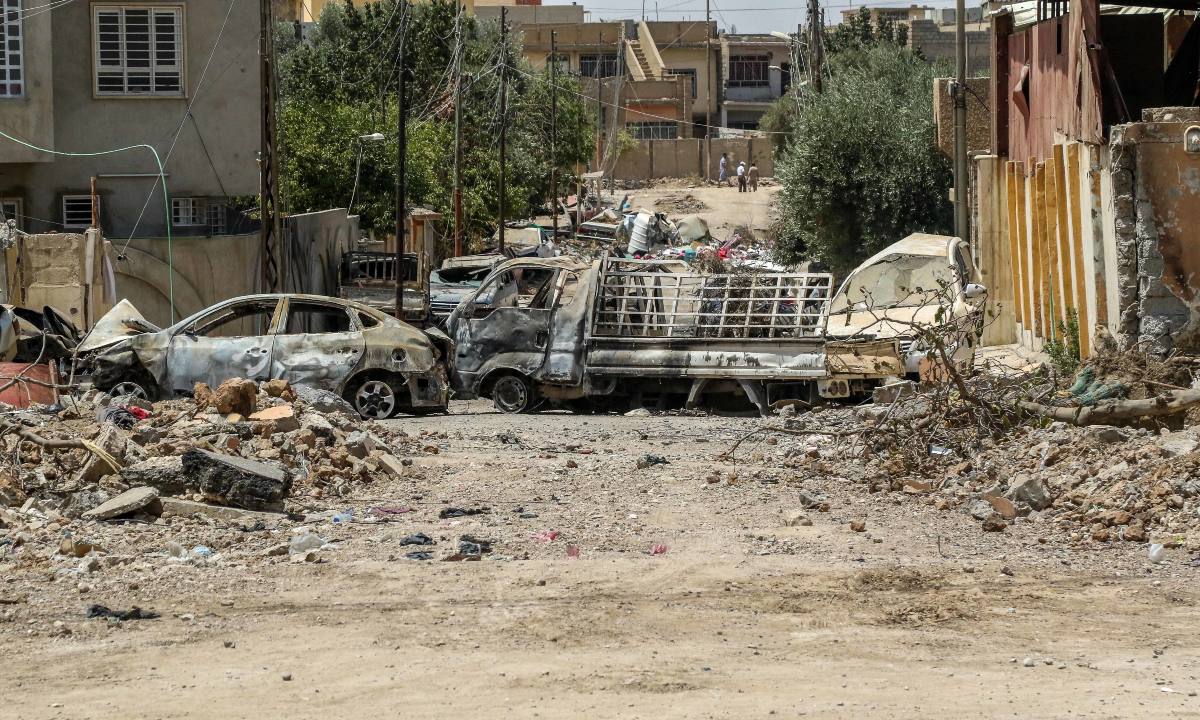
Especially given how russian elites are just several pyramids structured (and behaving) exactly like typical mafia. They only go for themselves, screw the rest. They only think now and maybe tomorrow, long term planning ain't a strong point of decision makers to be polite. Nihilism all around, to the very top. The whole war became purely an ego game, emotional stupidity of little boys who simply refuse to lose face (and thus life and legacy) even when colossal fuckup they created is right in their faces all the time.
But is is actually colossal fuckup to them? No it isn't, they get some international hate but plight of commoners is completely irrelevant to them, and who cares when you still have billions all around the globe. Also don't underestimate the capacity of russian population to just quietly accept brutal oppression and go on, its not something west can fully grok. Life of a human being has no value there, that's still the case as it was.,
Debatable. The war itself is basically a massively failure, but it completely stabilized the regime. Whereas 5 years ago there were clear questions about what would happen after Putin died, ZOV-logic is enough to power the regime for the next 10 years.
20 years of careful building of liberal oppositions by highlighting corruption is now out of the window. FBK, Kats, Volkov, etc are now all abroad with no chance to return; literally no one gives a fuck about corruption that's not military related. The new "liberal" party that replaced Navalniy & Co (Noviye Lyudi) is basically only liberal in economics.
The only thing that will decide if Russia ends up winning or losing in the long term is whether the "Pivot to Asia" strategy that they basically were forced to take will end up working.
Also, we are talking about the most technologically advanced war that ever took place, where the iteration cycles are measured with weeks. The Russo-Ukrainian war of the beginning of 2022 looked very different from what it currently is. For the actual modern urban warfare see the cities I mentioned.
I would then ask you about your mention of:
> turning Bakhmut, Vovchansk, Toretsk, Chasiv Yar et al. to _literal_ rubble
Leaving aside the horrible ethics. Would you say that this was an intentional strategic approach by the Russian leaders, as a mechanism of avoiding the difficulty of urban warfare, or an unintended side-effect of trying to conduct urban warfare?
The key nodes to control have to do with supply chain, energy and information; ie depots, road and rail, bridges, factories, substations and data centers or satellites.
Ukraine has severely weakened Russia by attacking those points, as Russia has Ukraine.
Beijing could well defeat Taiwan (and the US by proxy) by controlling its sea lanes, cutting its cables, and jamming its radio spectrum.
The PRC seems to be doing a good job building out its energy infra, fwiw. And it shares a massive land border with an ally and energy producer.
aye. it read like 2008 "hearts and minds" claptrap about capturing but also protecting a population.
it would be totally ignorable if it didn't have whiffs of "we're going to occupy American cities now, too"
It actually had the gall to finish with:
> Clausewitz offers no checklist for success in cities, but rather something more valuable. What he offers is a way to think clearly ...
I'm pretty sure that a checklist for success would have been more valuable.
There's a bit in On War where he descends from a lofty discussion on what victory means and how generals should should figure that out before the battle starts, to state abruptly that chasing a fleeing enemy is a bad idea, particularly through a forest, because it's a good way to get your forces strung out and cut down. This part is so vivid I've often wondered if he or a superior officer succumbed to enthusiasm and Clausewitz learned this lesson the hard way.
One problem with reading Clausewitz is that he was writing in an era of large set-piece battles where you had blocks of infantry that still marched around in square formation, cavalry charges and so on, though centuries-long practices were changing thanks to Napoleon's tactical innovations. Clausewitz writes in generalities rather than specifics because commanders of the time were very familiar with standard dispositions and didn't need them laid out in detail, and likewise strategic ideas like trying to ravage your enemy's supply lines and bypass forts hadn't changed significantly in millenia. Clausewitz was trying to give shape to the questions of whether and why one should go to war in the first place, how to break out of escalatory cycles so you don't end up isolated and so on. I often think he has more to say to the fields of international relations/statecraft than to pure military analysis.
If you prefer something less abstract there's a good small book by Machiavelli on the topic (confusingly also titled On War; easiest to find as a double-volume with The Prince) and of course Sun Tzu. I think the Samuel Griffith translation is the best one because Griffith was a marine officer in addition to being a scholar. Lidell-Hart's book Strategy also stands up to repeat reading and functions as a great roadmap of European military history.
They've got a set of 3 clear objectives and their tactics on the ground, e.g.
* prioritizing attrition over the capture of territory.
* avoiding urban fighting where possible (e.g. a multi-year avoidance of zaporizhia and kharkiv).
* minimizing civilian casualties.
Reflect not only the objectives, but the desire to avoid a lot of the "messiness" the author referred to. The fact that Ukrainian civilians fear busification more than drone strikes is a testament to that.
None of the other parties (Ukraine, Hamas, Israel) appear to follow clausewitzian logic, though.
Leaving the moral dimension aside, this entire war has been basically two JV teams going at it since the beginning. NATO would have wiped the floor with the Russian military based on their performance so far, and it's surprising considering what a juggernaut everyone claimed the Russian military was pre-war.
Considering my interests and those of my country I would like to believe, but reality do not provide much support for such hopes.
> and it's surprising considering what a juggernaut everyone claimed the Russian military was pre-war.
It is true, but they improved immensely during 3 years of intense conflict (the same for Ukraine). On the other hand NATO has most experience in bombing people in Africa and Middle-East.
War with Russia wouldn't be the same as battle of Timbuktu.
They're invading the largest country in Europe armed by a military bloc constituting 60% of world military spending. Which part of that screamed quick to you?
>Russian operational and strategic decision-making has been a bonfire of blazing incompetence
They somehow managed to achieve a body bag exchange ratio of 44:1 and an extreme busification crisis in Ukraine with a volunteer force.
It's a more impressive showing than Iraq.
>led to things breaking down into WWI-style attritional warfare.
Putin announced the strategy of attritional warfare in March 2022 after the land bridge was secured, so one could hardly argue that this wasnt the plan.
Ukraine has done a good job of playing into their hands by trying to cling on to land long past the point where it becomes defensible and getting enveloped in cauldron after cauldron.
Hence the issue where Ukrainian civilians are now more afraid of their own government's roving kidnapping gangs than living under Moscow's rule.
That part is probably going to be the real kicker in the end.
Russians target civilian objects - apartment complexes, hospitals, metro entrances, passenger trains. Constantly do a second strike when emergency crews arrive. They use drones to hunt civillians who live near frontline.
Militaries routinely use civilian objects for military purposes, so that these objects are targeted isnt meaningful in and of itself - like the time a pizza restaurant was targeted and it later emerged that the restaurant hosted a rather large military gathering.
"primordial violence, hatred, and enmity" - weren't really there - most Russians viewed Ukrainians as their brethren.
"Chance and Probability" - the Russians have proved pretty inflexible. I mean after they failed to take Kyiv in three days they could have gone home and saved a lot of bother, maybe keeping some lands in the south.
"Reason and Policy" - didn't make much sense. Few Russians wanted to go to war so Putin could lord it over the Ukrainians as well as the Russians. This looks more like a political move by Putin to keep power.
If Russia had actually had a clear objective to annex Ukraine they could have mobilised and knocked them out in no time but instead we have a mess and kind of stalemate which to me seems to be moving in Ukraine's favour as they can now hit most targets inside Russia.
Checklists aren't immutable. Having clear pre-war plans and procedures doesn't preclude changing them. But going in without them almost assures defeat.
Quoting again from the author's closing remarks:
> Victory in this environment requires more than technological superiority. It demands clarity of purpose, coherence between means and ends, disciplined execution, and moral restraint—the very fundamentals Clausewitz insisted upon. These are not optional in the urban century. They are decisive.
But that's so vague that I can't help but again yell "But what is decisive?!", "What should the commanders/politicians do in practice?". It's almost astrology in how it doesn't say anything objectionable.
> Clausewitz also famously wrote, “No one starts a war—or rather, no one in his senses ought to do so—without first being clear in his mind what he intends to achieve by that war and how he intends to conduct it.”
You could also make a checklist of stuff like "reduce effectiveness of enemy's forces" and "minimize damage to your own ability to wage war" - but that's basics which any upperclassman at a military academy could recite, in regard to pretty much any war ever.
It's been 2 centuries since Clausewitz was writing about military theory. He's still widely read because his ideas are big-picture abstractions. Bridging the gap between his abstractions and what to do, with whatever current-day/recent-tech forces you happen to have - that's the job of your flag officers and their staffs. Though their "checklists" will keep changing, as the war progresses.
It simply depends. No situation is unique.
Israels strategy towards tunnels for example is to blow up and level everything. Ukraine does not deem that acceptable to the russian tunnels inside Ukraine.
Consider the old adage:
>Never do something which you wouldn't want your grandparents to read about in a newspaper, or to discuss with them over Sunday dinner.
By extension, a military force should:
>Never do anything which when shown on the evening news would result in a Congressional inquiry (or a War Crimes Tribunal).
As I see it, the only way that we can have "Rules of War" is by proving that a war can be won while maintaining them. Otherwise (and unless you have a magic wand to make humans non-aggressive), these rules are worse than useless, because they limit the more ethical side, while making them lose to the less ethical.
You don't prioritize the well-being of the other side, but you do want to avoid radicalizing them. The more reasons they have to surrender, the more likely they are to surrender, thus ending the conflict sooner AND keeping the end conditions one they are comfortable living under.
If instead they feel they are in a fight to the death, then you have a much tougher battle on your hand because they will fight to the death. You'll still win (maybe) but it's going to cost you in personelle and time and money.
Next aspect. Moral of your troops. Everyone wants to be a hero, very few people join the military because they want to kill. And those that are in it to kill tend to be toxic leaders which is really bad for the rest of the team.
"Rules of war"/"rules of engagement" are methods that allow your troops to maintain their humanity and sense of purpose under horrific situations. You give up that and you are now undercutting the fighting power of your own forces.
The military did not come up with these ideas to make themselves weak. They came up with them and enforced them because they are the source of strength.
Failing to conquer a nation (or depose its government, or secure some land, or defend a border, or whatever your objective is) may be shrugged off by your own nation, and you may even be able to normalize relations after some time. But if you abuse the noncombatant population, you often create bitter enemies, generational hatred, and global pressures on your society from third party observers. In the worst case this eventually escalates to mutual threats of genocide and total war.
Even if a nation wins a conflict through sheer brutality, they may lose the occupation, or the reconstruction, or good relations with important partners, or all of the above. And they may create an enemy who will one day return with a vengeance.
I would have liked some more unpacking of how this disconnect would have been interpreted by Clausewitz.
It also struck me that as an outsider to these conflicts, I assume that the combatants are acting rationally from the perspective of the adage (“No one starts a war—or rather, no one in his senses ought to do so—without first being clear in his mind what he intends to achieve by that war and how he intends to conduct it“) and I judge the morality based on the inferred intent. That would also have been interesting to unpack…
If you are hated by everyone outside your tribe, you will stick with your tribe, because you have lost other options.