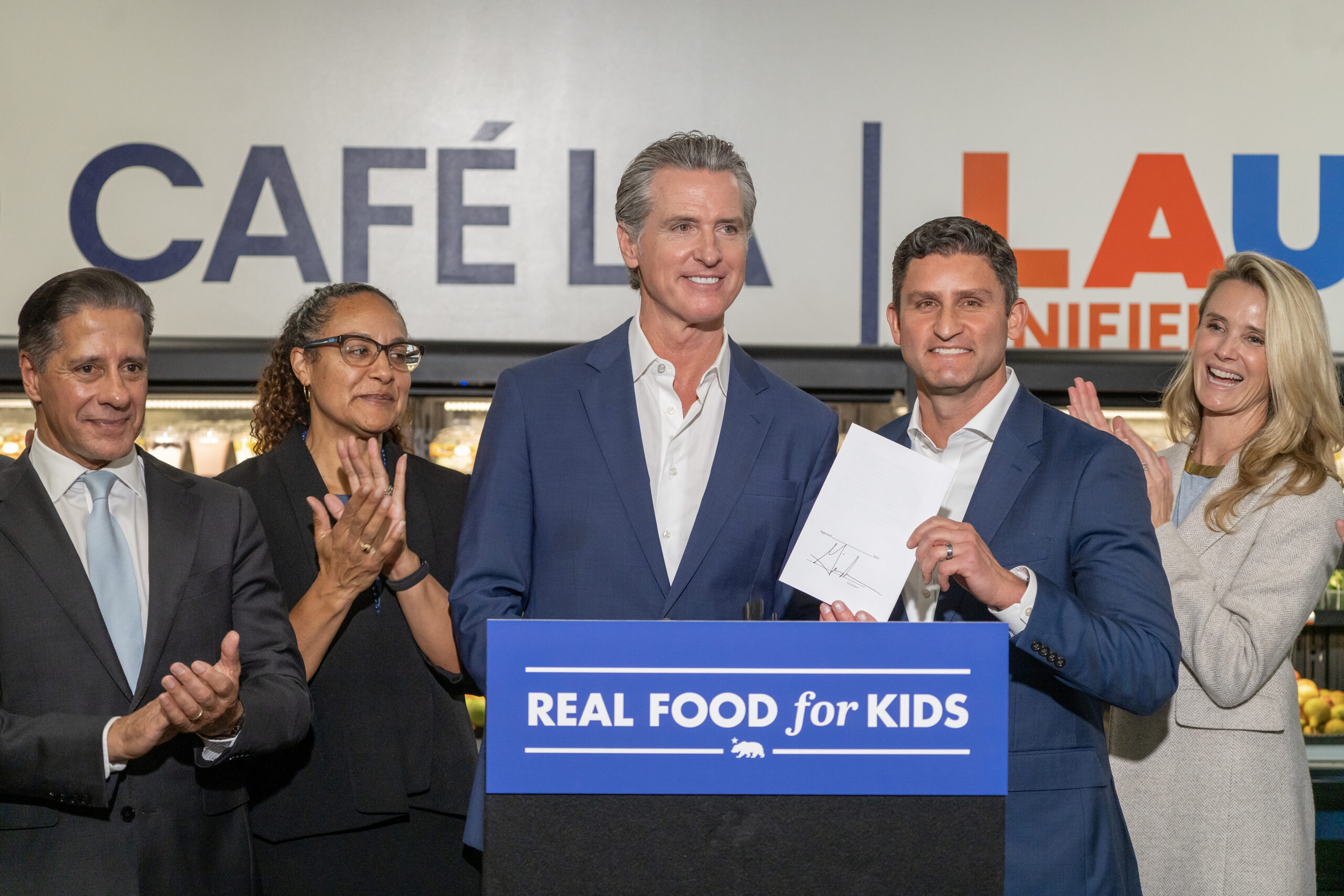
Governor Newsom signs first-in-the-nation law to ban ultra-processed foods from school lunches | Governor of California
State of California
Governor of California
197 points · by Kaibeezy · 1y ago · 270 comments
Edit: Found it. https://leginfo.legislature.ca.gov/faces/billNavClient.xhtml... (thanks to @crummy for the correction). Seems like a reasonable start. Amusing to see that alcoholic drinks are specifically not considered ultra-processed foods for the purposes of school meals!
> In July 2025, the federal Centers for Disease Control (CDC) reported that 32.7 percent of children and youth between 12 and 19 years old are prediabetic.
Wow.
> Wow.
Sadly, I'm not too surprised. My state also has free breakfast and lunch in public schools and it is possible for them to get served over 100g of added sugar between the two meals and classroom provided snacks. Then add to it whatever the kids are eating at home.
It also creates added difficulty for kids to concentrate on lessons when their blood sugar is spiking and crashing repeatedly throughout the day.
Doesn't mean we shouldn't try to offer healthy option, but just that those would have a limited impact on obesity, expect for maybe calorie deficit if they choose to forgo breakfast or lunch
When the option is some fried food vs a wilted salad with no protein source, it's a wonder that any kid would choose the salad.
I would love to see better options that are both healthy and enticing. Until then I doubt that we will see much change when the choice of what to eat in the lunch room is left to the children.
School food generally has the problem that they made to be cheap, low labor, and lowest common denominator terms of taste, spices and salt. To take Sweden as an example, the cost per serving sit just between $0.6 to $1.2 per student in term of ingredients cost. Even providing an apple per student would cut into that budget.
95% of the student body ate that pizza every single day.
This includes the supposedly "smart" kids in honors classes.
The real food was good! It was fresh and perfectly palatable and varied enough to be healthy!
Instead of eating it, the students literally invented a lie to hype up this disgusting facsimile of "pizza" as good. It was regularly claimed that this pizza came from a local small business that sold pizza. This was flagrantly wrong and obvious to anyone who had eaten that pizza, as they used a sweet sauce that was not used in the school pizza.
But what the actual hell do Americans expect? We spent decades disallowing the government from telling your kids anything useful, we opted out of "Only 12 minutes of advertising to children per hour on TV" because "regulation is bad", we built a society that advocates rampant consumerism to your kid from before they even can read.
Of course they're going to eat the shitty pizza. It's what consumerism tells people to do. In the US, consumerism is a literal lifestyle brand!
They’re rejecting WHAT you offer WHEN you offer. They’re not refusing to eat. If you simply allow them to say no, they get hungry and come back (usually within an hour). Ask them what they want from the available healthy options and feed them that.
In fact you can set this up ahead of time. “Child what are your five favorite foods? Great two of those are special occasions only, pick two more. Great. That’s your list. Here’s the deal. At meal time you can pick one of those five. I promise to make it, if you promise to eat it.” This gives them a feeling of control and gives you an easy answer.
This actually makes your life easier because you can plan ahead and always have that whitelist available. And it’s less complicated because their pallets are simpler.
There is a whole branch of child psychology devoted to this question. They’re not refusing to eat. They’re simply not interested in the thing you offered.
I was at a friend’s recently. He prepared a lovely meal. Fresh caught salmon and great sides. His daughter didn’t eat a single bite. I was slightly offended. I overheard the fight later “dad, I hate fish, you know that” (actually quite reasonable) his reply was “it’s not a very fishy taste” (a tenuous argument). She was hungry before bed and did eat. The whole mess could have been avoided by not trying to feed her something she hates. I then watched for the rest of the weekend. Every time she was offered something she liked she ate it no problem.
This does of course assume that nobody else is undermining you by offering them junk when they get hungry after refusing a meal.
https://leginfo.legislature.ca.gov/faces/billNavClient.xhtml...
> (3) (A) High amounts of saturated fat, sodium, or added sugar, as defined respectively as follows:
> (i) The food or beverage contains 10 percent or greater of total energy from saturated fat
I feel like the saturated fat limit would be the most impactful restrictions.
However right after it's entirely opened up again:
> (b) “Ultraprocessed food” or “UPF” does not include any of the following:
> (1) Commodity food specifically made available by the United States Department of Agriculture.
> (2) A raw agricultural commodity as defined in Section 110020.
> (3) An unprocessed locally grown or locally raised agricultural product as defined in paragraph
Excess sugar and simple starches tend to get absorbed more completely than excess fat, I'm not sure added fat is the biggest issue.
wonder who'll be the first to argue that HFCS isn't sugar.
Brilliant sleight of hand by the processed food industry.
Of the fats one can eat, saturated fat is generally the least processed and most natural.
Humanity has eaten saturated fat for ever. Refined/processed oils are a completely new thing that has become a staple of the modern industrial diet. Under this law kids will be made to eat more of the ultra processed literally refined oils and less natural fat.
“ultraprocessed food” or “UPF” means (any food or beverage that contains a substance described in paragraph (2) and either high amounts of saturated fat, sodium, or added sugar, as described in subparagraph (A) of paragraph (3), or a nonnutritive sweetener or other substance described in subparagraph (B) of paragraph (3)).
or
“ultraprocessed food” or “UPF” means (any food or beverage that contains a substance described in paragraph (2) and either high amounts of saturated fat, sodium, or added sugar, as described in subparagraph (A) of paragraph (3)), or a nonnutritive sweetener or other substance described in subparagraph (B) of paragraph (3).
or
“ultraprocessed food” or “UPF” means (any food or beverage that contains a substance described in paragraph (2)) and either high amounts of saturated fat, sodium, or added sugar, as described in subparagraph (A) of paragraph (3), or a nonnutritive sweetener or other substance described in subparagraph (B) of paragraph (3).
Also as quoted elsewhere: Deep frying is ultra-processing?
"NoScript detected a potential Cross-Site Scripting attack
from [...] to http://leginfo.legislature.ca.gov."
:|
These are unprocessed foods [1].
From them you get processed culinary ingredients, like olive oil, vinegar, honey and butter. As long as you’re minimally vigilant with these, you should be fine, though some production methods may still add preservatives or use solvents in their manufacture.
After that one has processed foods, which may still have a good amount of Group 1 and 2 ingredients, before we get to Group 4, UPFs, what California is banning in school lunches.
For me, processed food might include something like unsweetened peanut butter where while the only ingredient is peanuts, it's still been through a process of grinding so that it's no longer in its natural form.
At the other end of the spectrum an example of ultra processed food would be a factory packaged item with a long list of ingredients which includes ones you don't recognise e.g. chemical names or E numbers.
- Unprocessed or minimally processed foods (fresh or frozen products, yoghurts, etc)
- Processed culinary ingredients (oil, vinegar)
- Processed foods (foods created from combining elements of the first 2 groups using typical cooking processes, like bread, pasta, some meats, canned vegetables)
- Ultra-processed foods (foods requiring industrial processing).
Depends on if they’re ultra processed or not.
If they won’t stale for weeks, they’re ultra processed with preservatives and/or solvents. If they go stale and have a simple ingredients list, they probably aren’t.
(And kids don’t need to be habituated to having either with every lunch.)
When a grandma bakes some cookies for their grandchildren she uses only some basic ingredients - eggs, flour, butter, sugar.
For the product that food industries calls as cookies however, the list of ingredients looks like a git SHA.
...
> “Stabilizers and thickeners: Substances used to produce viscous solutions or dispersions, to impart body, improve consistency, or stabilize emulsions, including suspending and bodying agents, setting agents, jellying agents, and bulking agents, etc.”
So ... flour? Actually healthier things with scarier names like xanthan gum?
If used as a thickener, perhaps.
> Actually healthier things with scarier names like xanthan gum?
This would almost certainly fall afoul of these rules. And with good reason. Xantham gum is fine per se, but it tends to help unhealthy food stay together. I don’t see why a school kitchen needs to serve anything thickened with it.
I would gander you have little to no experience in the kitchen. Literally ANY sauce? Basically any Asian cuisine. Soup? Do you eat soup?
Common culprits include chemicals added during the bleaching process and addition of "enzyme" / other ingredients that help improve baking consistency. Some examples:
https://www.hfpappexternal.fda.gov/scripts/fdcc/index.cfm?se...
https://www.hfpappexternal.fda.gov/scripts/fdcc/index.cfm?se...
https://www.hfpappexternal.fda.gov/scripts/fdcc/index.cfm?se...
> Commodity food specifically made available by the United States Department of Agriculture.
Which I'd guess includes flour.
[1] https://www.fns.usda.gov/csfp/commodity-supplemental-food-pr...
I'm sure they extensively deliberated the health effect of Luo Han Fruit Concentrate and Maltitol
There is plenty of data showing diet has a big impact on health and other outcomes, yet far less data on specifics.
Since science doesn't give specific things to ban, legislation is pretty much headed towards "let's have everyone eat what they eat in the south of France where people are really healthy".
The problem isn't the MSG. It's providing a well balanced diet. We have a relatively clear idea of what constitutes "well balanced". You can quibble about the specifics but this bill is fundamentally off on a crazy unscientific tangents.
There are just three lines that actually address nutrition:
(i) The food or beverage contains 10 percent or greater of total energy from saturated fat.
(ii) The food or beverage contains a ratio of milligrams of sodium to calories that is equal to or greater than 1:1.
(iii) The food or beverage contains 10 percent or greater of total energy from added sugars.
Instead of paragraphs of banning the "scary chemicals", why not work on making sure kids get the vitamins, vegetables and fiber they need in each meal. I'm not a nutritionist, but there are some basics that are braindead simple that don't involve banning Sucralose.
Exactly. Science can’t give us actionable information, so appeal to established practice it is.
Not unsurprisingly, most of those changes use fancy processes and ingredients to mimick other ingredients and processes.
Legislation like this is saying "enough, you can only use the following set of processes". If that results in some hypothetical healthy food being banned, so be it, but really this is about a loss of trust.
What’s “processing”?
> The food industry has demonstrated that it doesn't give a crap about producing healthy food if that impacts the bottom line, so they pull every trick they can to increase profits whilst hiding the changes from consumers' ability to detect them
Ok? What’s that got to do with which forms of processing are unhealthy? This whole statement doesn’t really add anything.
> Not unsurprisingly, most of those changes use fancy processes and ingredients to mimick other ingredients and processes.
So it’s the “fancy” part you don’t like? What does fancy mean? You can quantify it, I’m sure?
> Legislation like this is saying "enough, you can only use the following set of processes".
Right, and as GP pointed out, the following set doesn’t seem to be particularly healthy.
Wholemeal bread with soya lecithins? Evil UPF, ban it.
Artisinally produced sourdough using refined flour with tons of salt but no lecithins? Delightful, fill your boots.
We've let nutrition policy become controlled by fad diet book authors and the results aren't pretty...
Outside of causing an imbalance (which would require a LOT of salt), there’s nothing bad about a lot of salt. People have been eating tons of salt for centuries.
> refined flower
Not sure what definition you’re using here so this might not be ideal, but probably fine. People have been milling for centuries.
> soya lecithins
Made in a lab about 100 years ago, and its primary use is to increase profits via long shelf life (increasing shelf life could be a noble goal, ie freezers are great). We have billionaires flying private jets around. Redo some resource allocation and we don’t need soya lecithins.
Much modernity has 0 respect for Chestetons fence. On top of that, nutrition science is basically a social science in terms of accuracy (not a dig, it’s very hard). Many “advances” today are purely profit motivated and don’t pay enough respect to the people’s wellbeing. We should be skeptical of changes done to make the rich richer.
They fuck up your microbiome and the insulin response. There is absolutely no reason to use them ever. Grow up and embrace the bitterness.
Someone who wants to drink a can of coke will drink a can of coke, why would we ban the healthier option?
Subjectively, a few months of wearing a monitor appeared to show no perceptible effect on my own.
Worse is that artificial sweeteners increase feed conversion efficiency (an effect which has been known since 1960s experiments with rats and Cyclamate), and are for this reason frequently added to animal feed.
For humans however this effect is undesirable, as it exacerbates the problem which they are supposed to solve.
Depends on
a) How well it's believed science is able to keep up with the "creativity" and dollars of the food industry.
b) The health costs to the individual and society of any subsequent problem.
c) How well the society in question is likely to do in overcoming the vested interests to fix any subsequent problem.
The countries that consume the most processed foods are also the longest lived, obviously such a correlation does not imply processed foods lead to longevity, just that any accusation of cause and effect is more easily explained by abundance and affluenza (sic).
How long before the UPF cult proclaims vaccines are poison, I note than some of their number already do.
This whole terminology just brings about brain damaged discourse as seen in this same thread. Just you wait for someone to say "itS jUsT LiKE caLLiNg wAtER dIHydrOgEN mONoXide".
I much prefer the following:
1. Food providers basically do all this crap to reduce costs. That's it that's the incentive. For _various_ reasons, a good, local food supply chain has become expensive. If we go debugging the causes of that we will find that the solution is outside the purview of a nutrition department. Let's not do that.
2. Instead, we try to limit menus that tend towards being cheap (like school food in this context) to contain dishes that are cheap by default. Food that's cheap by default, pre-cost-optimisation, is most often simple food. Small number of ingredients, very simple cooking process, minimal frying, etc,. Simple enough that they can just make it right there from start to finish, or somewhere nearby, for low cost, with minimal supply volatility.
Using my hollywood-inspired knowledge of the american school menu, but practical experience with handling food at schools in India, I'd suggest s/cereal/oats+fruits, s/mac-n-cheese/simpler pasta dish-say pesto or shredded chicken pasta, s/choco milk/just milk, s/chicken nuggets/pulled chicken sandwich with simple veggies. Can add some stew/soup in there as well. Beans too if needed. All with simple spice combinations.
These can be easily made fresh on-site or at a satellite kitchen serving 10-15 schools. Beyond 30-40 is when even this gets dicey.
Eggs I suppose schools won't be (probably aren't right now) allowed to break it and cook it on-site due to salmonella risk, which is why they all use pasteurised pre-made crap. So I've omitted it. It's also weird for lunch, I assume. I've left out cheese too due to the tendency for folks to shift to imitation cheese, as it's most common cheese even in usual grocery shops. Oil is also minimal - you basically are only using a drizzle of it for trapping flavour above. No frying is done. Bread is pretty much the only processed product left there, you can probably mandate whole wheat % for those, but still, overall it will be a big improvement.
Instead of playing a cat and mouse game where you make regulations, and you get back the same effect just through a route skirting those regulations, a practical solution similar to the one above, which removes the incentives to skirt, might be in order.
That said, I don't think school food has much to do with child obesity crises. What they eat outside school far outweighs school food in quantity. It's an easy political win though since it's the only part of kids diet that govt controls, which is why they harp on about it.
YMMV.
What? Are you talking about trans fats?
Since mid-1990s, margarine no longer contains appreciable amounts of trans fats.
Butter also contains trans fats but these are ruminant TFAs which I understand are not so bad.
This is why despite butter composition being worse "on paper" there is no empirical observation that it is less healthy than plant margarine.
"Brazil limits ultra-processed foods in school meals to 15%"
https://agenciabrasil.ebc.com.br/en/politica/noticia/2025-02...
A popular meme variation in the chef community is as follows:
"Wait, it's all just Sysco?" "Always has been"
Sport won't fix that, food will.
Whenever I travel outside the USA I am always astounded at how little effort I need to put into getting my daily steps vs when I am at home. At home it is a concentrated effort
(And by bread I mean non-American bread that does not contain sugar, or relatively little (mostly low-end commercial stuff for shelf-life).)
That tells a huge story.
the only places that dont need to build suburbs with 10 mile buffer zones from other people are cities like SF and NY that exclude people via rent prices or other place like alaska, obvious reasons
i have had (white) frends visit LA/hollywood and get arrested for walking on sidewalk, taken to local police station and told yes this is for your own safety, you are free to go but do not walk around here
this is nonsense
In Romania, Hungary, Croatia, Malta, Ireland obesity ranges from 38%–31% and it’s rising. On an individual level the solution is food and exercise. On a societal level there is no know solution and it’s rapidly getting worse.
One good thing in my opinion is that is much easier in EU to at least choose. I was amazed in USA how badly marked are the components (in EU you have at least on each thing sugar/100g, fat, salt, etc.) and how unavailable are fresher things (even if they would be expensive). So while in EU I would say "repeat more to people to eat varied and not abuse salt/fat/sugar", that would not work as well in the USA (or, you need to teach them math and unit conversion as well :-p)
EU obesity has increased by 138% across the broader WHO European Region since 1975, with rates rising 21% between 2006 and 2016 alone.
Not only is the study itself very interesting, but it does a great job going over the evidence landscape on UPFs and food at the current point in time.
Dr Dicken is very clear that at the moment, in his view, they have insufficient evidence to make policy decisions like this, a view that has been echoed by pretty much all academic institutions when they’ve helped inform recent dietary guidelines.
Making big sweeping moves based on flimsy evidence is a good way to make people wary of following dietary guidance at all. After all, what’s the point of listening to “the science” if they turn around in 5 years and say “whoops, turns out we were wrong”?
This is a misstep IMO.
A study came out recently that showed when folks ate a designed diet, one with and one without UPFs, they found the UPF diets resulted in a few additional lbs of weight gain.
The study accounted for a ton of variables. It showed that UPF calories lead to weight gain when consuming the same number of unprocessed calories.
https://www.cell.com/cell-metabolism/fulltext/S1550-4131(25)...
I think, at the current moment, there is enough evidence to support guidelines to avoid UPFs for the most part. Idk about banning but I do think it'll eventually get there, at least in schools. But who knows? American lunches are garbage in the first place
Avoiding UPFs can serve as a reasonable heuristic as it can help you avoid HFSS foods, but you could also easily make some adverse switches following such advice.
I’m not sure that study really supports the inference you’re making re: calories and weight gain. The UPF diet had ~15g fibre/1000kcal less than the MP diet, so for an individual consuming 2500kcal/day there’s a 150kcal difference of energy per day that doesn’t seem to be accounted for by the studies methods (could be missing this in their calcs though?).
So yeah, if we don’t equate things like this, things look bad for UPFs. But what is the “UPF” category adding here. We don’t need it to know that if more calories are consumed as fibre in an otherwise calorie-equated diet, you’ll lose weight relative to the low fibre diet.
Do these look like 1:1 substitutions where the only controlled variable is processing?
if there's any misstep here, it's not focused enough on sugar (which is a hard drug for kids) .
I’m not sure how this interacts with the point I’m making.
> if there's any misstep here, it's not focused enough on sugar (which is a hard drug for kids) .
Sure, free sugars are associated with risk (which is reflected in dietary guidelines). Plenty of UPFs are not (which is why they generally aren’t flagged as a concern in dietary guidelines).
Our school offers free lunch to all, but we pack our kids' lunches, with almost entirely minimally processed foods (fresh veggies, fruits, fresh bread [not Bimbo garbage], cheese [not sliced Kraft, also garbage], natural peanut butter and fruit preserves (not jam/jelly, also garbage), eggs, bean burritos (which we make ourselves), etc.
But it's discouraging how expensive and time consuming it is in today's world just to try to keep our kids healthy. We're not wealthy by any means, but this is what we prioritize in our spending. We could probably cut our monthly food bill in half by buying garbage food from Walmart (but then we'd end up paying more in health care costs).
Yum!
I was actually massively surprised by how helpful a label ultra-processed can be, even if there are edge cases.
Hormel are probably adding a huge number of lab-based emulsifiers, flavour enhancers and colouring, that you definitely won't have at home. It's a pretty open and shut case about whether or not its ultra-processed.
There's of course edge cases were something we think of as healthy might be ultra-processed, and something obviously unhealthy might not be considered ultra-processed. But it's a really helpful category for identifying a whole bunch of foods that are linked with a range of negative health conditions.
Even then a group classification is useless if it includes a single element with a undue influence.
Consider an arbitrary SuperGiant classification that says that SuperGiant foods are harmful. SuperGiant foods are defined as any food you can buy in a supermarket plus also Polonium. You can easily produce a wide range of statistics to show harms caused by things classed as SuperGiant foods.
That's very true, but you've intentionally made SuperGiant foods to have two distinct categories. Scientists only considering SuperGiant foods might show harm, but quite quickly a study could be done to show that specifically, Polonium is the relevant item.
If that couldn't be shown, then avoiding SuperGiant foods would be a sensible precaution, even if you suspect there's something specific causing harm that isn't in all SuperGiant foods - with the obvious caveat that you've defined SuperGiant foods to more or less impossible to actually avoid.
Currently UPF is not similar to this, in that nobody has yet shown that UPFs are a category containing something else which is bad for you. That probably is the case, but until the parallel of Polonium is found, being cautious around UPFs seems like a sensible idea.
and that bit of Section 49015 says:
(4) “Minimally processed prepared food” may include any food prepared using either of the following processes:
(A) Traditional processes used to make food edible or to preserve it or to make it safe for human consumption, for example, smoking, roasting, freezing, drying, and fermenting.
(B) Physical processes that do not fundamentally alter the raw product or that only separate a whole, intact food into component parts, for example, grinding meat, separating eggs into albumen and yolk, and pressing fruits to produce juices.
It's not to say one couldn't use large scale machinery to make real healthy food in my general though.
UPFs usually have ingredients you've never seen for sale.
Like that definition doesn't seem to work when there's foods where the commercial variant is made differently to the normal version.
A homemade cake is minimally processed. The flour and sugar are processed but nothing that heavily alters it.
A commercial cake on the other hand has stabilizers, ph balancers, etc.
You're over thinking it. Almost nothing made at home is ultra processed unless you're doing some weird sausage making. If you can name the ingredients easily, it probably isn't ultra processed.
This would be a Nova Group 3 food.
Processed. But not ultra-processed.
If you buy a fresh hamburger at the butcher, made by him with salt and pepper, it's processed food.
But if you add sodium nitrite/nitrate, monosodium glutamate, phosphates, high-fructose corn syrup, artificial flavors, sodium erythorbate, carrageenan, bha/bht, propyl gallate, tbhq, soy protein isolate, modified food starch, dextrose, caramel color, red 40, yellow 5, etc... it's ultra-processed food.
1. sodium nitrite/nitrate salts have been used in Europe at the very least from the 19th century to cure meat, the earliest regulations in (of course) Germany date back to 1916 [1].
2. MSG has been a part of traditional Japanese dishes, it naturally occurs in soy and fermented fish sauce.
So for these two substances, I'd say their presence in food doesn't make it "ultra processed" all on its own - they and their usage in cuisine date back to times when there was no food industry to speak of.
The public are not lab rats to be experimented on using these artificial ingredients so that companies can make money.
Everything is a chemical. Salt is sodium chloride. Ingredients should be assessed individually and scientifically for their safety. Not just scary name equals unsafe. That's childish.
The war on monosodium glutamate is based racism and not science. It's as safe as table salt. There is no real science showing that it's anything but delicious.
Dextrose is just a simple sugar. It's essentially glucose chemically. Nothing to worry about. Your body produces glucose itself. You are not ultra processed because of that fact.
High fructose corn syrup is just fructose, another simple sugar [1], and there's no real science to back up all the fear mongering around it. It's no worse for you than any other sugar. All things in moderation.
And colorants/"food dyes" are even worse. A bunch of them are under strong suspicion of being carcinogenic, and often are used to mask the ingredients being cured for longer shelf lives or being of sub-par quality.
Depending on production method, I believe MSG can be a Nova Group 2 (processed culinary ingredient) product.
The name comes from the additional step of converting some portion of the glucose to fructose after converting starch to glucose.
you are being skeptical in a very silly way, sorry to say. if you don't see the industry incentives to use trash in your food instead of normal ingredients, you are missing the point in a very unproductive way.
This responsibility is roughly identical to the responsibility that cafeteria staff have. Feeding meals to hundreds of kids is not any different from feeding meals to hundreds of adults. Yet cafeteria staff are, like you say, treated as garbage and uncreative jobs. So of course nobody who is passionate about food production decides to work in a school cafeteria.
Money solves this (plus society giving a shit about the flourishing of children). That's the long and short of the story. Decide that school lunch is not just about meeting minimum nutritional standards and make it about the joy of serving and eating food. Vastly increase pay for cafeteria staff, increase their autonomy to produce meals, and increase their budget for ingredients.
Everything else is putting lipstick on a pig. Further constraints on acceptable ingredients or macro and micro nutritional breakdowns will just force the cost optimization to some other unwanted state.
Cooks have absolutely no say in what they cook or really how they cook it.
It's Sysco food.
Your actual gripe is with local governments, the USDA and voters who consider funding any social program to be communism.
I have drastically reduced the amount of ultra processed food in my diet, now eating clean food only, and I cannot describe in words how my energy level climbed to levels I have never seen in the past years. My blood glucose is stable, my mood as well, and I have no cravings. Also my body weight dropped significantly. Although I eat full plates with vegetables, fish, poultry.
Spoiler: The science and definitions are... depressingly bad.
Arbitrarily defining foods that have artificial sweeteners as suddenly being ultra-processed is not coherent.
Kids don’t pay for school lunch in California.
Not for a few years now [1].
But when it comes to school lunches specifically, they're getting those for free in many (most? all?) states if they're low income. So these changes should benefit them (even if the kids would prefer coke and fries).
Think of ordinary tomatoes for example. In its raw form a tomato goes bad after a few weeks (depending on how it's stored), as a store you got to discard a bunch of them before that time because the tomato develops blemishes from handling/storage, and the tomatoes have to be handled more sensitively and with more effort.
Now, take that tomato and can it straight after harvest, together with a bunch of preservatives. It now has a far longer expiration time in the order of years, it doesn't need cooling, and tomatoes that come from the field with blemishes can now be used as well, just cut them up, remove the unsightly pieces and sell it as cut-up canned tomatoes.
From here on, the calculation is the same for both kitchens and low income populations... both need tomatoes to cook a meal. So what do they prefer? Fresh tomatoes where one now also needs to take care of leftover tomatoes and do another meal before they expire, or canned tomatoes that are cheaper to source and easier to match with actual demand?
The highest quality marinara almost universally starts with something like an ordinary can of San Marzano tomatoes. This isn't some exotic find at Whole Foods. This will be collecting dust on the shelves at Kroger and Brookshires.
Buying fresh produce 100% of the time is theatrics. There are a lot of things it's a good idea for, but you are genuinely wasting your time in other areas.
What preservatives are we talking about, citric acid? I checked the ingredient lists of Mutti and Heinz canned tomatoes (EU resident). Mutti contains exactly 2 ingredients: whole tomatoes and tomato juice, Heinz 3: whole tomatoes, tomato juice and citric acid.