Why Are So Many Pedestrians Killed by Cars in the US?
It’s unfortunately not uncommon for pedestrians to be killed by cars in the US.
construction-physics.com
149 points · by thelastgallon · 1y ago · 255 comments
So why do so many pedestrians get killed in the US? The two main reasons to me are: 1. Drivers don't look for pedestrians, and 2. pedestrians expect drivers to follow rules.
Another contributing factor is of course the huge vehicles that crush people with drivers barely noticing...
If you are in the UK, this turn is illegal always and everywhere, so it basically never happens.
I grew up in the US with right turn on red, so I was used to it and accepted it as normal. But after living the UK for 6 years, I'm now physically shocked when visiting the US at how dangerous it is to walk around even very dense urban US areas like Chicago's north loop. Cars are constantly trying to run you over by turning across active crosswalks. It's totally absurd to experience once you've lived somewhere else where that would result in you immediately losing your license. US culture in general has no respect for pedestrians (although of course some individuals do).
This isn't some utopian dream of ultimate walkability achieved through pro-pedestrian urban redesign. This is the most basic laws that govern cities actively making it dangerous to walk around because it saved a bit of gas during the 1970s oil crisis.
I think the major difference lies elsewhere. A major one could be that teaching drivers to ignore red is just a very bad idea. An other aspect I find quite different when I visited the states was that the transition time was extremely long compared to Sweden. Here it is not uncommon to see green to be only active for a handful cars worth of traffic before changing, or about the estimated time that it takes for a person to cross the road. It not designed to drive fast and do a quick turn.
I'll also say, it's not only pedestrians affected by this, anecdotally just this morning a car turned right on red directly into my path, while the driver was making eye contact with me as I was turning left through a green arrow.
> permits the operator of a motor vehicle to turn such vehicle right at a red stop light after stopping
Quoting GP, emphasis again mine:
> the driver glanced to his left and without stopping or looking in my direction, turned right across my path
The driver turned without stopping. That is explicitly and clearly illegal throughout the US.
This is one of those rules drivers are supposed to be trained on (and tested on) before being given a license, but it doesn't seem to stick.
The Wikipedia article notes that allowing turn-on-red became widespread in response to fuel scarcity. Fuel efficiency is dramatically higher in modern vehicles. Maybe it's time to repeal it after all.
If only there was public interest in public safety...
I think variations of this are pretty common in Europe. Your link says this actually. Details vary, but as the GP post says, it is not uncommon that the pedestrian has a green light and the car can still turn right across it. UK, indeed, does not have it. But frankly I find it frustrating, both as a driver and a pedestrian, as I feel waiting time on junctions is always infinitely long.
I'm not familiar with how it works in the US, but in Europe pedestrians have priority in such cases, and it's fairly well respected.
[0] https://highways.dot.gov/safety/speed-management/traffic-cal... [1] 3.14 Raised Crosswalk section of [0] [2] 3.16 Corner Extension/Bulbout section of [0]
I don't think it's a culture though, it's just people genuinely not being punished/rewarded for putting themselves in danger and avoiding danger when growing up.
I think it speaks volumes that the discussion is anchored around whether cars look or not despite the fact that the underlying algorithm will produce conflicts even if they do.
This has changed in the last 10 years in Poland, and there have been numerous angry debates. It was introduced anyway, and the safety improved.
It's only a problem if we let drivers get away with making it a problem. The inherent asymmetry in the driver-pedestrian relationship must be taken into account by the law and road design.
Last weekend after my son's elementary school soccer game, someone wasn't interested in trying to join the line of cars exiting the parking lot, and tried to pull forward over a grass patch that separated the parking area from the driveway by the field. Except there was a 2000 lbs boulder, 3' tall, just in front of their car... which they entirely forgot about after walking past it. Their head was on a swivel looking for a gap in the line of cars on the driveway, but not for anything else. They destroyed their bumper, probably damaged their radiator or suspension, and got the left front tire partially up on the rock.
I was just glad it wasn't one of the multitude of 3' tall kids at the game.
Drivers often don't, so it might be an improvement.
This was one thing not talked about in the article: drivers in the US are not used to pedestrians outside of major cities like Boston, NYC, etc. I've seen drivers blow past me while I was in the crosswalk to rush and make a right turn and were bewildered that someone was actually using the crosswalk.
Not sure why the people in Vermont have all worked this out, but they do.
You think that isn't the same everywhere? I've got some news: in every country there are parents distracted by kids fighting in the back seat, and in every country pedestrians walking into light poles while on the phone is a running joke. Also: the USA has managed to export it's love for large cars to most countries. Here in Australia we call large SUV's shopping trolleys.
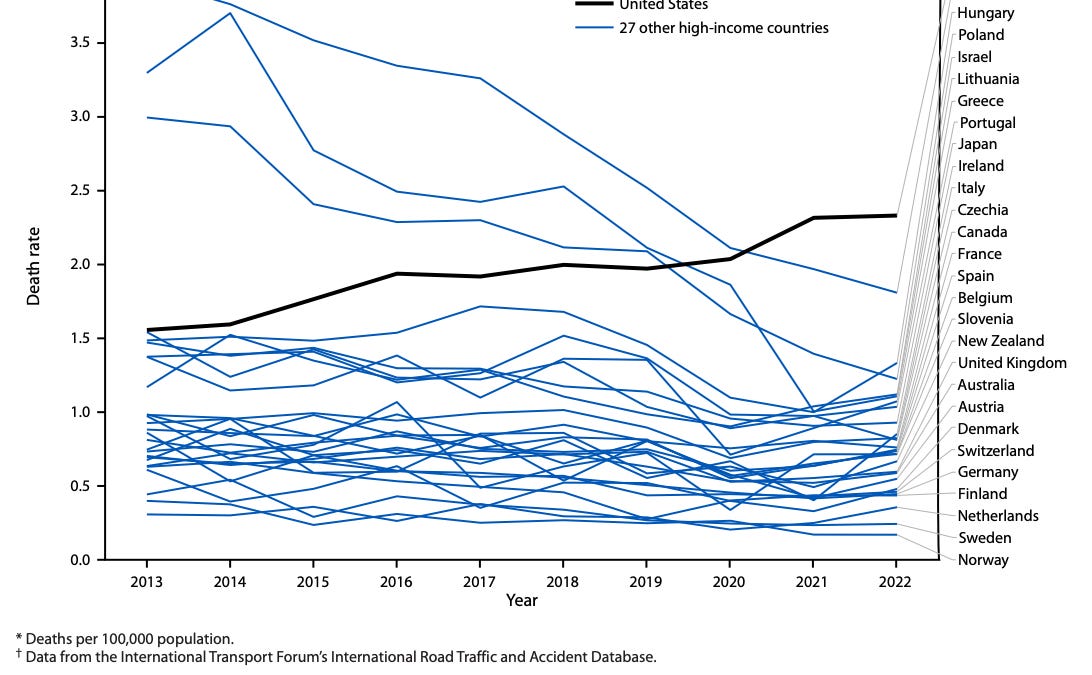
Despite this, if you look at the graphs in the article, you will see most countries have managed to drive down pedestrian deaths. Except the US, where the curve trends up. The reason is pretty straight forward, and has nothing to do with the cars, the attitudes of drives or pedestrians. Hell, you can even ask an AI what it is, and you will get a reasonable answer:
    [Countries] have historically managed to drive down pedestrian deaths due to motor vehicle accidents primarily by adopting the Safe System approach, which includes elements of Vision Zero, a long-term goal of zero road fatalities and serious injuries.

    This approach focuses on creating a road system that is safe for all users, particularly vulnerable ones like pedestrians, by managing speed, designing safer infrastructure, and ensuring safe vehicles and road user behavior.
If that is the cause, why did the number of drivers not looking for pedestrians suddenly start increasing around 2010?
>> Another contributing factor is of course the huge vehicles that crush people with drivers barely noticing
"If the increase of size and frequency of trucks and SUVs was behind the increase in pedestrian deaths, we wouldn’t expect to see an increase in the frequency of pedestrians killed by sedans or compact cars. However, if we look at pedestrian deaths by model of car, we see that pedestrian deaths involving popular sedans have increased as well. Pedestrian deaths involving Honda Civics and Accords, Toyota Corollas and Camrys, and Nissan Altimas have all increased substantially"
In my driving classes, I have been clearly explained that a right-on-red must be treated like a stop sign and that to turn, there needs to be two lanes free of cars: the one you are getting into and the next one (if one lane is available,this doesn't apply).
Many,many drivers treat the red light like a green light for turning right and that's the root of the issue.
I see that in both 1, and 2, and the lawyer ads everywhere necessary to make the consequences also someone else’s problem and fault.
""" The strongest evidence seems to be for the “Big SUV hypothesis” — it’s hard to see what else could be causing the increase in deadliness of pedestrian accidents, and not cause a similar increase in other things. The Big SUV hypothesis also seems like something that could be limited to the US. But this on its own isn’t completely satisfying: if its big SUVs, why are pedestrian deaths for sedans increasing too? Why aren’t deaths increasing on rural roads? There are still unanswered questions here. """
Here is what IIHS says in their study: https://www.iihs.org/news/detail/vehicles-with-higher-more-v...
>> This doesn’t necessarily mean the pedestrian was at fault — it could simply indicate that in a pedestrian death we only get one side of the story, which makes it hard to charge the driver with a crime.
But I have to say, I agree with both of you there. I lived in a country where car drivers are explicitly required by law to avoid killing people, and therefore are always at fault, even if pedestrian was crossing illegally. Law even requires drivers to speed down if they reasonably couldn't see a pedestrian. Basically, if you can't not hit people, you might as well abandon you car.
Just the fact that the pedestrian could be at fault for their own killing, I think, makes the chances of that happening way way higher. It's insane that "well my car weights 8 ton and cant stop in time even when im under speed limit" is even an argument for an innocence, and not a jail ticket that has "didn't care enough about not killing people" written on it.
[0] https://publichealth.jhu.edu/2023/narrower-lanes-safer-stree...
Because if it is - seems easy and cheap to fix.
The article that has all the cool plots, and no relevant information like the actual vehicles being discussed?
The article that doesn't even bother putting a 2000 Camry side-by-side with a 2025 Camry to make it blatantly obvious that it's not just SUVs?
That article?
Someone doesn't understand that any article that's drawing conclusions based on a workflow that involves putting a Chevy Suburban (functionally a chevy pickup from the B pillar forward) and a Honda HRV into the same category is sus at best and anyone uncritically accepting said conclusions is also sus at best.
If one wanted to be honest they'd look at GVW or some other metric that tracks size far more closely than a fairly arbitrary categorization that is highly gamed for regulatory reasons.
We're all just so sick of these shallow analysis. Shitting numbers and graphs onto them doesn't make them not shallow. Like what even is the point of a raw "deaths by state" map?[1]?
It does give slightly more insight than the map of US state population per capita[1].
[1] https://facebook.com/story.php?story_fbid=710896291698831&id...
> Other countries haven’t seen this increase in pedestrian deaths: in every other high-income country, rates are flat or declining. Whatever’s causing the problem seems to be limited to the US.
If you want to blow through an area fast, there are other roads for that with lighted crossings and sidewalks, and often slower mixed-use parallel roads for pulling in and out of businesses.
Some places are, others are absolutely awful.
> Another advantage is that narrower roads make drivers drive more carefully and slowly,
In some places, in others people go absolutely hell for leather because the roads are pretty fun.
This varies city to city.
Most people prefer not to drive on roads like that.
Some Americans can be hostile to increasing city density, arguing it will increase car traffic. Yet the whole point of dense cities is to help people avoid driving as you live next to everything.
Meanwhile development out in the hinterlands continues unabated, and the only way to get to the city if you live there is with a car.
When you ask the same Americans why they like visiting a resort or European city, they will talk about being able to walk around without a car to get everything they need.
To be fair, you're looking for different things at a resort than you are at home. At a resort, you're not looking to do weekly food shopping, or buy supplies to do work around the house, or etc, etc. That's not to say things can't be organized to make doing so more reasonable, but living in an area where you drive to get everything and wanting to _visit_ (but not live in) an area where you can walk to everything (because you don't need major things) is not unreasonable.
They thought I was crazy for walking basically. After reassuring them I knew who and where I was, they let me walk off.
Much of America seems very car-centric (to a European like myself).
There’s a great audio version (I think from the BBC) too.
Nothing screams "safety" like an SUV coming at you from behind and left while accelerating to highway speeds.
Perhaps something similar where you live?
I don't know what metrics they are using to assess walking or cycling infrastructure, but it seems like it's just raw miles of pavement/tarmac. This is a useless metric. You can have 10 miles of pristine cycle path but if it goes nowhere it's not useful and nobody will use it.
The metrics need to be based on graph completeness. Important places are the nodes. You get to draw an edge if there's a reasonable route that is less than, say, 150% of the crow flies distance (or some more clever formula taking into account gradients etc., ie. it's allowed to be longer if it means not including a 25% gradient). Then your score is simply number of edges divided by number of edges in the complete graph (or 2E/(N^2*N) where E is number of edges and N number of places).
given how many people die I'm surprised government's having made safety technology mandatory. things like toyota safety sense are pretty effective - you can check on youtube. people will place random dummys in front of the car and it stops pretty accurately.
We need crosswalks enforced by spikes that pop up from the ground or something similarly draconian to get people to wake up.
The US mostly (but not completely) solved the school bus problem (people passing a bus dropping off children) by having exceptionally hard penalties and enforcing them significantly for the first few months.
A similar nation-wide campaign is needed around auto safety.
They also changed bus routing best practice to alter the sorts of stops that were causing the bulk of the passing. Like for example right side stops on roads divided by any sort of median are avoided where possible these days.
I don't think the data really supports this, because pedestrian deaths have been rising continuously since 2008 instead of abruptly after 2019; there is at least a bunch of other factors at play.
Most suprising to me was the sharp rise in the "pedestrians on drugs" quota.
Personally, I think that "more distracted pedestrians" (from smartphones) is also an interesting theory which could possibly explain the huge increase in Sedan-lethality.
I'd be cautious of reading _too_ much into that, because in that time period the US has largely legalised a popular drug. You'd expect this rate to rise just because a cop asking "were you using cannabis" in the US is now a very different threat level than it was 20 years ago.
People jaywalk because the lights are timed more for the convenience of the drivers. People dart out between parked cars because the nearest crosswalk is a long way away. People cross the interstate because otherwise their 5 minute walk becomes an hour. Drivers shouldn't be going 55 in spots where someone can be obscured by a row of parked cars. etc.
> I see jwalking pretty much every day.
Jaywalking was a created crime by the early car companies to try to take away blame from distracted drivers. https://www.grunge.com/721704/the-truth-about-how-jaywalking... says it better than I.
> One dude I saw just a few days ago was crossing an interstate (see that about 2-3 times a month in the same place).
That IS a problem. However, what is the locality doing to fixing an obvious problem of 'nowhere to safely cross a high speed road'? Aside "fuckit, cross halfway when it looks safe" is basically the only sane response. WALKING up or down an interstate or major highway to get to a light or some crossing way would take 1+ hours to do.
> Then to add to that I see every single day people walking doing silly things and walking into the roads where they should not be.
Are they actually obstructing, or just crossing and you don't like that?
> I see people walking when the signal says to stay put.
So in my liberal-ish city in a republican state, we have basically terrible cargo-cult traffic control. They do shit like "dont turn on pedestrian lights when nobody presses the button", no right-turn on reds even if theres no ped crossing, arbitrary bad speed control, stuff like that.
On the city square, its routine to see no cars cause the lights are anti-timed to impede cars. BUT the light will be green allowing all those cars (NONE!) to continue. So yeah, we look the 1 way - its a 1 way road - and we will cross when we're not supposed to.
Again, this is what happens when you mix blaming pedestrians, poor traffic handling, and cargo cult liberal ideas all together. Makes a terrible situation for everyone.
> I see people darting out from between parked cars.
Again, goes back to car companies criminalizing "jaywalking", in order to steer the blame to humans rather than humans driving a 1 ton slab of metal and plastic.
> But a car doing 55 does not care.
Ah hah! And there's the gotcha. You're not talking about downtown and slower streets, like city residential or the city square. You're talking about Stroads, this bastardized terrible mix between a street (slow, humans everywhere) and a road (high speed, no humans, limited entry/exit). Not Just Bikes talks extensively about it. https://www.youtube.com/watch?v=ORzNZUeUHAM
Yes, Stroads kill. And Stroads are EVERYWHERE in the USA. This US-centric anti-pattern is best seen with a state highway going 55MPH, maybe dropping to 40-45MPH with a town built AROUND this bisecting nigh-uncrossable stroad. They are some of the most anti-human infrastructure we have seen.
> I make sure I cross at the places designated to do so and also make sure there are no cars coming at that moment because some fool decided that was the perfect time to play with their phone.
Thats the problem with stroads and the highways that bifurcate towns and cities. There's FEW places to cross, and the lights themselves are almost never set up to actually allow pedestrian traffic. And you're lucky to even get a sidewalk. And if you do, your door prize is face full of vehicles fumes and super loud vehicles.
The USA has sold off and demolished pedestrian infrastructure for implicitly requiring everyone have a motor vehicle, unless you're lucky enough to live in a rare city with great public infra. (And no, bus lines that share the road with regular vehicles will take you 2 hours to get where your car can take you 20 minutes.)
Window tint is a pet peeve of mine - as a long-time small car driver I'm used to being around taller vehicles that I can't necessarily see through or around. But the situation has gotten worse and worse.
The law hasn't changed AFAIK - there's a longstanding regulation that cars are generally not allowed to have dark tint from the factory but trucks, SUVs and vans can have dark tint from the second row back.
So you used to see older "standard" pickup trucks, the ones with a single row of seats, and there'd be no tint - you could see through the truck. Now the typical pickup has 2 rows, and dark tint in the back.
A lot of cars have become SUVs as well - now your Subaru Outback or even Crosstrek are technically categorized as SUVs and come with dark rear tint in most configurations.
As a result, when I sit at a traffic light, I can see much less of what is happening beyond the neighboring vehicles than in years past.
Sure, everywhere with roads has some large, opaque vehicles like delivery vans, etc. But the percentage of my field of view that is blocked by neighboring vehicles certainly seems higher than ever.
The spike started in 2010, which is when 4G was rolling out, Instagram launched, Facebook was already big, and social media in your pocket was becoming an addictive reality. Before this, there wasn’t a lot to do on a smartphone while driving.
Still the "on drug or drunk" for the pedestrians is wild.
It's insane that society has come to accept that some parts of the public space are deadly, and it's your fault if you're not cautious and get killed on them. Just to have more cars.
Now kids can't go to school by themselves
Not saying it's good or bad, but for instance, in some counties it's way simpler to have a parking lot without any traffic buffer area at the entrance than to get an approval for a roundabout to reduce electronic traffic coordination in feeder roads.
Even simple things like pedestrian passages that do not have any contact with the road (elevated passages or underground passages) are very hard to find in the US.
I really would like to know one day what kind of design philosophy the traffic engineering field follows with so much compromises.
Passive voice and saying that they are killed by cars is part oft the problem: https://visionzeroreporting.com/
I walked to school in the 90's and even then the curtain-twitchers scolded my mom for letting me. It has only worsened since, as every destination is ages away and involves crossing multiple 45MPH stroads with monster trucks with 5 foot high hoods roaring down them.
Driving, especially during commute, becomes an exercise of muscle memory for most of us. We are used to what we see. All year long I might encounter a pedestrian at my most commonly encountered intersections once a year. Most drivers are on auto-pilot, they're used to looking for cars, if people aren't abundantly obvious, they're missed.
They've started connecting sidewalks around me. Foot traffic has tripled as a result. Still, that means I encounter a pedestrian three times a year? That's not going to improve exposure enough to make anyone specifically look any more frequently. It's going to just create more opportunities for people to get hit. And that's what's happened.
As a result it really freaks me out when I visit home and friends and relatives will drive 25, 35, 45 mph right next to a row of parked cars where a person could walk in front of them at any moment, and not even consider the possibility of a pedestrian. It's a complete mindset shift.
Are US sedans hood designs different than in Europe?
One other thing that’s changed for both SUVs and sedans is that for the sake of occupant safety, the pillars are MUCH wider than they were in cars built 35 years ago. The impact on visibility is massive, and those pillars are generally placed to directly obstruct the view of pedestrians in or waiting to enter a crosswalk when the driver wants to turn through it.
Just yesterday while taking my daughter to school, I was looking at my phone, the light turned green, and the car behind me had to wait a few seconds, it was a police car. He clearly saw me, and absolutely nothing happened. The police back home in Catalonia would have roasted me for that.
And I have seen wild things here in US besides tons of people using phones like brushing teeth or eating with a plate and a fork.
... Like, the _driver_?
See: https://freakonomics.com/podcast/why-is-the-u-s-so-good-at-k...
We really really really really like our cars/trucks/SUVs in the US and have agreed that about 30,000 to 40,000 people a year will die so that we can keep driving the way we do.
It’s the price we pay for the way we choose to live.
When I see car people I see anger, frustration, furrowed brows everywhere, oh and did you hear about that asshole on the road yesterday?
From the outside this "love" looks more like an abusive relationship or Stockholm syndrome or something.
If you actually pay attention when driving you'll see a ton of sub par behavior. Ignorance is bliss and they're not ignorant.
I knew from a very young age that driving a car seemed like a dumb way to live and so wondered why everyone did it and why nobody decided to try something different?
My view is that if people really hated driving they would change their lives to do it less! Instead they make excuses about how they have to drive. I judge people's actions and the way most people choose to live tells me that they love driving!
Soccer vs american football is another visible example.
Fat cars getting fatter, pedestrian-hostile streets becoming faster, city infrastructure requiring people to drive everywhere.
Hmmmm, what could be the reason.
I really really really disagree with this.
A huge number of people could design a car-free or less car dependent life for themselves if that was something they valued highly.
People just don't value it as highly as they claim they do.
Whatever.
Change it to "city infrastructure heavily incentivizing people to drive everywhere by heavily penalizing all other modes of transportation and prioritizing automobiles and accommodating the needs of car drivers above everything else".
When the cities are designed for cars with everything else being an afterthought, people are going to driver everywhere.
I like (by which I mean I think it indicates a lack of moral character) that you say this despite the articles conclusion basically being "the data is all over the place, I see no strong trends <sigh> I guess it's the SUVs, ugh, maybe"
Like yeah, it probably is the SUVs to an extent but the data only indirectly supports this at best and there's probably confounding factors (in particular road design which has been discussed at length and people all over these commands are bringing up).
This isn't coherent, sorry.
>that you say this despite the articles conclusion being...
Notice that I said that the hypothesis is supported by the data presented in the article, not by the lackluster analysis (or the conclusion, which, nevertheless, does point to SUVs as the only hypothesis they find plausible).
>the data is all over the place, I see no strong trends <sigh> I guess it's the SUVs, ugh, maybe"
This is a bad and misleading summary of the article.
>Like yeah, it probably is the SUVs to an extent but the data only indirectly supports this at best and there's probably confounding factors (in particular road design which has been discussed at length and people all over these commands are bringing up).
You missed the entire point of the article, which is trying to understand why the rate of pedestrian fatalities spiked after 2009 in the US (but not in the EU).
Road design, BY ITSELF, isn't the cause of the spike, since IT DID NOT CHANGE.
The speed limits did go up in many places in the US, something that I brought up in another comment (and something that was glossed over by the article). That may be a factor.
But the primary factor is the elephant in the room - cars getting bigger, heavier, taller, and more hostile to pedestrians.
It's the goddamn obvious conclusion, and all the data out there supports it:
https://www.npr.org/2023/11/14/1212737005/cars-trucks-pedest...
Mostly, though, drivers have just gotten worse. Corner-cutting is one of my pet peeves, and a good example here. I used to see someone cutting a corner across opposing traffic - usually someone turning off an arterial vs. someone trying to come out of the side street - less than once a week. Now, even though I drive less, it seems to be everyone all the time. If they're not cutting the corner, they're swinging wide to the same effect. Ditto for running red lights. Where I used to see one person running it by half a second, I now see three running it by multiple seconds. Turning where there's a "no turn on red" same way. I've stood at a rotary and counted how many cars were not using it properly, endangering others. Yeah, I know, get a life, but the fact remains that drivers are worse.
The only real question IMO is why drivers are worse. I have more theories, of course. Breakdown of the social contract, people under more time pressure, phones (though that was already examined), etc. But those kind of aren't essential to my point so I'll leave them aside for now.
The article is well researched but doesn't seem to account for the increase in weight and size of the sedans it mentions as a counter to the rise of SUVs being a leading factor.
I'd be interested in the data on a small that remained the same size and/or got smaller in the window: the Mazda Miata.
| Model | Year | Length (in) | Width (in) | Height (in) | Curb Weight (lbs) | |----------------------|-------|--------------|------------|-------------|-------------------| | Honda Civic | 2009 | ~177.3 | ~69.0 | ~56.5 | ~2,600 - 2,700 | | Honda Civic | 2023 | ~184.0 | ~70.8 | ~55.7 | 2,877 - 2,935 | | Honda Accord | 2009 | 194.1 | 72.7 | 58.1 | ~3,193 | | Honda Accord | 2023 | ~192.2 | ~73.3 | ~57.1 | 3,239 - 3,280 | | Toyota Corolla | 2009 | ~179.7 | ~70.1 | ~57.7 | ~2,358 - 2,623 | | Toyota Corolla | 2023 | ~182.3 | ~70.5 | ~56.5 | 2,955 - 3,150 | | Toyota Camry | 2009 | ~192.1 | ~72.4 | ~58.1 | ~3,193 | | Toyota Camry | 2023 | ~192.1 | ~72.4 | ~56.9 | 3,244 - 3,280 | | Nissan Altima | 2009 | ~191.1 | ~72.0 | ~57.0 | ~3,192 | | Nissan Altima | 2023 | ~192.9 | ~72.0 | ~56.9 | 3,244 - 3,053 | | Mazda MX-5 (NC) | 2009 | ~157.5 - 158.3| ~67.7 | ~48.8 - 49.4| ~2,450 - 2,542 | | Mazda MX-5 (ND) | 2023 | ~154.1 | ~68.1 | ~48.6 | ~2,183 |
https://thundersaidenergy.com/downloads/us-vehicle-sales-by-...
That fact alone acts as a multiplier for everything else. The cars are bigger in the USA? The bad streets make it way worse. People are distracted at the phone? The bad street design makes it more deathly.
Fix USA's streets and towns and all kinds of deaths will be decreased. It is the most important factor.
This kind of problem is exactly what statistics is designed to do, and it makes me a bit sad that we are left with a bit of a shoulder shrug. It's absolutely possible to do a much better job at disentangling possible causes here with something as simple as a multilevel regression. (Although ok, proper causal inference would be more work).
That being said, (and to be clear I say this as someone that does not own a car). I also have been seeing more and more people not paying attention and just walking while staring at their phone. No walk symbol or anything. I have frustratingly had to grab my partner multiple times doing exactly this and almost walking into a car that was following the rules.
Seriously if your walking (especially in a car centric area) you don't need to be doom scrolling through Instagram or whatever other crap your looking at. Quickly changing music, sending a text, whatever is one thing but I don't understand needing to look at Instagram while walking.
And not just so you don't get killed by cars, the number of times these people almost walk into other people is insane...
That's over 3_000_000 people in the past 100 years.
https://en.wikipedia.org/wiki/Motor_vehicle_fatality_rate_in...
(corrected, thanks!)
are you sure you haven't thrown a zero somewhere when multiplying.
Or a raw increase in pedestrians on urban roads? Maybe people are more willing to go on a walk at night in the city these days?
(Not just Boston, I've seen this in some other cities since.)
In the comments here you'll see people saying that European roads are much better suited for pedestrians. If you ask me that is definitely not the case in e.g. Spain.
Having been in both Spain (a few regions) and the US, Spanish roads (at least what I saw of them) are immeasurably better for pedestrians than US ones.
> The tendency to compare the US to Europe in the comments here baffles me
Context is that the US is a huge outlier in road deaths. No European country comes close.
Norway has ~100 persons killed in traffic per year, but is not satisfied with that:
https://www.tryggtrafikk.no/content/uploads/2024/03/Nasjonal...
It was actually uncomfortable watching people not look, but cars always stopping when I lived in Germany.
Nevertheless, there had been a few episodes in the following years.
I don't know, feels like a recipe for roadkill
With people on their phones, roads will have to become obstacle courses with speed bumps and undulating curve to force people to pay attention.
Philadelphia's solution to speeding has been speed bumps. Sounds great until you realize there are no specs for this, and some of them are so high that nearly every 10th car going over now makes an extremely loud scraping sound. Now imagine living in front of that!
I ride a motorcycle most times and I am always at very high attention when riding. I see people scrolling TikTok not only at lights, but flying through town. I see they didn't find a cause there, but it seems so prevalent and dangerous that it has to have caused an uptick in accidents as well as deaths. That data feels very fishy for it to be so different between regions (there is not a different culture in different areas for phone use).
I also wonder if there are a few confounders, covid, number of cars on road, safety of cars, and local code rules on what constitutes a registered vehicle (this is more variable than you think). In some places, if it rolls, you can register it. NJ has mandatory 2y state inspection.
At least we have Roosevelt Boulevard, the most dangerous roadway in the entire US! We're #1! (It is literally called: The Corridor of DEATH) https://whyy.org/articles/philly-roosevelt-blvd-rising-traff... I think it goes up to 12 lanes wide at some point WITH a pedestrian crossing.
It's not just that SUVs are deadlier than sedans.
It's also that the sedans are becoming taller, wider, heavier — and deadlier.
The article says that blunt fronts are what makes a collision more likely to result in a death. Well compare a 2000 Camry to a 2025 one then on that metric.
To test this hypothesis, we need to look at all accidents where a pedestrian was hit — and see a breakdown on whether it resulted in a fatality, by vehicle and road type.
Another thing the article doesn't consider is that the speed limits have increased across the US, and where they haven't, the enforcement is not necessarily there (cough Bay Area cough).
Solutions like lane diet (or engineering cities for anything other than automobiles) never became popular.
The outcome is inevitable.
_____
TL;DR: bigger, fatter cars going faster kill more people.
They checked so many things I'm surprised it didn't match something just by accident (it's still a fun exercise :)) mostly just teasing)
this always feels strange to me in some US cities... why would you give a car a green light to turn into an active crosswalk? I've been honked at by drivers like I'm doing something wrong while having a cross signal
Worryingly, Von Der Leyen, in addition to capitulating to Trump on tariffs, apparently agreed to allow more of these things to be imported. https://www.transportenvironment.org/articles/eu-cave-in-on-...
It seemed every morning I got up and turned on the hotel TV, there was another news about some crash on the Interstate that morning
In the US there's a melange of different police forces in any area. Only one of them (Highway Patrol) cares about driving. And in my experience they don't care much about anything pre-accident (except for revenue-raising efforts like speed tickets for 10mph over the limit).
E.g. in the US you'll see countless vehicles with one headlight not working. In the UK (at least when I last lived there) you'd be pulled over and fined for even headlights that aren't correctly aimed.
I often drive in Europe for business and cry a little on the inside when I’m back on New York streets.
While individual points are supported or resisted individually and by individuals, when you sum it up on a population level it's like a gut reaction against listening to someone who's lead you astray before.
Basically the people pushing changes lack the political and cultural capital to see them through because the capital was wasted for naught in decades past.
Many mention rules about yielding, and having to stop when turning right on red: most of the drivers only know a fraction of the rules. They never learned most of them.
I’m not sure about this, but my understanding is that some states don’t even require a license if you are older.
I was crossing the street (a busy thoroughfare) in a marked crosswalk, that did not have a yield/stop sign or streetlight. A middle aged man in an SUV floored it in front of me. As he drove by he shouted 'FUCK YOUUU', as if I was in the wrong for walking in the crosswalk.
Anyways, there's no reason i'm sharing this anecdote.
  - poor visibility in modern cars due to rollover protection

  - touch screens and touch controls in cars

  - general proliferation of controls in cars

  - smart phones & smart phone addictions

  - higher vehicle belt lines are better for vehicle --> vehicle impacts but worse for vehicle --> pedestrian impacts

- poor pedestrian infrastructure, sidewalks, crosswalks, etc.Just kidding I know the answer is lobbying