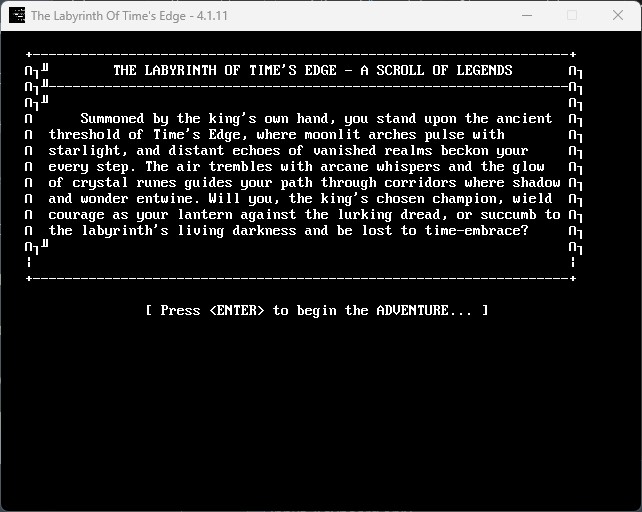
The Labyrinth Of Time's Edge by The Ventureweaver
itch.io
155 points · by ATiredGoat · 1y ago · 111 comments
Or at least, that’s how I remember it. It’s been a good 40 years though and I wouldn’t be surprised if reality was quite a bit different.
Edit: I’ve been thinking about this a bit and honestly my motivation for writing software hasn’t really changed. The users, sure, but not the motivation. It’s just thrilling to share things I built with other people.
I remember irritating the hell out of my parents (and our dog) with it until one day, by accident, I noticed they couldn’t hear the tone anymore. The frequency was somewhere in the range of 15-20 kHz IIRC.
So I wrote a “PASSWORD.BAS” source that would play that high pitched sound in short, one-tick intervals continuously while polling the keyboard for input but then stop after a random amount of time. To authenticate, the user had to hit the spacebar within a one second window of the sound’s termination. Hitting the spacebar too early would also result in access denied. Fun times!
Incidentally, if you're ever interested in playing around with one again, there's a really accurate VST emulator called Chipsynth C64 [1].
In the back of the manual were four BASIC programs. The first three were very simple, stuff like a loop that prints your name 10 times and then exits.
The last program balanced your checkbook. It was 4 pages long. I laboriously typed it in, hunt-and-peck style, which took hours... then I hit "run".
Nothing.
I couldn't debug it. Not only did I not really understand software, I didn't have a checkbook — hell I didn't even know what "balance your checkbook" meant.
We didn't have the exorbitantly expensive Atari floppy disk drive, nor the cassette drive, so I couldn't save my work. Still, I left that BASIC cartridge in there for several days, foregoing my games, because I didn't want to lose my investment.
Eventually, I turned off the computer and the program disappeared forever.
I didn't program again for 20 years.
I've always wondered if there is a correlation between developers and people that can enjoy tough but fair games like Super Meat Boy because of this.
I agree that resilience is important, but in my experience it emerges from a complex mix of temperament, environment, structural advantages, and mentoring, rather than being intrinsic to the individual. For illustration: I’ve trained a bunch of people from nothing on software and I always prioritized helping them find a project they cared about, because that motivation was what would power the through the inevitable frustrations.
Maybe if the Atari manual had taught me how to write a branching adventure game rather than a checkbook-balancing program, I would have stuck with programming back then. But I’m not dissatisfied with the path my life took.
The spaghetti code was astounding, and I remember squeezing line numbers between existing code-- adding a "31 GOTO 40" so I could squeeze a "room" into lines 32-39.
I never did grok the idea of building an "engine". Mostly I had PRINTs, INPUTs, and IF/GOTOs.
Looking back I wish I'd had a mentor. I think I would have accomplished so much more if I'd had somebody to offer some guidance and gentle direction.
However, we had old stacks of Compute magazine [1] lying around with BASIC source games printed out - and I remember initially being confused as to why all the line numbers were separated by intervals of 10...
I spent too many nights trying to implement complex text adventures in Commodore 64 Basic and I'm sure that instead of permanently damaging me (at least in the sense that Dijkstra meant) it just made me appreciate more all the abstractions later languages introduced to me.
And my memory might be from our Apple 2gs and AppleScript, actually (hence my caveat in the comment). But I’m sure the program was just PRINTs, INPUTs, IFs and GOTOs :)
I eventually learned to get a ProDOS disk setup, and save my work, but it was still fun.
Example:
--ROOM 22 START-- Village of Oathmoor 23,0,0,21 You find yourself in a narrow, dimly lit alley. An ELDERLY WOMAN sits perched on a broken stool, her piercing gaze fixed on you with an unsettling intensity. --ROOM 22 END-- --ROOM 23 START-- Village of Oathmoor 24,22,0,0 The road ahead begins to slope gently upward, winding its way past abandoned, barren buildings whose windows gape like empty eyes. --ROOM 23 END-- --ROOM 24 START-- Village of Oathmoor 0,23,25,0 The eerie stillness around you is oppressive, broken only by the creeping sensation of unseen eyes upon you. A chill snakes down your spine. --ROOM 24 END-- --ROOM 25 START-- Village of Oathmoor 26,0,0,24 A faint melody drifts toward you, its haunting notes carried on the breeze. The aroma of a meal cooking over a distant fire stirs both hunger and curiosity. --ROOM 25 END-- --ROOM 26 START-- Village of Oathmoor 27,25,0,0 You stumble upon a makeshift camp where people dance in defiance of their sorrows. The leader of this ragtag group locks eyes with you, their expression unreadable. --ROOM 26 END--
Not sure what the length has to do with handcraftedness though. This comment is handcrafted even if it is short.
The horseshoe theory of ai generation tells us that handcrafting and content generation extremism end up very close to each other: https://emshort.blog/2016/09/21/bowls-of-oatmeal-and-text-ge...
The fact that something is generated or hand-crafted is not interesting by itself no matter how much people try to pretend otherwise for social cohesion purposes. Mediocre thing + no AI and Mediocre thing + AI seem to be orthogonal to what people actually care about at the end of the day.
Online, almost nobody is actually going to crack open the interactions.txt file. Instead, the conversation is about the idea of it being interesting or of any special qualities, when it isn't. The thing itself is just a prop for the conversation, and you can see where anyone actually talking about the thing itself is on the margins.
When this is for a free text adventure game, it's harmless fun to hype it. But the other prong is AAA hype and AI hype, which seems like the opposite but is actually the same thing.
2) right horseshoe prong ("infinitely generated quantity is quality"): "100,000,000,000 unique planets made by one generative codebase" was the premise of Endless Space and it had a very rocky launch that took years of bespoke human work and decisions to improve the quality. Because when you're deadset on quantity being your primary quality, you also don't have time for intractable complexity or true differentiation.
And you can see the consequences play out in an adventure game like Starfield where they included infinite random planet generation, except the interactions and space of player decisions remain the exact same, so it's more like an infinite screensaver than gameplay.
On both ends, the media and discussion is aggressively channeled away from the thing itself and towards the narrative of it being something compelling and noteworthy by virtue of how it was created.
The "robot barista" at the SF airport "making" you an espresso by having a servo arm insert a kurig cup and charging you 5 bucks is extremely similar to someone charging you 50 bucks at a craft fair for a "handmade" set of earrings that look suspiciously like someone just wrapped some copper wiring they bought online around a semi-precious stone they bought online.
In one case you are "participating in a spectacle of the future" and living in an aesthetically futuristic moment while paying 500% markup to drink a shitty instant espresso, and in the other you are "participating in a spectacle of the past" and harkening back to the aesthetic of a time where we all came together as a close-knit community at our town market to support our village crafters and artists while... also paying a 500% markup for goods where real or perceptible increase in quality/value-add is often marginal.
The goods which are remarkable speak for themselves, the rest is marketing.
> requirements are light
> 512 MB RAM
raised an eyebrow.
Granted I haven’t owned or used a computer with that little RAM since 2003 or so, discounting phones, but I was sort of hoping it would say 640 KB for that true DOS-era spec.
(Remember: they're system requirements, not program requirements ;)
I went over the BAS source the last time this was posted a few weeks back and it has a lot of keywords that are specific to QB64 so unfortunately you can't run this on a true DOS machine (or DosBox).
[1] https://qb64.com
The first time it barfed was because there was a space in the filename, and the QB64 editor didn't handle it. Running on the command line, with quotes around the name, was flawless.
Just like machine created cutlery is essentially perfect, but human smithed cutlery will have lots of small imperfections.
It must be amazing to feel that way about the totality of human literature. Might want to adjust your priors somewhat.
Also, as fast as models are improving it's not a useful heuristic anyhow.
This rings false
There’s minimal if any interactivity in this “game” and I deleted it after 10 minutes of one screen with one line of text after another.
I don't think we're there quite yet, and hopefully we never will be. A tiny minority of games, maybe.
> The game is advertised as having more than 7.000 locations. In reality there are about 200 unique locations and the rest is part of a maze with exact locations.
[1] https://spectrumcomputing.co.uk/entry/6993/ZX-Spectrum/Snowb...
But big MUDs usually have "builder" teams so the comparison is unfair. However, these numbers have hardly been matched by game studios - WoW or Runescape comes to mind. And then there's Dwarf Fortress which reaches the infinite in some categories thanks to procedural generation.
[1] https://www.aarchonmud.com/arc/features
[2] https://www.mudportal.com/listings/by-genre/hack-slash/item/...
Collaborative building over decades adds up!
https://news.ycombinator.com/item?id=45612521
But basically no. It's possible an earlier version of the game might have been backwards compatible with QBasic, but the current source is QB64-specific and thus will never work in DosBox.
To play it you'll either need a compiled Mac binary or run it in QB64.
https://en.wikipedia.org/wiki/AI_Dungeon
Where AI has the power to shine isn't necessarily in the creation of novel stories, but in the capacity to act as a significantly more powerful and flexible text parser for player input.
Get ye flask and all that...
This is an important part of designing a text adventure that LLMs just do not care about.
Customer service AI already is a thing and it works pretty well, games are just an extension of that built upon fictional world data and dynamic events.
I think it would even be neat if you used standard dialog tree interfaces but had an LLM to slightly customize canned responses based on the player’s unique experience or reputation so far, while still communicating the relevant info, this way things feel less scripted.
Taken further the assistant's role could be expanded with greater autonomy. Games could include metadata and authors hints & directives for the narrator. Or a limited interface for manipulating the game state and shifting the traditional IF model closer to a two player collaborative game. Using the LLM to transform and extend pre-authored text might actually offer new narrative possibilities, assuming the model could do it subtly and well enough, the style, POV, mood an so on of prewritten content could be freely modified in some interesting ways. E.g introduce unreliable narrators, describe the player's actions from a point of a security camera or their dog, rewind and replay events from some other characters POV. Simulate psychological issues by subtly rewriting the player's (or the narrator's or NPCs) perception of the world and have them navigate a little twisty maze of emotional states, all different.
Restricting the model into operating strictly within the limits of human authored content could bypass some of the usual problems associated with purely AI generated games and the approach seems fitting for the genre and it's pre-existing rich tooling and talent.
That's a first person 3D space craft simulation with a very impressive Heads Up Display with vector graphics (unfilled on BBC and C64, filled on PC). It is also a commodity trading game to improve your spaceship etc and with a massive amount of variety in a binary smaller than an empty Word doc. Also: joystick and keyboard drivers and so on.
It's quite a tale.
GPS is another one (in particular the signal strength seems far too low).
Another one I was amazed by was Tomahawk on the Spectrum. A wireframe helicopter gunship flight sim with live ground campaign happening around you in 48k.