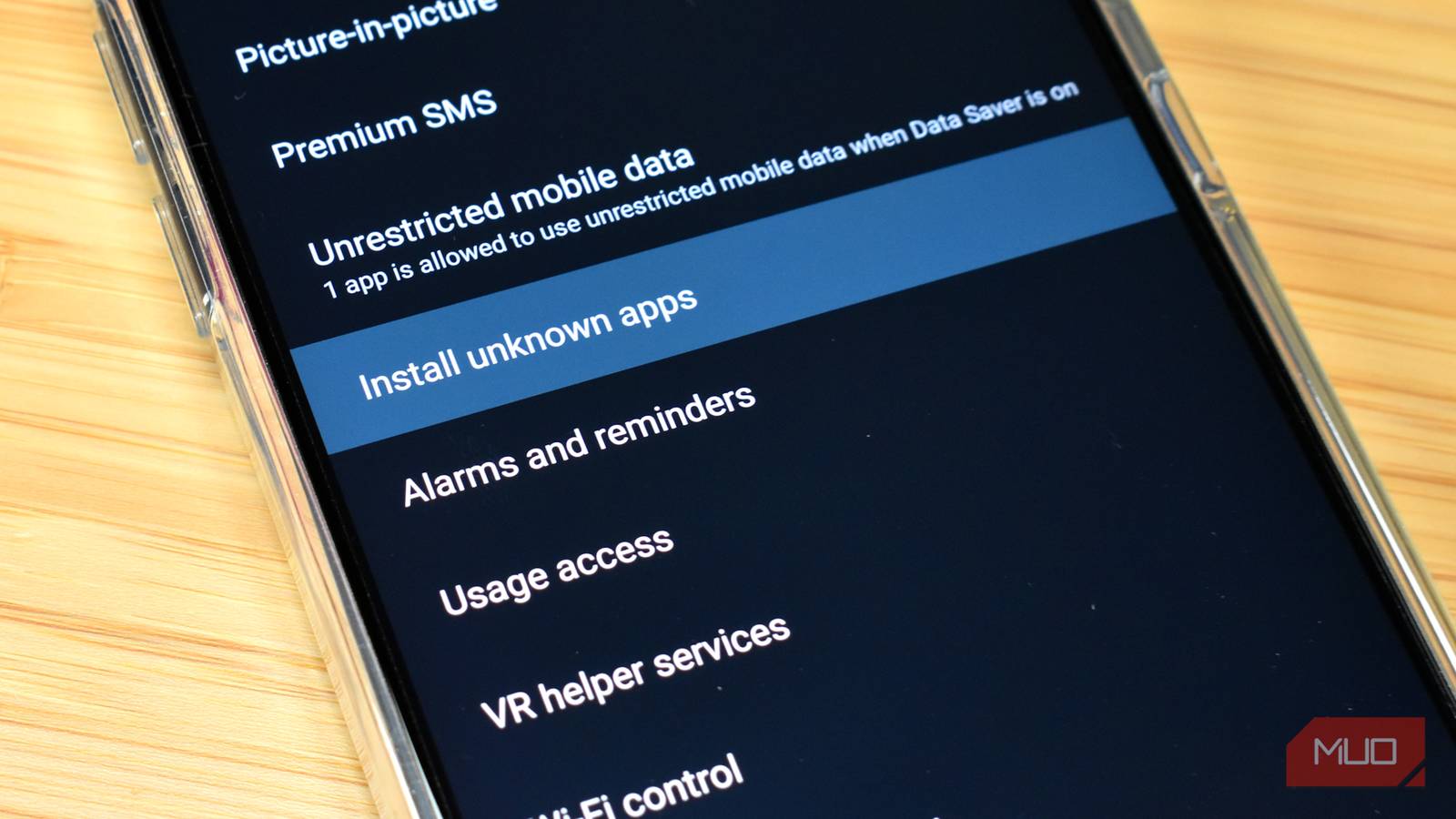
Android’s sideloading limits are its most anti-consumer move yet
Is Google's push for verified developers really about safety?
MakeUseOf
801 points · by josephcsible · 1y ago · 547 comments
I have the feeling Google has given up on using nerds as beachheads. The market is saturated enough and they don't need us anymore to do grass roots spreading of their products. It's the same with Youtube. As long as there were enough people who were unencumbered by ads because of their ad block and kept spreading links, the importance of Youtube was growing. After market saturation that vehicle isn't necessary anymore and they can squeeze them out.
Google needs to be broken up. Apple too.
The lack of antitrust enforcement is a clown show.
We have no choice in the most important computing category in the world. It's a duopoly and they have everyone in straightjackets - consumers, companies, competitors, governments, ...
A huge percentage of the world's thoughts and economy flow through mobile. And two companies own it.
Ma Bell was nothing compared to this.
It certainly seems like there is problematic behavior in the restrictions Google puts on OEMs that want to use Android (or, more specifically, play services) on their devices. However, I think it would take a different enforcement mechanism to address that.
It's become my go-to for "I need a utility for X task".
I, too, love vendor lockin.
Until EU's cross compatibility between messaging apps is passed, we are forced to be in vendor lockin.
It’s utterly bizarre how BBM could have been the iMessage and WhatsApp and who knows what else. But rich out-of-touch people thinking exclusivity is a perk in a commodities market just shows how business savvy and wealth are in reality disconnected from eachother.
WhatsApp became popular specifically because it was a multi-platform replacement for BBM.
BBM had little else to offer in terms of apps. It was a corporate ecosystem and good at that part of it.
iMessage also came out after BBM, and did their own device lock in, except iPhones were designed for the many instead of the few, especially beginners to smartphones.
For vast majority, Android vs iPhone is not massively different so iMessage availability is a draw for some people.
We do not have to choose the lesser of two evils this time.
So, if you're interested in adding more devices, join the community and see what you can do!
If an adjective is sufficient to make you fall back to the mean then there wasn't much one can do to convince you, I'm afraid.
So, yes, it's possible :)
Sideloading was the killer feature for me as well.
And guess what, sideloading has never been allowed on iPhones.
So you just went from bad to worse. The only rational option for tech-minded people nowadays is to buy a device that supports Lineage or Graphene (ironically Pixels are good for this) and to replace the stock OS.
So if the reason you're choosing Android over iOS is freedom and flexibility, once that's gone, why not choose slickness, speed, battery-life, photo quality, and an integrated experience?
Then I might as well treat myself with better hardware & ecosystem.
But you'll be reminded quickly how comparatively shit Apple's software is.
Aka the litany of "Oh, yeah, everyone knows that's broken but just deals with it, because there's no way to fix issues on a closed platform other than {wait for Apple}."
Remember when GPS navigation was a $5/month app that was a cellular plan addon?
Given that Google both owns Android/Google Play Store and YouTube: what do you think they would do with the developer information of someone who makes an app that skirts their ad-model for YouTube?
The "security" wording is the usual corpospeak - you can always trust "security" to mean "the security of our business model, of course, why are you asking?"
Things like Newpipe seems much more of a target, especially if you want to take legal action. More so than stopping users, this gives Google fat more leverage about what Apps can exist. If they ever want to stop Newpipe a serious lawsuit against whoever signed the APK seems like an effective way to shut down the whole project. Certainly more effective then a constant battle between constraining them and them finding ways to circumvent the constraints.
The fact that there was a temporary workaround didn't change the endgame.
It's just there to boil the frog more slowly and keep you from hopping out of the pot.
It's the same game plan Microsoft used to force users to use an online Microsoft account to log onto their local computer.
Temporary workarounds are not the same thing as publicly abandoning the policy.
“In 2024, the App Store made $103.4 billion to Google Play’s $46.7 billion.”
Android used to be weak against iPhone and needed to cooperate, so they allowed more apps in to grow the userbase. Now that they're big and strong, they don't need allies, so they start kicking out everyone who isn't making them money.
Every "enshittified" service does it - Imgur, Reddit, whatever. Everyone selling $10 bills for $9 does it. Microsoft did it. They took a step backwards by buying GitHub, when they realized they were totally blowing it on cloud. But now that they have users stuck on GitHub and VS Code, they're defecting again.
It means that Android is no longer suitable for my own private dev projects.
Do that + identity check = bans for virus makers are not easily evaded, regardless of where they live.
Googles/Apples argument would have been much stronger if their stores managed to not allow scams/malware/bad apps to their store but this is not the case. They want to have the full control without having the full responsibility. It's just powergrab.
Scam apps are rife in the iOS App Store. But what they can’t do easily install viruses that affect anything out of its sandbox, keyloggers, etc
I think they’re just going to track down a random person in a random country who put their name down in exchange for a modest sum of money. That’s if there’s even a real person at the other end. Do you really think that malware creators will stumble on this?
This has to be about controlling apps that are inconvenient to Google. Those that are used to bypass Google’s control and hits their ad revenue or data collection efforts.
Developers, and power users often pre-date these kinds of smartphones.
How will Google force Android users to "update" so sideloadinng can be prevented
Non-updated versions of Android running non-updated versions of sideloaded apps will not have the restriction
Another example of how not every "update" is for "security" and "updates" should be optional
The computer owner chooses one version of an operating system, e.g., "I chose Android because I can sideload any app", but by allowing automatic updates, without reviewing them first, the computer owner agrees to let the operating system vendor change the software remotely to anything the vendor chooses. The computer owner goes along with whatever the vendor decides, letting the vendor take them for a ride
If the operating system gets _worse_ in the opinion of the computer owner, if it fails to meet their needs, e.g., "sideloading", then that's too bad. The computer owner chose one version of Android, but by subscribing to "automatic updates" they effectively chose all future versions as well
This is why I prefer BSD UNIX-like operating system projects where I can choose to update or not to update. Unlike the hypothetical Android user, the project does not decide for me
HN replies may try to draw attention to "security" and away from "sideloading restriction". However there is no option to accept "security updates" while rejecting "sideloading restriction updates". According to the so-called "tech" companies that conduct data collection and surveillance as a "business model" through free, auto-updated software, every update, no matter what it contains, is deemed essential and critical for "security"
Online commentators seem to agree that the computer owner should have the choice to install or not install _any_ software outside the "app store", so-called "sideloading". Perhaps this freedom to choose whether to install or not install software should also apply to operating system "updates"
Google has the Google Play Services, which can be remotely updated via the Play Store, as has been done for the COVID exposure notification system [0]. Google's Play Protect already hooks into the installation process and could be updated to enforce the signatures.
(Own experients conducted over the years make this a "rhetorical question" meaning I already know the answer)
Not every app requires Play Services and internet access
(Online commentators sometimes try to argue that all apps, even offlines ones, "require" Play Services otherwise they cannot be updated automatically, highlighting the significance of "automatic updates" in steering debates about Android. Own experiments show that many if not most apps work fine without Play Services and can be updated manually if desired)
Not every phone is used for banking or other "government services"
(For example, some owners have mulltiple phones. Some owners may have phones with older versions of mobile OS that may be used for experiments)
Not every computer owner is the same
(For example, most phone owners do not install any apps at all. Of those that do, most use "app stores", not so-called "sideloading")
HN replies are likely to invoke "security" as a retort to any suggestion of decision-making and control being placed with the computer owner
Edit: that said, nowadays, maybe because I'm back in the EU, I use WhatsApp way more often than iMessage.
There are no good reasons left to use either platform - you're basically paying an arm and a leg to rent a device whose primary purpose is to usurp your attention and plunder your wallet at every possible opportunity.
Use and encourage your circle to use Signal, so you're not limited to any given platform, or the political or ideological whims of the gardenmeisters.
Google has gone full enshittified with this move, might as well move as far and as fast away from all the shit if you're technically capable, introduce whatever pressure you can to signal that there's a desperate need in the smartphone market for something clean and honest.
Many, but not all, of the programs I use on iPad are also available on Mac and Windows at much higher prices. That alone is reason enough to use a iPad. Most of these apps can be run on the least expensive iPad and/or older ones.
Like it or not, computing appliances have led to really good software markets. The “clean and honest” software markets are either much more expensive or don’t exist at all. The optimist in me is hoping that Android losing some freedom might lead to higher quality software and some actual competition to Apple.
But regardless, thirdparty ROMs will continue to exist regardless of how much effort it takes because the demand exists and will not merely dissipate.
2. I think it's better, I like the UX but that's subjective.
3. Not open source. AOSP is open source. Android is not open source.
The iPhone 17 is the same price as the Pixel 10
> better
But the iPhone 17 has better hardware features, like UWB, better cameras, and a _far_ faster CPU.
> open source
Only if you install Graphene, and then never install anything that requires Google Play Services, which is basically every commercial app.
It is still unbelievable to me that Google is shipping a product which takes 10 seconds to show anything when I search through my phones settings. What are they doing?
>open source
Sure. If you buy the right phone you get some open source components. Of course half the Android companies are trying to funnel you into their proprietary ecosystem as well. The rest just wants you to use Google's proprietary ecosystem.
You still can do that with PWAs in Android. Let's see for how long.
And I wonder when can we stop lying to ourselves pretending "web"-apps are real (native) apps?
On M1+ devices it might also need "ad-hoc signing" if the developer hasn't done it (not required for Intel binaries). This is not a true signing, it just inserts a cryptographic checksum into the binary, no actual signing is involved.
I had been thinking for a long time to switch to Android (GrapheneOS, probably) when my current iPhone 13 dies, but this whole thing with "sideloading" on Android is making me reconsider. If I can't have the freedom I want either way, might as well get longer support, polished animation and better default privacy (though I still need to opt-out of a bunch of stuff).
Can you do something similar to load unsigned apps on Android?
The perfect should not be the enemy of the good.
Technically Android still allows installation of anything if you use the debugging tool. Maybe that is where we have to draw the line, I'm not sure.
Are there consumer watchdogs in CA that would champion something like this?
https://github.com/zenfyrdev/bootloader-unlock-wall-of-shame
Didn't Google recently kill AOSP and stop providing board support packages for their phones?
I've been wanting to get into OS dev for years now, I may make an attempt at it soon. When I was younger I built my own kernels for the early OnePlus phones. Maybe I can build an alternative to Android, doubtful but I like a challenge.
The hardest part to making an alternative is the app ecosystem, you almost need a complete suite of 3rd party apps built before you can get any initial adoption.
I've reported it and that goes to an google form where the app stays up. I've even gone farenough where I've escalated through internal Google contacts. Nothing is done. It's not sideloading that's the issue.
It's google. This is a hostile behavior to all users of the devices and developers of their platform.
_--
My thoughts on where this might go:
We're getting into an era where there are organizations that are violently hostile to your device and they demand that. These people believe that the device you paid for and the service you paid for is theirs.
I.e. mobile ids from governments, which may introduce client side scanning. More so, theres a hostile push for "age verification" which would lean on the Play integrity chain. Want to find out who does this? Look into Magisck on reddit and the apps people have difficultly using. This is not a case of "someone wants to hack something".. it's all about control.
If you're watching the Root/third party space.. right now there are issues running apps. Some apps scan for "SuperSU" app and will refuse to run. (As in they're not sandboxed)
"Why should I change my name? He's the one who sucks"
Language is for conveying information to other people. If your audience doesn't understand what you're saying, you're effectively screaming into the void.
Android itself calls it "install" when you open an APK file, there's not mention of "sideload" in Android at all as far as I can tell.
There is an option in the TWRP recovery tool to sideload any capable .ZIP file.
You do realise that's been changing right? Slowly of course, there's no single villain that James Bond could take down, or that a charistmatic leader could get elected could change. The oil tanker has been moving in that direction for decades. There are legions defending the right to run your own software, but it's a continual war of attrition.
The vast majority of people on this site (especially those who entered the industry post dot-com crash) ridicule Stallman.
"Dan would eventually find out about the free kernels, even entire free operating systems, that had existed around the turn of the century. But not only were they illegal, like debuggers—you could not install one if you had one, without knowing your computer's root password. And neither the FBI nor Microsoft Support would tell you that."
Unfortunately it also means giving the key to the Kingdom to a company like Microsoft or Google which are definitely adversaries in my book. Keeping them in check was still possible with full system access.
Even Apple I don't trust. They're always shouting about privacy but they define it purely as privacy from third parties, not themselves.
And they were the first to come up with a plan where your phone would spy on you 24/7.
I've been in tech and startup culture for over a thousand programmer-years (25-30 normal years). It wasn't dot-com or the crash. It was mobile. The mobile ecosystem has always been user-hostile and built around the exploitation of the customer rather than serving the customer. When the huge mobile wave hit (remember "mobile is the future" being repeated the way political pundits repeat talking points?) the entire industry was bent in that direction.
I'm not sure why this is. It could have been designed and planned, or it could have evolved out of the fact that mobile devices were initially forced to be locked down by cell carriers. I remember how hard it was for Blackberry and Apple to get cell carriers to allow any kind of custom software on a user device. They were desperately terrified of being commoditized the way the Internet has commoditized telcos and cable companies. Maybe the ecosystem, by being forced to start out in a locked-down way, evolved to embrace it. This is known as path-dependence in evolution.
Edit: another factor, I think, is that the Internet had no built in payment system. As a result there was a real scramble to find a way to make it work as a business. I've come to believe that if a business doesn't bake in a viable and honest business model from day zero, it will eventually be forced to adopt a sketchy one. All the companies that have most aggressively followed the "build a giant user base, then monetize" formula have turned to total shit.
I remember sites on the early web like Hampster Dance, where monetization happened as an afterthought. But if you have to pay $99 annually and jump through hoops just to get your software even testable on the devices of a large number of consenting users, the vast majority of software is going to be developed by people who seek an ROI on that $99 investment - which wasn't cheap then and isn't cheap now. Hampster Dance doesn't and wouldn't exist as an app, because Hampster Dance isn't made as a business opportunity.
Similarly, outside of a few bright lights like CocoaPods, you don't get an open-source ecosystem for iOS that celebrates people making applications for fun. And Apple doesn't want hobbyist apps on its store, because Apple makes more money when every tap has a chance of being monetized. Killing Flash, too, was part of this strategy.
Apple certainly could have said "developers developers developers" and made its SDK free. But it realized it had an opportunity to change the culture of software in a way where it could profit from having the culture self-select for user-hostility, and it absolutely took that opportunity.
It's not a bad place, the environment we live in. But IMO, if Apple had just made a principled decision years ago to democratize development on its platforms, and embraced this utopian vision of "anyone can become a programmer"... it could have been a much brighter world.
I think a big reason was customers' ignorance. The manufacturers can come up with whatever they want, if no one buys it it does not matter. People accepted locked-down smartphones because they saw them a phones first and foremost. If I recall correctly the iPhone released without any app store, so it was really not that different from a dumb cell phone. If you had offered those same people a desktop PC or laptop that you could not install your own programs on, that had no file explorer, that could barely connect to anything else no one would have bought it. But because they say smart phones as telephones first it flew over their head. How many of the people who are upgrading to Windows 11 now because of lack of security support are still running an outdated smartphone? The phone probably has more sensitive data on it than the PC by now.
People are willing to accept restrictions when they come with newer technology. Why is that? I don't know, I'm just reporting on what I see.
Right. It was infuriating when those of us criticizing the iPhone's restrictions were told "it's just a phone, who cares", when it was clear that mobile computing was going to take over quickly.
I recently had a realization: I can name Cathedrals, that are 800 years old, and still standing. I can't name a single Bazaar stall more than 50 years old around any Cathedral that's still standing. The Cathedral's builders no doubt bought countless stone and food from the Bazaar, making the Bazaar very useful for building Cathedrals with, but the Bazaar was historically ephemeral.
The very title of the essay predicts failure. The very metaphor for the philosophy was broken from the start. Or, in a twisted accidentally correct way, it was the perfect metaphor for how open-source ends up as Cathedral supplies.
I'm not there yet, but I am perilously close to tipping over into believing that making open source software today is actually doing harm by giving more free labor to an exploitative ecosystem. Instead you should charge for your software and try to build an ecosystem where the customer is the customer and not the product.
I stress today because this was not true pre-SaaS or pre-mobile. FOSS was indeed liberating in the PC and early web eras.
"side" refers to the fact that it's not going through the first party app store, and doesn't have any negative connotations beyond that. Maybe if it was called "backloading" you'd have a point, but this whole language thing feels like a kerfuffle over nothing.
"Direct installation" sounds neutral to me, but "sideloading" sounds advanced or maybe even sneaky.
Let's calling, "Lameloading" or something to really nail it home.
Of course maybe I'm overthinking it. It's common for people deep in the bowels of an industry to invent pointless jargon, like "deplane" for getting off an airplane. Anyone know where the term "sideload" was coined or by whom?
But: "side talking" Is a worthwhile distraction to Google and look at Nokia N-gage memes.
I prefer the term "unlocked install". Consumers are already familiar with the terms: locked phones and unlocked phones.
Consumers are already familiar with what a "locked phone" is.
The setting to allow unsigned apps could be per appstore tracked by an on-device sqlite database, so a badly-behaving app will be known by its installer.
Then there is both increased protection and accountability.
linux phones can't come soon enough ...
your point about the termn "sideloading" is spot on, though. perverting the language is the first step of manipulation: installing software is "sideloading", sharing files is "piracy", legitimate resistance is "terrorism", genocide is "right to defend oneself" ...
The distinction between "own" and "license" is purely a legal one. If I buy a kitchen table I own it, I can chop it up and use the pieces to make my own furniture and sell it. When I buy a copy of a Super Mario game I cannot rip the sprites and make my own Super Mario game because I don't own the copyright nor trademark of Super Mario. But I do own the copy, and Nintendo does not get to march into my home and smash my games because they want me to buy the new one instead of playing my old ones.
> linux phones can't come soon enough GNU/Linux. I used to think Stallman was being petty for insisting on the "GNU" part, but nowadays I understand why he insists on calling it GNU/Linux. There is nothing less "Linux" about Android than Debian, Arch or any other GNU/Linux distro, but GNU/Linux is fundamentally different in terms of user freedom from Android.
This is a really interesting example to choose because the new Nintendo Switch 2 cartridges have literally no data storage except to hold a license key. The content has to be downloaded from their servers, which they absolutely will take offline eventually.
That would require a lot tighter and broader (but not corp-controlled) organization than what open source is accustomed to - making cheap and capable phones that aren't tied to a big corp is big challenge.
Precisely.
That last part there is the problem.
In the US, there's no requirement for a company to honor the claims of prior advertisements for things that they might do in the future for a different product. And even if a company does lie about the features of their product, advertising law does not require a company to change the features of their product to meet those claims. What could be required is a change in the advertising, or a refund for people who bought the devices under the false terms.
But if you advertise a certain side of feature features in a phone three years ago, and sell something completely different next year, that's entirely legal.
Microsoft Windows is an open platform that is open to running whatever software you want, while Xbox is a walled garden.
That doesn't mean that Google can fraudulently market an open platform and then close it after driving competing platforms out of the market without running afoul of antitrust law.
However, if Google wants to create a new platform that is a walled garden, as long as they are honest with users about what they are selling, that would be perfectly legal everywhere except the EU.
But they haven't done these things. If they violate the law, they will have violated the law. Google hasn't imposed the discussed requirements yet. However, even if they imposed them today, I do not believe they currently advertise that they allow side-loading.
Also the commercial market for sideloading is basically nil. I'm not sure what antitrust angle you'd take here -- whose market would they unfairly disadvantaging? Basically all antitrust actions thus far regarding mobile platforms have been regarding their gigantic commercial app stores. That is entirely unaffected by these changes.
> However, if Google wants to create a new platform that is a walled garden, as long as they are honest with users about what they are selling, that would be perfectly legal everywhere except the EU.
The policy they are proposing is the same policy that Apple recently switched to in order to comply with EU regulations! Apple is doing it precisely because it complies with the EU's demands.
> except the EU
Also Australia, Japan, Brazil, and the United Kingdom, with others sure to follow.
And even if it did, it’s not like marketing campaigns make claims that last forever.
Red Lobster doesn’t owe you anything because endless crab legs isn’t a thing anymore.
I already replied here: https://news.ycombinator.com/item?id=45512015
I think the reason you keep reiterating this is because once you realize that there is no legal justification to go after Google for this move under current US law, the only real solution becomes obvious: new legislation, and you really don't want that, because you know it will apply to Apple devices as well, which would be The End of the World.
If you want to see what the solution to this problem looks like, take a look at the bipartisan App Store Freedom Act: https://www.congress.gov/bill/119th-congress/house-bill/3209...
(This is before Apple/Google lobbying efforts result in either the death of the bill or a bunch of exceptions allowing companies to do "notarization" or "developer verification".)
Google has to live with the consequences of it's decisions.
Open platforms mean more growth more quickly, but they also place restrictions on what you are allowed to do in the future.
Anyway, you're now moving the goalpost, because you were originally talking about a case based on the premise that they engaged in fraudulent marketing, not a case based on the premise that they currently hold a monopoly. The former would never hold up in court, the latter already happened but the remedies were insufficient to stop Developer Verification.
[1] The reason Apple wasn't forced to allow third party app stores as a result of Epic Games v. Apple was not because iOS is a "closed platform"; they simply weren't found to be a monopoly in the "mobile gaming transactions" market (which does not preclude them from eventually being found a monopoly in the "mobile app distribution" market).
See also:
https://en.wikipedia.org/wiki/Epic_Games_v._Apple
https://en.wikipedia.org/wiki/Epic_Games_v._Google
https://www.theverge.com/24003500/epic-v-google-loss-apple-w...
From the mouths of rubes, I guess. The ID check at the airport has zero to do with safety or security and everything to do with the airlines' business model (no secondary market for tickets), enforced by government.
If it's really about protecting "airlines' business model", why did TSA recently start requiring REAL ID to board flights? Were airlines really losing substantial amounts of money through forged drivers licenses that they felt they needed to crack down?
Immigration politics
https://en.wikipedia.org/wiki/Real_ID_Act#Legislative_histor...
"In fact, the TSA does not require, and the law does not authorize the TSA to require, that would-be travelers show any identity documents. According to longstanding practice, people who do not show any identity documents travel by air every day – typically after being required to complete and sign the current version of TSA Form 415 and answer questions about what information is contained in the file about them obtained by the TSA from data broker Accurint…."
https://papersplease.org/wp/2020/05/19/tsa-tries-again-to-im...
https://papersplease.org/wp/2024/03/18/buses-trains-and-us-d...
https://en.wikipedia.org/wiki/Freedom_of_movement_under_Unit...
And some airports are now allowing non fliers inside the terminal.
Even hotels force you to verify your ID to check in even though the reservation I’d transferable - just add a guest to your room when you make the reservation.
Regarding banking apps and things like that, I don't run into to any issues except for not being able to scan checks for deposit on the mobile website. And also I have to have physical credit cards. If you can't do what you need, consider changing to a local credit union which has your interests in mind far more than a for-profit bank.
I've never run into a need for apps for a government purpose, but perhaps I will someday.
I'm sure my situation where I live may be different than your situation where you live.
I don't use an open source fork of Android daily and from what I can tell the best option that exists today.
The only hardware that I know will continue to be open enough for this to be viable in the future is Fairphone. I hope there are others. I would definitely would NOT trust Google Pixel to remain open for the foreseeable future.
Personally, I'm trying to get out of the habit of using my phone anyway, so I might as well have laptop or desktop hardware that can fulfill my needs.
I have no requirement to use apps other than calls, navigation, something to let me view pdf, take photos and maybe browse HN :) (already a big bunch)
Anyway, for navigation, try out Organic Maps. It's not as good as Google Maps in some ways, but in other ways it's better. I'm honestly very impressed with it as an open source project. I think you have to use a Google signed version of it to run it on Android Auto though, but honestly, maybe it's better just to have a phone holder instead of the finicky Android Auto experience that at least I go through.
Problem will be with banking apps and such, well you can get an used iphone and in lockdown mode it should be fine even if it reaches EoL.
If it's not copyleft, it's not free. Also, it's more than just a legal classification of IP law, it's an ethos. I don't care how "free" your underlying OS is, if most of the userland is proprietary and the only way to really effectively use the software on consumer hardware is to use a megacorp's implementation of it and to bow to their whims, it might as well be Microsoft Windows.
This is why I always thought Android never really was Linux. Sure, it has a Linux kernel, but that kernel just exists to run a bunch of software in a way that you have no real control over.
This is how the surveillance blob will get around the huge backlash to Apple's mandatory on-device child abuse scanning, close off any avenues to escape it before re-introducing mandatory on-device spying.
Yeah, check for all the fake sora apps in the play store.
There are better arguments against this that other commenters here have provided (including "my device, my rule") but this isnt a strong argument.
It is false to say they are great at it. It's also false to say they don't review it. They remove some, but they're not great at it.
Meanwhile they let shit like this go live
However, I don't think they haven't measured the number of users installing apps outside of the Play store. May be they just don't care about the small % of total users who are a large % here on HN.
This is a part of a bigger trend, Cory Doctorow spoke about 13 years ago in his "The coming war on general computing": https://www.youtube.com/watch?v=HUEvRyemKSg
And this will creep out to the major desktop systems too, Apple is doing it with their stupid "non-verified app" and Windows looks more likely to do so with their "need Microsoft account to login" to windows.
I used to work for Google, on Android security, and it's an ongoing philosophical debate: How much risk do you expose typical users to in the name of preserving the rights and capabilities of the tiny base of power users? Both are important but at some point the typical users have to win because there are far, far more of them.
The article implies that this move is security theater. It's not. I wasn't involved in this decision at all, but the security benefit is clear: Rate limiting.
As the article points out, Google already scans all the devices for harmful apps. The problem is knowing what apps to look for. Static analysis can catch them, dynamic analysis with apps running in virtual environments can catch them, researchers can catch them, users can report them... all of these channels are taken advantage of to identify bad apps and Google Play Protect (or whatever it's called these days) can then identify them on user devices and warn the users, but if bad actors can iterate fast enough they can get apps deployed to devices before Google catches on.
So, the intention here is to slow down that iteration. If attackers use the same developer account to produce multiple bad apps, the dev account will get shut down, requiring the attackers to create a new account, registered with a different user identity and confirmed with different government identification documents.
Note that in the short term this will just create an additional arms race. In order to iterate their malware rapidly, attackers will also need to fake government IDs rapidly. This means Google will have to get better at verifying the IDs, including, I expect, getting set up to be able to verify the IDs using government databases. Attackers will probably respond by finding countries where Google can't do that for whatever reason. Google will have to find some mitigation for that, and so on.
So it won't be a perfect solution, but in the real world, especially at Google scale, there are no perfect solutions. It's all about raising the bar, introducing additional barriers to abuse and making the attackers have to work harder and move slower, which will make the existing mechanisms more effective.
Does anyone know if there is a concrete evidence that bespoke measure violates the EU's digital markets act?
These are the rights of all the users. Take that perspective.
Remotely pushing a code to billions of devices to lock their baisc function (running code user loads) unless the device owner pay and provide sensitive info is a full-scale global malware attack by itself.
Rights and capabilities are for everyone, even if they're not currently using them due to not being a "power user". They're an important "escape valve": if things get bad enough, normal people become power users out of necessity.
Google have over-reached.
It is unacceptable to software developers to be unable to install software on their own phones, and this will lead to a successor to Android.
It will take time, but it will now happen.
You underestimate how much money & effort it takes to make an operating system.
In reality, most people don't even know what sideloading is. Those are the people who are buying phones and supporting the market for their existence.
The 0.001% of people who want to side load applications onto their phone, can clamor for a new OS all they want, but unless they put the resources in place to make that happen, it won't.
But there was Android. If you cared about loading, you could ditch Apple. You had something else to go to.
Now there's nothing.
If you were around for the early Android scene you might have heard of XDA Developers -- which was named for the O2 XDA Windows Mobile phone.
But who wants that? It’s cool. But I’d rather just have a fully functional phone that happens to be Linux.
It's not a zero-sum game in that regard. The entire point of Linux phones is to get Linux distros working in phone form-factors. Getting them to work as general-purpose computers is the easier, already finished part. Getting them to work as phones is the harder-part, the new work. Removing the easy, already finished part doesn't make writing the camera drivers, modem-handling software, etc. any easier.
> But I’d rather just have a fully functional phone that happens to be Linux.
Without the "workstation" stuff? That's Android.
And then they could offer apps, which (again I don't want this, just asking), could also be distributed if verified. F-Droid would have to be verified and would only be able to distribute apps from developers that are also verified.
And so conceivably you could still install apps from outside the Play store if they're verified. Unless the Play store is administering verification.
I'm not saying that would work, in fact, I think in practice it wouldn't. I'm just trying to play out what that would look like to understand the specifics of how F-Droid is being effectively dismantled. But I'm all ears if someone has a different interpretation about how F-Droid lives through this. It would seem that it would only survive on degoogled phones.
https://f-droid.org/en/2025/09/29/google-developer-registrat...
And it has been discussed in a couple of HN threads:
Since these are open source apps, couldn't f-droid maintain their own fork of each app with a different application identifier?
It would give Google the ability to shutdown F-Droid at will by baning their account and thus far more power to control what F-Droid publishes and how it operates. However, it seems like anyone could fork an open source app and use their own account and setup their own unique identifier for their fork.
No question this increases Google's power but it doesn't seem like it technically makes it impossible to operate a store like F-Droid.
Google's requirement for developers to be verified threatens app store F-Droid - https://news.ycombinator.com/item?id=45507173 - Oct 2025 (152 comments)
F-Droid and Google’s developer registration decree - https://news.ycombinator.com/item?id=45409794 - Sept 2025 (564 comments)
I don't know why I don't do that now, honestly. Sounds pretty interesting.
Principle > convenience. I am okay with that. Right now, GrapheneOS works properly and doesn't compromise my principles in exchange for the convenience.
In my eyes, Google is violating my rights because I did not agree to them stopping independent installation. I view them pushing this update as criminal vandalism.
https://www.congress.gov/bill/119th-congress/house-bill/3209...
Realistically speaking, that probably won't happen, though. What can you, yourself do to mitigate the impact?
Install a forked version of Android without Developer Verification. LineageOS, GrapheneOS and CalxyOS are all pretty good options. Stop using any apps with remote attestation via Play Integrity, which will mean sacrificing more and more functionality as time goes on. Try to use mobile sites instead of mobile apps as much as possible. Watch the F-Droid catalog get smaller and smaller until it crumbles completely when it becomes unusable by >80% of Android users.
The share of users who find this business move to be a deal-breaker is likely small enough for most manufacturers to not care.
Let's call it what it is. Attack on what ownership of our stuff means.
Similarly if I just wanted to make something for myself, not distribute it at all, I know have to register with this program just to install my thing on my own phone? I don't think even Apple goes that far?
(I'm not defending the practice — Android needs to be separated from Google, and it needs to be done 10 years ago)
You are renting a completely government and corporate controlled piece of hardware.
When I have taken the time to educate someone on a very personal level about privacy, the person understands the value and will change some of their habits. We can win this.
   git clone
   repo init
   make lunch
   "Can’t get more open source than that!"
Murena with e/OS/ [0], Purism with PureOS [1], Volla with Volla OS or Ubuntu Touch [2], and Furei Labs with FuriOS [3].
Those are the companies actually trying to sell a phone versus Pin64 selling a device to tinker with.
Alternative is checking personally managed OSes like postmarketOS [4] and Ubuntu Touch [5].
[0] https://murena.com/ [1] https://puri.sm/ [2] https://volla.online/en/ [3] https://furilabs.com/ [4] https://postmarketos.org/ [5] https://www.ubuntu-touch.io/
https://pine64.com/product/pinephone-beta-edition-with-conve...
> versus Pin64 selling a device to tinker with.
PinePhone Pro sure, but PinePhone works AFAIK. Similar specs as Purism's (though weaker cameras), and 4 times cheaper.
VoLTE was one of major contributors to the situation, by the way. Only iOS and Android supported voice call on 4G LTE for first 3-5 years, due to it being a huge pile of TBDs and transitional hacks. There were political fights in whether the LTE is to be 4G or it was to be 3.9999G and superseded quickly by a completely separate 4G standard. This meant that companies and consortium that maintained alternative OS could spend unrealistic amount of lobbying and engineering effort trying to get into it, risking investments needed for it, or give up and start procurement process for a white flag. All chose the latter, and we ended up with an iOS/Android duopoly with unprecedented totality.
(Sailfish OS is improving over time, if a bit slowly. :) )
Our “pocket” computers are locked in. The next computing platform will be more wearable such as AR glasses. We’re expected to have 3 players in the upcoming iteration - Apple, Google. Meta due to vivid services needed for valuable glasses services. Meta already shows how you don’t really own the device by what’s running on it. It’ll be very sad if next generations most used form of computing will be able to run only border-controlled software.
This is not about open source, the government being able to ban apps, or anything else but a principle.
I'm not a child and Google is definitely not an authority respectable enough to tell me what I can't install. They have lied, been sued countless times, had to pay billions of fines,..
At this point, there are 2 alternatives : iphone, grapheneos (don't even start with Linux phone).
Iphone suck just as bad on that matter but at least the software is more suited to professionals, it's not as half ass done as Google software.
Grapheneos, it runs just fine 99% of the time but these last 1% can be so annoying. Like how they disable face unlock, or how some apps refuse to work because of play integrity.
My last hope is that the eu will come once again to the rescue and bring the mfcker at Google who came up with this idea back to earth.
That or ban Google Android version and make an European Android alternative funded and developed by a consortium of tech companies that want to sell phone in Europe.
After all, Europe is even a more interesting market than the usa.
There's a study on positive or destructive workers, from a business management pov. The finding was that the "bad" employees and the "good" are often the same people: a "good" employee scorned becomes the worst type of employee.
I think Google will be discovering some variant of this from their previous fandom, and it will be too late.
And yeah, giants occasionally fall suddenly. But mostly just in the software world. Phones require extensive hardware and software knowledge, and increasingly also require playing nice with carriers/TLA government agencies.
The next thing will probably be AR glasses and we could use some alternatives to Meta and Google and Apple.
My understanding is side loading is only limited if play services are installed and Google mandates it.
This may give some room to some smaller phone makers to launch less encumbered phones.
But Google is working hard to make sure important apps won't work anymore due to their "Play Integrity" crap.
Maybe there will be options arriving in the market to re-introduce this concept.
[0] No royalties required if you pick up my "fantastic" idea, just send me a free device
Maybe they can make a comeback. If anyone at BlackBerry is reading this, just do it, please and thank you.
What I'm sad about is the fact that the QWERTY format was completely abandoned to cater to the entertainment-focused users on Android and iOS. Those are also the people who "don't care about privacy" and are fine with walled gardens, as long as their TikTok, Facebook and Netflix work.
I feel like getting 50% typing speed isn't so bad, and I doubt I would get a lot better than that with physical buttons. Generally I'd rather have more screen real estate.
That said, I definitely prefer physical buttons for games.
When typing text which isn't 100% dictionary words?
Google has lost its consumers for good. This is really sad. I have no reason to buy an android anymore when I upgrade my phone in the future. At least Apple does gaslight us
Continuing to bang on this drum has "less space than a Nomad, lame" energy. Except it's political, so you sound even more like an autistic loon. Start thinking, techies. Not everybody is remotely like you. 99% of Google's customer base don't care about this, and Google may have actually increased Android's value to end users.
Why is this argument even a thing?
They want to use Facebook, Instagram, TikTok... The exact services that wouldn't exist in the first place if there wasn't for the open neutral Internet, something they didn't care about too.
- if you compile from source and deploy via adb nothing changes
- if you use a closed source binary, the identity of the owner becomes mandatory
so the issue is anonymously published closed source software?
That's not how I understand it. Do you have a source?
"Starting in September 2026, Android will require all apps to be registered by verified developers in order to be installed on certified Android devices."
> Android Studio is unaffected because deployments performed with adb, which Android Studio uses behind the scenes to push builds to devices, is unaffected.
So, simply sending a download link for an APK to a friend is not enough anymore - I now have to teach them how to install and use adb.
EDIT
> we are also introducing a free developer account type that will allow teachers, students, and hobbyists to distribute apps to a limited number of devices without needing to provide a government ID.
Depending on how they implement that, this would at least partially improve the situation. Sounds like no ID is required, but I assume the whole ordeal with registering each app is still mandatory.
Yes, like the software for my ebike conversion kit for which I only have the APK. I have vetted the software and would like to install it. If Google blocks that, then fuck them.
So I can't just build an apk and distribute to others? What's the process for providing identity?
A weird hill to choose to die on given that in practice it's not really a meaningful percentage of people that are using adblockers and the negative PR they get from these oversteps is massive.
When you own a massively successful consumer product like Android, which is foundational to users' lives, you have an obligation to your users to keep them safe*. Sometimes you will have to choose between protecting users who don't know what they are doing at the expense of limiting users who know what they are doing. In this case, they have chosen to err on the side of the former.
I get it. It's OK to not like this development, especially if you use a lot of sideloaded apps. However, if you call this "anti-consumer", then perhaps you and Google have different notions of who the consumers are.
All said and done, Android/Pixel is still the most open mobile platform. Users are still free to install other AOSP-based OSes such as Graphene OS, which have no such restrictions on sideloading.
PS: I'm a former Google employee. I don't think I am a Google shill. I worked on mobile security, but I was not involved on this matter.
* I am using "safety" as a catch all for privacy and security as well.
I don't know how much it costs. But if there's any pushback that it costs too much, my comment is not about that.
There are 2 options in this space (practically). Being better than Apple, who is explicit about the fact that they own every iPhone on the planet, is not a flex.
Do you think Apple is being reckless not doing the same thing on MacOS, Microsoft on Windows? Is the population too stupid to be permitted general purpose computers?
I'm strongly against this Android change (for a simple reason written below) but the answer to this is a resounding yes! The general population is a complete security disaster with unsigned software! The latest generations being brought up within abstracted mobile ecosystems are no improvement either on that front (probably worse).
That said - and I think this is a key point in this debate - sideloading apps is already a fringe part of the Android ecosystem. The vast majority of average Android users will never interface with this functionality. Well there is still obviously a security risk as with any time unsigned software is offered, it doesn't seem to me to be a major issue in the ecosystem. This is clearly about control, not security. Let's say there is more antitrust action and Google loses more control over their preferred forced storefront monopoly within the ecosystem. With this change, at least according my understanding of it, they are still the arbiter of what is allowed on the platform and not even if an app comes from another app store.
FWIW, I am also pissed that there are only two mainstream options.
A relatively small percentage of HN users have empathy for people who haven't the faintest idea how their gadgets work and no curiosity about learning that. It can seem inconceivable.
I agree with you that normal people deserve safety when using their most intimate device, and that backdoors that can give technical people unfettered access will ultimately be abused by bad actors. I wish the world didn't work this way, but it's the one we live in.
I sincerely hope that a lot of people are actually better than how the stereotypes may make one think. Empathy (or lack of it) doesn't change the issue: users are deprived of choice and forced to go along a corporate decision, whenever it benefits them or not.
Ultimately, it all boils down to lack of informed consent and power/voice disparity between casual users and large corporations, especially when the choice is limited (and we have a de-facto duopoly). What you're seeing here is users expressing their dissatisfaction with a major decision that goes against their interests and that they had no say in. Have some empathy for those folks too.
I'm pretty sure most people who are unhappy about the news don't want to harm anyone and find no enjoyment if someone is harmed by lacking informedness. I'm very confident there are ways to present the issue and give a choice in a manner that is comprehensible to anyone, without requiring any technical knowledge. Every competent adult should be able to decide if they want to risk a thief gaining access to all their accounts at the benefit of ability to have extended control over their phone. Or be unable to install applications not blessed by the vendor, at the benefit of vendor promising to keep them safe from malware. I might not do the best job here, but I strongly believe that such things can be explained to anyone regardless of their life choices.
That's not what Google is doing, and their disrespect for user autonomy should not be confused for a lack of empathy towards those who don't understand computers.
Consider this framing: there's a controversy whenever it's acceptable that one could be punished for their choices on how their devices behave. I.e. whenever users willing to have better control over their devices should be punished by a refusal to access a lot of popular apps, sometimes even resulting in social awkwardness. I'm sure that empathetic people can see how this can feel unfair.
It couldn't possibly be a frustration and concern that this is blatantly anti-competitive and serves to make Google considerably more money and leaves us with little/no options for people who actually know how to use a computer.
Frankly I think the security argument is largely a smokescreen to avoid discussions of anti-trust.
Even better, how about we replace the concept of "smartphone" with a glossy print of a Pixel phone that people can carry in their pocket? It would be lighter and completely secure as there would be no way to run any software on it.
Obviously I'm being farcical here, but ultimately I think there's a spectrum of security, and generally speaking these kinds of "security increases" end up making the phone less useful. Sideloading apps is already disabled by default. Most users aren't going to enable it; really the only people who are going to enable this are nerds who want to sideload stuff, and there's a strong selection bias towards people who know how to take care of themselves in the first place.
Also, frankly I don't really buy the "security" argument anyway. These companies aren't selfless benevolent entities who care so much about us, they are for-profit enterprises. If all apps need to be approved by and purchased through Google, then they can extract more money from users, which wouldn't be true with a side-loaded app store (e.g. what Amazon tried).
I currently run an iPhone, but I don't like how locked down it is and I have considered moving back to Android because of that, but now I'm not really seeing the point. I could of course install Lineage or Graphene or something else but that's considerably more effort.
I wish Ubuntu Touch had gained traction.
And yes, I while I can still install some alternative OS on my older Pixel (now Google has stopped providing device trees for the newer ones which I therefore won't buy), Google constantly tries to make this as insufferable as possible with their "Play Integrity" crap.
Yeah, that sucks. I don't know if they made any official statement on that. I hope they will continue releasing device trees. It's a feather in their cap that the best mobile device to use for de-Googling so far was a Pixel device (with alt OSes). I hope they won't lose that distinction.
If you want to install software on you MacOS machine, the same thing applies. It must come from a verified developer with an apple account, otherwise you get a warning and must jump through hoops to override. As of macos15.1 this is considerably more difficult to override.
If you want to install iOS apps, the apps have to be signed by a verified developer. Theres no exceptions.
I just dont see a future where being able to create and publish an app anonymously is going to be supported.
Becoming a verified developer is a PITA, and can take a while or be impossible (i.e. getting a DUNS number if you're in a sanctioned country might be not at all possible) but at the same time, eliminating the ability of our devices from running any old code it downloads and runs is a huge safety win.
I won't be using any OS that doesn't allow me to step outside its walled garden, if I have any alternatives at all. With macOS it's quite simple - the second they won't allow apps from unverified/unsigned developers, I'm switching to Linux. On mobile, I might as well switch to iOS, since I'm not really sure what else Android offers anymore that's so compelling, other than being able to install apps directly. And then I'll just wait for a Linux phone or something.
Whenever I try to open an unverified app, this popup comes up saying "[AppName] Not Opened" "Apple could not verify [AppName] is free of malware that may harm your Mac or compromise your privacy." Then there's only two options to either press "Done" or "Move to Trash." - https://old.reddit.com/r/mac/comments/1ekv55h/cant_right_cli...
Your only option is to click on OK button, which won’t open the app. So how do you do it? - http://www.peter-cohen.com/2016/12/how-to-open-a-mac-app-fro...
Apple knowingly falsely claiming unsigned apps are "damaged": https://appletoolbox.com/app-is-damaged-cannot-be-opened-mac...
This is strongly needed if surveillance laws like Chat Control are not to be trivially bypassed. This way applications that don't offer governments the required surveillance features can be banned and the developpers can be sued. Not looking forward to that.
Except yeah, the way this android stuff works is closer to that way. Instead of Google giving out a key for signing, they instead ask for one and tie a developer to a namespace, so yeah, I guess your Android phone has to check whether or not that namespace is "in the clear"
No, this is just false. There's numerous, well-documented instances of malware making it past gatekeepers security checks. This move is exclusively about Google asserting control over users and developers and has nothing to do with security or safety.
The only "huge safety win" comes from designing more secure execution models (capabilities, sandboxing, virtual machines) that are a property of the operating system, not manual inspection by some megacorp (or other human organization).
Getting a DUNS number obviously doesn't make it so that you cant publish malware. It just provides a level of traceability/obstacle that slows down the process of distributing malware.