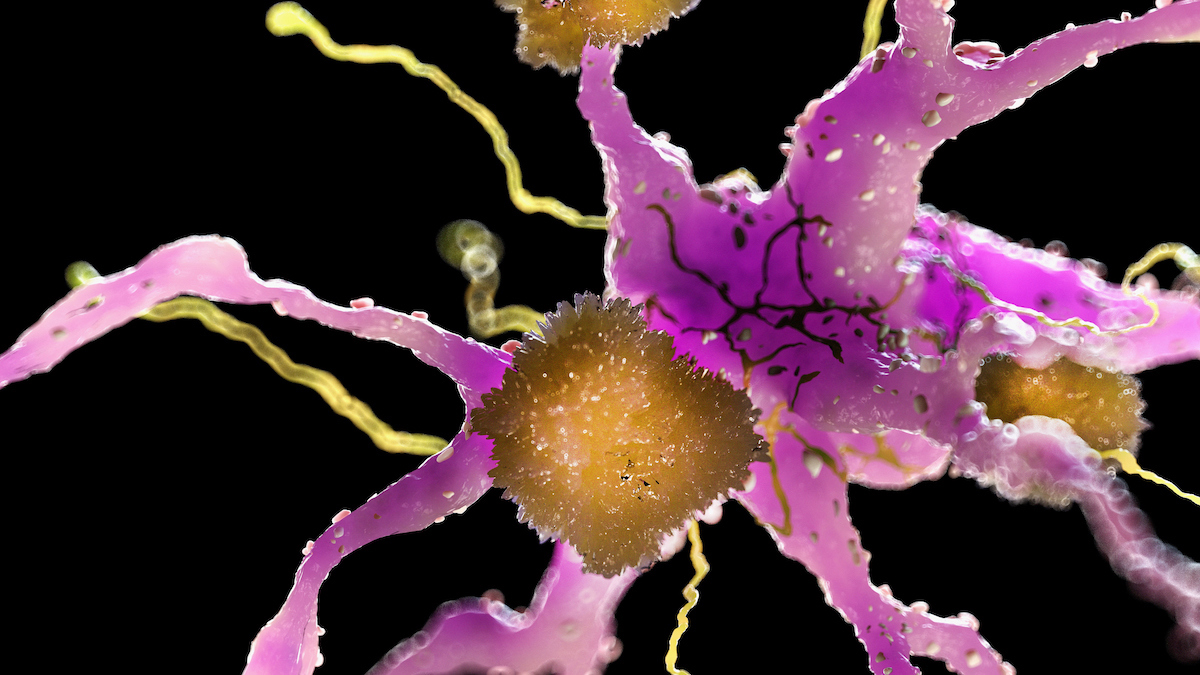
New Alzheimer's Treatment Clears Plaques From Brains of Mice Within Hours
Scientists have repaired a natural gateway into the brains of mice, allowing the clumps and tangles associated with Alzheimer's disease to be swept away.
ScienceAlert
143 points · by amichail · 1y ago · 115 comments
> The mice had previously shown signs of cognitive decline, but after all three doses, the animals performed on par with their healthy peers in spatial learning and memory tasks. The benefits lasted at least six months.
1. This is great news… for mice with Alzheimer’s that don’t mind treatments every 6 months.
2. It’s crazy to think about something like this actually curing Alzheimer’s in humans, even if for just 6 months. Even more so if repeated doses have the same effects.
3. As with all of these studies, mice != humans, but it’s nice to have hope.
Side note: the temporary part of #2 makes me think about The Last Days of Ptolemy Grey [1]. It’s hard to fathom having a relative “come back” like that for a short time. Or even permanently.
This resonates with me particularly strongly, as one of the many failures of my body is that I live with NPH (normal pressure hydrocephalus).
Almost a week ago, I had a spinal tap as a diagnostic test to see if I truly had NPH or if there was a different reason for the bubble of fluid in my brain. An hour after the tap, I felt my arms and legs moving more freely than they had in years, and I was able to move significantly faster than before. And now, a week later, I can feel the stiffness setting in again. I'm sliding my feet more, and I can't move as quickly.
I don't know how to characterize the sense of loss I feel. As my body returns to the pre-spinal tap "normal." I'm left with the fading sensation of a freer movement and a clearer mind, with the hope that one of the treatments for NPH will restore that better self.
I can only imagine, with a bit of horror, the sense someone would have coming out of the fog of Alzheimer's, feeling normal for months. Then the anxiety one might feel, as the Alzheimer's fog returns, and be scared that it might not go away again with the next dose—a real "Flowers for Algernon" moment.
I still need to talk to my neurologist to find out if I qualify for the CFS shunt/drain operation. It would be nice to have a clearer mind and freer body, even if I do become part Borg.
I wouldn't mind 10x a day injections if it keeps Alzheimer's at bay. Actually, I wouldn't mind a continuous IV drip.
There seems to be a much better way:
https://publichealth.jhu.edu/2025/small-amounts-of-moderate-...
"The researchers found that engaging in as little as 35 minutes of moderate to vigorous physical activity per week, compared to zero minutes per week, was associated with a 41% lower risk of developing dementia over an average four-year follow-up period. Even for frail older adults—those at elevated risk of adverse health outcomes—greater activity was associated with lower dementia risks.
The researchers found dementia risk decreased with higher amounts of physical activity. Dementia risks were 60% lower in participants in the 35 to 69.9 minutes of physical activity/week category; 63% lower in the 70 to 139.9 minutes/week category; and 69% lower in the 140 and over minutes/week category."
1. There aren’t serious side effects that make it more of a tradeoff
2. The price isn’t on the order of 6-7 figures (or possibly less for some)
And yes - I mean I would do that every 6 months.
I’m curious: Do you have any idea what care for such situations costs today?
As always, there's no guarantee that it will work IRL on Homo sapiens.
Let me tell you a story about a biotech startup that I worked at many moons ago.
- We were trying to develop new antibiotics to treat certain bacterial infections.
- We had created a new antibiotic that was chemically similar to an existing, commercially successful antibiotic.
- But our drug was ~2-4× more potent at killing certain pathogenic bacteria than the existing med.
- Sounds good for us, right?
- Well, the commercially successful antibiotic was also toxic to humans if administered for "long" periods (it causes severe anemia if administered for 20+ days [I may not remember the precise details here]).
- Therefore, we were concerned that if our drug was 2-4× more potent at killing the microbes, it might also be 2-4× more toxic to people.
- To obtain approval for human tests, we had to run toxicity tests of our drug using several non-human species. Those results were mixed (toxic in some species, non-toxic in others), but we did eventually get approval.
- Unfortunately, the original concerns were correct: our drug caused severe anemia within ~3 days (again, specifics may be wrong), which means that particular candidate died in Phase 1 (initial human trial assessing drug safety).
Thankfully, the severe anemia was reversible in our test subjects (stop taking the drug, and the anemia went away)
But they could give consent in advance.
If this horrific disease progresses to the point where ... I give my consent for ... Subject to final approval from family member/doctor/whatever.
That's not really an obstacle, people in those situations have family members consent for all sorts of treatment already.
Eventually they will be allowed and there will be a human trial. Not when they're still experimenting.
Just because someone has Alzheimer doesn't mean they're automatically a lab test subject.
Would you rather test it directly on humans?
Do you think they did it not caring whether it's also eventually applicable to humans all?
Do you think if the treatment reaches humans and is effective, and Alzheimer’s patient would "mind treatments every 6 months"?
Mice and humans are quite different, and whilst it looks like this treatment actually reverses the effects of dementia in mice, it’s far from clear that it would have the same impact on humans. By the time people start exhibiting Alzheimer’s symptoms, the brain will already have sustained quite a lot of damage - by which I mean death of neurons - so it’s hard to see how this would actually reverse the disease, as opposed to simply slowing or halting its progression, without these neurons being replaced.
Ideally I never get it, but if I do get I hope it's in like my late 90's, or even better by the time I get it they already have a cure, though the fact this might not work for humans makes me a little sad.
(Or was that the joke?)
the whole western field is 15-20 years behind because some researcher lied about plaque data and everyone spent all their time chasing the lead. I think you’ll see useful therapies in 15-20 years from the west, maybe sooner if all the some ai hype pans out.
or the Chinese thing turns out to work! can’t tell myself. there’s probably an American who will try it at some point and publish a case study. Very tough to judge Chinese papers..
here’s an overview: https://pmc.ncbi.nlm.nih.gov/articles/PMC12121576/
China has an actual medical establishment. The fact that the treat this as homeopathy should give one pause.
man that's a lifetime for this drug's trials.
I'm with you though. I know I'd want it more than the Alzheimer's.
But you can allow a proxy to make the decision for you via a lasting power of attorney.
A bit socialisation of health care for some but the benefits to the economy may well be worth the trade alone, never mind the individual benefits
[0] https://www.alzheimers.org.uk/blog/how-much-does-dementia-ca...
"If "x" % of the population has their life is extended an average of "y" years, how much more does that cost in pension payouts over the life of the individual vs the medical savings from curing Alzheimers?"