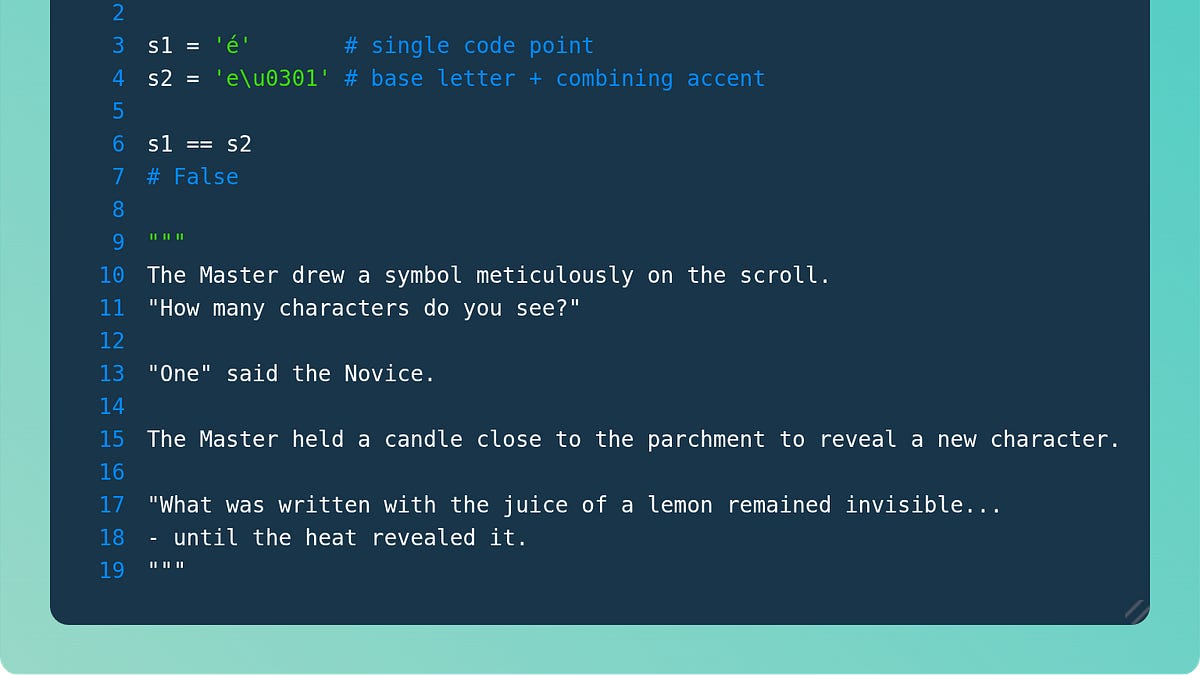
Koan 15: The Invisible Ink
Understanding Unicode equivalence and the deceptive nature of glyphs
pythonkoans.substack.com
43 points · by meander_water · 1y ago · 20 comments
By the way, try looking up the standardized Unicode casefolding algorithm sometime, it is a thing to behold.
in particular, the differences between NFC and NFKC are "fun", and rather meaningful in many cases. e.g. NFC says that "fi" and "fi" are different and not equal, though the latter is just a ligature of the former and is literally identical in meaning. this applies to ffi too. half vs full width Chinese characters are also "different" under NFC. NFKC makes those examples equal though... at the cost of saying "2⁵" is equal to "25".
language is fun!
Fortunately you can usually outsource this to a UI toolkit which can do it.
(Fonts may disagree on supported ligatures, for instance, or not support an emoji grapheme cluster and fall back to displaying multiple component emoji, or layout multiple graphemes in two dimensions for a given language [CJK, Arabic, even Math symbols, even before factoring in if a font layout engine supports the optional but cool UnicodeMath [0]] or any number of other tweaks and distinctions between encoding a block of text and displaying a block of text.)
[0] https://www.unicode.org/notes/tn28/UTN28-PlainTextMath-v3.1....
Why endorse a bad winner when you can make more of the trade-offs more obvious and give programmers a better chance of asking for the right information instead of using the wrong information because it is the default and assuming it is correct?
UnicodeDecodeError
With `bytes` it was obvious that byte length was not the same as $whatever length, and that was really the only semi-common bug (and was mostly limited to English speakers who are new to programming). All other bugs come from blindly trusting `unicode` whose bugs are far more subtle and numerous.
Python 3 introduced the bytes type that you like so much. It sounds like you would enjoy a Python 4 with only a bytes type and no string type, and presumably with a strong convention to only use UTF-8 or with required encoding arguments everywhere.
In both Python 2 and Python 3, you still have to learn how to handle grapheme clusters carefully.
https://docs.python.org/3/library/stdtypes.html#binary-seque...
"The core built-in types for manipulating binary data are bytes and bytearray."
Additionally, python2 supported a much richer set of operations on its bytes type than python3 does.