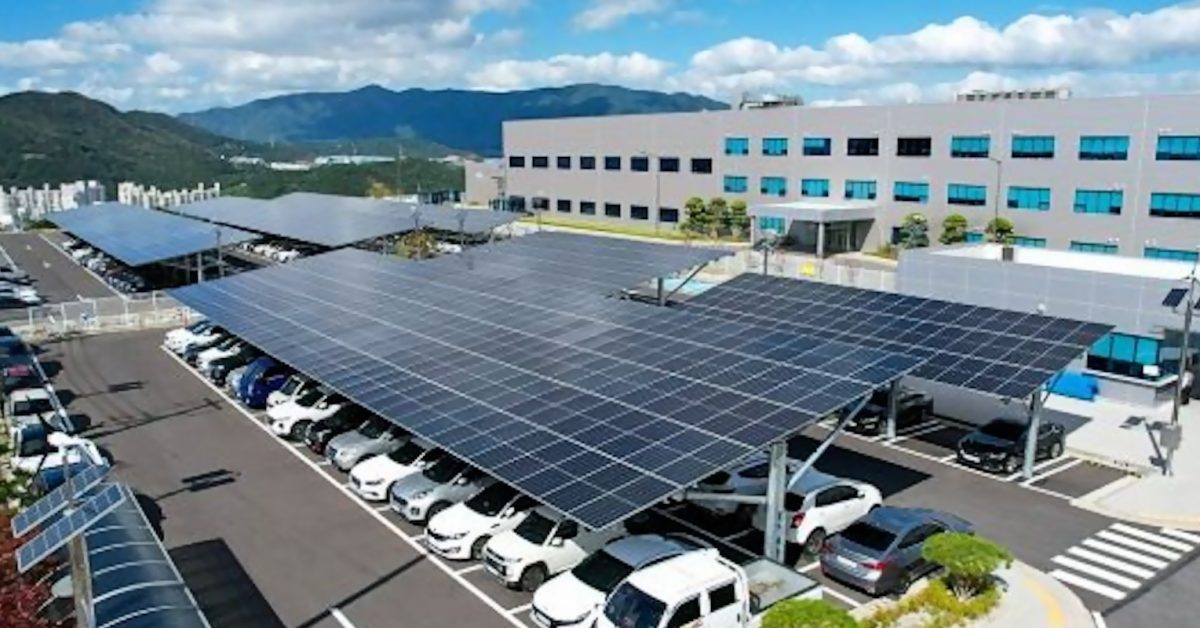
New national law will turn large parking lots into solar power farms
Starting this month, parking lots in South Korea with more than 80 spaces will be required to install solar canopies and carports.
Electrek
203 points · by thelastgallon · 1y ago · 171 comments
Parking lots are horrible. They're butt ugly heat islands that take up way too much space. While adding solar on them doesn't solve the last issue, it does help mitigate the heat island effect and solar panels are no less ugly than asphalt. Plus it is power creation right next to where it is being consumed for minimal transfer losses. It's also much nicer for the vehicles parked there to be in the shade.
Just because old school power generation is often out of sight, it shouldn’t be out of mind
In a free market, this leads to attractive conditions for batteries, and that is where the problem of base load begins: there is a lack of real demand, and base load then remains unused because its OPEX cannot compete with wind and PV.
There's just one problem. There is virtually no free and fair market in the electricity market. Utilities lobby very successfully for highly regulated markets to protect their monopolies. Nuclear power requires massive government protection from competition, which makes it attractive to utilities.
Everyone who has an electricity bill or pays taxes should be against new-build nuclear power because it is pretty much the most expensive way to produce electricity. You should instead lobby for wind, solar, and even closing coal power plants in favour of modern natural gas plants. All of those will cut more emissions, more quickly, per dollar spent.
Today I walked by someone dropping off people from his diesel VW Passat B6. You could smell that thing from afar and it bothers me that it's still considered roadworthy.
I'm actually pro-nuclear power, but the cooling towers are a pretty significant eyesore and a non-trivial downside. But apparently some people hate the way wind turbines look while I think they're sleek and futuristic looking, so taste as ever is subjective.
Hundreds of millions of people do, and their health would improve if they didn’t.
Are you?
There was a michael moore's documentary regarding climate change and I personally think that the best solution climate-wise speaking is probably nuclear but the whole world's sentiment is so regulated by lobby-ists which is why the cost of production of them and regulations shot up to an unreasonable amounts but the world was already transitioning to nuclear energies.
There are some new modular approaches to it which aren't as efficient but feel safer to the general public but nuclear is one of the most safest and compact sources of massive amounts of energy generation compared to solar and wind.
Nuclear Energy is cool.
Now am I right/wrong in saying this, let me know, I think I am right but I maybe wrong too, but its just that every expert I have seen on this topic really prefer's nuclear and my own "research" on this topic makes me feel the same really.
Somebody should write more clearly as to why nuclear is superior to solar and the others as a comment as I feel like I have written similar things atleast once more and maybe if there could be a nice website like why.nuclear or why-nuclear.net etc. which could give points of why nuclear is a superior form, it could be really great and I would love to hear more arguments both good and bad comparison with nuclear (primarily) and maybe comparing it with solar if somebody's an expert on this topic as I would love to hear an expert about it as well.
Better to replace some farmland, which you can make a strong argument for if you're growing crops for biodiesel or fuel-ethanol were the sun-to-wheel efficiency is terrible.
> Parking lots are horrible. They're butt ugly heat islands that take up way too much space.
I've got bad news about nearly black PV panels... it might be cooler under them, but around them is a different story.
My personal thought is to saturate rooftops before going for the poorer ROI parking lot PV canopies.
> Better to replace some farmland
South Korea is very hilly, farmland is too precious to replace with PV and I don't think they have been growing biofuel crops there.
Yeah, who needs to eat anyway? Lol it is perfectly fine to put this shit in parking lots. In hot climates, it's a benefit to customers to have covered parking. The wiring should be no more fragile than, say, power lines or lighting fixtures in the area. Parking lots are also better because it doesn't matter as much if water leaks between or around the solar panels. Putting them on rooftops tends to cause roof leaks and it presents problems for roof repairs.
>I've got bad news about nearly black PV panels... it might be cooler under them, but around them is a different story.
Higher temps around black PVs should be similar to black asphalt. Also, the thermal mass of the PVs is lower, so they will not stay as hot in the evening.
There are probably issues with PVs related to ice buildup and hail. They probably don't make sense in places with those issues.
> who needs to eat
You, uh, don't eat those.
Pedestrians too.
In winter I'd park my car at a train station and be sure to have the windshield pointed west so the car would be a bit toasty when I got in.
Hopefully this will be the sort of thing where we try different strategies quickly and pick winners and losers.
India has done a lot of work with covering irrigation canals with solar, and in some ways that’s a simpler problem so it makes sense that this is happening now instead of earlier. Big successful systems start as small successful ones. Maybe there is some substantial knowledge transfer that can occur there.
There's certainly no need for the support superstructure to need more pillars and members than your typical multi deck parking structure and while yes some have bad sightlines a majority are totally fine.
Matter of taste. But I find geometric rows of tilted rectangles much less noisy (visually) than a zillion random cars, or an acre of cracked asphalt.
Well, at least not so far.
Yes, but if you’re building shade canopies over the parking lot anyway (this is quite common in southern Europe, for example) the marginal cost to add solar to the design will be relatively small. And if the government is backing it, production volumes will rise so it’s no longer a niche product. Economies of scale.
And of course, once more people are using self-driving cars instead of owning their own, cars will have less idle time spent in lots.
Wait until you hear about public transit...
> Generally the problem with carpark solar is the mounting solutions are low volume niche products that cost way more than traditional ground mounts.
Not really. You don't need anything unusual, just regular flat panels. The main expense is building the canopy itself to conform to all the requirements for hurricane/seismic resistance.
Transit also destroys entire lifetimes worth of time every day by forcing people to wait or to suffer through inefficient routes.
That's why parking lots are the most beautiful structures in cities.
* Prevents being affected by grid blackouts
* Seen as progressive / eco by customers and ofc shade
* You've got captive demand - air-conditioning giant mall & food shops need industrial fridges
* Enough scale to do meaningful grid feed in
* Already have the infra to do generator switch over
* Access to financing and ability to plan over the 10 years or so that it takes to recover cost
I wonder how well the solar panels will stand up to hail.
Some parts of the interior of the USA will have very similar hail considerations.
https://reneweconomy.com.au/as-giant-hailstones-hit-the-suns...
Apparently in Australia climate change is making the hail bigger and more frequent.
You can't move the car protecting ones generally so it just comes down to making them tough and knowing your local weather, plus insurance.
Maybe the car insurance companies will cut you a check if you take the hit for them?
I have noticed though that they never seem to put them in flat. Always in quite an angle that doesn’t seem sun direction motivated. Usually v shape with car under each side of the v. Maybe thats for hail or possible to help rain clean it.
The best thing is that EV owners can be paid during the day for providing demand and paid again in the evening and at night for supplying.
On the home side, the hardware is largely there. The charger I'm buying and many others support it - though many need a future software update. On the vehicle side though, it's very inconsistent; there are only a few vehicles that support it and even for those, what my installer told me is that the manufacturer warranties typically either void the warranty entirely if V2(G/H) is used or harshly limit the amount of energy that can be used. They're concerned that it will lead to excess wear on the battery, the main component of an EV.
And I think I agree with them. With current battery technology, I don't think using EVs as a grid-scale storage system for renewables is viable. For grid-scale or residential storage, you want a battery that can be as heavy and physically large as it needs to be but it needs to deal with a lot of charge/discharge cycles. Your best option here right now is LiFePO. For the kind of EV people are generally willing to buy right now, you need to cram as much range into the car as you can, which means the battery needs to be as energy-dense as possible and charge/discharge cycles are less of a concern. That means LiPo.
I think the most realistic use of EVs for grid-scale integration is what they're calling "virtual plant", where they're treated like a separate source of energy that the grid can tap into in exceptional situations.
IIRC the most popular EV battery technology today is LFP.
But for EVs, the vast majority in EU/US is NCM/NCA. China is about 6 to 4 LFP to NCM, but China's EV market is about 2/3+ of the global EV share.
They’d wear out roads less, use less resources to make, be safer to others in crashes, etc. I dislike the trend of increasingly larger vehicles just to move a single person around 87% of the time.
It allows distributing load across more cells. It allows using cells with a lower C-rating, which typically have better energy density, and longer lifespan.
Distributing load reduces energy loss during charging, makes cooling less demanding, while allowing higher total charging power, which means adding more range per minute.
The excess capacity makes it easier to avoid fully changing and discharging cells. This prolongs life of NMC cells.
(but I agree that cars are an inefficient mode of transport in general)
I'm not so sure about less resources as the majority of the car is still required only smaller battery.
Seems a bit early to come to this conclusion, but I would also suspect, that the value of a parking garage full of EVs is not in providing energy to the grid but as a large scale consumer for load shaping.
How would this work? Who is then paying for the solar?
Wholesale prices went negative about 200 million times: https://www.bloomberg.com/news/articles/2022-08-30/trapped-r... (https://archive.is/nFsOk)
Regional clusters emerged, for example, in the Permian Basin in western Texas, and in Kansas and western Oklahoma in the Southwest Power Pool (SPP), negative prices accounted for more than 25% of all hours. Negative electricity prices result either from local congestion of the transmission system leading supply to exceed demand locally or due to system-wide oversupply. :https://emp.lbl.gov/publications/plentiful-electricity-turns...
Edit: This is called curtailment. It is now ~20% and increasing: https://en.wikipedia.org/wiki/Curtailment_(electricity)
I’m down about 18% capacity after 4 years of owning my current EV. It’s still plenty for my needs but I would be very disappointed if I saw this capacity drop much sooner or if it drops much more.
A replacement would be ~$15k and the cost of replacing the car would be a lot greater.
I’m very much digging the current strategy of grid-tied batteries and the myriad of companies working to re-use battery packs for grid batteries.
Basically you would haul (hopefully cheap) electricity form your work, to your home to use it in the evening.
I’ll believe that when I see it.
The new law requires the installation of solar panels in all *public* parking lots operated by the government. I checked this through local news sources.
In South Korea, there are already incentives to install solar panels on buildings, including parking lots. If you operate a solar power system with a capacity of over 20 kW, you can sell the generated electricity at prices higher than the market rate thanks to government support programs.
Despite these benefits, many parking lots in South Korea still do not install solar panels. This is mainly because, given the country’s high population density, most parking lots are located on land that is considered potential development sites. Once solar panels are installed, it becomes more difficult to change the land use later for development purposes, and the owners would also have to bear additional costs for removing the panels.
"build a conceptually similar, 657 kW solar carport system across 12 parking lots (shown, above) that delivers more than 1.23 million kWh of clean, emissions-free power annually and offsets the equivalent of 185,000 vehicles’ worth of harmful carbon emissions."
Not sure what that means but that doesn't seem right.
"Here in the US, we’re proving that out, too – the Northwest Fire District in Arizona partnered with Standard Solar to build a conceptually similar, 657 kW solar carport system across 12 parking lots (shown, above) that delivers more than 1.23 million kWh of clean, emissions-free power annually and offsets the equivalent of 185,000 vehicles’ worth of harmful carbon emissions."
12 parking lots
657 kW nameplate capacity
1.23 GWh per year of energy production
The 185,000 cubicles worth of CO2 emissions is likely based on average pollution per car, and average carbon intensity of the local grid.
I also did a double take, “surely it’s not 4.6 tonnes per year”. But it is.
If that came out as a liquid rather than a gas, we’d have stopped burning fossil fuels by now.
Great idea, where I live I'm pretty much maxing out the percentage of permitted structures allowed by zoning.
I could imagine that if solar panel carports didn't count towards structure limits, I'd build a carport across my absurdly large driveway :)
I think there are lots of "free" ways we could incentivize private construction of solar panels -- even without monetary subsidies.
Or we could even tax people for not doing it. In Denmark your land is taxed based on what it's zoned for, and how it could be utilized (not how it is utilized).
Either solar panels, or rain gardens, or permeable pavement, or canopy, or some combination.
But then again that might make loopholes that make my head spin. Might have to leave the higher rung up to organizations like LEED and leave the minimums as one or maybe two choices. Maybe make the other harder than solar unless you have a weird situation where say adding trees is simpler than running power distribution, like across the street from the shop.
1) EV chargers or 240V outlets in the garage
2) Heat pump water heater
3) Heat pump for HVAC
4) Induction stove
5) Solar panels, better yet, solar roofs
6) Main panel that supports V2X (vehicle to home, to grid)
7) Ethernet cabling throughout, we can make most devices PoE, also enable smart home
This can eliminate $ 1,000+ energy bills, which are now split between gas bills for two cars, natural gas for the water heater, heating, and cooking.
Those are already a large part in housing costs, and rooftop solar panels? That's both roofing work and installation of advanced electric equipment. And the market doesn't seem to have that many people who base their buying decisions on whether the house has solar panels installed.
Labor costs are going to stick around until we get humanoid robots to work well. But the permitting situation could sure benefit from a lot of regulation being purged.
It won't be enough to be self sufficient but it does offset a bit I guess
France has similar legislation.
https://www.pv-magazine.com/2024/11/18/france-publishes-new-...
Urban planning, too.
Alberta was the the fastest growing renewable producer in Canada due to high winds and long solar days and low cloud cover. The provincial government in the pocket of the oil industry banned renewable developments for months under the excuse that it was "destroying farmland" and then came back months later with a policy that hamstringed future development.
to these people, renewables are a threat because they can't be a parasite off it.
It's really not cool to insult people, you know. This is in just as poor taste as when smug Americans say "Europoors".
That's probably asking too much, though.
It’s effectively talking about people behind their back which is not that useful.
A term I don't think I've ever heard. Insulting America, on the other hand, is by orders of magnitude the favorite sport of the Internet.