I analyzed 180M jobs to see what jobs AI is actually replacing today
Last Updated: June 17, 2026What impact is AI having on the job market? Everyone has an opinion, but…
Bloomberry
200 points · by AznHisoka · 1y ago · 149 comments
Without those data this report isn’t really quantifying impact on “180M jobs.”
Also for a lot of jobs in security it's pretty hard to measure how well it's being done, so if the AI based solutions are worse, that might not show up for a while
Nothing going wrong: “What are we paying you for?”
Everything going wrong: “What are we paying you for?”
It’s a no-win situation unless you manage to score a division manager who understands security and understands the reports a good security division produces. And most importantly, understands that no news is good news.
Cost centers in businesses are early canaries of expected pain, and a reduction in security roles may reflect belt-tightening irrespective of AI impact.
Time for budget cuts? Cut the Security team!
Security is a process. It's not a constellation of products or certifications.
* Engineers are being pushed for ownership of security more directly. You still need someone on the team to guide and support them, but they're not going to be directly involved all of the time.
* Significant amounts of automation and centralized security. Supply chain management is a double edge sword. It does open up vulnerabilities, but you can simply pay one of the SaaS companies in the space to help with a lot of the heavy lifting.
* Commoditization/Platform-ification drastically reduces attack vectors.
OWASP has a nice comparison from over the years: https://github.com/OWASP/Top10/blob/master/2021-2003_Compari...
I'm a security consultant and work with multiple companies that provide security services. Work has increased massively in the last year.
Taking two years and drawing conclusions from those two years seems to miss larger pictures - especially when the mess of Covid and the pandemic years and that job market is mixed in with this. Yea, that's half a decade back but companies are still trying to figure out how much staff they need where.
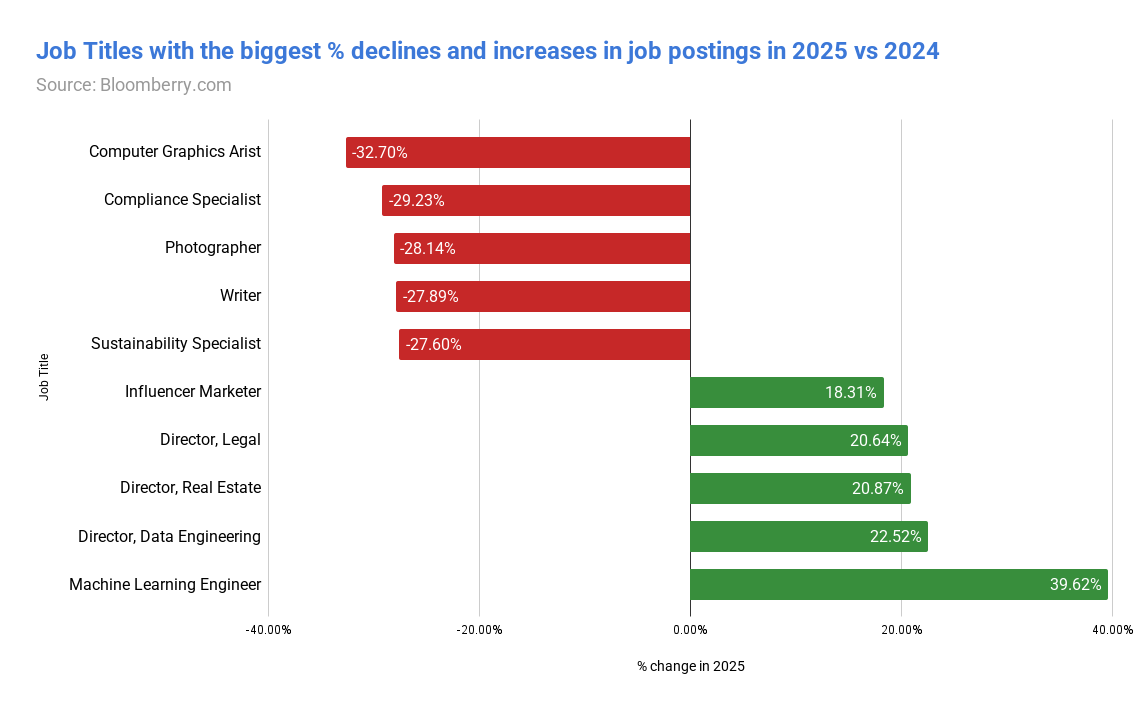
Photography? Yes, that's likely been impacted. Compare https://web.archive.org/web/20230124085038/https://www.bls.g... and https://www.bls.gov/ooh/media-and-communication/photographer... and the rate of growth has changed. However I'll also draw attention to the estimates that there's only a few thousand open positions with that classification each year. This includes self employed stock photographers and artists - corporate photographers have been a hard thing to get for a much longer timeframe (I looked into it a little bit back in '09). Additionally, artistic photography is impacted by the amount of money that regular people are willing to spend at art festivals and the like - that's gone down irrespective of AI.
This subset is not perfect, but good enough.
Meanwhile the amount of accounting that has to be done is pretty inelastic. Whenever accounting gets more efficient you just reduce the number of accountants instead of doing more accounting
Creative is somewhere in between. Not completely static demand, but not extremely elastic either. The healthy rise in postings for creative directors indicates that the cost reduction has lead to more art being done, but the increase in demand isn't big enough to offset the job losses in the rank and file positions
Until Software Engineers have automated away all the other jobs with AI & software they'll be safe. That's going to take a long time.
Replacing software engineers with AI only affects the bottom line of software companies. Companies are usually fine with increasing the bottom line if they can exponentially increase the top line. I think software engineers will provide that capability for at least the next 10-15 years.
Even without outright layoffs one can see how fast leverage of average IT engineer is disappearing. After 20 years of experience my value or feedback matters less than when I was 4 years into paid job. And it has far less to with AI so far.
Most custom work of past is just a library, component or framework to use. And those are mandated to be used as it much easier to hire/replace teams to work on those.
Now It may be always be true to have reusable components created but growth of IT industry kept people employed in ever greater numbers. However now it seems to be reaching limit. Leaving aside highly visible layoffs by US tech giants, growth is fading in countries like India with huge IT offshoring workforce. There are millions upon millions jobless fresh graduates waiting to get jobs with some IT degree.
Hard disagree here. Anecdotally, know a few people who can't write a Java program that will compile, who can leverage ChatGPT to produce functional websites.
A good friend of mine ChatGPTed his way into a masters degree that involved a lot of coding. A good 97% of his degree was done by AI, and the other 3% was me helping him troubleshoot he couldn't get AI to solve.
LLM is vastly different from a compiler/translator. Despite the joke, you can't just fire up Python with import website and have a functional website. But you can basically do that with LLMs, which will then add features as requested. It's not perfect, nor guaranteed to be functional, but it is quite a bit more capable than a compiler is for such tasks.
At my work, the sales guys are using AI tools to rapidly prototype features on our website with prospects. While it doesn't do all the work, it can produce useful HTML templates that the front-end team can make functional.
But what about pay? Elevator operator jobs have never been more prevalent, but increased accessibility to the layman pushed the price to zero.
When using a pen you become a poet ? lol
Most people who code aren't software engineers, you certainly can't extend the definition to every AI users
No. By definition, a poet writes poems. Not all pen use leads to poems.
By definition, engineers build systems. What else can you do with code (and LLMs; same thing) other than build systems?
No. You do not. It may make you a developer, at best. I don't even call my self a software engineer, because I'm not. I'm a self taught coder that has spent 25+ years gaining experience, but I've never graduated from a school with any kind on engineering degree. I started CSE way back in the 90s, but stopped because life got in the way.
Maybe you're joking, but you just know people actually feel this way. They have no idea the difference of a coder and an SWE, and flippant comments don't help
So? Per the dictionary, engineer is clearly defined as: A person who designs, builds, or maintains machines, structures, or systems. There is no mention of school or having an engineering degree.
It has always been a bit debatable if software fits into machine, structure, or system, granted, but we generally have come to agree that it does. And per the context of discussion, we've already established that it does for the sake of discussion. On that understanding, designing/building/maintaining a system in "LLM code" instead of C++ code is fundamentally no different.
You're likely confusing engineer with Professional Engineer™, but that's something else entirely. That obviously has nothing to do with anything that we're talking about here.
Stopped reading.
VR flight simulator software is accessible to the layman. Does that make them qualified to be a captain (pilot-in-command) for a commercial passenger plane?
No. They might be able to fly a plane poorly, though. Engineer doesn't imply being qualified, only engaging in the act of designing, building, or maintaining a machine, structure, or system. You don't have to be qualified, or even be good at it, to carry out those acts.
You're probably thinking of Professional Engineer™, which does represent recognized qualifications, but that's something completely different. Obviously if Professional Engineer™ was meant, Professional Engineer™ would have been written.
Further even if you have some strict ACM/IEEE definition of Software Engineer®, a person is not going to end up in jail if they don't fulfill those but call themselves software engineer nonetheless.
My observation so far is that micromanaging AIs still sucks
Doesn't this also suggest that the job market is in such an unusual state, that any further analysis makes little or no sense?
Maybe Apps are less of a priority now?
I'm not familiar in this industry so someone help me out here
Frontend code can be very repetitive / labour intensive, I bet that has made this more attainable than for other layers in the stack. Most mistakes in UI code are also easily corrected and have a very tiny impact radius.
I got a new job recently and my main task has been overhauling a Claude generated app into something functional. The backend is an unsalvageable disaster, but the frontend is actually pretty good. Which is great for me because I suck at UIs.
I think if you have a solid backend already in place, an LLM can produce a pretty functional frontend with far less effort to fix up.
Backend code is far less likely to be available because it's more likely to be closed source and is spread over many languages (Java, Python, C#, JS, Ruby, Go, PHP...).
Uhhh... That's a very big issue. In addition, there is also a glaringly obvious analysis error here related to layoffs/attrition.
No offence but is this analysis vibe analyzed or something?
All this is actually measuring is how the number of job listings in a specific industry have changed globally. That's not the same thing as "what jobs AI is replacing" at all!
Like nurses decreasing 11%. There is 0% chance that AI is disrupting nurses. If anything, nursing is probably in more demand due to continual aging. It might just be that fewer people are quitting because of covid being over. The total number of nurses might be going up still!
Are we just upvoting anything with AI in the title now? HN used to be pretty respectful of scientific methods. The methodology section here just reads like personal resume filler for showing that you can use AI. I mean I get it and I admire the hustle, but the quality here is pretty lacking overall. https://bloomberry.com/blog/i-analyzed-180m-jobs-to-see-what...
https://emusings.substack.com/p/is-automation-going-to-eat-y...
The first graph you show is missing the corresponding table from the source which shows the exact opposite of what you have stated: the workforce had been steadily increasing until ~2019 and is in decline since then. Not massively but still it contradicts what you stated. Next you switch to Korea and the wage increase without aligning a corresponding price increase or adjust for inflation. Then you switch to the history on the industrial revolution. At that point I gave up because I know the point you are trying to make and I can see, you adjusted your samples to match that point.
If you have additional data, I would be grateful for it and I will amend my article.
O’NET taxonomy is better for this task, IMHO.
I doubt they have this data. I highly doubt they have this data.
It's just that 180M seemed a bit high.
10x more than this one (also yours): https://bloomberry.com/blog/how-ai-is-disrupting-the-tech-jo...
Btw. I'm not arguing about the quality of your posts, which I consider really good :).
I analyzed the data, only ~100M job postings. There's a lot of repetition (some jobs are posted as much as >10 times).
The actual number of real, unique jobs in there should be on the order of 10M and I'm being generous.
Thanks for sharing your work.
While consumers are generally receptive to assistive machine learning like speech recognition, translation, limited auto-complete I think there is a huge backlash towards it being used to generate content and as far as I know all the major AI companies are losing huge amounts of money with every transaction. I am sure AI is being widely used as a reason for staff reductions but the reality is more likely sales are down, costs are up and head count is too high for current business requirements.
Meta, Alphabet, and Oracle are even issuing almost $60 billions in bonds. Unheard of.
I was under the impression Big Tech is cutting jobs across the board, all regions.
Google announces $15B investment in AI hub in India https://apnews.com/article/google-artificial-intelligence-vi... (3 weeks ago)
[Indian] ex-Accenture CTO named Google Cloud’s Chief Product https://www.hindustantimes.com/trending/us/who-is-karthik-na... (last week) (a lot of people speculate they named an Indian Accenture guy to move as much as possible to India)
Big Tech giants defy US-India trade tensions, record strongest 12-month headcount growth in India in 3 years https://www.moneycontrol.com/technology/big-tech-giants-defy... (September)
https://www.reuters.com/world/india/openai-launch-first-indi...
https://www.anthropic.com/news/expanding-global-operations-t...
...