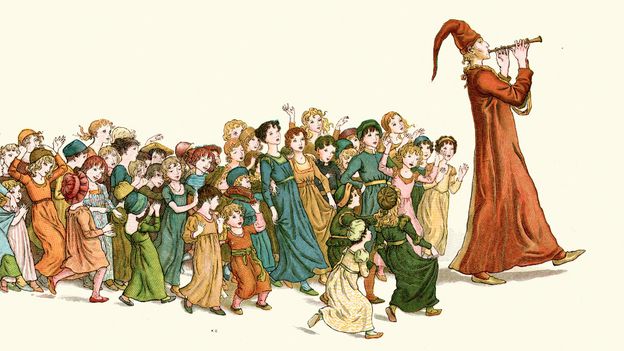
The grim truth behind the Pied Piper
Writers like the Grimm Brothers and Robert Browning may have shaped the Pied Piper legend into art, but it turns out the story is likely based on an actual historical incident.
bbc.com
109 points · by Anon84 · 1y ago · 99 comments
It seems much more plausible that e.g. children emigrated as adults to another region (as mentioned in the article) and the old-timers who stayed behind lamented the 'loss of their children' so to speak; when the history was recorded in town records, it's unlikely that any of these old-timers or children were around. Hundreds of years of historical layering, where the most interesting version of the story is the one that is reinforced likely explains the mythological nature of the tale.
But what do I know? I suppose it is curious.
In short the town screws the piper for his work with the rats, in what looks to be an act of greed and arrogance by the town leaders, likley even having done this before (tales of exploited contractors are easy to find even to this day).
But the moral was in the way the piper responded, shockingly and surprisingly taking off with (per the plaque) some 130 children at midsommer no less.
It’s a little abstracted here as the article doesn’t start with the legend (of course cause it’s so famous); but I think the historical reframe to draw from this is that after not being paid for his work removing rats he “takes payment” by recruiting 130 children and taking them to settle new lands (being paid then for the provision of the children to the settlors).
I think for those interested in the histories, it somewhat solves the mystery and clarifies how the piper was paid in the end. The beauty of the narrative and the core moral of the story remain. And likely this story is still relevant for us today.
Make good on your promises especially around payment lest the other party takes payment in other ways, with possible costs that you never first considered.
I mean if you could it would be handy to automate it in large cities even today, no toxic poisons.
I’m not sure what evidence there is for that part of the story. It could be a tale as others have posted as to why the town lost so many children.
As to why, the article asserts the scenarios of forced migration for settling new areas, or perhaps a "childrens' crusade" to the war in the Middle East.
100 years later is actually pretty damn close all things considered! For comparison we have contemporaneous inscriptions and epigraphs attesting the existence of alexander the great but the earliest surviving accounts of his actions are from 200-300 years later. It can be the dedicated work of a scholar's lifetime to pry a handful of verifiable facts from these second- and third-hand, biased, incomplete accounts. But the lifetimes stack up and the guesses come into focus as knowledge.
This is true, but those surviving accounts quote or paraphrase contemporaneous accounts from his generals like Ptolemy and others that have since been lost.
My family has far more trivial information passed down orally that is way older than 100 years.
Humans have a context problem. We all insist ours is the best culture; whereas, all culture is a lie which only persists in the retelling.
In that sense, we Westerners have a long, long way to go to catch up with the aborigines.
The Spanish flu is a great example of that phenomena. It's hardly mentioned in history books yet we had a flu season where people were dying in the streets. Very shortly after it happened, people stopped talking about it or mentioning it.
COVID is looking like it will very much turn into the same thing.
These are massive global events that may only get small blubs 100 years later. Now imagine an event that happens in a localized area. How much of that event will get carried on or reported?
You also have to remember that in the 1200s, things like paper and ink were a lot more expensive than modern paper. That's part of the reason literacy rates were a lot lower.
This is wrong. It is 4 generations.
https://en.wikipedia.org/wiki/Generation
« the average period, generally considered to be about 20–30 years, during which children are born and grow up, become adults, and begin to have children. »
> a great example of that phenomena
This is wrong. "Phenomena" is plural. The singular is "phenomenon."
> It's hardly mentioned in history books
Because it is living memory for a small number of people.
"Spanish flu" is widely remembered, and just 4-5 years ago thousands of articles were published comparing the measures taken a century before against a pandemic.
> small blubs
I think you meant "blurbs", as in "short informal pieces of writing", and it's a poor choice of words anyway. "To blub" means to cry.
https://www.collinsdictionary.com/dictionary/english/blub
These repeated errors strongly weaken your argument, and suggest that despite your confident tone you don't know as much as you think.
Meh, the feast day of two saints. Pretty much any day of the year. Today is the feast day for Saints Bertille, Zechariah, and Elizabeth.
They had to a greater or lesser extent, fairs, games, dances - they were literally festivals. People looked forward to and prepared in advance for feast days. There are at least 2 things that I think are relevant: firstly feast days punctuated and delimited the calendar and people's lives and secondly feast days were very memorable shared whole-community events.
This doesn't necessarily make the story more believable but it can make it more memorable. Think of a story where it says "it happened at Halloween and again at Christmas" and it could just help fix that story in a specific time making it more memorable in our brains.
Subsidence farming is a brutally demanding, painful way to scrape a living. Even with modern technology, it can't be overstated the sheer amount of labor it takes to grow enough food just to feed yourself, and that's without owing an obscene portion of your product to your "landlord" (who's also your employer and your local government, and can forbid you freedom of movement and dictate your personal life).
Laundry was an immense amount of labor. Keeping the home intact took labor. Maintaining your clothes took labor.
Look up the the BBC historic farm series if you want an idea of the amount of work it takes to actually run a farm, without any of the extra problems actually living in that period would bring, such as not understanding germ theory and sanitation, unreliable access to clean water, no real medical care, no real birth control, and no defense against a bad season just breaking your back.
The grim truth behind the Pied Piper - https://news.ycombinator.com/item?id=24450760 - Sept 2020 (23 comments)
It's just that readers are often curious to look at past discussions. Sometimes I point that out: https://hn.algolia.com/?dateRange=all&page=0&prefix=true&que....
Is it that 'pied' is or was less specific and can mean patches of any colour, or is it that the English name is a bit lost in translation?
I do remember him wearing brightly colored patchwork clothing in the stories, but I could not say if that was an integral part of the original fable or just added in retellings to make the character stand out more as a mysterious stranger.
I grew up around Hameln and can confirm, that is how he is depicted.
Also a depiction of him from 1592: https://de.wikipedia.org/wiki/Rattenf%C3%A4nger_von_Hameln#/...
So it is part of the fable.
> Udolph favours the hypothesis that the Hamelin youths wound up in what is now Poland.[40] Genealogist Dick Eastman cited Udolph's research on Hamelin surnames that have shown up in Polish phonebooks
https://en.wikipedia.org/wiki/Pied_Piper_of_Hamelin
Also, every town in Southern Germany looks like that. Hamelin is nothing special in that respect
> In fact, Udolph found that the family names common in Hamelin at the time show up with surprising frequency in the areas of Uckermark and Prignitz, near Berlin, that he locates as the centre of the migration.
Maybe try reading the whole article before condemning it, instead of just the first couple of paragraphs.
Strange thing to note (and wrong), given they have completely different purposes and the BBC article conveys "actual information" as well just in a less clinical way.
That whatsit phenomenon strikes again!
I wonder if there was or will be a typical modern twisty-take movie about this
He is referring to the Baader-Meinhof-Komplex book, that pretty much documents the RAF https://en.wikipedia.org/wiki/Red_Army_Faction
There are many theories, one of them is the Children's Crusade[0], diseases, pagan sects, but yes, the leading one is the "Ostsiedlung".
[0] https://en.wikipedia.org/wiki/Children%27s_Crusade [1] https://en.wikipedia.org/wiki/Ostsiedlung
Could just be that it’s a very inconvenient consonant cluster (and and a speaker of modern English will to some degree turn it into a [lən] or [lɪn], however you spell it).
"Eine andere, weniger stark vertretene Theorie besagt, dass die Hamelner Kinder einem heidnischen Sektenführer aufgesessen sein könnten, der diese zu einem religiösen Ritus in die Wälder bei Coppenbrügge geführt hat, wo sie heidnische Tänze aufführten. Dabei habe es einen Bergrutsch oder Erdfall gegeben, wodurch die meisten umgekommen seien. Noch heute lässt sich dort eine große Kuhle finden, die durch ein solches Ereignis entstanden sein könnte." > https://de.wikipedia.org/wiki/Rattenf%C3%A4nger_von_Hameln#H...
I'll roughly translate it:
"Another, less thought after theory says, the children of Hameln got seduced by a pagan cult leader. He lead the children to the forest of Coppenbrügge for a religious ritual, where they performed pagan dances. This caused an landslide, causing most of them to die. There is, to this day, still a large pit, that could have been caused by such an event."
Edit: Expanded translation
It's all about the angle. I am sure that just outside of the camera frame, there's a mobile phone shop, a Burger King or MacDonald's, and other trivially universal city commerce. :-) Let's see...
https://maps.app.goo.gl/hbRSXaDvfKNFmQtT6
No, but there's Rossmann, Kik, Döner, and Woolworth's.
> Also, every town in Germany looks like that.
> Well, I looked it up. It's about a predatory flautist who murders children in a cave.
This passage doesn't make much sense to me, given that Saxony had been converted around 800 CE. What could "local Christian faction" even mean when everyone was (nominally) Christian?
A propaganda phrase that ruins the end of the article.
Early discovery of MDMA.
It is a literal account of a real life tragedy.
https://en.wikipedia.org/wiki/Dancing_plague_of_1518
Is this when they invented the Harlem Shake?
I hope this AI generated