Why I Stopped Being a Climate Catastrophist
And why so many climate pragmatists can’t quit catastrophism
breakthroughjournal.org
79 points · by paulpauper · 1y ago · 109 comments
I would consider all of these to be "catastrophic" but some may not consider migrations + damagaes to be "catastrophic."
So what will happen if that gets disrupted? And badly disrupted, while at it. And while that is happening, multiple other things pile up in different ways everywhere?
Thats the danger. You don't die from climate change. You may occasionally die from increasingly frequent extreme weather, a flood because rains, some dam break, extended forest fires and so on. But that is not a single catastrophic event that kill billions. What will kill billions are losing food security in big scale, no safe/climate controlled place to live, violence and wars, widespread diseases and no way to help. In some years to decades millions to billions may die by that combination of factors.
So no, it wont be a single day, sudden event that will kill billions. Is the breakup of the system that holds it together. Agriculture needs a stable climate, megacities need food, the economic system depend on more things, and everything else is packed together. And the first wave of deaths will be just the start.
Really underestimating the amount of deaths that will occur when our food production systems start collapsing.
I have not seen evidence that there will be food system collapse driven by climate change that would be worse than those events, but my ears are open if you have some.
The higher global average temperatures alone are already a yearly catastrophe, by this standard.
I think you’re showing a lack of imagination. The COVID shutdown was not that long ago. People lost their minds when they were asked to wear a mask in public.
All you need to do to make a “catastrophe” is imagine the trauma response played out over shorter and shorter time periods.
Now take the speed of natural disasters measured over hours and days. Recovery time over months and years.
Now pile multiple such events back to back and dispersed across the nation.
You will have a Tipping Point where public opinion and suffering overwhelm any attempts by government to restore order with a speech.
Finally, Marshal Law and empty stores.
There you go. Have a nice day.
Unless AMOC collapses and we foolishly trip into another glacial period, the 200ft increase in sea level is inevitable in the next thousand years, but totally manageable for the continents. It's the oceanic mountaintops, aka, low level islands, and coastal cities that are at risk. Most of those cities are already filled with happy rich people who will have been long gone decades, or even centuries before Florida and Bangladesh are submerged and Russia, Australia and Canada are booming with happy with abundant rainfall, crops and awesome weather.
It just seems like focusing on ameliorating pain and focusing on the making the inevitable a better outcome is the most important focus for the next few decades.
These underlying assumptions being incorrect are the reason climate alarmist move the goal posts every year.
Most others in the climate science debate have been far more realistic and measured. Similarly, I tend to ignore everything from David Wallace-Wells, another person who has written a ton on climate but from a very different political perspective, who has also been quite wrong.
How about explaining why he is wrong? Don’t just respond with incredulousness and generalizations and assumptions.
One of the funnier points in this word salad is when he casually dismisses AMOC collapse without giving any real reason why then “trust me bro.”
What pragmatism?
Perhaps I read it wrong, but isn’t he basically suggesting that he will be relying more on the observed effects of climate change as compared to predicted rather than just adopting the theoretical predictions as his driving POV? That’s literally the definition of pragmatism.
> Climate science largely disagree
Climate scientists may largely disagree, but not all do. Shame that it also apparently needs to be stated here that science isn’t a democracy that is subject to popular vote. When observed effects don’t match the predicted effects, it really doesn’t matter much if climate scientists disagree with the observed effects. Actual data is actual data and should be considered even if it doesn’t match your model.
An expensive liability? Definitely. A civilization or nation ending event? Unlikely.
I fully expect no workarounds will be done just like Climate Change Mitigations. Getting off fossil fuels should have been seriously started 30 years ago, and maybe even 50 years ago. Instead the politicians have been adding hot air talking and fighting instead of doing real work.
We are now seeing this repeat with "engineered workarounds", no one wants to pay for it, so yes I call BS on the article.
All I can say is I feel real bad the past generations did nothing to really reverse CC, people being born now are looking at a very bleak future.
The sooner we start, the cheaper it will be, so we shouldn't put it off, but it's not going to kill everyone or even convince everyone to leave NYC in the foreseeable future.
If you draw the line at the year 2100, things are uncomfortable but maneagable. If your horizon is 2300 or 2500, you get a different story. But you would hope that in tha sort of time frame, we have time to adapt.
Would Canada be able to build a seawall to protect Vancouver? I am not sure.
[1] https://www.cbc.ca/news/politics/trudeau-announces-high-spee...
What causes this climate change, how much infuence humans have on it, and how much we could possibly do about it is unclear.
That's not a reason to not do anything about it, but there's also no reason to be super intense about it.
Earth's climate has been stable during the rise of human civilisation. It has changed more in the past 100 years than in the past 200,000.
It's true it's changed often over the course of the 4 billion year history of the pkanet. It's not true to claim it's fluctuated wildly over the course of human civilisation.
> What causes this climate change, how much infuence humans have on it, and how much we could possibly do about it is unclear.
False.
It's clear the cause is the increased insulation factor of the atmosphere. It's clear this change has been in the majority due to human activity dragging up millions of years worth of past captured C02 via fossil fuel extraction.
> That's not a reason to not do anything about it,
Naturally, because as stated it is false to claim the cause is unclear.
> but there's also no reason to be super intense about it.
Sure. It's true that no one alive today in a G20 non equatorial country need fuss much about it - all the real serious consequence will fall after their lives have passed.
I don't think so.
Look at sea level: 125,000 years ago, sea level was 8 m higher. 20,000 years ago, sea level was 130 m lower. [0]
So over the past 200,000 years sea level has varied ~ 138 meters. It hasn't varied that much over the past 100 years.
I'm not so concerned about disasters or economic impacts, I just have a deep moral belief that we should leave our environment the same as when we entered it. We know that fossil fuels release pollution that we have no technology to clean up. We we should not be using it. It's not rocket science.
Admittedly, it makes no rational sense go without today so that future humans can experience the earth in the same way I have. I understand why many people dismiss risks of things unlikely to effect them or their children, but to me to feels wrong, and I would like to have as little impact on the climate as I can.
https://wmo.int/news/media-centre/wmo-confirms-2024-warmest-...
Holocene extinction - Wikipedia https://en.wikipedia.org/wiki/Holocene_extinction
That is, if there are any people in 3000. Nuclear war is still the number one problem. AI is a candidate for number two right now; the next decade should clarify things.
The irony is that without them, you (wherever you are) and I (wherever I am) could not be trading messages. Every bit you send and every pixel lit has a fossil fuel cost associated with it.
Our world 100% runs on fossil fuels and right now there is no alternative that rids us of them that can be made without them. No replacement technology can be developed that won’t employ fossil fuels even further to excess in its creation. So “not using it” is not an option. Cutting back is not an option. The only way to replace them is to extract, refine, and burn more and hopefully that investment can be the one that gets us the returns we need to hopefully one day eliminate our dependency.
But what about the year 2200, or 2300? At three degrees warming per century, the earth looks like a pretty hostile place to live in a few centuries.
"A society grows great when old men plant trees in whose shade they will never sit", and all that...
I care, in my comfortable life as an office worker, about the fact that chocolate, coffee, and wine will become luxuries as yields and quality drastically drop off.
I care about the fact that many places I visit frequently will need A/C to be _survivable_.
Those are not civilization-ending events but the hubris you need to have to just hand-wave this away are beyond my understanding.
In fact I suspect that Gates would be dismissed as too woke for making this one of his main points:
> But we can’t cut funding for health and development—programs that help people stay resilient in the face of climate change—to do it.
> It’s time to put human welfare at the center of our climate strategies, which includes reducing the Green Premium to zero and improving agriculture and health in poor countries.
This is just rehashed Green New Deal language for the global stage. (Something I fully support!!)
  Nordhous: "The amount of warming that is conceivable … is not remotely consistent with the sorts of catastrophic outcomes … where tens or hundreds of million, perhaps even billions of lives were at stake."

Gates: "Although climate change will have serious consequences — particularly for people in the poorest countries — it will not lead to humanity’s demise."We've known for almost a decade now that the RCP8.5 scenarios are no longer on the table, and even that worst case scenario wasn't civilization ending.
I read Bill Gates' note as not an evolution on his view at all, it seems 100% consistent with everything he has worked for, but rather trying to place climate change in a more humanity-focused context for evaluating tradeoffs of where to put money. That's very important for governments and for wealthy philanthropists like him, and for the COP 3 audience he's talking to.
my favorite was getting told we "deserved it" for being in Texas during the ice apocalypse, because Texas is a red state.
I hope that people exhibiting that kind of behavior are finally starting to question whether or not it's helpful. The article suggests that is perhaps beginning to happen.
If you want people to make sacrifices to improve the future, just maybe messaging that it's hopeless and anyone who doesn't see that is stupid isn't the best strategy for effecting real change
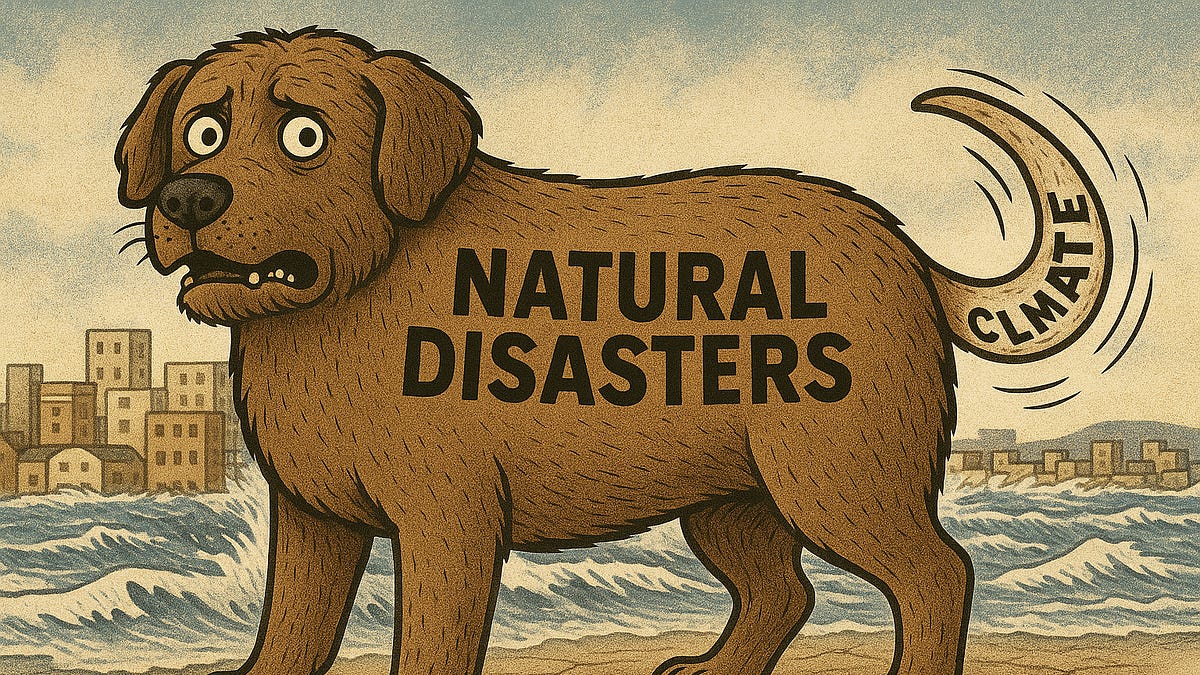
Why would a serious author go with this image? Just a few years ago, misspelling "climate" and having nonsensical political cartoon to headline your article would have just been disqualifying.
Queue the “always have been” meme.
Of course people could feign intelligence before, but it's much easier now and our standards are lower. This is a double whammy.
A. Have some relevance to the actual content.
B. Don't exhibit glaringly obvious AI flaws (polydactyly, faces like melted wax candles, etc.).
It's amazing how little time people take to vet images that are intended to be the first thing viewers will see.
Reminds me of the image attached to Karpathy's (one of the founding members of OpenAI) Twitter post on founding an education AI lab:
"The economy will be fine"
True Idiocracy moment....
Life is a co-op, winning does not mean being the last ones left standing.
I look at these 'climates changing" and see absolutely no problem at all. Looks like an improvement to me. How can we go about speeding up this process?
Holocene extinction - Wikipedia https://en.wikipedia.org/wiki/Holocene_extinction
Great place to start with flames.
>This won't be a nice change of pace for your climate. It will be a mass extinction even humans have never experienced. It's obscene even.
The science clearly says that isn't the case at all. Feel free to reference IPCC RCP8.5 scenarios where we magically find extremely more fossil fuels and burn those as well. No extinction is expected even in those scenarios.
https://en.wikipedia.org/wiki/Eocene#Climate
The eocene was approximately 14celcius warmer than it is today and life thrived.
https://en.wikipedia.org/wiki/Last_Interglacial
During the last spike, the eemian, it was about 2 celcius warmer than today. Roughly 100,000 years ago, and that's roughly all we do expect to happen now. Life was thriving.
Yes, because life can adapt in 100k years at a rate that it cannot in 100 years. And that life did not particularly care for preserving thousand-year-old human settlements.
> Great place to start with flames.
I am not the OP but if the point above flew you by then consider how much you have thought about the matter.
The interglacial warming is the most likely origin of the catastrophic global flood mythos across many cultures (including the Bible). And involved a scale of mass migration and suffering/death that would make modern sensibility recoil.
Your argument is like if I burned down your house or community but stated "well the forest will reclaim it in 10 thousand years and it will be beautiful and full of life! Is anything really even different on the grand scale?"
I care about the immediate future. And all the suffering and death, and the animals and plants that coevolved with us and ARE our evolutionary environment.
It's absurd and either supremely ignorant or bordering on malicious anti social behavior . The paradox of tolerance is being pushed to its limit.
Lucky for your conscience the world doesn't give a shit about global warming, nor your realization that you can't do anything about it
Of course the world is fucked
After 25 years of dire, ‘existential’ warnings, the political messaging is beginning to taper off and moderate.
It’s a necessary step. If you tell people the worlds about to end for too long, you lose credibility with all but the true believers.
Apologies are due to everyone that was fried on social media for suggesting things were not as bad as described. Anyone not fully radicalized was declared a ‘denier’ and accused of being ignorant about the overwhelming science.
It seems the people who acknowledged the climate was changing, but did not consider it an immediate, existential threat now have the high scientific ground. It seems possible they’ll keep it.
Holocene extinction - Wikipedia https://en.wikipedia.org/wiki/Holocene_extinction
You all call yourself pragmatist but us doomers actually seem to be the only ones who want any of humanity to survive at all ....
Experts have not been suggesting that a catastrophe will wipe humans from the planet within the next handful of years. They have been suggesting that our trends are deeply unsustainable for the planet. And the effects of screwing with our planet will easily be catastrophic in many years if trends continue.
So yes, urgent action would be necessary to get the trends to be more manageable. But because monkey brain doesn’t see an immediate threat, monkey brain calls climate scientists liars for some reason. We have these “temperature targets” not because the world instantly ends once we hit however many degrees of warming, but because we know the impact of that much change will be more drastic over the following decades. Monkeybrain just doesn’t know how to prioritize that threat without making people afraid of it.
I'm ~50, and my whole life, back to the 80's, there have been these sort of breathless extreme articles about the existential threat that climate poses. I remember, as a kid, it was global cooling, and we were all going to have to deal with an ice age, which terrified me.
Then it was global warming, and the "tipping point" and hawaii and all of our coastal cities were going to be under water within 5 years.
Then it was "climate change" which was poorly defined to me, but humans were definitely to blame, and causing hurricanes and destroying the planet - even though when I bothered to look at the actual data, the rate of hurricanes and other events had actually decreased.
I've read some super compelling articles from what I'll call "measured environmentalists" that argue persuasively that to do the most good for people, we should shift our focus to immediate harms that we can actually control well - things like malaria, and reliable clean water and heating, that would have a far greater impact for tens of millions of people than something nebulous like carbon credits.
I'm far from an expert on this stuff, I just wish that the conversation (as with so many things) could have less yelling, and more considered thoughtful discussion. This article, and Gates' seem to be a great start.
This is the kind of stuff one should take in from one ear, and let it out through the other ear without letting it touch the brain.
[1] complexity in the sense of mathematics.
That makes it at least as valuable to me as any given "we're all going to die" article that pops up endlessly in these kinds of discussions.
I agree though, that a big problem with these conversations is dealing with complex systems, small signals and potentially large impacts and communicating all that in an effective way.
Most people (myself included) are simply not equipped to understand the details, so we rely on others to explain it to us.
My point was just that I enjoy a more balanced take on the issue.
In a well-established field like Physics or Biology, if an expert is talking about the established part of their field, they can just say things and you can trust that they are correct. If they saying things about the unestablished parts of their field - say a physicist talking about string theory - they need to properly cite stuff.
In a not so well established field like Climate Science, where there is a lot of disagreement, every expert needs to cite their sources so people in adjacent fields can verify what they are saying.
"To know, and not yet to do, is not to know" - Aristotle.
Everyone still flies on planes. Ceasing burning kerosene is the easiest possible thing you could do to reduce your climate impact, but no-one does it.
Everyone hates being called out on it, but it is true. No-one really cares, because no-one is prepared to make a socially costly signal, costly in prestige or relationships or group membership. It's all posturing.