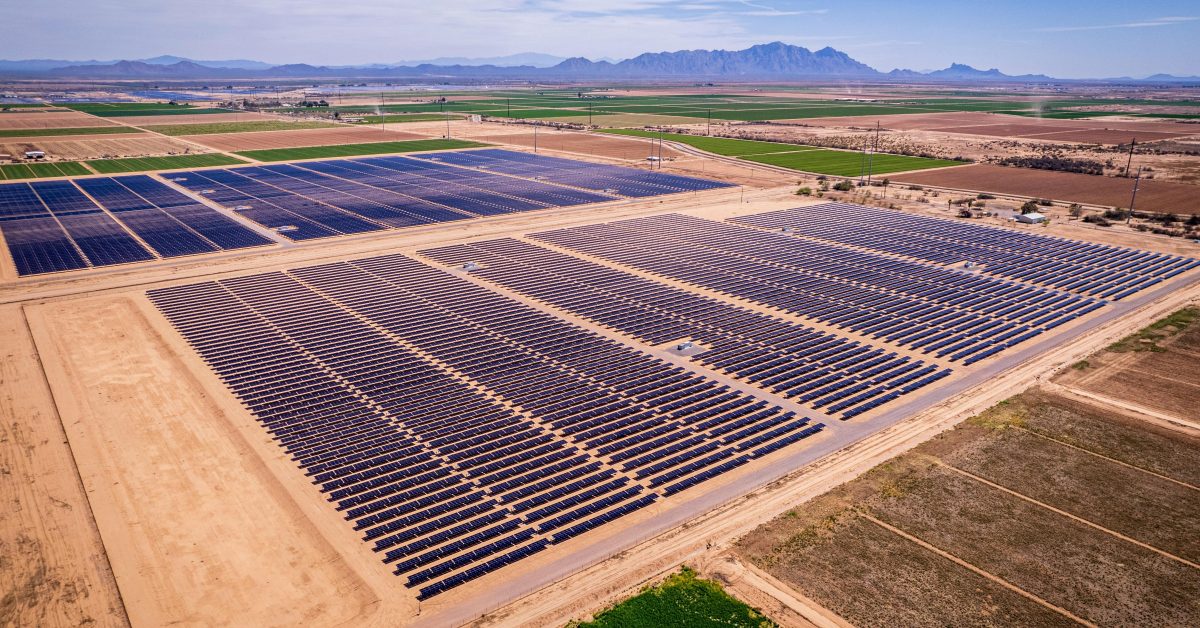
Australia has so much solar that it's offering everyone free electricity
Australia's extensive solar power penetration makes so much energy that the government wants to offer free electricity at peak hours.
Electrek
295 points · by ohjeez · 1y ago · 303 comments
Something sad about that, really.
But since then there was an endless stream of negative press especially in English speaking countries against German energy policies, so not much of this positive comments are still remembered.
It's all very exciting I think.
The solar+battery revolution is doing for power what cell phones did for communications in the third world in the 90's and 2000's.
See for yourself: https://luminocity3d.org/WorldPopDen
India has 1.4B people on 3 million km^2, Africa has 1.4B people on 30 million km^2 (out of which 9 million is Sahara).
Starlink's use case is low population density areas, and Africa has plenty of those. Very different case from India.
The effects of this are going to massive and huge in 10 years.
There is a huge swath of Australia that does not have good internet access and/or very poor cell phone coverage.
And I am not talking about about people living in the middle of the desert, I am talking about people who are 10 to 15 minutes away by car from a small town.
So yes Starlink or it's local equivalent are necessary.
For example, that would cost about three times as much in the UK but median income is about an order of magnitude higher so its more affordable.
I do realise it is a lot more affordable than telecoms were in the past, but its something like a day of median income.
Does that operate at good speeds in rural areas?
> On farmland and on rooftops, Iraqis turn to solar as power grid falters
https://www.reuters.com/business/energy/farmland-rooftops-ir...
But, what exactly do you mean by fragility? In what way are they fragile?
[0]: https://www.eesi.org/papers/view/fact-sheet-proposals-to-red... [1]: https://www.instituteforenergyresearch.org/fossil-fuels/rene...
A third solution is to pipe it across timezones using HVDC and accept some level of efficiency loss and some geopolitical risks.
A fourth solution is to mix lots of wind, which performs better in winter and cancels out the lower insolation.
Realistically it's going to be all of the above, with the balance determined by local factors.
Maybe something like microwave transmission or cheap superconductors will solve it.
My understanding of the intentions of connecting international grids is for things like emergency supply of electricity to a different grid to stabilise the frequency and prevent blackouts.
The argument always seemed disingenuous. For sure, China produces a lot of pollution as they are modernizing, but they are also investing a lot in the direction of sustainability. If we take the balance of (pollution produced - pollution prevented) for the two countries, the day will come, if it isn't now, that the US is on the losing side of that comparison, and I wonder what the new argument will be for the US not doing more.
China's numbers did rise quickly on that measure and is above the EU now I think but still way below the US.
And if you don't like per capita, then China with 4x as many people is still behind the US when you compare cumulative CO2.
https://www.whitehouse.gov/wp-content/uploads/2025/05/Ending...
The Chinese leadership understands several things very clearly:
- The country has experienced multiple catastrophic natural disasters in the past.
- Such disasters often lead to regime change (losing the mandate of heaven via natural disasters leading to social unrest)
- The leadership is comprised of smart people (and a lot of engineers) and they don't play dumb political games like denying the reality of climate change.
- Climate change will bring far worse problems in future, which threatens the country's economic growth and therefore their hold on power.
So they have massive incentive to care about the reality of climate change and do everything they can to mitigate it and protect their environment.
But none of that matters, China would pursue massive solar power infrastructure regardless, because they want energy independence. Stupid amounts of solar power means they will no longer be importing lots of oil and fuel, and that means they would be less vulnerable to the US blockading them in some sort of conflict, which is one of their primary geopolitical concerns.
They would do this even if solar power was dramatically less effective or was significantly more expensive, because solar power is the first kind of power generation that it is economical to way overbuild, and have serious redundancy and surplus and excess, because there's no consumables that scale your running costs like if you tried to build massive amounts of coal power plants.
China would like to have that kind of scale for power because they can use it to subsidize things like datacenters running less efficient Chinese made computer components. The fact that power doesn't have to run a profit in China helps this.
The US should be taking fucking notes, about how nationalized infrastructure can be a force multiplier economically, and how infrastructure that doesn't have to be profitable can be even more powerful.
Slaving ourselves to the enrichment of well connected capital owners is harming our country, and preventing a literal energy revolution. We have the option to, for the first time in human history, actually have energy resources that are too cheap to meter.
Therefore reaching self sufficiency in terms of power generation will make this threat less relevant and an enemy will no be able to use it to make them back off.
And??? The parent commenter wrote about the manufacturer of said solar panels, going outside the frame of that article to something related but still relevant, given that that article surely is meant to stimulate a more general discussion.
I doubt the Uyghurs would agree:
https://www.bbc.com/news/world-asia-china-57124636
https://www.business-humanrights.org/en/latest-news/in-broad...
https://sustainabilitymag.com/articles/gb-energy-blocks-use-...
https://www.greenmatch.co.uk/blog/solar-companies-linked-to-...
The entire coerced labour propaganda are bunch of country bumpkin Uyghurs getting enrolled in poverty alleviation programs where they're paid close to median wage, i.e. 2x+ typical subsistent agri income. This is equivalent to US starting a jobs program to give bottom quantile earners (15k) a median income (40k).
The reality is these are well paying jobs, relative to bottom quantile recruits these programs are designed to uplift usually go towards more ethnically "Chinese" applicants, because factory bosses don't want to deal with Uyghurs who don't Mandarin Good until central pushed Uyghurs (and Tibetans) to front of queue, when frankly much more qualified "Chinese" applicants exist.
Are individuals sometimes fucked in the process, of course, statistic inevitability, but poverty alleivation is net good for Uyghurs, XJ solar is net good for the world.
If I was to post a comment that frames the armenian or rohingya genocide, or indeed any genocide, in a good light, would my comment be flagged? What exactly is HN policy on moderating genocide-washing propaganda?
asking for a chinese friend
So many people did so that at one point last year the government said, "So many people are exporting it now, and the surplus is so great on the network we may have to charge you for exporting it". Wholesale power prices become negative during peak solar times - but retail companies will still charge you for using it!.
Obviously, that didn't go down too well and this is the response - free electricity during peak solar hours.
That said, my understanding is that free electricity is only for people who are on the "default offer" from the electricity companies - that is effectively the highest tier of pricing. Most people are not on the default offer.
I'm pretty sure he hasn't actually paid for electricity or gas (same provider) since.
I think this is about battery sales for those that can afford it. Fill a battery up for free and use the power during peak hours.
"For a limited time only, we're offering a $500 upfront electricity bill credit* with every eligible home battery system (Tesla Powerwall 2 & 3, LG Chem HV, SolarEdge batteries only) purchased through Electrify with ActewAGL and installed by one of our approved installers - plus a further $100 credit* every year for the next five years, so long as you stay connected to our Virtual Power Plant.
Join the thousands of households across across Australia taking advantage of the Cheaper Home Batteries Program. Over 100,000 systems have been installed since July 2025, and with the rebate scheduled to decrease as installations rise, now is the time to act."
By rebate you mean: a wealth transfer from tax payers to those who need it least, those who can afford a battery, those who aren’t renting.
Sure. But if you live in Australia, you knew that slap was coming. You could almost have said to have signed up for it.
Very early in the piece, the government offered to pay people who installed solar about $0.50 for every kWh you fed into the grid. To be clear, that was far more than the retail price of electricity at the time. It was sunsetted, in 2028 from memory (so if you signed up back then, that sweet subsidy money still flowing strong.) I know a few people who installed 50kW of panels on their houses and sheds purely because of that incentive.
The idea behind the subsidy was to kickstart the solar industry, and it worked. It was always obvious what was going to happen to feed in prices if it did work. Given the price of power is now very close to $0 for 8 hours a day, it's working very, very well. That's how this "free electricity" offer came about.
The same incentives are now happening for batteries. The Australia electricity regulator created a special kind of retailer called a "Virtual Power Plant". It's effectively a collective of battery owning consumers, and the VPP allows them to sell their excess storage into the wholesale market. The government is now subsidising batteries, in the same way they subsidised solar panels. And now, they are looking at offering free power to charge the batteries(!) The result you should be able to get will over a 10% return by installing a battery and joining a VPP. Consequently, there is currently a shortage of battery installers.
That 10% won't last forever of course. It will last for a while, especially in Queensland (where I live) as the conservatives are installing more gas turbines rather than building more renewables. The high price of gas generated power guarantees a good return on my battery investment. I will take great pleasure in sending the gas and coal generators broke by selling when the price is highest (which is a night) and taking their profit.
And fortunately night lasts a long time, and years and years of battery installs to take a real bite out of it. Nevertheless the fun and profit will wind down eventually. When it does I won't be whinging about a receiving slap in the face. I will shrug, be thankful I could have my fun while it lasted, and move on.
Here, you deal with it. No options. It’s solar and batteries rammed down your throat. At your cost. If it doesn’t work out, it’s on us.
No big (reliable base load) energy projects to power industry in to the future, China can do all of that for us.
Equality. Everyone can have nothing.
They are now also subsidising batteries while should help meet the wave of solar with a wave of distributed storage capacity to smooth out grid demand as well as successful rollout of grid-scale batteries.
This is a generational success story big enough to have geo-strategic implications.
So long as you ignore the working-poor. Those who live pay check to pay check, can’t afford solar / battery - or are renting so none of that applies to them.
Yeah, they can just get fucked.
What a success!
Median full-time salary in AU is ~90k AUD, and we have pretty good minimal wages, so solar panels are affordable to almost every working homeowner.
Mine (a VPP) does pass it on. They charge me the going wholesale rate. If the wholesale price is sufficiently negative they pay me to use electricity. That's pretty rare, but it does happen every few months. The wholesale price has to be below about -4.5¢ for my price to be negative because the people who own the wires get to add a fee regardless of what direction the electricity is flowing, as does the government (admin fees of some description).
The converse is also true. If the price spirals to $19/kWh, I get to pay that too. At that price as single night could cost me $400, or it would if I didn't have a battery.
Which possibly explains why you haven't heard of it. If you don't have a battery big enough to get you through at the peak and shoulder hours and enough solar to charge it during the day you are better off with a more traditional retailer, who charges you a fixed price regardless of the wholesale price.
It's quite fun (and educational) with the kids to work out when to put the car on to charge, when to run the dryer etc, looking at the few days ahead forecasts.
Last month, we paid 11p per kWh on average, which is less than half what you'd pay on a standard tariff, and it's nice to be doing something good for the environment too. It's particularly satisfying to charge up the car when tariffs go negative.
Here's today's rates (actuals): https://agilebuddy.uk/latest/agile
Here's a forecast: https://prices.fly.dev/A/
That's pretty rough. That should be about 14¢ per kWh which only a hair less than the median price per kWh in the US (~17¢).
As if we aren't busy enough. I see this as just yet _another_ job the government/business is making us do instead of them.
Is it too much to ask for my government to provide sensibly and simply priced energy so we can get on with our day, working, studying, raising kids etc?
IMO this is just setting us up for insane surge pricing for those people who don't do the good citizen thing of becoming nocturnal
Dunno about where you live.
If you’re going to throw capital at large metal refinery infrastructure, you want it running 24/7, or have guaranteed subsidies from local, state, and federal governments.
And remember that subsidies are paid from the public purse.
Prices have gone negative because of things like subsidies - which in the short term is a good thing IMHO - it subsidizes industries developing systems to make use of that free (but not negative cost) energy...
Somebody has to go and turn it off, and having this person available overwhelms all of your operational costs.
Or alternatively, you need the infrastructure to do it automatically, what is currently expensive. (But there aren't intrinsic reasons for that being expensive, it's probably due to lack of scale.)
If it's just slightly negative, or just rarely so, it's not worth it.
There is not “person” turning things on and off.
By making the price go negative, you are creating the market incentives for someone to do something about it: households will invest in BES systems to suck up all that free electricity to use during peak times, and some industrious entrepreneurs might even be convinced to do it on a very large scale to start arbitraging on the price fluctuations.
You don't even need the price to go negative to have a BESS buffer make financial sense.
Something I firmly believe is that there’s a ton of low hanging fruit for timing our energy use better. It is just hidden by the desire to present a uniform energy price.
Like why not run our water heaters when power is cheap? Then if that became a thing, we might even be interested in larger water heater tanks. Batteries cost per volume, you only pay for the surface are of a metal tank!
The price difference is significant: About €0.08/kwh compared to the €0.2 - €0.4 I'd be paying during normal day/peak times.
This has made my day-to-day driving basically free, less than a euro per 100km (€0.08/kwh * 7kwh/100km)
I tried doing the same thing for other large(ish) loads in the house, dishwasher, washer & dryer, but the cost benefit was really really small when compared to the big savings from my EV charging.
I heat my water using an oil burning boiler, but if I had an electric water heater, it would make total sense to run that during the "EV" hours as well. If I could, I would then also invest in more capacity, and set the thermostat higher to have essentially a hot water battery that could last me the whole day.
At my old house I had an overspecced solar system, and I set it up to dump the remaining available solar energy after the batteries are done charging into my hot water heater. The thermostat was set to 75C or something, super hot. I'd then have piping hot water for most of the day, and maybe needed a small electric boost in the mornings, especially in the winter. Another 200L or so would have resulted in me not needing any grid power to heat up enough hot water for the household.
It rolled this out in 1953:
https://en.wikipedia.org/wiki/Zellweger_off-peak
It let coal plants run more efficiently and people could heat their water overnight.
Somewhat bafflingly they seem to have somewhat failed this same task with the solar rollout.
Presumably 21st century capitalism got in the way of the mid 20th century engineering.
My home state of WA is not a part of the same power netwrok.
Charge the batteries in the free time and then use the stored power the rest of the day.
I thought I'd read that they planned to expand the scheme to non solar homes to fit in with the ethos of the new "benefits of solar for people without solar" messaging of the proposal under discussion here.
But I checked my supposed source and it was just someone suggesting that it would be consistent and useful if they did make that change.
I have also upgraded to a 20kW inverter (I have ~10kW of panels on the roof) so I can import or export twice as fast and I will be switching to a provider that offers wholesale pricing. Getting a guaranteed 3 hours of free power a day for charging (even in winter) is just going to be the icing on the cake.
Based on back of the envelope calculations, the battery should be paid off in about 5-6 years during which time I will have paid zero for electricity (outside of a $25/month access charge).
"The future is already here – it’s just not very evenly distributed." - William Gibson
Best 5 years of my life. I'm back in the US now temporarily, but there's zero doubt in my mind I will end up back in Aus. I've lived in 8 cities now(1), and Sydney was the highest quality of life I've had out of any of them. Great infrastructure, great work-life balance, great culture, and fantastic weather. Only downsides are the distance and the lack of ozone layer (do not fuck around with the sun in Australia - there's a reason why they have over 10x the global average of melanoma). Happy to answer any questions about it or the process for getting citizenship.
(1) Cities lived for comparison: San Diego, LA, Honolulu, San Jose, San Francisco, Seattle, Portland, Sydney
As solar efficiency goes up, and prices of solar and batteries come down and make local installation easier, an already audacious project seems less and less likely to complete.
I think they're pivoting the giant solar farms they were building for this to AI or green hydrogen now.
By the time they get the cable to Singapore, it will just be cheaper to generate it in Singapore.
Suppose fusion power becomes a thing, and after handwaiving some issues let's assume it can power everything indefinitely.
Does that make things like heating, cooling, travel, ocean desalination, bandwidth, AI, Bitcoin mining, permanently free?
Shouldn't all of humanity be homing in on that holy grail?
I read here and there that geothermal could be the next best thing. Maybe HN can say more on that.
(P.S. terrestrial fusion may also explain why nobody bothers to build Dyson spheres out there)
The ambient vibe of our time, and here on HN, is often really pessimistic. I don't believe such pessimism is realistic. Commercial grade fusion power will come, and we should push very hard to make it happen. It will change the equations at the core of the economy and open up whole new paths for technology -- far beyond the pure digital.
There is always some capital and operational costs. Plus transfer. Limit is cost of infra and operations. And the financing costs. So you can get to very cheap, but not free.
Unless that also counts when the car could charge for free at the workplace of course.
Obviously it still works great on the weekend, or whatever days you’re not working to charge the EV at home for free.
Given all power is free, why wouldn’t you charge the EV at work in the middle of the day? Even if you pay to have the charger installed it will pay back quickly.
It’s not going to happen overnight, but with literally free electricity things will change quickly, and even huge parking structures or lots will have a stack of chargers that are free or very close to it.
Is that anything like the "_ agenda being pushed" I keep hearing about, but can't seem to see anywhere?
> Australia proposes letting everyone benefit from negative wholesale rates
I know more countries have this now, so that's a good initiative that hopefully will spread to other countries (with negative rates).
I would bet over time the supply charge and non-free hours will increase in price to compensate and overall bills will be the same. It will shift some load to the middle of the day with people setting timers on appliance and it will take pressure off generation which will be politically convenient when another poorly maintained coal plant falls over but I will be shocked if it will be a win for consumers.
Poorer home owners and rentals that don't have solar pv and can't afford to buy new appliances that might be able to take advantage of being set to run during the cheap hours are going to be left further behind.
The country is full of monopolies, duopolies and price gouging and the regulators are useless.
No, I just run the numbers. The numbers they provide.
https://www.pge.com/en/account/rate-plans/hourly-flex-pricin...
However, they aren't taking net metering customers yet, but if you end up spending more on the hourly variable rate plan, they'll refund you to the same you would have spent on the regular time of use rate plan.
Oh yeah, yes, after paying all the money to get the electrical hookup he doesn't want or need - yeah, he's gonna be on the hook for around $100/month.
He should’ve done DD on the land and local AHJ restrictions before moving ahead with a plan that wouldn’t work. One call to the local planning and permit office is all it would’ve taken to avoid this problem and find a different jurisdiction.
Which utility and plan is this? I'm not aware of any California residential rate plans that charge you for putting power back on the grid, much less $100/month.
That said, wholesale electricity rates are set by high frequency supply/demand markets.
Recent residential net metering rates are closely aligned with wholesale supply/demand based rates, so most utilities will compensate your brother in law near $0 when you are pushing power to the grid when wholesale rates are <= $0, because there are not enough buyers of the power he is generating.
He is using the grid as a battery, which comes at a cost.
This is of course changing as more grid connected storage comes online and creates demand for off peak electricity. In that case, you actually get paid for selling power back to the grid during high grid stress periods. I get paid a few hundred dollars a year in CA for doing that with my measly home backup battery.
The HARD PART is
1) STORING this electricity ( Storage is very expensive and technology changing)
3) Getting this electricity from the storage to where its wanted - is EXPENSIVE and requires many $BILLIONS of new transmission lines ....
Assuming a COP of 2.5 (small, air cooled), that would be around 300 kW or 1M BTU of cold storage per day, which is around 42 kBTU or 3.5 tons of raw cooling capacity running 24x7.
I imagine if commercial buildings with support for larger and vastly more efficient chillers did this we could take a huge chunk out of NYC’s ~50 TWh power bill.
Ok, I’ve convinced myself. ConEd, please update when the free electricity program is activated.
There might be a surplus now but dropping the price to zero will increase use (demand).
I was surprised the story does not even specify "residential," it really says "everyone." That's a great way to exhaust existing supply. Entrepreneurs can presumably be quite creative in the shape of businesses they set up if unlimited free power is on offer during the day.
You get penalized for having solar panels here in Alabama the Beautiful.
Only available in some parts of Australia
Renters, as usual, rarely get it.
It clearly said the free electricity will be for renters too.
As I said........
In Australia - solar power overwhelmingly benefits the rich over renters.
A few hours a day of free electricity for all does not wipe that out.
Solar power is a rich persons thing in Australia, remains very very strongly true.
But in any case, let’s say I agree with you. A ton of rich people have solar and are getting really cheap power. Cool.
Now EVERYONE is going to get free power for a few hours a day, and the “poor” didn’t have to spend a cent to get it. Sounds like a benefit for everyone to me, regardless of how rich they are.
How is it not?
Don't bet on us avoiding apocalypse by the only way that never happened in the history of development of our species. We won't suddenly get any smarter, we never did. And now it's important.
Definitely watch out for the severe acute toxicity variants.
You're not wrong about the plants and animals though. It's basically an island, and islands always end up with super weird flora and fauna - there usually just aren't many (any?) predators, so the competition takes species in weird directions.
Yes, it snows.
Yes, I’m on the city fringe. Like millions of others here.