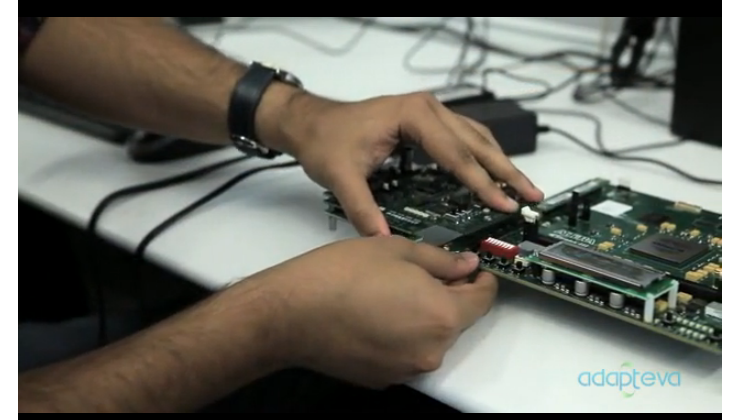
$99 Raspberry Pi-sized “supercomputer” touted in Kickstarter project
Parallel computing for everyone promised with 16- and 64-core boards.
Ars Technica
59 points · by suprgeek · 14y ago · 61 comments
This doesn't necessarily invalidate the product, but it really does put me off it. If they're going to market a product like that it's going to be to a pretty techy crowd and they should get their terminology right.
A lot of companies are using the combined totals to tell how fast/big/etc something is. It isn't even a recent development either.
Just for one example, if you go to Dell's store right now you'll find computers with 8 GB of RAM; but what they fail to tell you is that that is 2x4 GB sticks rather than 1x8 GB stick. So it is actually the "total" RAM in the machine.
Now you might argue that for technical reasons there is a difference between how RAM and CPU-cores are exposed to the underlying software, but that within its self is only true in some infrastructural designs, but not true in others (e.g. Sometimes two cores pretend to be one, sometimes a single core pretends to be two).
Two small shovels aren't the same as one big shovel, but two small bags of dirt are basically the same as one big bag of dirt. If you're going to continue with the memory analogy, this would be like combining the graphics memory and general purpose RAM into a single figure.
RAM, however, can be added together as data can be cached across one or more sticks. Thus adding another stick of RAM does increase the overall total amount of RAM available.
I'm not an expert on this, but I believe this is why clusters are measured in calculations per second (eg FLOPS) rather than frequencies. Calculations run in parallel (such as clusters do) are increasing the overall number of calculations performed per second. Where as multiple cores running in parallel don't increase the clock frequency.
But if I watch 1 clock for 60 seconds, the amount of time that has passed is exactly the same as if I watch 2 clocks for 60 seconds or 100 clocks for 60 seconds.
It does not make any sense at all for them to add the numbers up, aside from being able to present a huge single number for marketing purposes. Even non tech people understand that a 4 x 2ghz processor is not a 8ghz processor....
Having spoken to a few non-tech people I'm pretty sure that I could find a bunch who don't understand anything in that sentence.
Having spoken to some supposedly tech-savvy children on 4chan /g/ I know that there's a lot of confusion about cores and processors and speed, and that's before you talk about potential benefits and disbenefits.
As incredibly misleading as it is, our objections may largely come from preconceived notions of what a hz is. We want it to be a function of a single core because that's how we grew up thinking about it.
Now, let's say that I have a cuckoo clock that chimes once per hour. This is a rate of ~ 278 μHz. Now, imagine that I buy 3600 of these clock and set them to offset them by 1 second each. I now have 3600 x 278 μHz signals. However, I also have 1 clock going off every second. Thus, the frequency rate for the entire system is 1 Hz, even though the individual components have a much slower rate.
Now, let's say that I didn't do such a great job in aligning the signals of the clocks. Some are 2 seconds apart while others are mere milliseconds apart. From a Fourier transform perspective, there's now multiple signals with multiple frequencies occurring. However, if I average over a long time period, I'm still getting 3600 events per hour, or 1 event per second. The signal may not be a perfect sine curve, but, barring a pathological timing, the strongest Fourier component is going to be the 1Hz signal. Thus, 1Hz would be a reasonable way to describe the cuckoo bird rate of the system.
It's not perfect - but is a lot easier than dealing with having to look up Intel CPU numbers to see how many cores it has, then multiplying that by the clock speed, then guessing. Getting the total cycles means you can jump straight to the guessing ("estimating") part.
This might fool non-tech people, but non-tech people will not buy this product anyway.
I dug out this article from 2007 about building a 26 gigaflops "supercomputer" called the Microwulf Supercomputer which cost under $2500 [1].
And according to Intel [2], the Intel i5-650 processor can do 25.6 GFLOPs.
This is just the worst kind of kickstarter marketing.
1 - http://www.geekologie.com/2007/09/supercomputer-does-26-giga...
2 - http://download.intel.com/support/processors/corei5/sb/core_...
The defining feature of this proposal is their 70 gigaflops/watt number, which is impressive. But that doesn't make it a suitable target for hobbyists. Hobbyists who want to play with supercomputing for cheap should just use their existing video card.
The days of a gigaflop being an impressive unit of measurement are surely over.
It doesn't sound like they have compelling applications in mind -- they're kind of throwing it out there to see what people will do with it. But there are only a few things that needs so much computation and so little memory. Even a lot of scientific computing today is more like "big data" than "big compute".
Also, it seems obvious that you'll want to use more than one together, so some info about network connectivity would be useful.
One random example I can think of would be cracking encryption and or hashes (without the use of rainbow tables or similar).
Your entire comment essentially seems to be "I don't think a usage scenario exists, because I cannot think of any, so why didn't they make it a 'large data' device instead of a compute device?!" which seems more a limitation on yourself than the device its self.
The relatively few applications explains why they are using Kickstarter for funding. If it had more applications, then people with deep pockets would be falling over themselves to give them money.
There's nothing wrong with this -- the page is just so full of marketing-speak that it's hard to tell.
Going from A to B is exactly an example of a task that can't be solved in parallel fashion. On the other hand, if you needed to merely cover N miles, then a pool of cars would work just fine.
To use another car analogy. Counting clock speed is like counting the cars max RPM instead of actually measuring the performance. And then they have totalled the max RPM figures as if they have have 90,000RPM engine.
People = threads and cars = cores.
You can nitpick as much as you want, but for a lot of applications it's perfectly OK to sum up the frequencies. A job that can be spread over 8 cores will be executed at about the same time as it would execute on a single core at 8x the frequency
I've seen similar projects in the distributed-memory space (tiny clusters like Limulus[1], MicroWulf[2], or LittleFe[3]). These things are great for educational purposes, and the low cost makes them a lot of fun for classes and workshops. LittleFe, for example, supports distributed-memory and GPGPU programming and teaches you about clusters, and the educational program at the Supercomputing conference lets some educators build one and take it home for free.
But for professional work, I think a workstation-class PC, maybe with a GPU, is always going to win out.
[1] http://limulus.basement-supercomputing.com/ [2] http://www.calvin.edu/~adams/research/microwulf/ [3] http://littlefe.net/
sigh There is no guarantee on Kickstarters.
https://www.digilentinc.com/Products/Detail.cfm?Prod=ZEDBOAR...
No idea what's hiding on the FMC daughterboard, though.
Seriously though, this sounds amazing :)