Vicinity
Your neighbourhood
vicinity.social
57 points · by clarencehoward · 1y ago · 61 comments
There are two features right now:
Drop - Single chatrooms that can only be seen within a specified radius and only last for a time less than 48 hours chosen by the user.
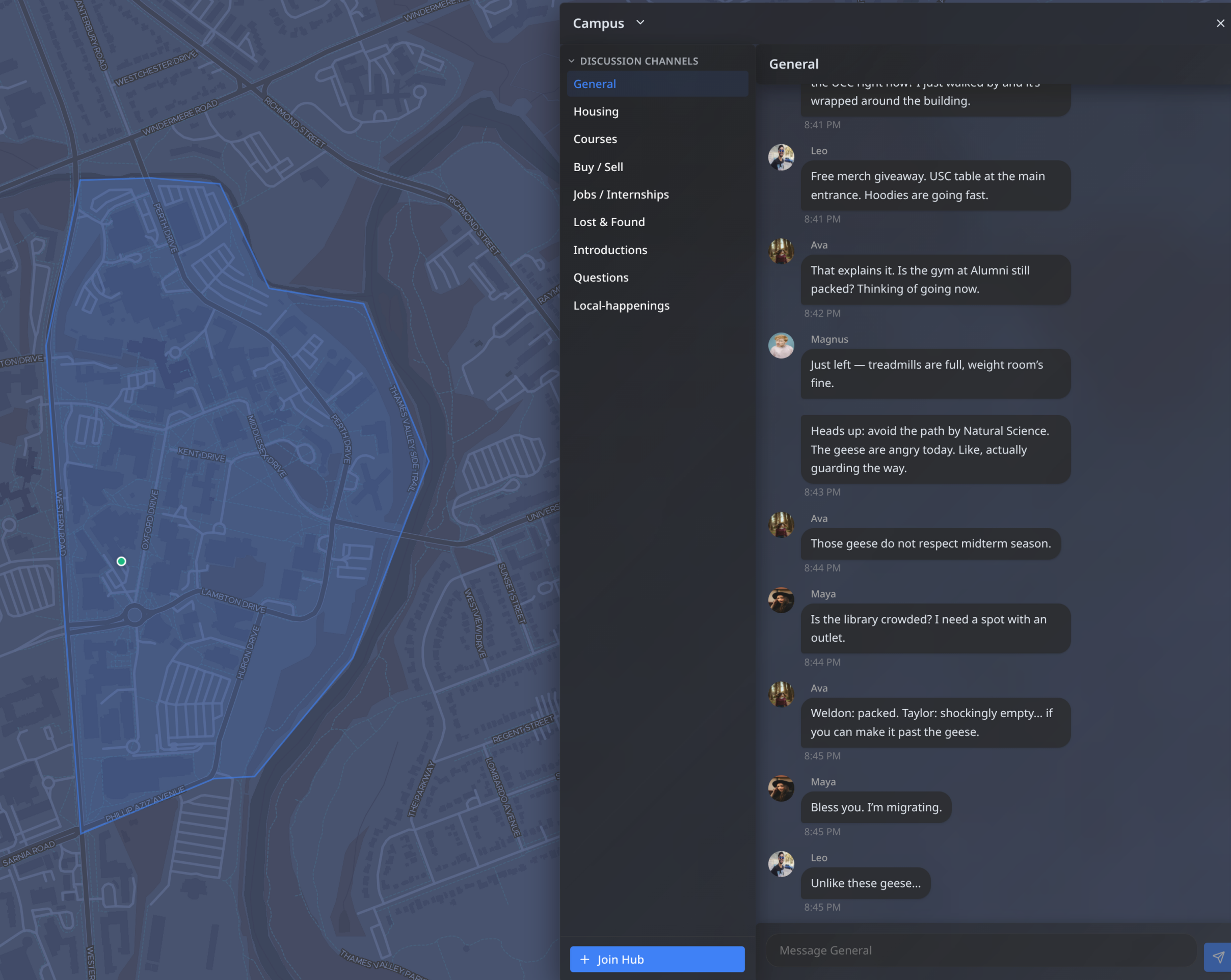
Hubs - Geofenced servers modeled after Discord. These are not time restricted. They can be created by anyone and the creator becomes the admin able to add channels and set rules. When a user enters the location’s area, they can join the hub and continue seeing messages even after leaving. Hubs cannot overlap, so once one exists in an area another cannot be created on it. The hub will persist as long as it is being actively used. If unused for two weeks, it will be deleted. (Still implementing this deletion aspect, so that is not in the landing page at the moment)
Why I built this.
I do not like the feel of most social media anymore, but I really like my university’s discord server. I wanted something more general that provided similar interactions. So I thought something that might work is a more general social app tied to location.
I think if it is done right it can recreate the atmosphere that I liked. I thought a lot about what that atmosphere is. I think for social media to feel natural it needs a “third thing”: a shared interest or object that creates a connection between two people, or a neutral ground for communication.
Having something in common just makes the interactions better and more useful. I think location can serve as general thing in common, especially if the servers are curated by locals. It could also be a good way for people to immediately connect in a new place.
Right now, I’m just having fun building this thing. I would honestly like to use it if other people were on there… and it was built better and an app.
Feedback
I’m looking for any feedback. What’s a good idea or what’s a bad idea. This is really just a prototype, so there are some rough edges, and I am actively working on it. If you find any bugs and feel like communicating them, please do. You can reach me at nhowar@uwo.ca
Then I tried to create a Hub, but couldn't figure out how to get it to accept my drawing (there's no "done" button, only "cancel", even though the polygon I want is right there). After a few frustrating tries, I went back and noticed that I need to click the first point again, which is very unintuitive.
After that, it kept complaining that my area is too big, and there was no way to live-adjust the area while seeing how big it is. I had to cancel out of the whole thing, go out to the hub screen, then click "start drawing" again for another try. I didn't make it past that.
It is probably too small, but for now I just want to make it easy to use. At the default zoom level 125 hectares is tiny and I am not surprised it was hard to make something small enough. I just got so used to the way it worked when I was testing I would immediately zoom in without noticing.
It will not save your hub unless you're logged in. The logic was that since someone needed to be an admin, they needed to be logged in. I should probably find a work around for that for now while I am just trying to get people to test it out. No one wants to give their email to some random site.
I am going to work on making the hub drawing more intuitive. It should really have a done button.
Thanks for giving it a try.
It's good that you increased the area for now, because there's no way that I find anyone on there in what's basically the size of a neighbourhood. Maybe you could reduce it if it gets more popular?
How do you deal with spam?
For example, Telegram has a "people near me" option which is full of drugs and sex-workers. Great if you like that sort of thing, but not exactly welcoming if you just want to chat to other people in the park / conference / stadium etc.
[1] https://shkspr.mobi/blog/2024/07/why-is-it-so-hard-to-chat-t...
> Telegram Announces Removal of "People Nearby" Feature
So I've also been thinking for a while now: how can that style of community be recreated? There's of course the chicken-and-egg problem until you have traction, but also things like: how big should the community be, geographically? The same size in the US vs EU likely encompasses quite different amounts of people. Should it be anonymous or real identities? Should history be viewable by new members or should it be ephemeral? And so on.
Anyway, interesting prototype, I hope you get some traction!
But, if enough people used it around certain areas, it could be a lot of fun & very helpful just to chit chat & talk about the weather & etc.
https://en.wikipedia.org/wiki/Yik_Yak
EDIT I can't accept the terms on my Samsung phone, as the text is over top of the buttons and I can't do anything but scroll the terms. Not sure if this is a browser (Brave) problem or a font size or what.
Human moderation is going to be a huge hurdle for this. Connecting Internet users by location seems like a massive safety liability.
Making sure users are human and not just gathering locations of uses at an individual non-aggregated level also seems like a horrendous bad time.
On top of that, anonymous mode is going to be removed in the future, so you literally just have to tell other users your seemingly somewhat precise location, tied to your real persona.
Who wants this?
It’s also crazy that this site asks for location before even telling us what it is. On mobile it’s especially bad because the site isn’t even loaded or visible before the OS prompt covers basically the whole screen.
The service does need your location on the marketing page, collect that when users actually start using it.
[2] Seven paid staff members, $5 for an account, been around at least 22 years.
And there are bound to be a dozen outside the US that I don't know of. I've heard of this [3] being a Dutch one that had a good run for decades with multiple full-time employees, but can't confirm as I don't speak Dutch. Supposedly ad and donation sustained (?). Again, has outlived most social networks. Maybe a Dutch HNer who reads this can tell us more.
You can mean a thousand things by "profitable" but both achieve what I posited and what most commonly underlies "profitable": sustainable. And they are. They're easily in the top 1% of social networks by longevity. That the former is non-profit doesn't make a material difference, these are effectively medium-sized businesses as I posited.
[1] https://en.wikipedia.org/wiki/Front_Porch_Forum
I wonder if there could be a variant for Drop which is world wide - imagine being able to join a chat in a foreign country (hopefully you speak the language!) and chat with the locals. I imagine moderation would be a big pain but I could see it being fun and sort of in the spirit of the old web.
- The error message that anon users can't create hubs should happen when they click "Create", not after they go through the creation process
- 125 hectares is ridiculously small. Even in densely-populated areas, it takes 2500 hectares encompasses a neighborhood
- The chat window doesn't maximize, it's just a sidebar, and there's no emojis or GIFs or image embeds or links or markdown/richtext support or ability to edit/delete messages
- It would be cool if there was a bottom bar with a "global chat" / event log where you see people creating new hubs/drops
Thanks for all the feedback so far! It has been very helpful.
I have been thinking about similar systems: https://web.archive.org/web/20061014073443/http://zby.aster....
You’re looking to replicate a college campus experience but for the general public. That’s your first yellow flag so to speak.
The problem is that adults don’t live on college campuses and don’t really have the same socialization patterns. They’re not in a “safe” bubble where everyone they encounter has the commonality of attending the same admission-required school, where they have a baseline level of trust for random people like a college student has for the other people in their bubble. College students can get physically kicked off of campus for doing things against school policy that aren’t even at the level of being illegal. In real life I can be living next to a convicted sex offender and there’s nothing I can do about it besides move.
Your competitor is Facebook Groups, which is an absolute elephant in the space.
Your implementation so far feels creepy. You’re asking for location immediately on the marketing page (why?).
The marketing page seems to indicate that users are just going to disclose their exact current location and not be anonymous after the beta. The screenshots look like I’m going to reveal my location to strangers as a dot on a map. I don’t know if you’re really disclosing your users’ exact locations to each other or if they’re made more generalized but that seems like an immediate no thanks for just about anyone with any reasonable sense of threat evaluation.
I don’t mean this in a discriminatory way, but your founder profile seems to be “two nerdy male college students.”
Can I ask you: do you think women would want to disclose their semi-precise location to strangers on the Internet? What’s the male to female ratio on this campus discord server you’re looking to capture the vibe from?
You also say this experience is trying to replicate the close community you have on discord. Why am I not just using discord? Spoiler alert: I’m already using discord with local people in my area.
Amazing portfolio project, I’m just not vibing with it as a business idea.
Edit: reading further, I suspect these were just taken from somewhere unless in 2025 they've got some Flash code to protect:
>Copy or adapt the Services' software, including but not limited to Flash, PHP, HTML, JavaScript, or other code.
One other concern about the implementation: it sounds like Hub administrators - who is just the first person to create a Hub in a particular area - are given a lot of power. No more Hubs are able to be created in an area? So if a Hub admin abuses their power that area is screwed, unless of course you (or whoever would be handling such cases, if indeed that would happen) agreed that they've overstepped, which may or may not be the case, particularly with a vague TOS
Anyway I think the idea is intriguing, and like new ways of exploring social media/communities.
That does not seem to be so evil .. but I did not found the legal terms on a first glance, so maybe there is more?
It would be a good legal base though, to be able to enforce it if needed.
I live in America
I have red hair
I like bluebirds
Do you think it is good and just and fair to ban someone for one of these falsehoods?
Otherwise there is the concept of making a prank which is fine by me.
But intentionally spreading lies for political propaganda or scam is very much a reason to ban someone like this for me.