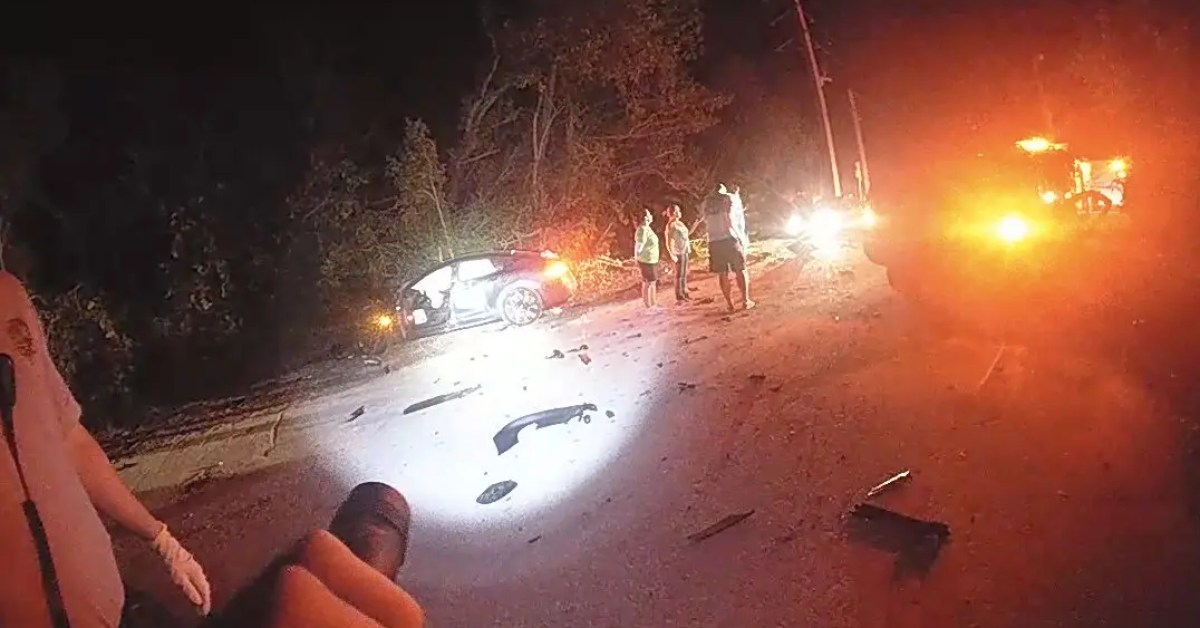
When Tesla's FSD works well, it gets credit. When it doesn't, you get blamed.
When FSD is on, a human driver must remain attentive. When things go well, Tesla takes the credit. When things go bad, it blames you.
Electrek
151 points · by Bender · 1y ago · 145 comments
Only rigorous, continual, third party validation that the system is effective and safe would be relevant. It should be evaluated more like a medical treatment.
This gets especially relevant when it gets into an intermediate regime where it can go 10,000 miles without a catastrophic incident. At that level of reliability you can find lots of people who claim "it's driven me around for 2 years without any problem, what are you complaining about?"
10,000 mile per incident fault rate is actually catastrophic. That means the average driver has a serious, life threatening incident every year at an average driving rate. That would be a public safety crisis.
We run into the problem again in the 100,000 mile per incident range. This is still not safe. Yet, that's reliable enough where you can find many people who can potentially get lucky and live their whole life and not see the system cause a catastrophic incident. Yet, it's still 2-5x worse than the average driver.
100% agreed, and I'll take it one step further - level 3 should be outright banned/illegal.
The reason is it allows blame shifting exactly as what is happening right now. Drivers mentally expected level 4 and legally the company will position the fault, in as much as it can get away with, to be on the driver, effectively level 2.
The legal standing doesn't care what tech it is behind it. 1000 monkeys for all it matters. The point is level 3 is the most dangerous level because neither the public nor the manuf properly operates in this space.
The human collision numbers only count actual incidents, and even then only ones which have been reported to insurance/authorities. It doesn't include many minor incidents such as hitting a bollard, or curb rash, or bump-and-run incidents in car parks, and even vehicle-on-vehicle incidents when both parties agree to settle privately. And the number certainly excludes ALL unacceptably close near-misses. There's no good numbers for any of these, but I'd be shocked if minor incidents weren't an of magnitude more common, and near misses another order of magnitude again.
Whereas an FSD disengagement could merely represent the driver's (very reasonable) unwillingness to see if the software will avoid the incident itself. Some disengagements don't represent a safety risk at all, such as when the software is being overly cautious, e.g. at a busy crosswalk. Some disengagements for sure were to avoid a bad situation, though many of these would have been non-catastrophic (such as curbing a wheel) and not a collision which would be included in any human driver collision statistics.
FSD, what most people use, is ADAS, even if it performs a lot of the driving tasks in many situations, and the driver needs to always be monitoring it, no exceptions.
The same applies to any ADAS. If it doesn't work for in a situation, the driver has to take over.
I've made this comparison before but student drivers under instructor supervision (with secondary controls) also rarely crash. Are they the best drivers?
I am not a plane pilot but I flew a plane many times while supervised by the pilot. Never took off, never landed, but also never crashed. Am I better than a real pilot or even in any way a competent one?
So much for "Full Self" whatever.
I worry that when it gets to 10,000 mile per incident reliability that it's going to be hard to remind myself I need to pay attention. At which point it becomes a de facto unsupervised system and its reliability falls to that of the autonomous system, rather than the reliability of human + autonomy, an enormous gap.
Of course, I could be wrong. Which is why we need some trusted third party validation of these ideas.
Tesla, though, is still hyping a technology that seems to have maxed out years ago.
I had a party at my house a couple months ago, mostly SF tech people. I found the Tesla owners chatting together, and the topic was how much FSD sucks and they don’t trust it.
I asked and no-one said they would buy a Tesla again. Distrust because they felt suckered by FSD was a reason, but several also just said Elon’s behavior was a big negative.
We're on the cusp of trading the Tesla in for a Rivian most likely. I should be Tesla's target customer, but instead I'm exactly who you described:
- I don't like the brand. I don't like Elon. I don't like the reputation that the car attaches to me.
- I don't trust the technology. I've gotten two FSD trials, both scared the shit out of me, and I'll never try it again.
- I don't see any compelling developments with Tesla that make me want to buy another. Almost nothing has changed or gotten better in any way that affects me in the last four years.
They should be panicking. The Cybertruck could have been cool, but they managed to turn it into an embarrassment. There are so many alternatives now that are really quite good, and Tesla has spent the last half a decade diddling around with nonsense like the robot and the semi and the Cybertruck and the vaporware roadster instead of making cars for real people that love cars.
Like, what are they _doing_? Do they still have R&D at all?
IIRC the deposit was 250K, and I know people who signed up on the first day. Can you imagine a more dedicated fan?
How do you not deliver to that group? How big an own-goal is that?
Whoosh. They've been saying Tesla is an AI company for nearly a decade. AI has been propping up entire US economy for last few years. EV bandwagon has left long time ago.
Saying all that I wouldn't mind even cheaper Tesla - small screen, 1 camera instead of 11, fully offline, fully stainless steel, fully open source - basically minimally tech and maximally maintainable and maximum longevity.
I'm sure they would be if the stock price had ever showed any signs of being based in reality.
But for now Elon can keep having SpaceX and xAI buy up all the unsold Teslas to make number go up.
If that ever stops working, just spin up a new company with a hyper-inflated valuation and have it acquire Tesla at some made up number. Worked for him once, why not try it again.
And at this point he can get even fraudier, with the worst possible realistic outcome being that he might get forced to pay a relatively small bribe and publicly humiliate himself for Trump a bit.
But there's really no more consequences to any sort of business fraud (for now) as long as you can afford the tribute.
#WorldLibertyFinancial
Mine has been an extremely well done vehicle and I was (and kind of am) bullish on FSD as a driver assistance technology, but a car is a 6-7 year investment for me and I have big doubts about their direction. They seem to have abandoned the idea of being a car company, instead chasing this robotaxi idea.
Up until 2023/2024 was fine for my 6-7 year car lifecycle. Tesla was really cool when they let you do all sorts of backwards-compatible upgrades, but they seemed to have abandoned that.
I’ve found it incredibly disappointing seeing their flailing direction now.
Rivian seems to still have a lot of the magic that Tesla had. They’re definitely a strong contender for my next vehicle in a year or two.
Which means if Tesla can really build that Cybercab - with an underpowered motor, small battery, plastic body panels, just cameras (which I think they promised to sell under $20k) - they'll be able to hit a business expense level and profitability that Waymo will only be able, in say, 10 years.
Even if you don't want to talk about non-existing hardware, a Model 3's manufacturing cost is surely much lower than a Waymo.
Once (if) they make self driving work at any point in time before Waymo gets to the same level of cost - they'll be the more profitable business.
Not only that, they'll be able to enter markets where the cost of Waymo and what you can charge for taxi rides is so far apart that it doesn't make sense for them - in this sense, they'll have a first mover advantage.
Any realistic mass deployment will use cheaper cars, more suitable for taxi service.
The core problem with Waymo’s model is its lack of (economically rational) scalability. Shipping finished vehicles to a second facility to strip and rebuild them as robotaxis is inherently inefficient, and cannot be made efficient by scaling up. To achieve meaningful volume, Waymo would need to contract an automaker to build finished robotaxis, ideally domestically or where tariffs are sufficiently low.
Obviously Tesla's solution only works if their vision-only strategy bears fruit. Assuming it does (a wildly controversial assumption in this space, but let's go with it for now) the economics are utterly wild. It's difficult to imagine how any competitor could come close to competing on cost or scale. And that's assuming the Model Y, ignoring the as-yet hypothetical Cybercab.
I suppose Alphabet could buy the corpse of Canoo. I suspect that if it had a plausible manufacturing ramp, they would have been snapped up quickly. Automotive-scale manufacturing is a crucible, and it destroys most who attempt it. In fact most die long before they begin frfr.
Isn't Waymo going with Ioniq 5 vehicles built for them in the US by Hyundai, with all the vehicle sheet metal and other mods installed at the factory? That was the story a few months ago.
Tesla FSD 12 -> 13 was a massive jump that happened earlier this year. 14 is still rolling out.
Testing out 13 this weekend, it drove on country roads, noticed a road closure, rerouted, did 7 miles on non divided highways, navigated a town and chose a parking space and parked in it with zero interruptions. It even backed out of the driveway to start the trip. I didn't like the parking job and reparked; other than that, no hands, no feet, fully autonomous. Unlike 12, I had no 'comments' on the driving choices - rotaries were navigated very nicely, road hazards were approached and dealt with safely and properly. It was genuinely good.
Dislike Elon all you want, but Tesla FSD is improving rapidly, and to my experienced eyes adding 9s. Probably two or three more 9s to go, but it's not a maxed out technology.
> It was genuinely good.
Like why can an LLM create a nicely designed website for me but asking it to do edits and changes to the design is a complete joke. Lots of the time it creates another brand new design (not what i asked all) and it's attempts at editing it LOL. It makes me think it does no design at all rather it just went and grab one from the ethers of the Internet acting like it created it.
Bingo. It just "remembers" one of the many designs it has seen before.
As far as hallucinations go, it is useful as long as its reliability is above a certain (high) percentage.
I actually tried to come up with a "perceived utility" function as a function of reliability: U(r)=Umax ⋅e^(−k(100−r)^n) with k=0.025 and n=1.5 is the best I came up with, plotted here: https://imgur.com/gallery/reliability-utility-function-u-r-u...
Wasted 1 hour each of your 5 co-workers who ended up reviewing unusable slop? Silence.
As with Marmite, I find it very strange to be surrounded by a very big loud cultural divide where I am firmly in the middle.
Unlike Marmite, I wonder if I'm only in "the middle" because of the extremities on both ends…
The family of the first person killed by that will know who to sue for a punitive trillion dollars.
Depends on the type of stop and go driving. Crawling along at 15mph, sure. But the most dangerous driving scenario - whether human or machine is the driver - is a scenario with large variations in speed between vehicles and also limited visibility.
For example suddenly encountering a traffic jam that starts around a blind corner.
His foot was on the gas though
Looking at this author's other articles, he seems more than a bit unhinged when it comes to Tesla: https://electrek.co/author/jamesondow/ Has Hacker News fallen for clickbait? (Don't answer)
The driver admitted he looked down after dropping his phone and blew a stop sign; Tesla argues his foot was on the accelerator, but the jury still assigned partial fault because Autopilot was allowed to operate off limited-access highways and the company didn’t do enough to prevent foreseeable misuse. The driver had already settled separately.
If the wheels of the car fell off, whould Tesla have any blame for that? If we had laid wires all along the road to allow for automatic driving, and Tesla's software misread that and caused a crash, would it be to blame?
When is Autopilot safe to use? Is it ever safe to use? Is the fact that people seem to be able to entirely trick the Autopilot to ignore safety attention mechanisms relevant at all?
If we have percentage-based blame then it feels perfectly fine to share the blame here. People buy cars assuming that the features of the car are safe to use to some extent or another.
Maybe it is just 0%. Like cruise control is a thing that exists, right? But I'm not activating cruise control anywhere near any intersection. Tesla calls their thing autopilot, and their other thing FSD, right? Is there nothing there? Maybe there is no blame, but it feels like there's something there.
A foot on the gas overrides braking on autopilot and causes it to flash up a large message up on the screen that "Autopilot will not break / Accelerator pedal is pressed"
It can't be healthy to be so obsessed with something/someone you dislike.
Drivers have tackled this problem by wearing polaroid sunglasses.
I really hope someone asks Tesla how they plan to solve the Sun glare issue.
If only there was some kinda technology that didn’t rely on optics that could see in pitch dark or when the sun is shining.
Why was that OK? Why was it safe to let people use like that without informing them?
Having driven Tesla FSD and coded with Claude/Codex, it suffers from the exact same issues- Stellar performance in most common contexts, but bizarrely nonsensical behavior sometimes when not.
Which is why I call it "thunking" (clunky thinking) instead of "thinking". And also why it STILL needs constant monitoring by an expert.
Apple's famous for not being first, but being best to a well established market and cleaning up.
People certainly don't remember de havilland, who was first to the market of "passenger jet airliner".
I certainly won't be putting my kids in any of these, and especially not in a vehicle operated by a company with a "devil may care" approach to safety.
Sure, it works fine in Arizona or Texas; let's see it work okay with a snow storm in Boston.
And by the way - I have heard big tech folks repeat that phrase, not really understanding the moral of that Steve Jobs story.
wonder what driving force behind this, because at somepoint money didnt matters
For example, I've had numerous conversations where people will point to safety rating in vehicles to defend their purchasing decisions. Its simple to understand really, I want the safest car for my family/child etc, that is why I refuse to buy an older, used vehicle or prefer a sedan over SUV. Safety becomes cover for preference and defending trends like expanding pickup truck sizes since the 2000s while there is no safety rating or even objective measure of the efficacy of these self-driving systems.
Hopefully I haven't wasted your time, its just a psychological trend that I think exists.
I have training and a great deal of experience with vehicle emissions systems, but not medical training beyond first aid and CPR. I think that mostly the respiration problems are caused by particulates volatile organic compounds, oxides of nitrogen, and sulfur dioxide(which is quite nasty), mostly from diesel emissions. The catalytic converters and emission controls prevent nearly all VoC and like %90 of NOx, so the effect from passenger vehicles seems pretty small there. They do nothing to eliminate SO2, which is why we mandate DEF (diesel emissions fluid) on some diesels.
Brake dust and tire wear is another smaller contributor, though