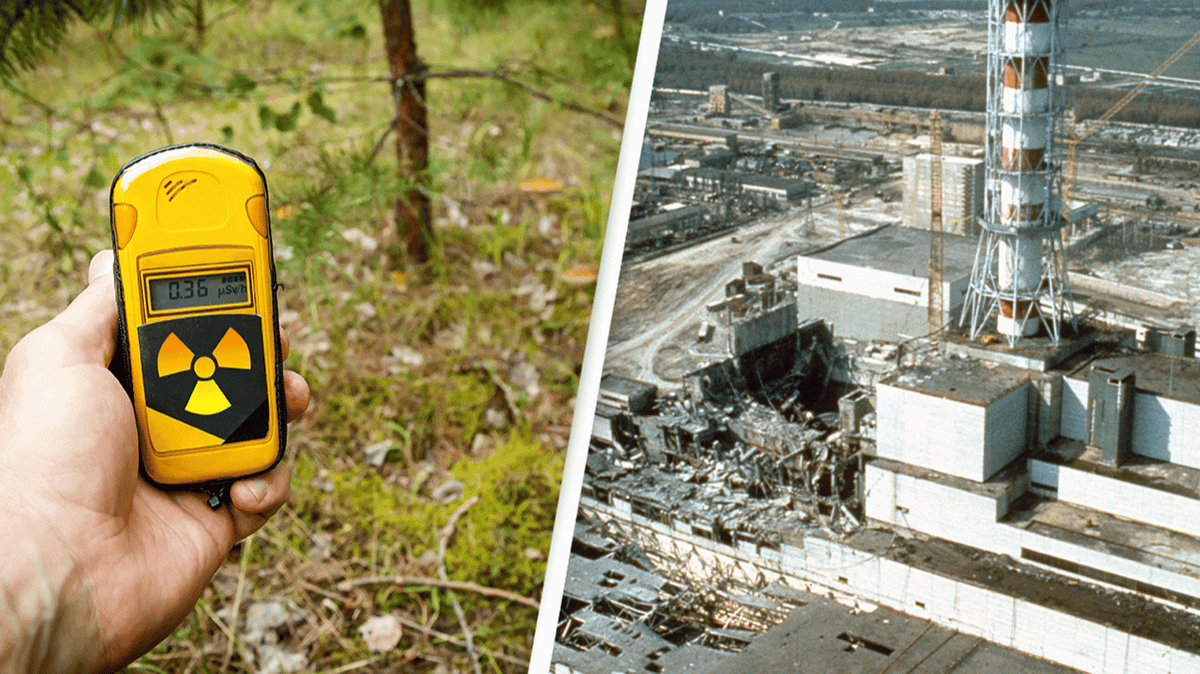
Fungus in Chernobyl nuclear disaster zone has mutated to ‘feed’ on radiation
The fungus, which has been found on Chernobyl's Reactor 4, has adapted to convert gamma radiation into chemical energy.
UNILAD
88 points · by thunderbong · 1y ago · 82 comments
> we cautiously suggest that the ability of melanin to capture electromagnetic radiation combined with its remarkable oxidation-reduction properties may confer upon melanotic organisms the ability to harness radiation for metabolic energy. The enhanced growth of melanotic fungi in conditions of radiation fluxes suggests the need for additional investigation to ascertain the mechanism for this effect.
https://en.wikipedia.org/wiki/Project_Hail_Mary
Good, fun book. The main protagonists are a bit too inventive and quick to do solve, fix things. But in all fairness it's SF after all.
It looks good, big budget with Ryan Gosling as MC
Later on, one of the characters sees the face of Pope John Paul II in the poop and the owner of the spaceship (who was supposed to be played by Jack Black but instead Josh Gad ruined the entire series) sends up a laser light show to illuminate the dookies in space.
We're going to see an increase in plastic metabolizing bacteria as well, so eventually our plastics will 'rust' and degrade faster.
https://big.ucdavis.edu/blog/plastic-eating-microbe
https://en.wikipedia.org/wiki/PETase
November 4th : https://www.sciencedaily.com/releases/2025/11/251104013023.h...
> Beneath the ocean’s surface, bacteria have evolved specialized enzymes that can digest PET plastic, the material used in bottles and clothes. Researchers at KAUST discovered that a unique molecular signature distinguishes enzymes capable of efficiently breaking down plastic. Found in nearly 80% of ocean samples, these PETase variants show nature’s growing adaptation to human pollution.
https://news.ycombinator.com/item?id=45886479 ("Widespread distribution of bacteria containing PETases across global oceans (oup.com)"—1 day ago, 72 comments)
(The new $300 iPhone thong is made of PET (polyester), so, it's reassuring to know the universe does have the capability to unmake those).
What plastic is there in a road???
Earth had a plastic like problem before. There were no fungi that eat cellulose so dead trees were just piling up without degrading. Those trees turned into ~petroleum~ coal that we consume now.
That trees somehow turned into ~petroleum~ coal, I learnt in school. I used to imagine trees were somehow buried under stand suddenly and before they could be degraded they turned into ~petroleum~ coal under heavy pressure.
> The world at beginning of the Carboniferous period was a humid, tropical place. Seasons, if any, were indistinct. The Carboniferous trees and plants resembled those that live in tropical and mildly temperate areas today. They grew in wetlands and were shallow-rooted. This, combined with their great height and ponderous weight, was a bad combination, because these enormous trees would regularly become uprooted and topple into the marshy ground, landing on other trees that preceded them.
> Here is where fate steps in. Although trees had evolved lignin and cellulose, no bacteria that could digest these woody substances had yet evolved. In fact, those bacteria would take another 60 million years to evolve. All this time huge trees kept growing, crashing into the swampy ground, and piling up on top of uncounted other trees, getting buried deeper and deeper into the ground. Over millions of years, subjected to the heat and pressure of deep burial, the carbon in these trees was converted into the fossil fuels we know and love today – coal, oil, and natural gas. All the fossil fuels we use were produced during this 60-million year period.
Meanwhile we got plastic-eating bacteria after like 100 years.
Also there's the risk that we accidentally release some genetically modified bacteria and they prove to be hardier than expected.
I read too much dystopian sci-fi to write much else, but in truth, I have pretty high hopes for these garbage-eating microbes.
From memory; a scientist created a breed of bacteria that could digest a special food-like plastic, which was accidentally released, but sporulated as their special food source could not be found in the environment. Decades later, a product company introduced "bio-degradable" plastic for greener packaging, which happened to be similar enough to their original food source that the bacteria were able to feed on it. Unfortunately for humanity, plastic itself was also much more widely distributed in the current year, and the bacteria was able to make the jump from eating this plastic to eating "any" plastic. (For added drama, this process also resulted in the release of explosive gases - methane, maybe?)
Also perhaps related, I also picked up The Last Gasp[1] at the same book sale, another speculative sci-fi about global warming. It was very influential on my preteen mind.
[0]: https://www.goodreads.com/en/book/show/2368220.Mutant_59
[1]: https://www.goodreads.com/book/show/1685500.The_Last_Gasp
That could only have been on land, or in the very top layer of the ocean (because they don't pass through water).
So where in earth's history do we have a period where a large landmass had sufficient wattage in high energy gamma rays? Or at the very least a lot of UV rays, enough to damage/kill normal life. Such a place would otherwise have been very unhealthy for almost all life, as it destroys DNA.
A Black Fungus Might Be Healing Chernobyl by Drinking Radiation - https://news.ycombinator.com/item?id=43148355 - Feb 2025 (10 comments)
Fungus at Chernobyl absorbs nuclear radiation via radiosynthesis - https://news.ycombinator.com/item?id=24166994 - Aug 2020 (104 comments)
Radiotrophic fungus - https://news.ycombinator.com/item?id=20342750 - July 2019 (63 comments)
Chernobyl Fungus Feeds On Radiation (2007) - https://news.ycombinator.com/item?id=6763520 - Nov 2013 (53 comments)
Black Fungus Found in Chernobyl Eats Harmful Radiation - https://news.ycombinator.com/item?id=127626 - March 2008 (1 comment)
Like algae?
It sounds like humans, from the description. Not sure if that was the joke.
>As the environment at that depth is so much like the early Earth, it may indicate what types of organisms existed before there was an oxygen atmosphere. Billions of years ago, some of the planet's first bacteria may have thrived in similar conditions. https://en.wikipedia.org/wiki/Desulforudis_audaxviator
No. Radioactive materials decay at the same rate no matter what you do to them.
> the effects of the uranium is largely mitigated
Very different from decaying faster. It's possible that by covering it in algae you block the radiation from escaping. But the algae is still going to have to sit there for 10000 years without moving before the waste is decayed. You're better off sticking it inside lead.
The chemical process obviously has to differ considering gamma radiation has enough energy to knock off electrons, but once you deal with that, it's energy ripe for the taking. I'm not shocked that life finds a way to harness that energy where abundant.
In fact, had life come about on an Earth with a weaker magnetic field, it may have relied more on gamma radiation than visible light, especially considering the larger potential amount of consumable energy present in gamma rays.
Apparently trees used to lay fallen on the ground for millions (?) of years before fungus evolved to eat them, and since then there has been no new coal.
(I may be wildly off on the specifics but that is the gist I got from reading stuff here and there)
I swear fungi are the coolest and most "alien" lifeforms on this planet next to cephalopods ଳ
Or they're the original and we're the alien
Pretty neat.
There's a lot of complexity in fungal physiology and research has barely scratched the surface.