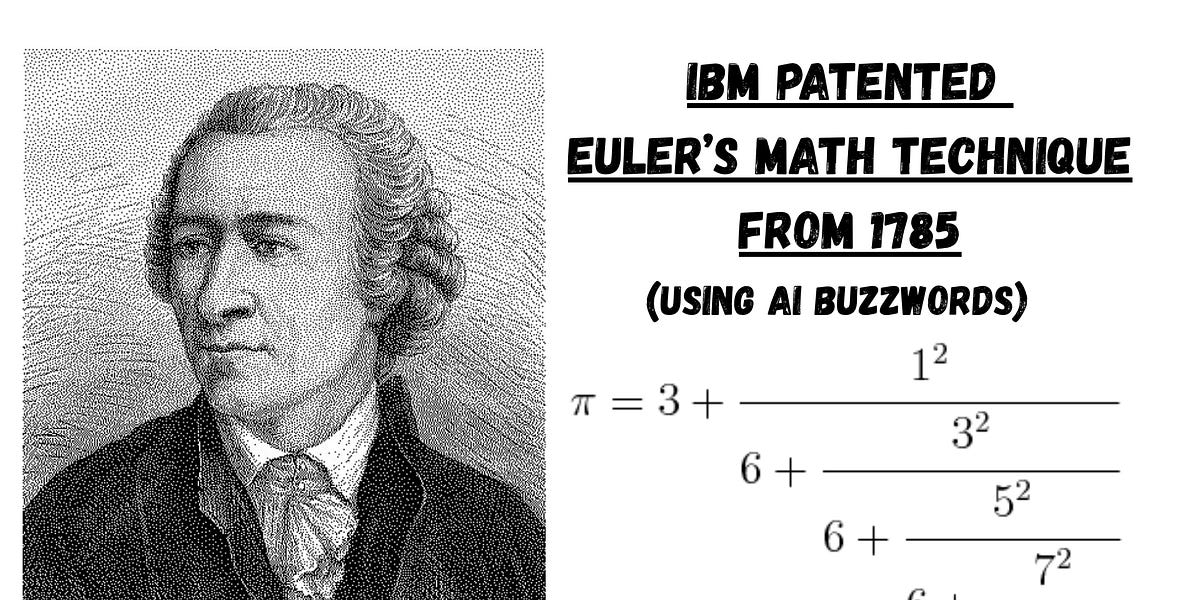
IBM Patented Euler's 200 year old Math Technique
IBM Slapped the Buzzwords 'AI Interpretability' on Generalized Continued Fractions and their Series Transformations and was awarded a Patent
leetarxiv.substack.com
172 points · by busymom0 · 1y ago · 67 comments
Show me one useful software patent that (a) is not "obvious to one skilled in the art", and (b) benefits society by being granted a monopoly. Just one!
Software rarely requires expensive research that would be worth protecting. Rather than enabling a fair market, this takes fairness out of the market.
Software patents are like getting a patent on "Murder story with final revelation of who did it." Maybe add one or two features, like a "detective with hat", etc. In one fell swoop you would be able to own most murder mysteries.
Software (like books, stories, art, etc) is better handled by Copyright law. May the one who actually has a better product win!
Sorry for the rant.
Software patents are stupid, and even more so with AI soon to be able to take arbitrary compiled code and produce readable, well composed source in a target language with documentation and optimizations.
Studios and platforms and funds and giant corporations that "own" terabytes of IP are a cancer.
We're going to have to fix copyright. Until then, pirate everything.
I was originally named on a patent filing (along with the CTO), but left the company and apparently it was too much effort to communicate with me so they just swapped my name for another engineer. But it was literally my idea (in as much as any such software patent is one person's idea). I was literally given a problem to solve and came back with two alternative solutions to implement, without conferring with anyone else at the company or elsewhere. The only input from anyone else in the company was selecting one of the two options, which I then fully implemented entirely myself.
Not only have I always disliked software patents on principle, I was also cheated out on having a patent to put on my resume. (Heck, it was hardly my best idea and for all I know the company patented a bunch of my other work without citing me.) Which is pretty much their only value--as social currency for hiring or highly specious pretend asset security for VC investments.
Technically, removing my name from the filing invalidated the patent, but it's all just a ridiculous shell game.
Even if these things were novel at one point, doing them again in software is not novel.
I want to know about these patents that you want your name off of! What were they for? Why do you want your name removed? This is the opening to a great story, please tell!
A good portion of the perception and use around patents is the word "awarded", which implies that there was some evaluation, either objective or subjective, by an expert in the topic and that the invention met some high level of… something that made it worthy of being "awarded" for the "work" that it took to invent. Most parents are not evaluated like that today, and software patents specifically probably never have been.
we've been through several such cycles - "...on computer", "... on Internet", and now " ... with AI" .
(of course i have several, including couple with AI, and i'm against patents, especially software ones)
Secondly, we already have that in limited forms with trademarks and copyrights.
Thirdly, I think the concept of intellectual property is one of the most brilliant social innovations in the past 500 years, as it aligns incentives to innovate (why would I innovate if someone will just steal my work?).
Patents are propelling the society when they work as intended. They made XIX century and at least good chunk of XX century. Without patents, people fall back to copying each other, because it is much easier to copy than to innovate.
Instead a wide range of factors like better plants feeding both population growth and an ever larger percentage of society could do something other than grow food where the real root causes here. Devoting land and labor to cotton for example requires a surplus of food.
The "more" is basically busywork for lawyers. We effectively have patents for software itself.
This is probably the only argument I've seen in favour of software patents in which I see any merit!
otherwise I agree, copyright is the way to go.
And even if that weren't the case, nobody needs to be given exclusive rights to math. In principle the law says as much, but in fact that's never been an obstacle.
In modern software terms, to me, that means any software patent should be open sources, and they aren't, which is a worst of all worlds sort of thing.
Unfortunately, there are probably many people here on HN that make a living off software patents.
And that patent got invalidated in most of the world anyway.
that's a bullshit criterion, and nothing about what you said applies to software in particular.
it's generally agreed that monopolies are bad for society, but patents only grant a temporary monopoly to reward innovation, in exchange for which society gets disclosure (at the time patent systems were promulgated, many ideas died with their inventors as trade secrets) and encourages more R&D by creating a system for payoff.
But disclosure is rarely an issue with software, and patents are bad at properly disclosing software details in the first place.
And in software there's already a huge motivation to do R&D, while patents are more likely to block useful work than in most fields. Even if I think of highly optimization-motivated fields like video encoding, patents slow down innovation more than they accelerate it.
So can you name some software patents where those motivating factors actually worked? It's a fair question.
> But disclosure is rarely an issue with software
patents require disclosure. patented software requires disclosure. if you are saying that software is often disclosed (open source vs "rarely an issue"? you weren't specific) that doesn't mean you get a free ticket for some other restriction, and open source was not common when software patents were granted.
>So can you name some software patents where those motivating factors actually worked?
I'm not sure I believe that the patent system works to do that. But it is absolutely true that trade secrets can die with their owners an that society benefits from disclosure. I'm not here to defend the patent system. I'm here to say that you did not do a good job of arguing against software patents.
An example of a software patent that I think is fundamentally "solid" is public key encryption. Some people thought of it, they developed it, it is at least as novel and clever and non-obvious as the cotton gin, so if the cotton gin should be patentable, public key encryption should also be.
but I'm not here to defend patents, I'm just saying that you are not moving the needle.
Applications are seldom withdrawn or ultimately rejected altogether, but may be granted with severely narrowed claims. Also, you can revise the claims without changing the text, within limits, which results in granting of a patent with a very broad text followed by narrow claims
For a rather unpopular definition of "seldom", sure.
https://patents.justia.com/patent/20230401438#history
> A method, a neural network, and a computer program product are provided that provide training of neural networks with continued fractions architectures.
It's a bit like the propelling device https://patents.google.com/patent/US1331952A/en -- it doesn't invent or patent shoes, or invent or patent springs, but it patents attaching springs to shoes.
It would seem using continued fractions with elliptic curves what the author wants to do, wouldn't be covered.
However, I still think it can still be challenged if someone can show that continued fractions have been used in with NN before. Or even better, maybe pytorch or other open source projects can explicitly reject crap that's patented. If you put your shit in a junk patent, take it out of the project and enjoy yourself, don't spread it around. So, if the authors of the patent are the ones pushing for the inclusion, then someone should challenge that and have it removed unless the patent is withdrawn.
Ofcourse, patents are trash.
RTFC: Read the Fucking Claims
The claims are the only part of the patent that really matter because those are the only enforceable language. Plus, this is a patent application so the claims have not even been examined yet.
Without commenting on the merits of this patent itself, remember that new applications of existing techniques are still novel, and hence patentable. In fact, if you think about it, almost all inventions and innovations are just applying novel combinations of well-known techniques to new use-cases. (Anything that doesn't fit that definition and introduces genuinely new methods is usually in the "groundbreaking" category.)
So I'd guess "applying old technique to new problem" is probably the case here. I'm no subject matter expert, and there may be prior art that invalidates this, or it may not meet the non-obviousness bar... but when the "200 year old math" came about neural networks were not really a thing.
Most large companies pay you a bonus when a patent is filed, when it's granted and when it's licensed.
It's one of the few ways to change your income on such companies as a technical person.
If the objective is to maximize investment by protecting successful results, I don't think our system is doing a very good job.
Also, this might be tangentially related to Fractan. Any Mathematician there? if there's some relation, the patent might be void/null.
For many years I had to install a linux distro and then mess around with freetype because there was a valid patent on subpixel hinting that was valid in the US and irrelevant in Europe but because the distro's I used at the time where US based I got caught in the cross fire.
Given the huge imbalance between US tech and Europe Tech (and rest of the world really) in software they sneeze, we get flu.
That only stopped been a problem when the patents expired[1].
Another one was Lame and MP3. And I remember the codecs issue with the Penguin Liberation Front for Mandrake, LIVNA for another distro and Debian Multimedia, among others.