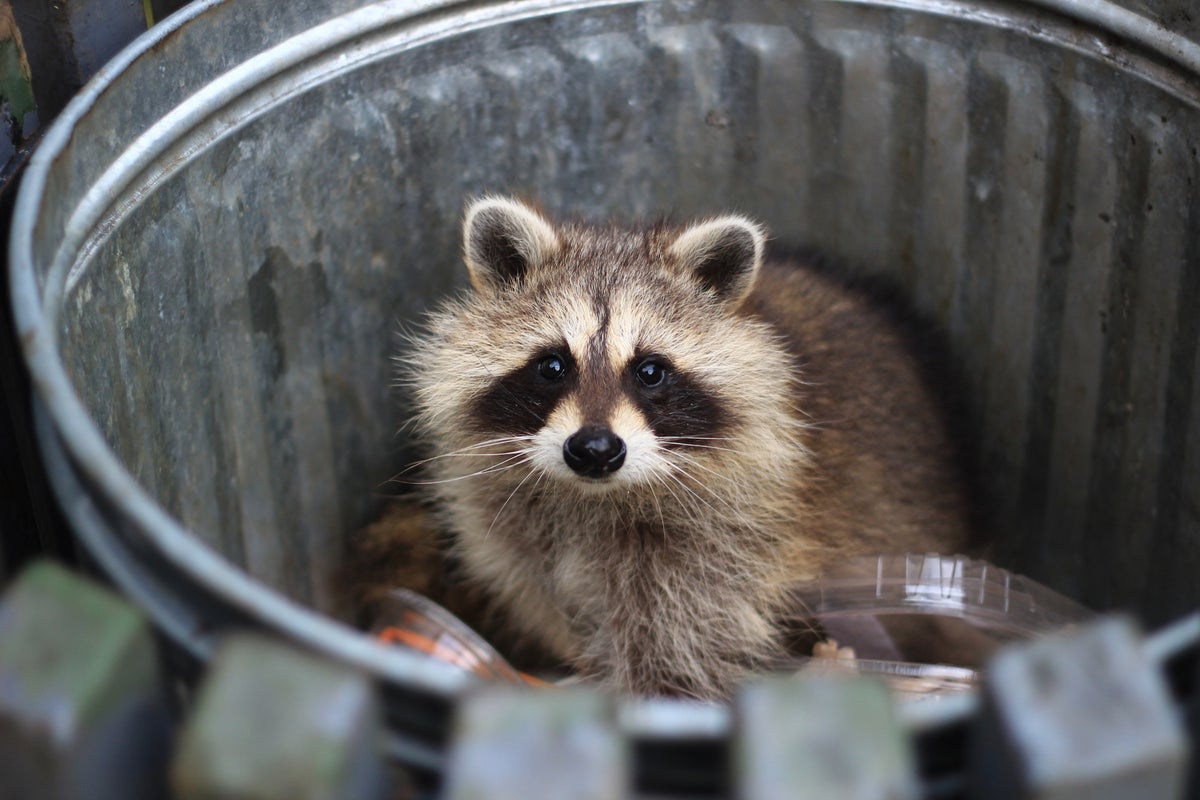
City Raccoons Are Evolving to Look More Like Pets
City-dwelling raccoons seem to be evolving a shorter snout—a telltale feature of our pets and other domesticated animals
Scientific American
258 points · by pavel_lishin · 1y ago · 220 comments
From what I remember spending time on this topic, raccoons need super challenging locks as toys and TONS of engagement from their keepers because they get bored easily and bored raccoons == ultra destructive raccoons. Also, rabies.
The biggest challenge is that they basically have hands. He would climb up the kitchen cabinets, grab a box of cereal, open it up and sit there eating out of it like a toddler.
We only had him for a few months before reintroducing him to the woods behind the house. I've wanted a pet raccoon again ever since.
Camping I heard a crunching sound, looked out from the tent to see a racoon helping itself to granola in the back of the car. Lock your doors.
If we can set aside ethics, it would be interesting if the result was a truly good life long pet. They are so smart.
I've wanted a pet raccoon since I saw this on TV in the '80s, and raccoons aren't even a thing in Europe :(
(I mean, there's good reasons my country does have those laws, and I don't _really_ want to have a wild animal as a pet, but I kinda do.)
They not only get bored they get very particular with who in the family they enjoy following. Which can cause even more havoc when someone gets upset the raccoon doesn't want to be around them. One particularly funny story was a customer's kid (Business was attached to the house) begged and cried to be let hold the raccoon. We all knew it was a bad idea but Grandpa caved to the customer's demands so the kid would shut up. The racoon gladly let me hand her over to the kid, crawled up on the kids shoulder and proceeded to shit from one shoulder to the other then immediately jump off and return to my shoulder to glare at the kid. Never again did we let anyone outside the family touch the raccoon until we gave her up to a local zoo for use in educational programs since she was fairly well trained to behave for treats.
Here in Washington state for example there have been no documented cases of rabies in any wild raccoon in at least 60 years. Same goes for all other wild terrestrial mammals here.
Rabies is neither subtle, nor slow.
Because it sucks less than dying of Rabies and boy you don't want to know how low the bar is here
The most coherent take I've read on it is that there actually needs to be an evolutionary advantage for the species in order for the domestication to work out, which means it's essentially something that needs to take place over generations. Raccoons being cute and fluffy might be a reason that we would like to have them around, but I think the larger question is whether there's a good enough reason for them to develop a lifestyle where they hang around indoors with humans. Putting it in terms of evolution also can help clarify why the personality characteristics you mention aren't a simple obstacle to overcome; the fact that they might be better off as a species in the long run if they could just immediately switch over to being a type of house pet like a cat or dog might not be enough if the path to that from where they are now requires significant "downward movement" from a local optimum in the short term for the adaptions start becoming more advantageous so that the can reach a higher optimum.
It astounds me, that government still doesn't want to kill say 20k of these invaders.
If they were domesticated, you’d just get them vaccinated at the vet.
> Raccoons are a rabies reservoir in the eastern United States, extending from Canada to Florida and as far west as the Appalachian Mountain range. Within these areas, 10% of raccoons that expose people or pets have rabies, making them one of the highest rabies-risks in the United States.
https://www.cdc.gov/rabies/php/protecting-public-health/inde...
I don't understand the language of this quote. What does it mean for an animal to expose people?
I wonder if increased interactions between humans and raccoons will lead to a reduction in that 10% figure (more reasons to bite humans).
It's possible they botched the grammar here a little, but my interpretation is saying that if you look at the group of raccoons that allow themselves to be exposed itself to a human or pet (rather than avoiding us, which is not that hard for them to do it they want), around 10% of them have rabies.
If a breach occurs they also will trap raccoons and vaccinate them by injection in the area of the breach.
Raccoons while cute, smart, interesting, etc., should not be considered as pets as long as this parasite exists.
Hmm, so evolutionary pressure of existing around humans makes animals cuter.
I wonder why we find these features endearing?
I no longer have the book on hand, but read a few months ago that this correlation between juvenile traits and domestication was one of the main theses of Barrett's "Supernormal Stimuli" in Chapter 4. She cited a few studies of fox domestication [1], [2] and other works to support these theories.
[1]: https://courses.washington.edu/anmind/Trut%20on%20the%20Russ...
[2] https://www.cell.com/current-biology/fulltext/S0960-9822(05)...
Daytime, larger animals (e.g. sheep, goats, or even rabbits) have a larger chance to be domesticated as food.
Those features activates the same areas of our brain that babies' faces activate.
Feeling that something is "cute" is the evolutionary way that our brain is using to make us care of our kids.
It's a side effect, evolution made sure we take care of our offspring.
Perhaps a combination of adaptableness, small size, prodigious reproduction, and cuteness saved some species from being wiped out whereas other species didn't fare so well once humans arrived and transformed their territory. Adapt to urban encroachment or face extinction.
Larger head-size relative to the body, larger eyes, smaller jaws and noses, longer limbs, etc.
Interesting parallels across species towards less aggression, greater pro-social behavior, more physical traits that shout "trust me, I'm harmless."
Almost like pro-social, intelligent team co-operation is a huge advantage compared to solo predatory behavior.
Among domestic cats, there are Persian cats and Sphinx cats.
Racoons, especially in the city, will kill and eat an older housecat or easy to access domestic chickens without hesitation.
Declawing them helps, but nature happens when a declawed racoon feels a call to roam and is outmatched by even a small hawk or possum.
Some chickens made it, most in fact. But playtime involved ripping the heads off 3 of them.
They can be quite sinister.
One was kept as a pet in Jamestown Virginia in the 1600s. Another lived in the White House in the 1900s. Surely, not a decade has passed between have there been NO domesticated raccoons in the US? If living near humans changes animals, that started at least 25,000 years ago here in North America. Not recently.
My neighbors had a pet raccoon growing up. It lived inside but would come and go.
The people who wrote this article seem out of touch with the topic they chose to pretend to be experts about?
An animal of wild parentage that was raised by humans is tame but not domesticated. So no, there's aren't really domesticated racoons, only tame ones.
Domestication is a process that takes many generations. It is a selective breeding process more than anything else. Animals that are 1 generation away from wild ancestors aren't domesticated, by definition.
And the last category is feral animals, "that live in the wild but are descended from domesticated individuals.".
This is quickly becoming the norm for experts, unfortunately. I keep seeing more an more people with educational expertise in something that they have zero hands-on or practical experience with.
I remember being at a social event once and chatting with someone who was a business professor at any Ivy League university. Making small talk, I asked him which companies he'd worked at, and he told me that he had gone the academic track and started teaching during and after getting his PhD (in exactly what I don't remember). I remember being stunned that students would pay over $60k a year to learn about business from someone who'd never worked for or started a business.
Were you stunned that your parents paid lots of money to put you in front of educators from kindergarten to college?
Why would you restrict yourself to learning from one businessman when you can get learn from an educator who has distilled the experiences of hundreds if not thousands of business people?
(MBA, anyone?)
It primarily says they can now observe physical changes associated with domestication.
Also, keeping a wild animal as a pet does not domesticate it.
Domestication, in the way that we see having happened with dogs (and cattle, and chickens) takes a really long time.
We consider cats “domesticated” and yet demonstrably they are not. If they were much bigger, they’d eat us, and if set into wild, nearly all household cats immediately revert to feral.
I owned five ferrets once. Loved them so much, but came to the realization that there are animals that should be pets and animals that maybe shouldn’t (yet). I think we have many, many more generations before raccoons are at the same level as dogs.
I'm sorry your experience with cats hasn't been as pleasant, but I assure you they are much more domesticated than chickens - which you seem to have little experience with. Screw eating us - they'll eat each other.
I also have 2 cats, having had 2 prior. They’re great. But it’s just science that they are not fully domesticated.
I also lived on a farm as a kid.
So let’s not make assumptions to prove an incorrect point.
As crepuscular animals, they are very, very afraid of humans.
(I'll convince you all to get pet rats eventually!!! :))
Consider the statement above that tame raccoons need "TONS of engagement from their keepers because they get bored easily". Breeding that out means essentially a less curious, more complacent animal. Cows and sheep that easily figure out how to escape their paddocks are a liability.
Which category do you think is more clever: Wolf and coyote; or pug and chihuahua?
dog breeds considered "clever" often more closely resemble their wild ancestors. And they are often not "easy" breeds to own.
Cats can vary wildly. One of my cats seems dumb as a box of rocks and haven't even grasped the idea of object permanence. If she's tracking a laser, and I move it around a corner, she can't figure out where it went. She goes from intense staring and tracking to standing up and looking around, confused. When I bring the laser back around the corner, she's instantly back to squatting and tracking it.
Similarly I've seen cats have one of two reactions to a mirror: ignoring it entirely or actually using it by e.g. looking me in the eyes and meowing at me through it. While I've not witnessed it personally on the internet there's also tons of videos of cats freaking out and trying to fight the other cat in the mirror.
This supports the idea that the gamut of intelligence in cats is quite wide.
Occasionally, he'd demonstrate the ability to plan too. When he started to get territorial and start fights with neighborhood cats, we started keeping him inside. Naturally, this didn't sit right with him. After watching someone enter the house every day in the evening, eventually, he would perch next to the door in the evening waiting to bolt out the moment the door opened.
Dogs are social animals that have evolved to be human companions a long time ago. This is why they are "trainable" and, therefore, seem more intelligent.
Cats are not; they are extremely good hunters that by and large tolerate humans in exchange for easy access to food and water. You can't really train them, but they will find hiding spots you didn't even know existed and you will NEVER have problems with mice with one around.
Donkeys have a reputation for being stupid and stubborn because they're smarter than horses. Too independent for easy training, and will refuse an idiotic command.
This is exactly what a dog would say.
Does the scent gland do anything more than just stinking? For a cat, removing the claws literally removes bones from them. It limits their mobility and hurts like hell.
(Not that I want a pet skunk. Just curious as to why it's unethical)
It's part of their communication system. There's no direct corollary in human qualia, but you might say it's akin to permanently destroying your ability to flirt or tell other people that something belongs to you. You would still experience the impulse, but not have the cognitive equipment to do so any longer. Removing scent glands destroys the physiological equipment, of course.
The practice has been banned in the UK for almost 20 years, under the exact same laws as ban declawing cats. It's unnecessary mutilation with no medical justification.
Would they have to measure "biological" friendliness, comparing lab raised countryside-descended and city-descended raccoons? Domesticated animals can be very unfriendly. Feral cats for example.
The raw meat is even smelly.
Edit: Dexter did say that, after a few days of aging in the forest, the flavor improved considerably. He was even willing to share.
FYI, Kassel kinda is the so-called capitol of raccoons. 30k+ raccoons life there, according to estimates.
I certainly would not want to live there. It is crazy how these animals flock together and invade properties. And they aren't shy anymore due to the reverse positive reinforcement they receive by not killing them.
Yes, it is of course in Germany forbidden to kill an invading predatory species - even on your property. This is Germany 2025.
https://www.youtube.com/watch?v=5DJXsI_A5DU
https://www.kassel.de/buerger/sicherheit_und_ordnung/tiersch...
I can’t get my head around how such big animals manage to live all around us in such densely populated place. I suppose it helps that they are cartoonishly adorable.
But they are increasingly getting really, really big. It’s just a matter of time before the chonker living in my neighbour’s shed bullies me out of my house.
Example: https://www.cbc.ca/news/canada/toronto/raccoon-resistant-bin...
Curiously, that raccoon population was established legally and intentionally in the 30s to bolster local fur production; later efforts to eradiacte the animals (for being pests from an agriculture perspective) have been given up.
Damage to local ecosystems seems fortunately pretty limited, even though the raccoons are highly successful and spreading.
This is blatantly false.
The nandus that are living in the north can and are being killed for exactly this reason: https://de.wikipedia.org/wiki/Nandu#Wilde_Population_in_Nord... (https://en.wikipedia.org/wiki/Greater_rhea#Distribution_and_... for a shorter paragraph in English)
I guess there is a more nuanced reason for not killing the raccoons in Kassel.
> Es gibt viel zu viele Waschbären, um mit den erlaubten jagdlichen Mitteln im städtischen Umfeld eine nachhaltige Bestandsreduzierung bewirken zu können, denn Waschbären können hohe Verlustraten durch vermehrte Fortpflanzung ausgleichen. Je mehr Waschbären getötet werden, umso mehr Jungtiere kommen nach. Die vielen Jungtiere machen aber unter Umständen mehr Probleme als die Alten, und die Gefahr einer Ausbreitung von Krankheiten und Parasiten wird durch die abwandernden Jungtiere erhöht statt vermindert.
> There are too many raccoons for permitted hunting methods within an urban context to have a sufficient effect on population numbers as raccoons react to high death rates with increased breeding. The more raccoons are killed, the more young are born. The large amount of young raccoons can create more problems than older animals, and the danger of spreading disease and parasites is increased as young animals roam from established territories.
tl;dr: you're not allowed to just randomly shoot shit in urban areas because duh, the population is too large for trapping, and the raccoons are just gonna fuck more and then go a-wandering, making everything worse.
Along with 200k+ of the most violent species on the planet: humans.
Raccoons can and are hunted in Germany, what are you talking about? The federal laws regarding hunting don't mention them and thus allow states to decide. I haven't checked every states local laws and executive orders, but I'm not aware of any that don't allow hunting raccoons.
It's pretty interesting to see their Instagram stories.
On Facebook, there's been this running gag/joke/meme/whatever going for at least the last year, where anytime the official North Carolina Wildlife Resources Commission page posts anything, a large portion of the comments quickly turn into a discussion of the merits (or lack thereof) of pet raccoons[1].
I don't know exactly how it started. Somebody innocently asked "How do I get a permit for a pet raccoon?" and the page replied "You can't, they are illegal in NC" or something prosaic like that I imagine. But it became a big "thing" and now raccoon talk is everywhere. The page controllers play along with it, which is part of why it's kept going so long I guess. But sometimes they'll get semi-serious and post something like
"Look, all joking aside, the reason pet raccoons are not allowed is because no matter how friendly raccoons look, they are wild animals, not domesticated, and they can be a hazard to you, and your family and <blah, etc, etc>".
Soooo... I'm just waiting to see somebody post this very article in a comment on that page with a note saying "Suck it, NCWRC!" (all in a spirit of good fun, of course).
[1]: or one or more of another of a small set of topics, including flounder, pet alligators, armadillos, UFO's, and the possibility that the person running the page is the product of secret government genetic engineering experiments involving "all of the above". It's... complicated.
EDIT:
Welp ,that took about as long as I expected. ROFL.
Could domestication happened simple because we human expand too much?
I like your dogs too, and ain't no way I would disrespect them... Pets are not food sources. But a coon.. . They seem nice enough until they fight over food ... Then they become _ <- insert unfavoroable political party.
Weird question. My preconceptions don't overrule my tongue. (And the answer is: hairy. Very hairy.)
Tuna tastes delicious. But you may be right about mammals.
Tasty, no.