Scientists now know that bees can process time, a first in insects | CNN
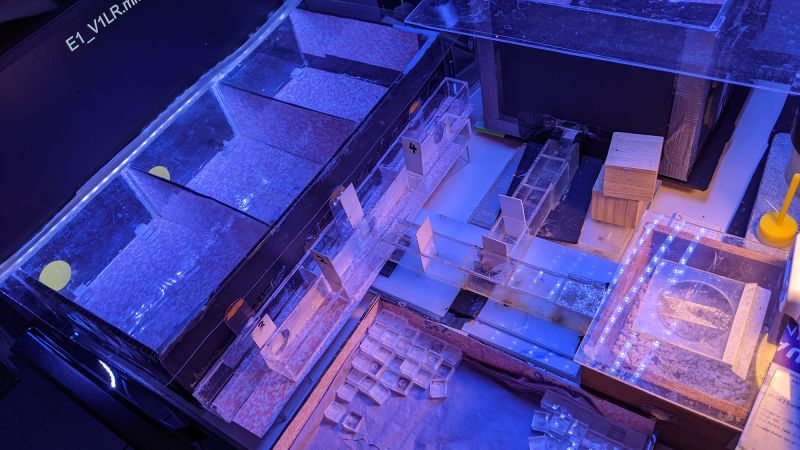
Bumblebees can process the duration of flashes of light and use the information to decide where to look for food, a new study has found.
CNN
221 points · by Brajeshwar · 1y ago · 128 comments
They can count https://news.ycombinator.com/item?id=21222227
Bees play https://news.ycombinator.com/item?id=33369572 https://www.science.org/content/article/are-these-bumble-bee...
All of this reinforces my belief that nearly everything is conscious and aware, we differ in a capabilities and resolution but we are all more similar than we are different.
Spider Cognition: How Tiny Brains Do Mighty Things https://news.ycombinator.com/item?id=46003146
Watching new calves play in spring meadows is one of the most purely joyful things you can ever see. They have best friends and will avoid playing with other calves until their friend comes to play with them.
They are fellow sentient beings capable of experiencing pleasure, pain, fear, and forming social bonds. It's a lot of why I take issue with anthropocentrism, and think factory farming is an absolute tragedy. It's the industrialized denial of a meaningful life and one of the biggest examples of human cruelty.
We had pigs for one terrible year. Pigs know when the electric fence is down because the sociopaths regularly push each other into it. I think they do it to a) test the defense and b) because they're bastards that enjoy watching other creatures suffer.
I hate pigs entirely, by the way. We raised them for one year and decided they weren't worth the hassle. They're the worst.
Sunburns.
I have no idea
Still, though... bivalves?
Societal dogma aside, I think this probably applies to all critters, including within species, including us.
Or. . . The encroachment of suburbs in currently rural areas means coyotes and pets come in contact. . .
Also I still live on the farm. And animals here can be dumb as hell as well. Our neighbors miniature donkey regularly escapes, just to get his head stuck in the fence trying to get to his food trough from the outside.
That said, wasps are still quite intelligent for insects with regarding to spatial memory, individual recognition, learning, problem-solving, and social cognition. In fact, their intelligence is comparable to honeybees in many respects.
Contrary to popular belief, wasps are not mindless aggressors, their defensive behavior is calculated based on threat assessment. :)
I recently read that honey bees in particular get the most attention from humans lately, so they are kept in high numbers.
This has some adversarial effect on other pollinators, which hurts ecosystems more than it helps.
[1] https://www.usgs.gov/faqs/what-role-native-bees-united-state...
[2] https://www.scientificamerican.com/article/the-problem-with-...
Can you provide me more specifics on this by the way?
> This has some adversarial effect on other pollinators, which hurts ecosystems more than it helps.
What are those adversarial effects, what other pollinators, and how does it hurt the ecosystem more than it helps?
I do not mind bees having kept in higher numbers, and beekeepers can do it anywhere without affecting the ecosystem, I believe.
Are you vegan?
I also keep my dietary preferences very low key. In a social setting, if I accidentally eat something I try and avoid, I don't make a fuss.
Thank you for responding also. I felt like you were someone who had similar values just through the subtext of your response and I was curious if we aligned.
How and why you draw the line on what is acceptable to kill is mostly arbitrary
I’d argue a mushroom or a bee are more “conscious” than most chickens
There are more nuanced ways of thinking about this. A good example is Jainism's version of vegetarianism which requires paying attention to what one consumes.
https://en.wikipedia.org/wiki/Jain_vegetarianism
"Jains make considerable efforts not to injure plants in everyday life as far as possible. Jains accept such violence only in as much as it is indispensable for human survival, and there are special instructions for preventing unnecessary violence against plants."
lmao
Some would argue that "consciousness" is something non-physical that has no impact on the physical world, and so is not physically detectable or responsible for any behavior, but I feel then it inherently cannot be whatever we mean by "consciousness" that we're directly aware of and talking about in the physical world (because that itself is a physical impact).
Insect wise, bees have to take the cake. Symbolic communication and counting, and now time. This all tracks for something that needs to share the location of food with the colony.
Nature sure is neat.
While ants have control over each limb, they mostly move by rotating two tripods one at a time. It's like they turn on an output for three legs, turn off the output, and then turn on the output for the other three legs.
Ants can walk backward, though, so perhaps it is more like a half-bridge rectifier with multiple channels.
They're like little organic ICs.
Just imagine how cool would it be to have programmable bees.
https://web.archive.org/web/20100612184109/https://nelson.be...
Neural Circuit Recording from an Intact Cockroach Nervous System https://pmc.ncbi.nlm.nih.gov/articles/PMC3969889/
Descending influences on escape behavior and motor pattern in the cockroach https://pubmed.ncbi.nlm.nih.gov/11536194/
Multisensory control of escape in the cockroach Periplaneta americana https://link.springer.com/article/10.1007/BF00192001
> "Ahhh! Why am I suddenly running and where am I going to steer this runaway body?"
I wonder if it's tied to the optical sensors to steer toward darker places.
https://news.ycombinator.com/item?id=40466814
I’m curious if this experiment actually tests for time perception at all or if it’s a very different effect that we attribute as being actual experience of time.
We have no idea what other insects can do this or when they got the ability. Sounds more like a first in Scientists. (tongue somewhat in cheek)
> The circles were in different positions at each room in the maze, but the bees still learned over varying amounts of time to fly toward the short flash of light associated with the sweet food.
Do not state, if the light suddenly changed in the rooms. If not, other factors might come into place.
To clarify, the CNN article asserts that this is the "first [discovered] evidence" that bees possess this capability, not that bees are the first insect to have ever developed this capacity, as the headline may suggest.
It was such a rare event that "evolution" didn't explain her more than simply mechanical response to something uniquely different that day.
— former beekeeper
There's this popular notion that humans are fundamentally different beings to everything else, which I believe is just a form of narcissism.
If intelligence is used to navigate the world, then it is derived FROM the world, and your role is to be able to use those facts in your mind to change the world.
I'm sure a wolf is as, or more, intelligent at surviving in the wild, with the tools it has, than your average suburban adult.
Wolves understand distance, time, sun-time light levels, resource economy, body-energy economy, they know prey behaviors, complex hunting tactics, the basics of sound transmission, they know about self security, seeking adequate shelter, they know the basics about fall damage and how that may relate to height/weight, they know how to step when running, they know momentum, etc
They absolutely do calculate a very very basic physics and animal psychology.
Because, essentially, beings know/are intelligent about the things related to their survival. They have to be, its their existence.
Therefore I speculate bees may know more about time than even this article suggests. And probably as well as sound transmission and perception and maybe even air pressure due to flying being such an important role for them. Maybe they also have a basic space-time vulnerability conception. They for sure have excellent home etiquette and social awareness.
Im sure having a tiny brain doesnt eliminate the basic physics processing capacity that all beings need, maybe it just makes it shallower.
* the vast majority (including me) are not really very intelligent. We have a lot of "state" that's transferred from generation to generation. Once in a while, a very small percentage of people make advances and they filter through society and improves (or maybe just changes) the state. We collectively gives humans credit for these improvements but it's not the species but those specific people who created that jump in capabilities.
* this notion of inherited pride or inherited achievement is very common. This leads to being proud of membership in a group (country, religion, tribe, corporation, university etc.) and also of instinctively rejecting ideas put forth by others (e.g. see the amount of derision vegetarians and especially vegans attract).
* achievement/progress is also time-scale dependent. While we get smug about our progress, if it ends up destroying the one planet we have, it will be incredibly stupid. Humans fundamentally are not capable of thinking long-term.
Everything around me was not made by me. I don't even understand how I would potentially make most of these from scratch without using machines made by other people or knowledge acquired over time (see first bullet above). Within the framework provided to me, I can convince myself to reason and act but the framework itself is my operating system. Of course, I like to think I am intelligent and reasoning but it's all in a box. I feel this describes almost everyone I know except for a few outstanding scientists I have worked with.
I have to quote one of my favorite thinkers here:
"Society does not consist of individuals but expresses the sum of interrelations, the relations within which these individuals stand." - K. Marx
This world knowledge is built upon piece by piece, the conceptual tools of the past create the conceptual tools of the future, that line is drawn through books and projected through minds, again onto books. This whole society depends deeply on cohesion and cultural continuation.
Our intellectual thread is the cultural knowledge and technological progress itself, its not even down to great individuals alone. I think believing in great individuals is a product of a sort of personality-fetishism (though individuals can do great things, if that makes sense).
This fetishism or mystification of the person who contributes I view as a product of an old frame of thinking which is called philosophical liberalism. This framework does this because it posits that all peoples exist under equal social value (political, legal and economical), thus people who contribute more must have a greater capacity that is innate and unexplainable or untraceable; inherent. Its a widespread philosophical frame of thought that does not consider the conditions of the individual.
We most see this employed with rich people. We hear they are truly great, savvy, exceptional individuals, when in reality a lot of the times the explanation for the vast majority of the rich is that they had rich parents. Where would you be if your parents owned an emerald mine? or Where would you be if your parents gave you a small loan of a million dollars?
In the same vein this human progress that we encounter, which seems to be carried on the backs of the Newtons and Einsteins of the world, is in fact a steady drip-feed of collective human knowledge that gets compiled and analyzed, made consistent and expounded upon by a few persons every certain amount of time. No lesser of a feat, mind you, the work is still there. I am not minimizing these persons, but contextualizing them.
[Insert the "on shoulders of giants" quote here]. Is a great example of humility and awareness by a visionary.
One thing I find impressive at times is the vast amount of German intellectuals throughout history, which upon looking at history can be explained by their colonial exploits leading to greater national wealth, leisure, and cultural amplification. This is often the case with Europe and the USA as well.
So there is a chance that we are all base-level intelligence, since we are all essentially the same species. What changes that is access to the cultural wealth of information, and not only access to this cultural wealth of information but a CULTURE OF ACCESS to that wealth of info. A level of social development around you that enables you.
People would rather immediately jump to physiological and even genetic explanations of intelligence rather than look at the social context of the individuals involved. This is because of the flaws of philosophical liberalism at contextualizing and actually scientifically looking at the world around us.
Again: there's a good chance that we are all just base level intelligence. What we know is actually different between us is the preparation and economic/social context of the individuals.
They walk up to it and wait a few seconds. If it doesn't open, they go off and do something else and try again later. They don't sit there and try to pull the machine apart.
This could be explained by hunger levels, though, and knowing that they are used to eating whenever they feel like that.
https://youtu.be/qWsBZbnt_4A?si=3AcS7IdGT41gF598
Professional nerds in silicon valley and beyond might consider whether they can help, and how.
My understanding from long conversations with a beekeeper who has lost millions of bees, including entire colonies remote from agricultural and residential pesticides and artificial colony technology (which are some of the hypothesized causes blamed) is there is a mix of a) pathogens, and b) global supply chain homogeny distributing the pathogens mixed into various agricultural products eg mulch and soil, and c) environmental factors to include possibly RF which have been observed to destroy previously healthy colonies very quickly and then also scramble or interfere with the colony division/expansion process where a queen starts over. To include in some cases the queens apparently getting lost and/or leading astray their entire swarm of minion bees during the fragile process of relocating. This getting lost is apparently a new puzzling phenomenon.
Anyway, it would be bad if large fragile ecosystems upon which many species including ours depend, were deprived of key pollinators. There is probably some very smart insightful person or team here on HN who could help and profit from helping on a global scale.
Edit. Typos
More professional nerds should be working on keeping bees healthy, but that's probably outside the purview of tech nerds.
We’ve known about the early bird since Ben Franklin’s day.
What is indeed fascinating is how scientists invent all these experiments
https://www.youtube.com/watch?v=9kQb-badp1s
This video made me change my approach to consuming animals - I realized that just because animals are dumber than humans doesn't mean they don't have real, meaningful life experiences. And I'd be a dick to deprive them of those experiences.
There's also some hypocrisy in us wanting hyper intelligent AI to have compassion for humans and the human experience even though we're dumber than it, but us not doing the same for animals.