180 points · by K0IN · 1y ago · 174 comments
Jailbreak stores have never felt like a particularly strong illustration of what's possible due to their tiny user market - I'd love to see what developers would do if even for a period we could use these devices to anything remotely like their potential.
But really, imagine how much power these things have and if you could actually run a free (as in freedom, in the GNU sense) OS on them and really get access to all that power in a handheld device. Only if.
I have an M1, which is like N-times faster than the laptop I write this on. Yet it collects dust because I'd rather continue to use this old dinosaur laptop because that M1 macbook is a locked down, very fast, shiny Ferrari, but I just want a Honda Civic I can do whatever I want with.
I'm pretty sure battery performance would drop significantly if root was too easy to achieve. The temptation to run "that one more background service" would be far too much for most apps, both free and otherwise.
To get good battery perf out of a device, you need to be extremely good at saying "no", even if that "no" comes at the expense of user freedom and features. Free software is usually extremely bad at this by design, although there are exceptions (Graphene OS comes to mind).
On Apple devices, core system services are written by Apple itself. That puts pressure on the software development side to care about battery perf, as that is what users want (and what increases sales). If software is written by 3rd parties with their own business goals unrelated to device sales, I'm afraid "featuritis" and lower development costs would win out over efficiency, as it usually does in such circumstances.
I would assume that an iPhone has similar amounts of unwanted background apps and would also be able to gain battery life instead of losing it if rooted. Obviously if you install spyware, you lose a lot of battery life. Funnily enough, I remember that a few years ago, people were surprised to find that uninstalling facebook increased battery life because it behaved much like spyware.
Well, except Android :P
My phone runs a build of AOSP that I compiled myself. I can go change the source code to do whatever I want (and I do). It's pretty cool that that's possible IMO. To be fair, the drivers are closed-source
When you just have to focus on a handful of hardware platforms and when you own the hardware and software, this becomes much, much easier.
No offense, but this is one of the most absurd things I have ever read on a hackernews discussion.
I bet if I could get root on iOS I would get even better battery life as I kill off services related to iCloud and other background processes I don’t want running.
> To get good battery perf out of a device, you need to be extremely good at saying "no", even if that "no" comes at the expense of user freedom and features.
There is zero evidence that this is the case. In fact saying “no” to root allows more services and things running on the device than I may want.
Skipping the "handheld" bit of this just for a second. You can run an (almost entirely) open stack on your hardware, and do so on an i9/9800X3D with 256GB RAM, 5080, and MultiTB of NVMe storage.
But it doesn't realy matter for 95% of users, because the hardware is already way faster than they need and the bottlenecks are on the server side and on shitty software architecture. I have an i9 with 128GB RAM for work, and Excel still takes 30+ seconds to load, Teams manages to grind the entire thing to a halt on startup, slack uses enough memory to power a spaceship... Running those apps on my desktop is pretty much the same experience as running them on my 10 year old macbook.
If it's a corporate device, it's usually some anti-virus abomination (or other security-related software) that steals 90% of the resources.
Which spaceship though? Not sure spaceship is the model you're looking for, as all of the ones I'm familiar have had a very locked down limited amount of memory. Apollo had something like 4Kb of memory. The space shuttle had 1MB.
Sure, iOS is certainly restrictive, fully locked-down, app store only etc etc, and I'd love a full-fat firefox with its plugin system available on my phone. But what are you doing on a non-Mac laptop that you can't do on an M1 mac?
I'm a big fan of linux and have used it as a main machine for many years, but use an M4 macbook as my daily driver at the moment (everyone else I work with does too, it's just easier). I haven't felt limited at all. I can build and install whatever I like, I have brew for my tooling needs...
Yeah I don't see it with Mac. Unless you're actually needing linux and dockerisation won't cut the mustard I guess.
You also get nice eBPF tools.
- The user interface and UX is pretty and all[1], but doesn't quite work as I'd like and I can't really do much beyond a few limited "hacks". Switching workspaces has a horrible and annoying animation I can't turn off. All applications windows are grouped together and for example some actions cause all of them to jump to the top. Top-level shortcuts are limited and I can't do the same things I can on Linux - eg, I bind Super+Enter to open a new terminal window, on MacOS I can kind get a janky version of that, but due to how the window manager works, it not as streamlined as Linux
- The whole notarization stuff and signing - I mean okay, security, great. But it's annoying and you have to pay Apple like $100(?) a year just for the privilege of developing software for their platform. When I did desktop app dev on MacOS, I had to do `xattr com.apple.quarantine` commands to turn off the security nonsense that prevented me from running our own app I or my coworkers wanted to test locally.
- I have a list of utilities/apps I need to install on a new MacOS machine just to get it to partially behave the way I want. Ideally MacOS should let me customize it directly with the necessary options so these extra apps aren't necessary. Nothing I'm asking is all that complicated - Linux environments provide it more or less by default with a few setting tweaks, even Windows behaves closer to what I want and I'm no fan of Windows.
- Recently I noticed MacOS was using bunch of CPU while idling - I traced it down to some background indexing scanning that was running constantly. I had to look up esoteric command line commands to stop it - which didn't work. I ended up disabling Spotlight almost completely to make it stop using my CPU every time I stepped away for a few mins.
Annoying stuff like this really puts me off of MacOS. Like I'm being forced to conform to their way of thinking and using a device. I'm an adult, let me decide for myself.
tldr; I just like Linux, it works, it's slick, I can turn-on/off, add/remove whatever I want. I'm not restricted to what some company thinks my workflow should look like.
[1]: I'm leaving out their "glass UI" blunder... what a horribly silly thing that is. Plenty to be said about that and others already have, so I won't repeat it here.
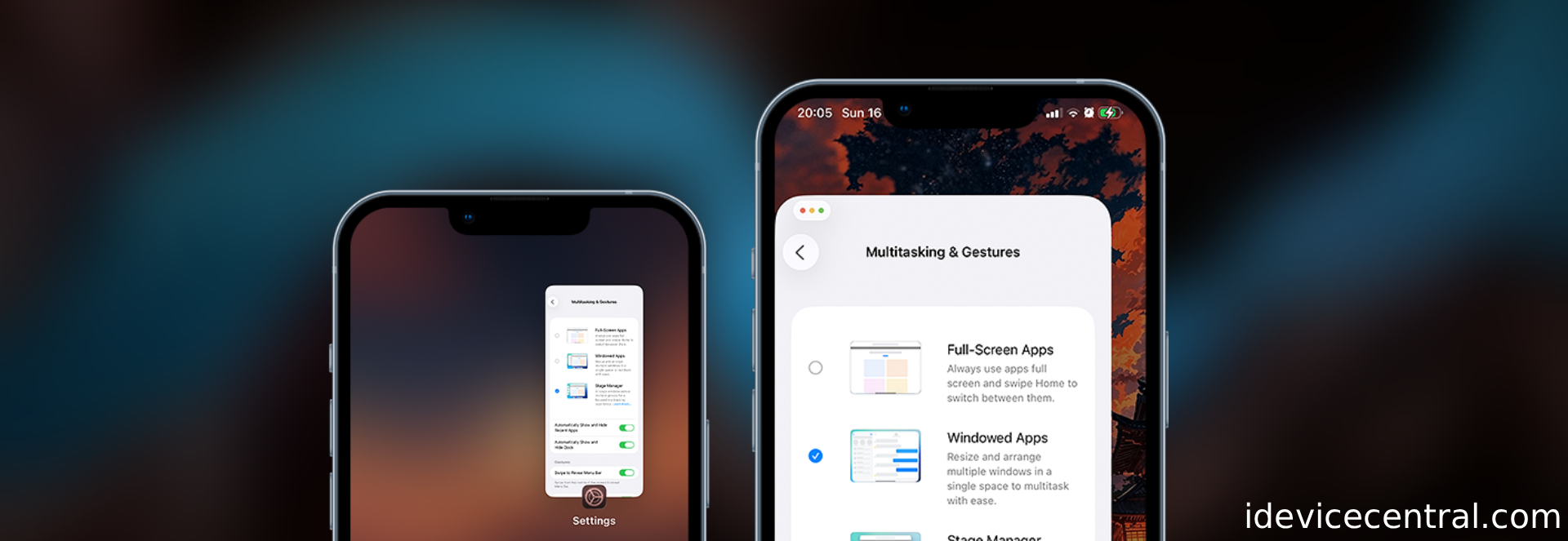
Could you elaborate? What specifically would you do? Because I'm finding it hard to imagine what I'd do with an "open" iPhone that I can't do now, but it's extremely easy to imagine all the horrific security risks that would emerge in what today is most people's primary computing device, storing data about literally their entire lives.
If you're finding it hard to imagine what you can do with a device that _does not_ restrict what you can do with it, then you're likely fine in the Apple ecosystem, that's fair and okay. Some people aren't, you'll just have to take my word for it, I don't wanna write an essay here and you're probably not interesting in reading all that.
Security risk is a common one that comes up. Google used that to justify locking down sideloading recently. Let me take the risk. I bought this device, I should be allowed to make adult decisions right? I'm not downloading stuff off Limewire or a shady website. I'm downloading stuff off of Linux distro repos or F-Droid.
There's a lot more to be said about all this. Including the amount of e-waste created because a device is too old to be supported by manufacturers, yet people run decade(s) old laptops/desktops using free OSs because they can.
Just my 1AM rambling thoughts. Hope some of it makes some sense.
(which would mitigate a lot of security risks by itself. I also note that people seem to do fine with desktop OSes, despite their outdated security models)
Also, a working foss ecosystem.
All kinds of shit.
I'd make locking the phone while the flashlight is operating require pressing the lock button again to wake the screen with no exceptions, so the screen no longer shines in my eyes reducing the effectiveness of the flashlight, and stay palm input stops opening the camera.
I'd hook screen time management of my children's devices—which I perform on my own device—into FaceID instead of requiring a stupid passcode.
You don't have to go far to find areas where iOS could use some customization. But if it's Apple's code, the most useful adjustments are off limits.
Jailbroken iOS was a fantastic platform for the first 9 major releases or so because it had that kind of stuff in it. Now it's "throw a suggestion in the box on our website and we'll ignore it in the order it was received."
I don't even need GNU-freedom, regular MacOS is fine. I just can't live with a iPadOS anymore.
edit: you can pry locked down iOS from my cold dead hands. Love it exactly because it's a walled garden.
Start with a laptop, you believe they should be open.
Remove the keyboard so it's only a screen, you believe they should be opened.
Shrink that screen down, and now they should be locked down?
I sort of don't have to imagine, because somewhat viable options like this exist (eg. GrapheneOS). The issue there is that I'd still rather use a more polished handheld device (iOS) than jump ship and get those extra features.
And wondering what GrapheneOS would be like with all its power, plus the polish of iOS is pointless fantasy, because it likely won't ever happen.
My guess, based on experience, is that eventually, iOS's quality will degrade enough that I'll find Android or GrapheneOS more attractive.
Tbh, with the quality of the latest iOS I’m getting pretty close to that point. Looking at Ubuntu Touch right now.
Your M1 has supported Linux pretty well for years now… Install the Fedora Asahi Remix and give it a try.
It makes a lot of sense considering high end SoC are now more powerful than the M1.
I love using the MacBooks, but the OS just doesn't feel like it was designed for me, and that would be OK, but I have limited alternatives if I want all of the hardware to keep working.
Also, yes, gaming, but that's less important to me.
- Locked, proprietary bootloader with no guaranteed Linux support
- No official Vulkan drivers, DXVK broken without downstream patches (unlike every other GPU I own)
- Every Docker solution runs worse than WSL (somehow)
- macOS is ad-ridden and genuinely intolerable
- APFS is borderline useless relative to EXT4 and NTFS, doubly so if you collaborate at work
I have iDevices because I want simplicity and single-task-ness; I have Macs for multi-tasking.
If Apple needs to satisfy both single- and multi-tasking iDevices users, there should be some kind of mode toggle.
Like gyomu said below, iPadOS Windows Apps is optional and opt-in. The default is full screen:
https://support.apple.com/guide/ipad/work-with-multiple-wind...
Select "Full Screen Apps".
And you do not have to use Tab Groups.
iPad User Guide link: https://support.apple.com/guide/ipad/organize-your-tabs-with...
Unsarcastically speaking, I've been using these OSes for 2 decades plus but I still read through each OS's respective User Guides and still learn a ton every release.
iPad User Guide: https://support.apple.com/guide/ipad/welcome/ipados
iPhone User Guide: https://support.apple.com/guide/iphone/welcome/ios
Mac User Guide: https://support.apple.com/guide/mac-help/welcome/mac
I can't imagine trying to do that on an iPhone. Surely it's useless.
What this does do is reveal the fiction that "iPadOS" and "iOS" are separate. Clearly not.
The more people that file, the more likely it is to happen.
Just as a N=1, I would rather pay a recurring fee in the Disney-Netflix range to Apple to get more liberty in usage from my machines. But I think they don’t dare to go those routes, because they need the broad market base and cannot extract the current cash flow from a smaller base, while setting expectations that the Googles, Samsungs can copy.
Industry leaders dilemma. Apple currently settles on market differentiation via physical products.
Technically, I don’t think anybody ever claimed they were 100% distinct. Apple, for instance, says (https://developer.apple.com/ipados/get-started/): “Powered by the iOS SDK, your iPadOS apps”, and they’ve touted the ability to build apps that ru on both iPhone and iPad.
marketing-wise, they clearly are separate, in the same sense as https://en.wikipedia.org/wiki/Car_platform: “A car platform is a shared set of common design, engineering, and production efforts, as well as major components, over a number of outwardly distinct models and even types of cars, often from different, but somewhat related, marques.”
The only difference is that here, Apple apparently ships all or major parts of the special parts for the iPad on iOS, too. Maybe they also do that vice versa? Can you enable the calculator app on iPad with this method?
When there's a will you'll be glad there's a way.
People used to make do with "tiny" screens throughout the 1980s and 1990s: Bigger displays sure but smaller resolutions Han the iPhone. Doom came out in 320x200 ffs
When traveling I've had to do all sorts of tricks to use various services while away from home. Like my bank app which set an OTP to email or SMS, but if you swiped out of the app to go check the message, it would generate a new OTP when you switched back to the bank app. So I had to check my mail/messages on the minuscule Apple Watch screen. And that was the only time I ever used email on the Watch but I was infinitely glad that it had that option.
Screen isn't much bigger than an iPhone Pro Max, if at all, but I was able to adapt to the desktop GUIs without much trouble.
Closest thing you can get now is that they finally brought the dialer app to the iPad... I can sort of make calls now through my cellular iPad using my iPhone's voice account with the "wifi calling on other devices" feature.
There seems to be something wrong with the Cloudflare server that's supposed to serve me (Bucharest, they say).
I was trying to take a break and read something on HN. Clicked on 4 sort of interesting headlines, 3 got me the Cloudflare error (including this one) and one sort of loaded some navigation bar without CSS and content.
Cloudflare offers a great service... until it breaks half the internet.
I've been hoping Apple will get eventually around to work this out, and the article shows it'd be easier than anticipated. I think it'll happen eventually.
As for travelling specifically, it'd be easier to bring a MacBook than to bring a mouse and keyboard and portable display. The display could be replaced by a TV in your acommodation, but it's rare to be able to use that ergonomically.
It'd be instead quite interesting in general for people who already only use little more than the browser.
I'm always fascinated at the threshold where people will decide something just won't happen ("useless") because it's not comfortable enough.
I'm more in the camp of pushing the limits as far as technically possible if it means I'm neither walking around with a 13" screen at all time nor need to be home to be able to look at two things at the same time.
So I'll be fine with readjusting a bit the window to input text if it means I can do the thing now instead of 6 hours later. At least I don't want Google to kill the feature just because it requires working around some quirks.
I rarely use split screen mode on my Android phone but I am rather annoyed when I'm on iOS and I can't keep two apps open at the same time.
Some vendors do a much better job than others, though. Google in particular doesn't seem to offer more than the bare basics.
It is my feet and my gun and it is up to me if I want to risk shooting the former with the latter.
I don’t even want touch to work on the iPad running macOS. Just let me run my own input hardware against it.
I don’t find many of these features useful on my iPad (to be fair, my Mini is my daily iPad), let alone, my iPhone. I can’t see myself doing all that work, for features I don’t want to use.
644? Isn't that creepy?
Why?